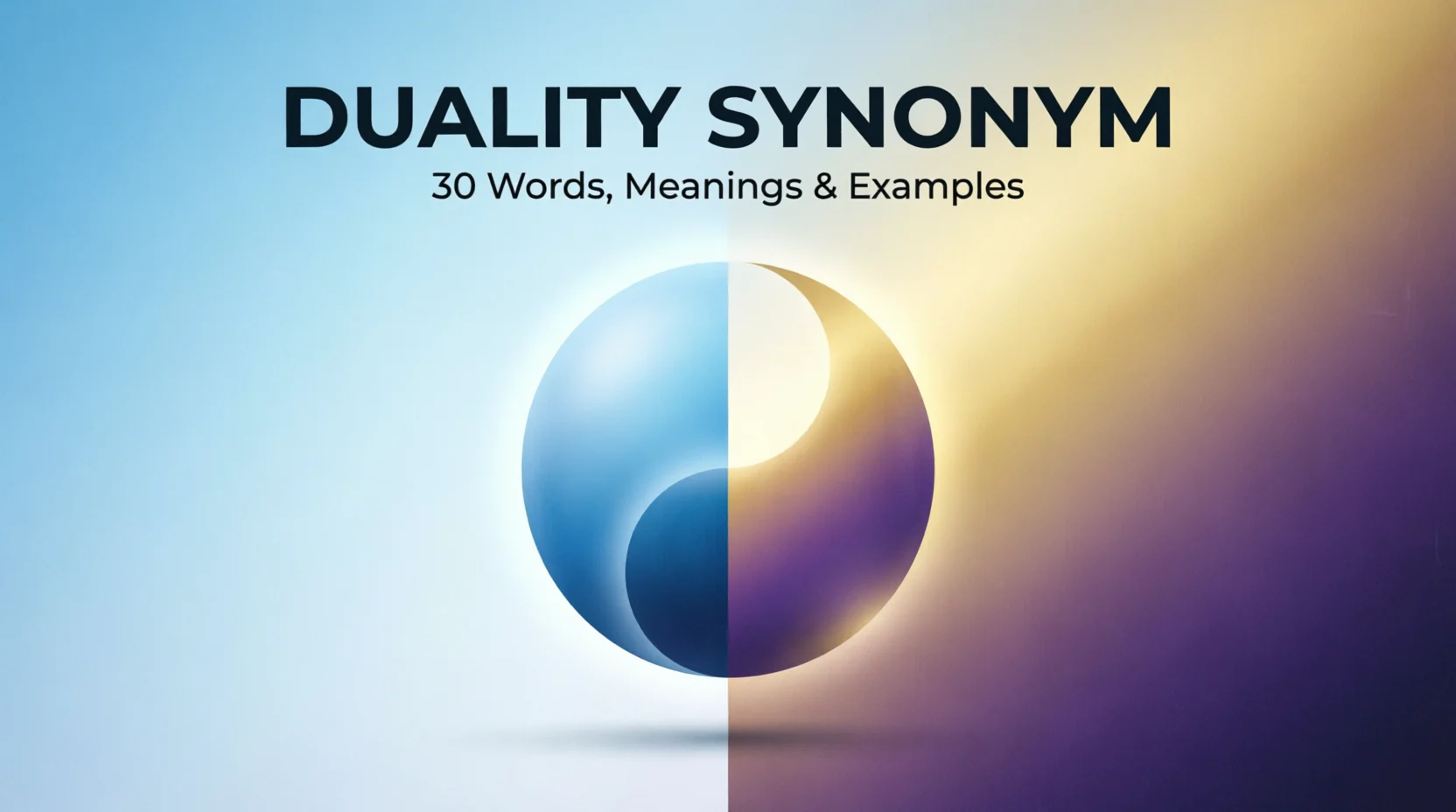
Finding the right duality synonym depends on the meaning you want to express. Common alternatives include dichotomy, dualism, contrast, opposition, polarity, and twofold nature. These words describe different aspects of having two sides, two elements, or two contrasting principles within one person, situation, or concept.
If you are writing an academic essay, exploring philosophy, improving your English vocabulary, or creating meaningful content, understanding these alternatives will help you choose words that express your ideas clearly.
Quick Answer: What Is a Synonym for Duality?
A synonym for duality is a word or phrase that describes the presence of two sides, qualities, elements, or principles within one thing or situation.
The best alternatives include:
- Dichotomy: a division between two distinct or contrasting things.
- Dualism: the idea that two different principles or realities exist.
- Polarity: a relationship between two opposing qualities or forces.
- Contrast: a noticeable difference between two things.
- Ambivalence: the experience of having conflicting feelings about something.
- Twofold nature: the condition of having two aspects.
- Dual nature: the presence of two different qualities in one person or thing.
- Complementarity: a relationship in which two different elements complete or support each other.
These words are related, but they are not always interchangeable. For example, dichotomy emphasizes a division, while dualism often refers to a philosophical belief or framework.
What Does Duality Mean?
Duality is the condition of having two sides, aspects, qualities, or principles. These sides may be opposite, different, or complementary.
For example, a person may show both confidence and insecurity. This combination illustrates the duality of human nature.
The word is used in philosophy, psychology, literature, science, relationships, and everyday discussions.
Understanding Duality Through Examples
In human nature: Someone can be both kind and competitive, showing two different qualities in one personality.
In relationships: Two people may experience love and frustration at the same time, revealing the complexity of their connection.
In literature: A character may represent both good and evil, creating a conflict between opposing sides.
In philosophy: Duality may describe the relationship between mind and body or between two distinct principles.
In science: A system may display two different but related characteristics. In physics, for example, wave-particle duality describes the way quantum objects exhibit both wave-like and particle-like behavior.
30 Synonyms for Duality With Meanings and Examples
The following words and phrases cover different aspects of duality, including opposition, division, two-sidedness, complexity, and the relationship between complementary elements.
1. Dichotomy
Simple meaning: A division between two distinct or contrasting things.
Example sentence: The novel explores the dichotomy between freedom and responsibility.
Best usage/context: Use it in academic writing, philosophy, literary analysis, and discussions involving two contrasting categories. A dichotomy can suggest a clear division, sometimes one that oversimplifies a more complex situation.
2. Dualism
Simple meaning: The belief or idea that two distinct principles or realities exist.
Example sentence: The philosopher examined the relationship between mind-body dualism and human consciousness.
Best usage/context: Best for philosophy, religion, metaphysics, and theoretical discussions about two fundamental principles.
3. Twofold Nature
Simple meaning: The condition of having two aspects or qualities.
Example sentence: The twofold nature of technology allows it to connect people while sometimes isolating them.
Best usage/context: Use this phrase when explaining two characteristics of one person, object, or situation without necessarily suggesting direct opposition.
4. Dual Nature
Simple meaning: The presence of two different sides within one thing.
Example sentence: The character’s dual nature makes her both admirable and unpredictable.
Best usage/context: Suitable for descriptions of personality, behavior, relationships, and fictional characters.
5. Polarity
Simple meaning: The condition of having two opposing ends, qualities, or forces.
Example sentence: The story examines the polarity between hope and despair.
Best usage/context: Use it in science, psychology, philosophy, and discussions of opposing ideas or emotional states.
6. Contrast
Simple meaning: A noticeable difference between two things.
Example sentence: The contrast between the character’s public image and private life reveals her inner conflict.
Best usage/context: Ideal for essays, comparisons, visual descriptions, and literary analysis. Unlike duality, contrast does not necessarily mean both qualities exist within the same thing.
7. Opposition
Simple meaning: A state in which two ideas, forces, or interests work against each other.
Example sentence: The opposition between tradition and progress drives the central conflict.
Best usage/context: Use it when the two sides actively disagree, conflict, or resist each other.
8. Dichotomous Relationship
Simple meaning: A relationship organized around two distinct or contrasting elements.
Example sentence: The author presents a dichotomous relationship between order and chaos.
Best usage/context: Suitable for formal writing and analysis when emphasizing a clear division between two ideas.
9. Duality of Nature
Simple meaning: The presence of two different aspects within a natural system or individual.
Example sentence: The poem explores the duality of nature through images of destruction and renewal.
Best usage/context: Use it in discussions of human behavior, the natural world, literature, and philosophical questions.
10. Ambivalence
Simple meaning: Having mixed or conflicting feelings about something.
Example sentence: His ambivalence about leaving home reflected his desire for independence and his love for his family.
Best usage/context: Best for emotional complexity, relationships, decisions, and psychological discussions. It describes conflicting feelings rather than duality in every possible sense.
11. Paradox
Simple meaning: A statement or situation that seems contradictory but may reveal a truth.
Example sentence: The paradox of freedom is that too many choices can sometimes make decisions harder.
Best usage/context: Use it in philosophy, literature, and reflective writing when two apparently conflicting ideas coexist or produce an unexpected result.
12. Contradiction
Simple meaning: A conflict between statements, ideas, or qualities that cannot easily agree.
Example sentence: There is a contradiction between his promises and his actions.
Best usage/context: Suitable for arguments, debates, critical analysis, and situations involving inconsistency.
13. Two-Sidedness
Simple meaning: The quality of having two sides or aspects.
Example sentence: The two-sidedness of fame includes public admiration and private pressure.
Best usage/context: Use it in accessible, everyday writing when explaining that a situation has two aspects.
14. Bifurcation
Simple meaning: A division into two branches or separate paths.
Example sentence: The discussion focuses on the bifurcation between personal freedom and social responsibility.
Best usage/context: Best for technical, scientific, mathematical, and formal discussions of branching or division. It is not a general synonym for every kind of duality.
15. Duality Principle
Simple meaning: A principle connecting two related or corresponding aspects of a system.
Example sentence: The researcher discussed a duality principle that links two different mathematical descriptions.
Best usage/context: Use it when a particular field has a recognized principle connecting two concepts. The precise meaning depends on the discipline.
16. Complementarity
Simple meaning: A relationship in which two different elements complete or support each other.
Example sentence: The complementarity of creativity and discipline helped the team succeed.
Best usage/context: Suitable for relationships, teamwork, philosophy, and scientific discussions in which two aspects work together rather than compete.
17. Interdependence
Simple meaning: A situation in which two or more things depend on each other.
Example sentence: The interdependence of mind and body is an important theme in the book.
Best usage/context: Use it when emphasizing mutual dependence. It relates to duality when two connected elements influence each other, but it can involve more than two elements.
18. Ambiguity
Simple meaning: The quality of having more than one possible meaning or interpretation.
Example sentence: The ambiguity of the ending allows readers to interpret the character’s motives differently.
Best usage/context: Best for language, literature, communication, and situations where meaning is unclear. Ambiguity concerns interpretation rather than necessarily two opposing sides.
19. Multiplicity
Simple meaning: The presence of many different elements, forms, or possibilities.
Example sentence: The novel explores the multiplicity of identities people develop throughout their lives.
Best usage/context: Use it when the situation involves several aspects rather than exactly two. It is a broader concept than duality.
20. Dualism of Mind and Body
Simple meaning: The view that the mind and body are distinct in some fundamental way.
Example sentence: The debate about the dualism of mind and body has influenced philosophy for centuries.
Best usage/context: Best for philosophical discussions of consciousness, physical existence, and the relationship between mental and bodily processes.
21. Twofoldness
Simple meaning: The quality or state of consisting of two parts or aspects.
Example sentence: The twofoldness of the argument becomes clear when we examine its practical and ethical dimensions.
Best usage/context: Suitable for formal or explanatory writing when you want to emphasize that something has two components.
22. Polarity of Opposites
Simple meaning: The relationship between two opposing qualities or forces.
Example sentence: The polarity of opposites between light and darkness shapes the poem’s imagery.
Best usage/context: Use it in philosophical, literary, symbolic, and reflective writing about opposing forces.
23. Inner Conflict
Simple meaning: A struggle between competing thoughts, feelings, or desires within a person.
Example sentence: Her inner conflict arose from the tension between ambition and loyalty.
Best usage/context: Ideal for psychology, storytelling, character analysis, and descriptions of difficult personal choices.
24. Dichotomization
Simple meaning: The process of dividing something into two distinct categories.
Example sentence: The dichotomization of success and failure ignores the many stages between them.
Best usage/context: Best for academic, analytical, and technical writing when discussing how complex ideas are divided into two categories.
25. Dual Aspect
Simple meaning: One thing viewed through two different aspects or perspectives.
Example sentence: The issue has a dual aspect: it affects both individual well-being and public policy.
Best usage/context: Use it when explaining two dimensions of the same subject without implying that they are opposites.
26. Duality of Character
Simple meaning: The presence of two contrasting or different qualities in a person’s personality.
Example sentence: The duality of character makes the hero compassionate in private but ruthless at work.
Best usage/context: Suitable for fiction, biographies, psychology, and discussions of complex personalities.
27. Duality of Purpose
Simple meaning: The condition of serving two purposes at once.
Example sentence: The community center has a duality of purpose: providing education and bringing neighbors together.
Best usage/context: Use it when one person, object, policy, or activity serves two functions. In many sentences, the simpler phrase dual purpose sounds more natural.
28. Dualism of Opposites
Simple meaning: A framework that treats two opposing principles as distinct parts of a system.
Example sentence: The essay questions the dualism of opposites that separates reason from emotion.
Best usage/context: Suitable for philosophical, religious, and theoretical writing about opposing principles.
29. Coexistence
Simple meaning: The state of existing together at the same time.
Example sentence: The coexistence of tradition and innovation defines the community’s identity.
Best usage/context: Best when two different qualities or systems exist together, whether or not they conflict.
30. Unity of Opposites
Simple meaning: The idea that opposing forces or qualities can belong to one connected whole.
Example sentence: The play illustrates the unity of opposites through its recurring themes of love and loss.
Best usage/context: Use it in philosophy, literary analysis, and discussions of systems in which opposing elements remain connected.
Comparison Table: Which Duality Synonym Should You Use?
| Synonym | Main meaning | Best context |
| Dichotomy | Division into two distinct categories | Academic writing and analysis |
| Dualism | Two distinct principles or realities | Philosophy and religion |
| Twofold nature | Two aspects of one thing | General explanations |
| Dual nature | Two different qualities in one entity | Personality and literature |
| Polarity | Two opposing forces or qualities | Science and philosophy |
| Contrast | A noticeable difference | Comparisons and descriptions |
| Opposition | Conflict between two sides | Debates and disagreements |
| Ambivalence | Conflicting feelings | Psychology and relationships |
| Paradox | An apparent contradiction with a deeper meaning | Literature and philosophy |
| Contradiction | Inconsistency between ideas | Arguments and critical thinking |
| Complementarity | Two elements that complete each other | Teamwork and scientific contexts |
| Interdependence | Mutual dependence | Relationships and systems |
| Ambiguity | More than one possible interpretation | Language and literature |
| Bifurcation | Division into two branches | Technical and scientific writing |
| Inner conflict | A personal struggle between competing desires | Psychology and storytelling |
| Coexistence | Two things existing together | Society, culture, and relationships |
| Unity of opposites | Opposing elements forming a connected whole | Philosophical analysis |
How to Choose the Right Synonym for Duality
The most accurate word depends on your intended meaning, the tone of your writing, and the relationship between the two elements.
1. Choose by Meaning
When you mean two distinct categories: Choose dichotomy or dichotomous relationship.
Example: The essay examines the dichotomy between public and private life.
When you mean two fundamental principles: Choose dualism.
Example: The philosopher questioned the traditional separation of mind and body.
When you mean two qualities in one person: Choose dual nature or duality of character.
Example: The character’s dual nature makes her difficult to predict.
When you mean opposing forces: Choose polarity, opposition, or polarity of opposites.
Example: The story explores the polarity between hope and despair.
When you mean two elements that work together: Choose complementarity or coexistence.
Example: The complementarity of experience and creativity strengthened the team.
When you mean conflicting emotions: Choose ambivalence or inner conflict.
Example: His ambivalence about the decision made it difficult to move forward.
2. Choose by Tone
| Tone | Recommended words | Example |
| Simple and conversational | Two-sidedness, dual nature, contrast | The issue has two sides. |
| Academic and formal | Dichotomy, dualism, bifurcation | The paper examines mind-body dualism. |
| Philosophical | Paradox, polarity, unity of opposites | The argument explores the unity of opposites. |
| Psychological | Ambivalence, inner conflict | Her inner conflict shaped the decision. |
| Positive and cooperative | Complementarity, interdependence | Their skills showed complementarity. |
| Literary and descriptive | Duality of character, paradox | The character’s duality drives the story. |
3. Choose by Intent
- To explain a division: Use dichotomy or bifurcation.
- To discuss a philosophical theory: Use dualism or duality principle when appropriate.
- To describe complexity in a person: Use dual nature or duality of character.
- To show disagreement or opposition: Use polarity or opposition.
- To discuss mixed emotions: Use ambivalence.
- To describe two qualities working together: Use complementarity.
- To emphasize that different things exist together: Use coexistence.
- To express a seemingly contradictory truth: Use paradox.
- To explain a personal struggle: Use inner conflict.
Common Mistakes When Using Duality Synonyms
Related words can express different ideas. Understanding their distinctions helps you avoid inaccurate or unnatural sentences.
1. Treating Duality and Dichotomy as Identical
Duality refers broadly to having two aspects. Dichotomy emphasizes a division between two categories, often contrasting ones.
Less precise: The duality between the two categories leaves no middle ground.
More precise: The dichotomy between the two categories leaves no middle ground.
Use duality for two aspects of a whole and dichotomy when the division itself matters.
2. Confusing Duality With Dualism
Duality describes a condition or relationship involving two aspects. Dualism usually refers to a belief, theory, or framework based on two distinct principles.
Example: The duality of the character makes her complex.
Example: Mind-body dualism is a philosophical position concerning the relationship between mind and body.
3. Using Ambivalence to Mean Every Kind of Duality
Ambivalence specifically describes mixed or conflicting feelings. It does not simply mean that an object has two sides.
Incorrect: The ambivalence of the coin includes a front and a back.
Better: The coin has two sides.
Correct use: Her ambivalence about moving reflected both excitement and fear.
4. Confusing Contrast With Duality
Contrast describes a difference between things. Duality often emphasizes two aspects that belong to or are associated with one subject.
Example: The contrast between the two paintings is striking.
Example: The duality of the character’s personality creates tension.
5. Using Dichotomy When More Than Two Categories Exist
A dichotomy generally divides something into two categories. If you are discussing many different identities, possibilities, or perspectives, multiplicity or diversity may be more appropriate.
Less precise: The dichotomy of the community includes many different viewpoints.
Better: The multiplicity of viewpoints makes the community diverse.
6. Overusing Complex Words
Words such as bifurcation, dichotomization, and dualism are useful in the right setting, but they can make simple explanations unnecessarily difficult.
Instead of saying, “The bifurcation of the issue creates two different approaches,” you could write, “The issue divides into two approaches.”
Choose clarity over complexity whenever both options express the same idea.
FAQs:
1. What is the closest synonym for duality?
The closest synonym depends on context. Twofold nature and dual nature are broad alternatives, while dichotomy emphasizes division and dualism refers more often to a theory or framework involving two distinct principles.
2. What is a formal synonym for duality?
Formal alternatives include dichotomy, dualism, polarity, bifurcation, and twofoldness. Use dichotomy for a division, dualism for a theoretical position, and polarity for opposing forces or qualities.
3. What is another word for duality in human nature?
Useful alternatives include dual nature, duality of character, twofold nature, and inner conflict. Choose inner conflict when the two sides involve competing feelings or desires rather than simply different personality traits.
4. What is the difference between duality and dichotomy?
Duality describes two aspects, qualities, or principles associated with a subject. Dichotomy emphasizes a division into two distinct categories. The two concepts overlap, but duality does not always require a strict separation.
5. What is a positive synonym for duality?
Complementarity, coexistence, and unity of opposites can express a constructive relationship between different elements. They are especially useful when two qualities support one another or form a connected whole.
6. What is a synonym for duality in philosophy?
Common philosophical terms include dualism, polarity, paradox, and unity of opposites. The correct choice depends on the particular theory, such as mind-body dualism or the relationship between opposing principles.
7. Can contrast be used as a synonym for duality?
Sometimes. Contrast works when you want to emphasize differences between two aspects. However, it does not always convey the idea that both aspects belong to one whole, which is often central to duality.
8. What is the opposite of duality?
There is no single opposite that works in every context. Depending on the intended meaning, possible contrasts include unity, singularity, or oneness. For example, singularity emphasizes being one, while unity emphasizes being joined into a whole.
Conclusion
The best synonym for duality depends on the relationship between the two aspects you want to describe. Use dichotomy for a division, dualism for a philosophical framework, polarity for opposing forces, and ambivalence for conflicting feelings.
When two different qualities support each other, complementarity or coexistence may be more accurate. By understanding these distinctions, you can choose words that express complex ideas clearly in academic writing, everyday communication, and creative work.

I’m Jaxon James, an author at SaysReply, where I share simple, clear, and natural alternative ways to say things and help readers express their thoughts better.