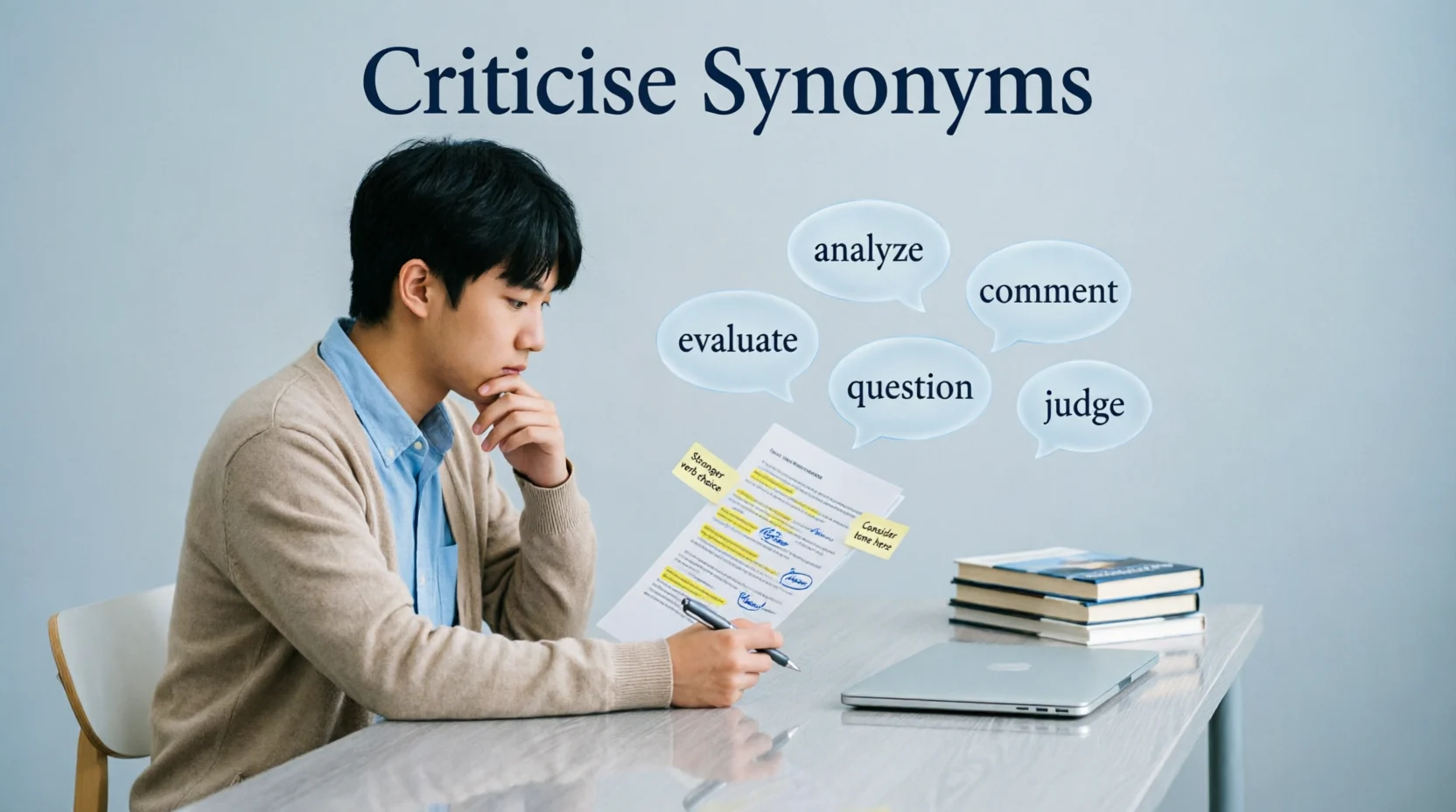
Finding the right criticise synonym can make your English more precise, natural, and effective. The verb criticise means to point out faults, weaknesses, problems, or mistakes in someone or something. Depending on the situation, you might want a softer word such as question, a neutral word such as critique, or a much stronger word such as condemn.
Choosing the right alternative matters because criticism can range from helpful feedback to severe public disapproval. This guide explains 30 useful synonyms for criticise, with simple meanings, practical examples, and clear guidance about when each word works best.
Quick Answer: What Is a Synonym for Criticise?
Common synonyms for criticise include critique, fault, blame, censure, condemn, rebuke, reproach, disapprove, question, challenge, object to, denounce, disparage, nitpick, carp, chastise, admonish, castigate, lambast, decry, berate, pan, slam, knock, complain about, find fault with, take issue with, point out flaws, impugn, and attack.
The best choice depends on your meaning. For constructive feedback, use critique or point out flaws. For strong disapproval, use condemn, denounce, or censure. For informal criticism, slam, knock, or pan may be appropriate.
What Does Criticise Mean?
Criticise means to express disapproval of someone or something by identifying faults, weaknesses, mistakes, or problems.
For example:
The teacher criticised the essay for having unclear arguments.
Here, criticised means the teacher identified problems in the essay.
The word can also describe personal criticism:
He criticised his colleague for arriving late.
However, criticise does not always mean something extremely negative. In many situations, criticism can be useful because it identifies areas that need improvement.
Criticise vs. Critique
These words are closely related, but they often have different tones.
Criticise usually emphasizes finding or expressing faults.
Critique often means to examine something carefully and give a detailed evaluation, especially in academic, artistic, professional, or creative contexts.
For example:
- The editor criticised the article for its weak introduction.
- The professor critiqued the student’s research paper.
A critique can contain criticism, but it often sounds more analytical and constructive.
Criticise vs. Condemn
Criticise can mean pointing out problems or weaknesses.
Condemn is much stronger. It means expressing very strong disapproval, often because something is considered wrong, unacceptable, or harmful.
- The reviewer criticised the restaurant’s slow service.
- The organization condemned the violent attack.
The second sentence expresses much stronger disapproval.
Criticise vs. Blame
Criticise focuses on faults or shortcomings.
Blame usually means saying that someone is responsible for a problem or negative result.
- The manager criticised the report.
- The manager blamed the employee for the missing information.
These words are not interchangeable in every situation.
30 Synonyms for Criticise
1. Critique
Simple meaning: To examine and evaluate something carefully, often by discussing both strengths and weaknesses.
Example: The professor critiqued the student’s research paper.
Best usage/context: Academic writing, art, literature, design, professional feedback, and detailed evaluation.
2. Fault
Simple meaning: To find a problem or weakness in someone or something.
Example: The manager faulted the team for failing to meet the deadline.
Best usage/context: Formal or neutral situations where you want to identify a specific mistake or weakness.
3. Blame
Simple meaning: To say that someone or something is responsible for a problem.
Example: The coach blamed the poor result on a lack of preparation.
Best usage/context: Situations involving responsibility for mistakes, failures, accidents, or problems.
4. Censure
Simple meaning: To express strong official disapproval of someone or something.
Example: The committee censured the member for breaking its rules.
Best usage/context: Formal, institutional, professional, or official contexts.
5. Condemn
Simple meaning: To strongly say that something is wrong, unacceptable, or harmful.
Example: The organization condemned the use of violence.
Best usage/context: Serious wrongdoing, harmful actions, unethical behavior, or strong public disapproval.
6. Rebuke
Simple meaning: To speak angrily or firmly to someone because they have done something wrong.
Example: The supervisor rebuked the employee for ignoring the safety instructions.
Best usage/context: Direct personal criticism, especially when someone has clearly violated expectations.
7. Reproach
Simple meaning: To express disappointment or disapproval about someone’s behavior.
Example: She reproached her brother for forgetting their agreement.
Best usage/context: Personal situations where disappointment, disappointment-related criticism, or moral disapproval is important.
8. Disapprove
Simple meaning: To feel or express that something is wrong, unsuitable, or unacceptable.
Example: Her parents disapproved of her decision to leave school.
Best usage/context: Personal opinions, choices, behavior, decisions, or actions.
9. Question
Simple meaning: To express doubt about whether something is correct, reasonable, or appropriate.
Example: Several researchers questioned the accuracy of the results.
Best usage/context: Careful, neutral criticism when you want to express doubt without making a harsh accusation.
10. Challenge
Simple meaning: To question or dispute an idea, claim, decision, or assumption.
Example: The journalist challenged the company’s explanation.
Best usage/context: Arguments, claims, decisions, assumptions, academic discussions, and debates.
11. Object to
Simple meaning: To express disagreement or disapproval about something.
Example: Several residents objected to the proposed construction.
Best usage/context: Formal or everyday disagreement with a plan, action, decision, rule, or proposal.
12. Denounce
Simple meaning: To publicly and strongly criticize something or someone.
Example: The leader denounced the dishonest practice.
Best usage/context: Public statements, serious wrongdoing, unethical conduct, and strong formal criticism.
13. Disparage
Simple meaning: To describe someone or something as less valuable, important, or impressive than it really is.
Example: He often disparages other people’s achievements.
Best usage/context: Negative comments that belittle a person, group, achievement, or idea.
14. Nitpick
Simple meaning: To criticize very small or unimportant details.
Example: The editor tends to nitpick every minor punctuation error.
Best usage/context: Informal situations where someone focuses excessively on tiny mistakes.
15. Carp
Simple meaning: To complain or criticize repeatedly about small problems.
Example: He constantly carps about the food at the office cafeteria.
Best usage/context: Informal English, especially for repeated and often irritating complaints.
16. Chastise
Simple meaning: To criticize or scold someone strongly because of their behavior.
Example: The coach chastised the players for ignoring the instructions.
Best usage/context: Strong personal criticism, especially when correcting inappropriate behavior.
17. Admonish
Simple meaning: To firmly tell someone that they have done something wrong.
Example: The teacher admonished the students for disturbing the class.
Best usage/context: Formal or semi-formal correction, warnings, and serious advice about behavior.
18. Castigate
Simple meaning: To criticize someone or something very severely.
Example: The newspaper castigated the company for its careless practices.
Best usage/context: Very strong formal criticism, especially in journalism, public commentary, or serious writing.
19. Lambast
Simple meaning: To criticize someone or something very strongly.
Example: Critics lambasted the film for its weak storyline.
Best usage/context: Strong criticism in journalism, reviews, public commentary, and informal reporting.
20. Decry
Simple meaning: To publicly express strong disapproval of something.
Example: Human rights groups decried the unfair treatment of workers.
Best usage/context: Formal public criticism of practices, policies, conditions, or actions considered harmful or wrong.
21. Berate
Simple meaning: To criticize or scold someone angrily and harshly.
Example: The manager berated the employee in front of the team.
Best usage/context: Angry personal criticism, especially when someone speaks harshly to another person.
22. Pan
Simple meaning: To give something a very negative review.
Example: Several reviewers panned the movie for its predictable plot.
Best usage/context: Informal or journalistic reviews of films, books, performances, products, and creative work.
23. Slam
Simple meaning: To criticize someone or something very strongly.
Example: The newspaper slammed the company for its poor customer service.
Best usage/context: Informal journalism, public commentary, and strong criticism.
24. Knock
Simple meaning: To criticize or speak negatively about something.
Example: Some customers knocked the product for its complicated instructions.
Best usage/context: Informal English, especially casual reviews and conversations.
25. Complain About
Simple meaning: To say that you are unhappy or dissatisfied with something.
Example: Many customers complained about the long waiting time.
Best usage/context: Everyday situations involving dissatisfaction with service, conditions, products, or experiences.
26. Find Fault With
Simple meaning: To identify problems or things that are wrong with someone or something.
Example: It is easy to find fault with a plan after it fails.
Best usage/context: General criticism, especially when focusing on weaknesses or mistakes.
27. Take Issue With
Simple meaning: To disagree with or object to something.
Example: The researcher took issue with the report’s main conclusion.
Best usage/context: Formal and semi-formal disagreement, particularly in writing, debate, and intellectual discussion.
28. Point Out Flaws
Simple meaning: To identify weaknesses, mistakes, or problems.
Example: The reviewer pointed out flaws in the product’s design.
Best usage/context: Constructive criticism, editing, reviewing, teaching, design, and professional feedback.
29. Impugn
Simple meaning: To question the truth, honesty, quality, or reputation of something or someone.
Example: The lawyer impugned the witness’s credibility.
Best usage/context: Formal writing, legal contexts, debates, and situations involving someone’s credibility or integrity.
30. Attack
Simple meaning: To criticize something or someone aggressively, either verbally or in writing.
Example: The article attacked the proposal as unrealistic.
Best usage/context: Strong or aggressive criticism of ideas, policies, arguments, decisions, or people.
Comparison Table: Criticise Synonyms at a Glance
| Synonym | Strength | Tone | Best Context |
|---|---|---|---|
| Critique | Mild–Moderate | Analytical | Academic and professional |
| Fault | Moderate | Neutral | Mistakes and weaknesses |
| Blame | Moderate | Direct | Responsibility |
| Censure | Strong | Formal | Official disapproval |
| Condemn | Very strong | Formal | Serious wrongdoing |
| Rebuke | Strong | Direct | Personal correction |
| Reproach | Moderate | Personal | Disappointment |
| Disapprove | Mild–Moderate | Neutral | Choices and behavior |
| Question | Mild | Neutral | Doubt and uncertainty |
| Challenge | Moderate | Analytical | Claims and ideas |
| Object to | Moderate | Neutral | Disagreement |
| Denounce | Very strong | Formal | Public criticism |
| Disparage | Strong | Negative | Belittling |
| Nitpick | Mild | Informal | Minor details |
| Carp | Mild | Informal | Repeated complaints |
| Chastise | Strong | Formal | Behavior correction |
| Admonish | Moderate–Strong | Formal | Warnings |
| Castigate | Very strong | Formal | Severe criticism |
| Lambast | Very strong | Informal/Formal | Public criticism |
| Decry | Strong | Formal | Public disapproval |
| Berate | Very strong | Harsh | Angry personal criticism |
| Pan | Strong | Informal | Reviews |
| Slam | Strong | Informal | Public criticism |
| Knock | Mild–Moderate | Informal | Casual criticism |
| Complain about | Mild–Moderate | Everyday | Dissatisfaction |
| Find fault with | Moderate | Neutral | Identifying weaknesses |
| Take issue with | Moderate | Formal | Disagreement |
| Point out flaws | Mild–Moderate | Constructive | Feedback |
| Impugn | Strong | Formal | Credibility or integrity |
| Attack | Strong–Very strong | Aggressive | Ideas, arguments, decisions |
How to Choose the Right Criticise Synonym
The best synonym depends on what kind of criticism you mean, how strong you want to sound, and where you are using the word.
For Constructive or Helpful Criticism
Choose:
- Critique
- Point out flaws
- Question
- Challenge
- Fault
These words work well when the goal is to identify weaknesses rather than simply express anger.
Example:
The editor critiqued the article and suggested ways to improve its structure.
This sounds more constructive than:
The editor attacked the article.
For Mild Disagreement
Choose:
- Question
- Disapprove
- Object to
- Take issue with
- Knock
These are useful when you disagree without wanting to sound extremely harsh.
Example:
Several researchers questioned the conclusion.
This is more measured than:
Several researchers condemned the conclusion.
For Personal Disapproval
Choose:
- Reproach
- Rebuke
- Admonish
- Chastise
- Berate
These words focus more on a person’s behavior.
Compare:
The teacher admonished the student for being disrespectful.
with:
The teacher berated the student for being disrespectful.
The second sentence suggests a much harsher manner.
For Strong Public Criticism
Choose:
- Denounce
- Condemn
- Decry
- Lambast
- Slam
- Castigate
These words are particularly useful when criticism is public and serious.
Example:
Consumer groups denounced the company’s misleading advertising.
For Reviews
Choose:
- Critique
- Pan
- Knock
- Point out flaws
For example:
Critics panned the movie for its weak dialogue.
Pan is especially common when discussing entertainment and creative work.
For Formal or Academic Writing
Choose:
- Critique
- Question
- Challenge
- Censure
- Take issue with
- Impugn
These choices can make your writing more precise, although some are considerably stronger than others.
For example:
The researcher challenged the assumption that the results applied to every group.
This sounds analytical rather than emotional.
For Very Strong Criticism
Choose:
- Condemn
- Castigate
- Lambast
- Berate
- Denounce
- Attack
Be careful with these words because they suggest intense criticism.
If you only want to mention a small weakness, condemn would probably be too strong.
Common Usage Mistakes
1. Using “Criticise” When You Mean “Blame”
These words are related but have different meanings.
Incorrect:
The teacher criticised him for causing the accident.
This sentence can be grammatically correct, but if your intended meaning is that he was responsible for the accident, blamed may be more precise.
Better:
The teacher blamed him for causing the accident.
2. Using “Condemn” for Small Problems
Condemn expresses strong disapproval.
Saying:
I condemn this restaurant because the soup was slightly cold.
sounds unnecessarily dramatic in most everyday situations.
A more natural choice would be:
I criticised the restaurant because the soup was cold.
3. Confusing “Critique” With Simple Negative Criticism
A critique is usually a careful evaluation. It does not necessarily mean attacking something.
For example:
The professor gave a detailed critique of the novel.
This suggests analysis rather than simply saying the novel was bad.
4. Using “Berate” for Neutral Feedback
Berate suggests angry or harsh criticism.
Instead of:
My manager berated my report and suggested three changes.
you may want:
My manager critiqued my report and suggested three changes.
The second version sounds more professional and constructive.
5. Confusing Criticism With Complaining
Complain about usually describes expressing dissatisfaction.
Criticise is broader and can involve analyzing weaknesses.
For example:
She complained about the noisy office.
This mainly expresses dissatisfaction.
She criticised the office’s poor soundproofing.
This identifies a specific weakness.
6. Forgetting British and American Spelling
Criticise is the common British spelling.
Criticize is the common American spelling.
Both forms have the same basic meaning.
Examples:
- British English: The journalist criticised the proposal.
- American English: The journalist criticized the proposal.
The spelling difference does not change the meaning.
Criticise Synonyms by Strength
If you are unsure which synonym to choose, think about the level of criticism.
Mild
- Question
- Disapprove
- Knock
- Complain about
- Point out flaws
Moderate
- Critique
- Fault
- Challenge
- Object to
- Reproach
- Take issue with
- Find fault with
Strong
- Censure
- Rebuke
- Chastise
- Admonish
- Disparage
- Decry
- Pan
- Slam
- Impugn
Very Strong
- Condemn
- Denounce
- Castigate
- Lambast
- Berate
- Attack
The exact strength can change depending on the sentence and context.
Criticise Synonyms for Students
Students often need vocabulary for essays, presentations, and classroom discussions. In these situations, it is useful to choose words that sound precise rather than overly emotional.
Good choices include:
- Critique for detailed academic evaluation
- Question for expressing doubt
- Challenge for disputing an idea
- Point out flaws for identifying weaknesses
- Take issue with for formal disagreement
- Fault for identifying a specific problem
For example:
The writer challenges the assumption that technology always improves education.
This is usually more precise in an academic context than:
The writer attacks the idea that technology always improves education.
Criticise Synonyms for Writers and Content Creators
Writers often need different words to avoid repetition.
Instead of repeatedly writing criticised, you can choose a more exact verb:
- A reviewer panned the film.
- The editor pointed out flaws in the article.
- The researcher questioned the conclusion.
- The journalist challenged the claim.
- The organization denounced the practice.
- The newspaper condemned the decision.
- The professor critiqued the essay.
The important point is not simply to replace one word with another. Choose a synonym that preserves the exact meaning and tone.
Criticise Synonyms in Different Situations
When reviewing a movie
Use critique, pan, knock, or criticise.
Several reviewers panned the movie for its predictable ending.
When discussing an academic argument
Use critique, question, challenge, or take issue with.
The researcher challenged the study’s main assumption.
When discussing someone’s behavior
Use rebuke, reproach, admonish, chastise, or criticise.
The manager admonished the employee for ignoring the safety rules.
When discussing serious wrongdoing
Use condemn, denounce, decry, or castigate.
The organization condemned the harmful practice.
When expressing everyday dissatisfaction
Use complain about, object to, or disapprove.
Several customers complained about the long waiting time.
FAQs:
What is the best synonym for criticise?
There is no single best synonym for every situation. Critique is useful for careful evaluation, question for expressing doubt, condemn for strong disapproval, and point out flaws for constructive feedback.
What is a polite synonym for criticise?
Critique, question, and point out flaws can sound more measured and constructive than stronger alternatives such as condemn, berate, or attack.
What is a strong synonym for criticise?
Strong alternatives include condemn, denounce, castigate, lambast, berate, and decry. The exact choice depends on whether the criticism is formal, public, personal, or aggressive.
Is “critique” the same as “criticise”?
They are closely related but not identical. Critique often means giving a detailed evaluation, while criticise more generally means expressing disapproval or identifying faults.
Is “condemn” stronger than “criticise”?
Yes, in most contexts. Condemn normally expresses very strong disapproval, while criticise can describe anything from mild feedback to severe criticism.
What is the difference between criticise and blame?
Criticise means to point out faults or express disapproval. Blame means to hold someone or something responsible for a problem or negative result.
What is the British spelling of criticise?
Criticise is the standard British spelling. Criticize is the standard American spelling. Both mean the same thing.
Can criticism be positive?
Yes. Criticism can be constructive when it identifies weaknesses while helping someone improve. For example, an editor may criticise an article’s structure while suggesting specific improvements.
Conclusion
Learning a range of criticise synonyms helps you communicate with greater accuracy. Not every alternative has the same meaning or emotional strength.
Use critique when you want careful evaluation, question when you want to express doubt, and point out flaws when you want to give constructive feedback. Choose condemn, denounce, or castigate when the situation calls for much stronger disapproval.
For personal criticism, words such as rebuke, reproach, admonish, chastise, and berate can describe different degrees of correction or harshness. In informal reviews, pan, slam, and knock may sound natural.
The key is to choose a synonym based on your exact meaning, audience, and tone. A precise word makes your writing clearer and helps readers understand not only that criticism occurred, but also how strong and what kind of criticism it was.

I’m Sawyer Michael, a writer passionate about language and communication. I enjoy helping readers discover clearer, more natural, and creative ways to express their thoughts through words.






1 thought on “Criticise Synonym: 30 Clear Alternatives to Express”