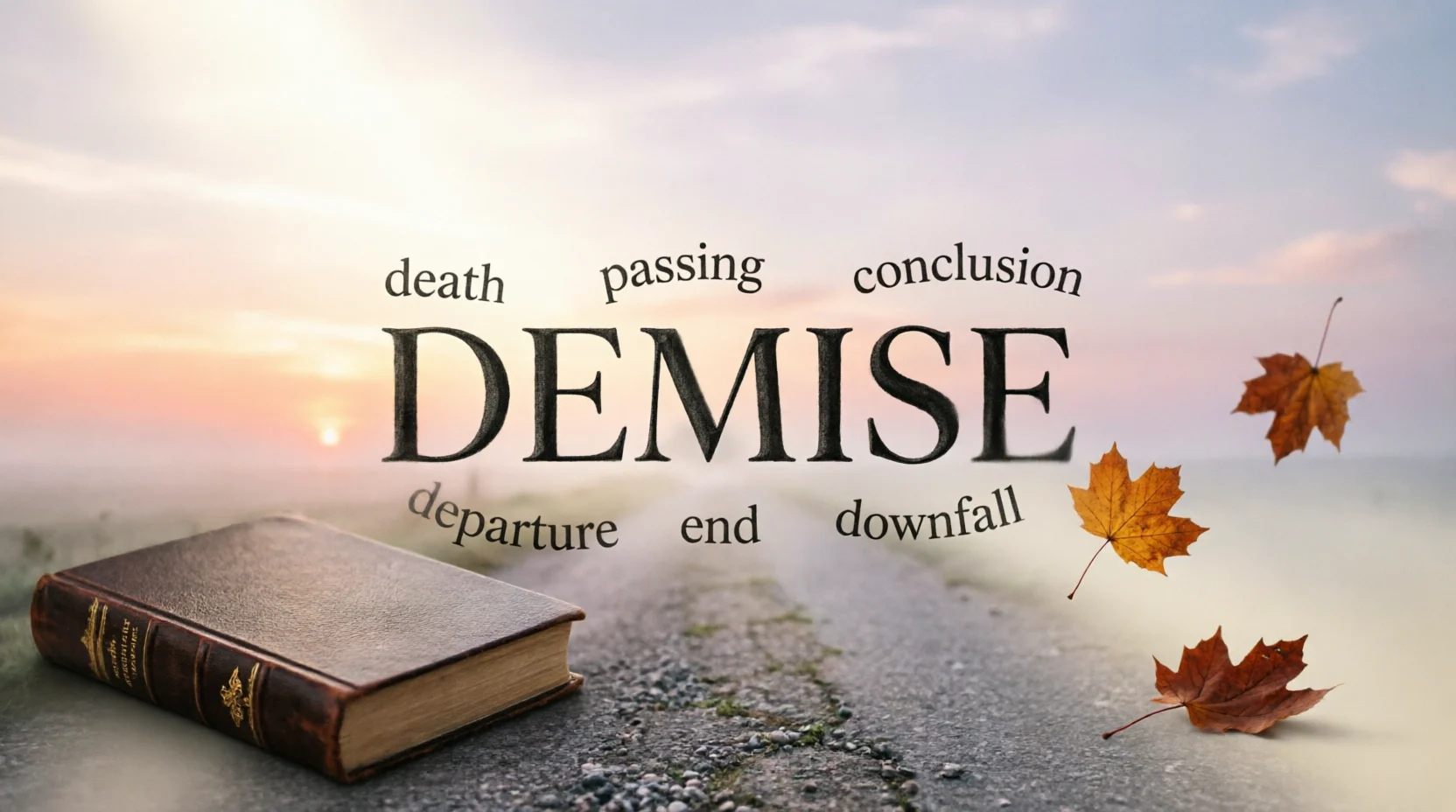
The best demise synonym depends on your tone and context. Common alternatives include death, passing, decease, departure, end, expiration, loss, and passing away. Some are formal and respectful, while others are direct, literary, or gentle. Choosing the right synonym can make your writing clearer and more appropriate for the situation.
Quick Answer
A demise synonym is a word or phrase that can replace demise, usually when referring to the death or passing of a person. Death is the most direct synonym, while passing and passing away sound gentler. Decease is formal and legal, whereas departure can have a literary or poetic tone.
What Does “Demise” Mean?
Demise generally means the death of a person. It is a relatively formal word and is often used when discussing someone’s death respectfully or indirectly.
Example:
The family announced the demise of their beloved grandfather.
In modern English, demise can also mean the end or failure of something, especially in formal writing.
The company faced difficulties that eventually led to its demise.
So, the meaning depends on context:
- A person’s demise → death or passing
- The demise of a company → collapse, failure, or end
- The demise of an institution → decline or disappearance
30 Demise Synonyms
Here are 30 useful alternatives to demise, with their meanings, examples, and best contexts.
1. Death
Simple meaning: The end of a person’s life.
Example: The news of his death shocked everyone.
Best usage/context: Direct, neutral, and suitable for most situations.
2. Passing
Simple meaning: A gentle way of referring to someone’s death.
Example: We were saddened by the passing of our teacher.
Best usage/context: Respectful conversations, condolences, obituaries, and announcements.
3. Passing Away
Simple meaning: To die.
Example: Her grandmother passed away peacefully.
Best usage/context: Gentle, personal, and compassionate communication.
4. Decease
Simple meaning: Death.
Example: The document was prepared following the decease of the property owner.
Best usage/context: Formal, legal, administrative, or historical writing.
5. Departure
Simple meaning: Leaving or going away; sometimes a poetic reference to death.
Example: The poet described death as a final departure.
Best usage/context: Literary, poetic, spiritual, or euphemistic writing.
6. Expiration
Simple meaning: The ending of life or a period of validity.
Example: The official record noted the expiration of his life.
Best usage/context: Formal contexts, though expiration is more commonly used for dates, contracts, or periods.
7. Loss
Simple meaning: The death of someone important to you.
Example: The community struggled with the loss of its beloved leader.
Best usage/context: Emotional, sympathetic, and condolence-related contexts.
8. End
Simple meaning: The point at which something finishes.
Example: The novel describes the hero’s final end.
Best usage/context: Broad contexts; can refer to life, relationships, events, or organizations.
9. Demise
Simple meaning: Death or the end of something.
Example: The family gathered after the demise of their father.
Best usage/context: Formal, respectful, or figurative writing.
10. Perishing
Simple meaning: Dying or being destroyed.
Example: Many animals were at risk of perishing during the severe drought.
Best usage/context: Literary, dramatic, historical, or broader descriptions of death and destruction.
11. Fatality
Simple meaning: A death caused by an accident, disaster, disease, or other event.
Example: The accident resulted in one fatality.
Best usage/context: News, reports, statistics, and formal descriptions of deaths.
12. Mortality
Simple meaning: The state of being mortal or the occurrence of death.
Example: The study examined mortality rates among older adults.
Best usage/context: Medical, academic, scientific, and statistical writing.
13. Obit
Simple meaning: A short form of obituary, a notice about someone’s death.
Example: The newspaper published an obit for the retired professor.
Best usage/context: Informal journalism and everyday speech.
14. Obituary
Simple meaning: A written announcement or account of someone’s death.
Example: Her obituary appeared in the local newspaper.
Best usage/context: Newspapers, memorial publications, websites, and formal death announcements.
15. Bereavement
Simple meaning: The state of suffering after someone’s death.
Example: The organization offers support to people experiencing bereavement.
Best usage/context: Counseling, healthcare, support services, and formal discussions of grief.
16. Loss of Life
Simple meaning: Death, especially when several people die.
Example: The disaster caused a significant loss of life.
Best usage/context: News reports, public statements, disasters, and formal writing.
17. Mortality Event
Simple meaning: An event involving a death or deaths.
Example: Researchers recorded each mortality event during the study.
Best usage/context: Technical, medical, and research contexts.
18. Final Rest
Simple meaning: A peaceful state after death.
Example: The memorial was built where his remains found their final rest.
Best usage/context: Literary, religious, poetic, or memorial writing.
19. Eternal Rest
Simple meaning: Permanent rest after death.
Example: The family prayed that she would find eternal rest.
Best usage/context: Religious and spiritual contexts.
20. Last Breath
Simple meaning: A person’s final moment of breathing.
Example: He remained surrounded by family until his last breath.
Best usage/context: Emotional, literary, and dramatic writing.
21. Final Journey
Simple meaning: A poetic expression for death.
Example: The poem portrays death as a final journey.
Best usage/context: Poetry, memorial writing, speeches, and reflective language.
22. Untimely Death
Simple meaning: A death that happens earlier than expected.
Example: The actor’s untimely death saddened millions of fans.
Best usage/context: Public statements, biographies, journalism, and emotional writing.
23. Demise of a Company
Simple meaning: The failure or end of a company.
Example: Poor management contributed to the demise of the company.
Best usage/context: Business, economics, journalism, and analytical writing.
24. Collapse
Simple meaning: A sudden failure or breakdown.
Example: The collapse of the organization followed years of financial problems.
Best usage/context: Businesses, governments, systems, institutions, and structures rather than individual death.
25. Downfall
Simple meaning: A decline that leads to failure or ruin.
Example: Corruption eventually caused the politician’s downfall.
Best usage/context: People, organizations, governments, careers, and institutions.
26. Decline
Simple meaning: A gradual movement toward a weaker or worse state.
Example: The decline of the traditional industry continued for decades.
Best usage/context: Organizations, cultures, industries, health, and systems.
27. Extinction
Simple meaning: The complete disappearance of a species or group.
Example: Conservation efforts helped prevent the species from extinction.
Best usage/context: Biology, environmental writing, and discussions of disappearing species or traditions.
28. Termination
Simple meaning: The act of bringing something to an end.
Example: The termination of the program was announced last month.
Best usage/context: Formal, administrative, business, and technical writing.
29. Disappearance
Simple meaning: The state of no longer existing or being present.
Example: The disappearance of the old tradition changed the community.
Best usage/context: People, traditions, objects, cultures, and institutions; not normally a direct synonym for human death.
30. Passing On
Simple meaning: A gentle expression meaning to die.
Example: His passing on left a lasting impact on the family.
Best usage/context: Gentle, spiritual, informal, or reflective language.
Demise Synonyms Comparison Table
| Synonym | Basic Meaning | Tone | Best Context |
| Death | End of life | Direct | General writing |
| Passing | Death | Gentle | Condolences |
| Passing away | To die | Gentle | Personal communication |
| Decease | Death | Very formal | Legal writing |
| Departure | Leaving/death | Literary | Poetry and reflective writing |
| Loss | Death of someone | Emotional | Sympathy and grief |
| Fatality | Death caused by an event | Formal | News and reports |
| Mortality | Death as a condition/statistic | Academic | Medicine and research |
| Obituary | Death notice | Formal | Newspapers |
| Bereavement | State after someone’s death | Formal/emotional | Grief support |
| Collapse | Failure | Neutral | Organizations and systems |
| Downfall | Failure or ruin | Strong | People and institutions |
| Decline | Gradual weakening | Neutral | Companies and cultures |
| Extinction | Complete disappearance | Scientific | Species and groups |
| Termination | Ending | Formal | Programs and agreements |
Death vs. Demise: What Is the Difference?
Death and demise are closely related, but their tone is different.
Death is the straightforward word. It is clear, common, and appropriate when you want to communicate the fact without softening it.
Demise sounds more formal and indirect. It is often chosen in respectful announcements, formal writing, biographies, or expressions such as the demise of a leader.
Compare:
The patient’s death was confirmed by the hospital.
The family announced the demise of their beloved father.
Both sentences refer to death, but the second sounds more formal and respectful.
Passing vs. Death
Passing is generally softer than death.
Use passing when discussing someone’s death in a sympathetic or sensitive situation.
We were deeply saddened by her passing.
Using death is more direct:
We were deeply saddened by her death.
Neither is inherently incorrect. The better choice depends on the emotional tone you want.
Demise vs. Downfall
These words are sometimes confused when demise is used figuratively.
Demise can mean the end or disappearance of something:
The demise of the traditional newspaper industry was gradual.
Downfall usually emphasizes the process or circumstances that caused failure:
His dishonesty contributed to his downfall.
Therefore, demise focuses more on the end, while downfall often focuses on the decline that leads to the end.
How to Choose the Right Demise Synonym
The best synonym depends on tone, meaning, audience, and intent.
For a Respectful Tone
Choose:
- Passing
- Passing away
- Demise
- Departure
- Final journey
These expressions are useful when discussing someone’s death with sensitivity.
For a Formal Tone
Choose:
- Demise
- Decease
- Mortality
- Fatality
- Loss of life
These words work well in formal documents, reports, journalism, and professional communication.
For an Emotional Tone
Choose:
- Loss
- Passing
- Passing away
- Last breath
- Final journey
These alternatives can communicate grief or affection more naturally.
For a Literary or Poetic Tone
Choose:
- Departure
- Final journey
- Final rest
- Eternal rest
- Last breath
These expressions are particularly suitable for poetry, memorials, speeches, and reflective writing.
For Business or Organizations
When demise refers to the end of a company, institution, or system, better alternatives may include:
- Collapse
- Downfall
- Decline
- Failure
- Termination
- Disappearance
- Extinction
For example:
The demise of the company was caused by years of poor financial decisions.
can become:
The collapse of the company was caused by years of poor financial decisions.
Common Mistakes When Using Demise Synonyms
1. Using “death” when a softer expression is more appropriate
In condolences, passing or passing away may sound more compassionate than death.
2. Treating every synonym as interchangeable
Words such as mortality, bereavement, and obituary are related to death but do not mean exactly the same thing.
For example:
- Mortality = death as a condition or measurable occurrence
- Bereavement = grief or the state of losing someone
- Obituary = a written notice about someone’s death
3. Using “fatality” for every death
Fatality usually describes a death resulting from an accident, disaster, conflict, or other event.
The accident caused three fatalities.
It would sound unnatural to say:
My grandfather was a fatality.
4. Using “collapse” for a person’s death
Collapse is generally used for systems, businesses, structures, or organizations. It is not a normal direct synonym for human death.
5. Confusing “demise” with “bereavement”
A demise is a death. Bereavement describes the emotional or social experience following someone’s death.
FAQs:
What is the best synonym for demise?
The best synonym depends on context. Death is the most direct, passing is more gentle, decease is formal, and departure can sound literary or poetic.
Is “demise” a polite word for death?
Yes. Demise is often used as a formal or somewhat indirect way to refer to someone’s death. However, passing or passing away may sound warmer in personal conversations.
What is a simple word for demise?
The simplest word for demise is death when referring to a person’s life ending.
Is “passing” a synonym for demise?
Yes. Passing can be used as a gentle synonym for demise when referring to someone’s death.
What is the opposite of demise?
The opposite depends on the meaning. For a person, possible contrasts include birth or life. For an organization, the opposite could be growth, success, establishment, or continuation.
Is “decease” the same as “demise”?
Both can mean death, but decease is more formal and is particularly common in legal or administrative language.
Can demise mean the end of a company?
Yes. Demise can describe the end, failure, or disappearance of a company, organization, institution, or system.
What is a professional synonym for demise?
For a person’s death, decease, passing, or demise can work depending on the situation. For an organization, closure, collapse, failure, or decline may be more precise.
Conclusion
Understanding the right demise synonym helps you communicate death, loss, or an ending with the appropriate level of clarity and sensitivity. Death is the most direct choice, while passing and passing away are gentler. Decease suits formal contexts, and departure or final journey can add a literary touch.
When demise refers to an organization or idea rather than a person, words such as collapse, decline, downfall, termination, or extinction may be more accurate. The key is to choose a synonym based on the exact meaning and tone you want your reader to understand.

I’m Amelia Rose, an enthusiastic writer who enjoys exploring better, clearer, and more natural ways to express ideas. I create helpful content that makes finding alternative phrases simple, useful, and enjoyable for everyone.






2 thoughts on “Demise Synonym: 30 Better Words for Death, Passing, and Loss”