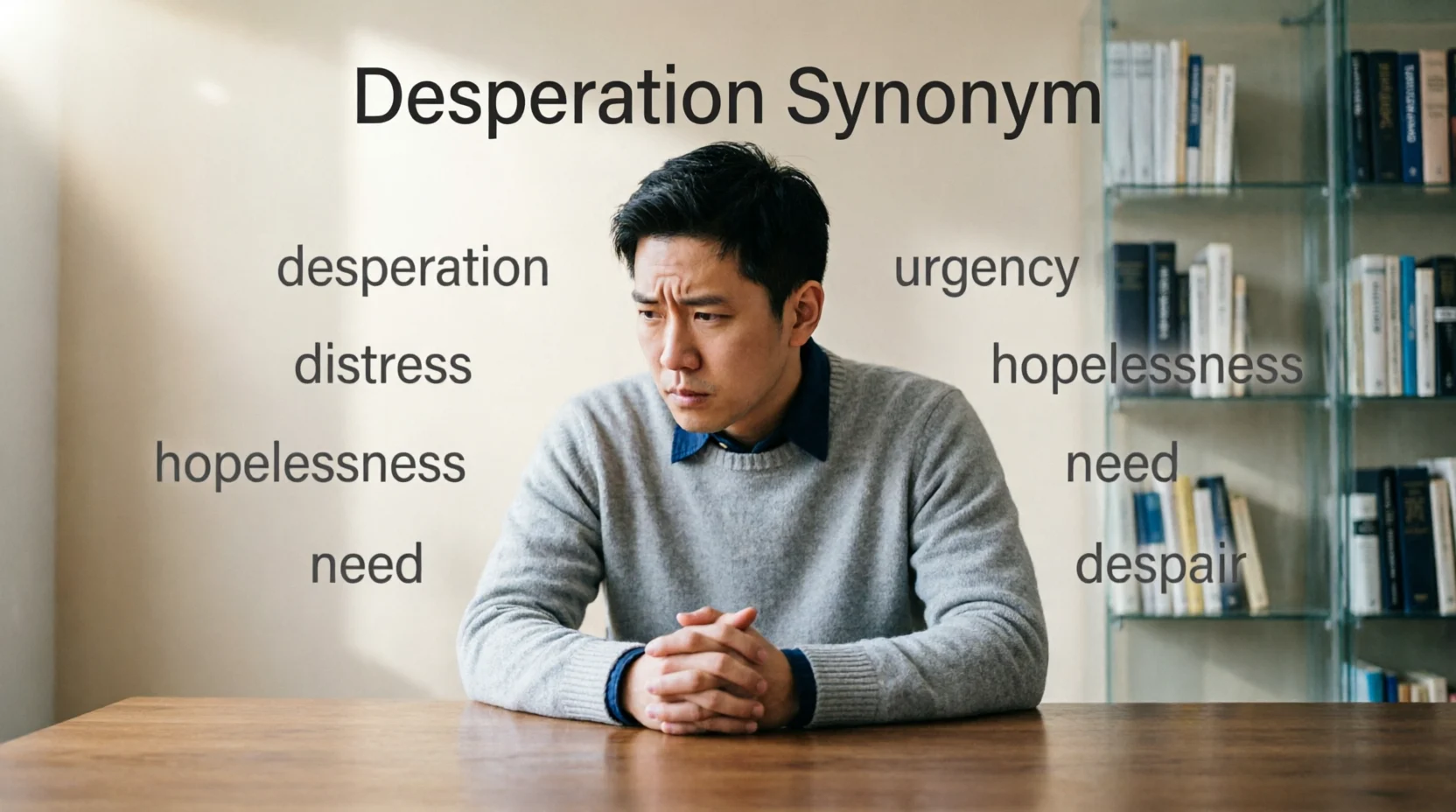
Finding the right desperation synonym can make your writing more precise, natural, and emotionally expressive. Words such as despair, hopelessness, urgency, and need are related to desperation, but each carries a slightly different meaning.
Desperation describes an extreme feeling of needing something or wanting a situation to change, often because a person sees few or no other choices. The best synonym depends on if you want to emphasize emotional pain, urgency, fear, helplessness, or an intense need.
Quick Answer: What Is a Synonym for Desperation?
Common synonyms for desperation include despair, hopelessness, urgency, distress, anguish, panic, helplessness, need, extremity, desperation, craving, eagerness, anxiety, distress, and dismay.
The closest alternatives are usually despair, hopelessness, distress, urgency, and helplessness. However, they are not always interchangeable because desperation can involve both intense emotion and a strong need to act.
What Does Desperation Mean?
Desperation is an extreme emotional state in which someone feels that they urgently need something to happen or change. It often occurs when a person believes that normal solutions are no longer enough.
For example:
She searched for work with desperation after losing her only source of income.
Here, desperation communicates both urgent need and emotional pressure.
The word can describe a temporary reaction or a prolonged emotional condition. It may also influence behavior, causing someone to take unusual risks or make decisions they would normally avoid.
Desperation as an Emotion
As an emotion, desperation can involve:
- Fear
- Anxiety
- Hopelessness
- Distress
- Helplessness
- Urgency
- Emotional pain
Desperation as a Strong Need
Desperation can also describe an intense desire for something.
Example:
“He was desperate for a second chance.”
In this sentence, the person strongly wants another opportunity and feels that the situation is extremely important.
30 Synonyms for Desperation
Not every synonym below has exactly the same meaning. Some emphasize emotional suffering, while others highlight urgency, desire, or helplessness.
1. Despair
Simple meaning: A complete loss of hope.
Example:
“She fell into despair after receiving the disappointing news.”
Best usage/context: Use despair when the main idea is the belief that things will not improve.
2. Hopelessness
Simple meaning: The feeling that there is no hope for a better outcome.
Example:
“He struggled with a sense of hopelessness after repeated failures.”
Best usage/context: Best for emotional or psychological contexts where optimism has disappeared.
3. Distress
Simple meaning: Great worry, sadness, or suffering.
Example:
“The family showed obvious distress after the accident.”
Best usage/context: Useful for emotional suffering, difficult circumstances, emergencies, and formal writing.
4. Urgency
Simple meaning: A strong need for something to happen quickly.
Example:
“She spoke with urgency because the deadline was approaching.”
Best usage/context: Use this when desperation is mainly about speed or immediate action rather than hopelessness.
5. Anguish
Simple meaning: Severe emotional or mental pain.
Example:
“He waited in anguish for news about his missing brother.”
Best usage/context: Strong choice for deep emotional suffering, grief, or painful uncertainty.
6. Despondency
Simple meaning: A low state of hope or confidence.
Example:
“Months of rejection eventually led to despondency.”
Best usage/context: Appropriate for formal, literary, or serious writing.
7. Helplessness
Simple meaning: The feeling that you cannot control or improve a situation.
Example:
“She experienced helplessness while watching the storm damage her home.”
Best usage/context: Use when a person feels powerless rather than simply eager or anxious.
8. Panic
Simple meaning: Sudden and overwhelming fear.
Example:
“He searched for his child in panic.”
Best usage/context: Best when desperation is accompanied by intense fear and an urgent reaction.
9. Need
Simple meaning: A strong requirement or necessity.
Example:
“There was an urgent need for clean drinking water.”
Best usage/context: Use for practical situations where something essential is required.
10. Craving
Simple meaning: A very strong desire for something.
Example:
“She had a powerful craving for freedom.”
Best usage/context: More suitable for intense desire than emotional hopelessness.
11. Yearning
Simple meaning: A deep and persistent desire for something.
Example:
“He felt a strong yearning to return to his hometown.”
Best usage/context: Excellent for emotional, personal, romantic, or literary writing.
12. Longing
Simple meaning: A strong desire for someone or something.
Example:
“She felt a deep longing for her family.”
Best usage/context: Common in personal and emotional writing, especially when something is absent or distant.
13. Eagerness
Simple meaning: Strong enthusiasm or willingness to do something.
Example:
“His eagerness to find a solution was obvious.”
Best usage/context: Use when the feeling is positive or energetic rather than painful.
14. Anxiety
Simple meaning: Strong worry or nervousness about what may happen.
Example:
“She waited with anxiety for the examination results.”
Best usage/context: Suitable when desperation comes from fear, uncertainty, or anticipation.
15. Agitation
Simple meaning: A state of emotional disturbance or nervous excitement.
Example:
“His agitation increased as the search continued.”
Best usage/context: Useful when desperation produces visible restlessness or emotional disturbance.
16. Dismay
Simple meaning: A strong feeling of worry, disappointment, or fear.
Example:
“To her dismay, the opportunity disappeared.”
Best usage/context: Best when an unexpected problem creates emotional shock or disappointment.
17. Suffering
Simple meaning: Physical or emotional pain.
Example:
“The community endured great suffering during the crisis.”
Best usage/context: Use when desperation is connected to prolonged hardship or pain.
18. Misery
Simple meaning: Extreme unhappiness or suffering.
Example:
“Years of poverty left him in misery.”
Best usage/context: Strong for severe unhappiness, difficult living conditions, and emotional pain.
19. Torment
Simple meaning: Severe physical or emotional suffering.
Example:
“Uncertainty about the future became a source of torment.”
Best usage/context: Use when suffering is intense, prolonged, or mentally overwhelming.
20. Frustration
Simple meaning: Annoyance caused by being unable to achieve something.
Example:
“Repeated failures filled her with frustration.”
Best usage/context: Appropriate when desperation develops because efforts repeatedly fail.
21. Impatience
Simple meaning: A lack of willingness to wait.
Example:
“His impatience grew as the response was delayed.”
Best usage/context: Useful when desperation is expressed through an urgent desire for immediate results.
22. Fervor
Simple meaning: Intense enthusiasm or passion.
Example:
“She defended her cause with remarkable fervor.”
Best usage/context: Better for passionate commitment than fear or hopelessness.
23. Vehemence
Simple meaning: Great force or intensity in expression.
Example:
“He argued with vehemence when discussing the injustice.”
Best usage/context: Suitable when desperation appears through forceful speech or behavior.
24. Extremity
Simple meaning: An extreme or difficult condition.
Example:
“In his extremity, he asked strangers for assistance.”
Best usage/context: Formal or literary writing describing severe circumstances.
25. Dire need
Simple meaning: An extremely urgent and serious need.
Example:
“The village was in dire need of medical supplies.”
Best usage/context: Excellent for humanitarian, emergency, financial, or practical situations.
26. Desirousness
Simple meaning: A strong state of wanting something.
Example:
“Her desirousness for success was evident in her dedication.”
Best usage/context: More formal and less common; use carefully when emphasizing strong desire.
27. Zeal
Simple meaning: Strong enthusiasm and energy for a cause or goal.
Example:
“He pursued the project with great zeal.”
Best usage/context: Usually positive and energetic, so it works when desperation involves intense commitment rather than despair.
28. Fretfulness
Simple meaning: A state of worry, nervousness, or restlessness.
Example:
“Her fretfulness increased as the appointment drew closer.”
Best usage/context: Useful for mild-to-moderate anxious desperation, especially in descriptive writing.
29. Apprehension
Simple meaning: Anxiety or fear about something that may happen.
Example:
“He entered the meeting with considerable apprehension.”
Best usage/context: Best when desperation is connected to fear about an uncertain future.
30. Compulsion
Simple meaning: A powerful feeling that forces someone toward an action.
Example:
“She felt a compulsion to find the truth.”
Best usage/context: Use when desperation creates an overwhelming drive to act.
Desperation Synonyms Comparison Table
| Synonym | Main Meaning | Emotional Intensity | Best Context |
| Despair | Loss of hope | Very high | Serious emotional situations |
| Hopelessness | Absence of hope | Very high | Emotional and psychological contexts |
| Distress | Severe worry or suffering | High | Problems, emergencies |
| Urgency | Need for immediate action | Medium–high | Deadlines and emergencies |
| Anguish | Deep emotional pain | Very high | Grief and uncertainty |
| Helplessness | Lack of control | High | Difficult situations |
| Panic | Sudden intense fear | Very high | Emergencies |
| Need | Requirement | Low–medium | Practical situations |
| Craving | Strong desire | Medium–high | Wants and desires |
| Yearning | Deep desire | Medium–high | Emotional or literary writing |
| Longing | Strong desire for something absent | Medium | Personal relationships |
| Eagerness | Enthusiastic desire | Low–medium | Positive situations |
| Anxiety | Worry about the future | Medium–high | Uncertainty |
| Dismay | Shock and disappointment | Medium–high | Unexpected setbacks |
| Misery | Extreme unhappiness | High | Prolonged suffering |
| Torment | Severe suffering | Very high | Intense emotional pain |
| Frustration | Annoyance after failure | Medium | Obstacles and setbacks |
| Dire need | Extreme necessity | High | Emergencies and hardship |
| Apprehension | Fear about what may happen | Medium | Uncertain situations |
| Compulsion | Powerful drive to act | Medium–high | Overwhelming impulses |
Desperation vs. Despair
Desperation and despair are closely related but are not identical.
Desperation often suggests that someone urgently wants to change a situation or obtain something. Despair focuses more strongly on the loss of hope.
Desperation:
“She searched desperately for another solution.”
Despair:
“She eventually lost all hope.”
A desperate person may still believe that action could help. A person in despair may believe that nothing will help.
Desperation vs. Hopelessness
Hopelessness describes the absence of hope, while desperation can involve urgent action.
For example:
- “He felt hopelessness after years of failure.”
- “He acted out of desperation to solve the problem.”
The first sentence emphasizes an emotional state. The second emphasizes the urgent need to do something.
Desperation vs. Urgency
Urgency focuses on time and immediate action. Desperation usually carries a stronger emotional component.
Compare:
“The situation requires urgency.”
This sounds practical and relatively neutral.
“She begged for help in desperation.”
This communicates powerful emotional pressure.
Desperation vs. Distress
Distress means serious emotional or physical suffering. Desperation usually adds a sense of extreme need or an urgent desire for change.
Someone can experience distress without becoming desperate. Desperation often develops when distress becomes severe and the person sees few alternatives.
How to Choose the Right Desperation Synonym
Choosing the right word depends on the exact feeling or situation you want to communicate.
For Loss of Hope
Choose:
- Despair
- Hopelessness
- Despondency
These words work when someone believes that improvement is unlikely.
Example:
“After years of rejection, he was overcome by despair.”
For Urgent Action
Choose:
- Urgency
- Dire need
- Extremity
- Impatience
These emphasize the need to act quickly.
Example:
“The injured traveler needed medical attention with great urgency.”
For Emotional Pain
Choose:
- Anguish
- Torment
- Misery
- Suffering
These are stronger choices when the emotional experience is painful and intense.
Example:
“She waited in anguish for the final decision.”
For Fear and Worry
Choose:
- Panic
- Anxiety
- Apprehension
- Fretfulness
These words are appropriate when fear is the main emotion.
Example:
“He called his family in panic after losing his way.”
For Powerlessness
Choose:
- Helplessness
- Distress
- Suffering
These emphasize the inability to control circumstances.
Example:
“She felt helplessness as the situation continued to worsen.”
For Strong Desire
Choose:
- Craving
- Yearning
- Longing
- Eagerness
These work when desperation is mainly about wanting something strongly.
Example:
“He had a deep longing for a peaceful life.”
For Positive Passion
Choose:
- Zeal
- Fervor
- Eagerness
These words can describe intense motivation without suggesting hopelessness.
Example:
“She approached the new opportunity with genuine eagerness.”
Common Usage Mistakes With Desperation Synonyms
Using “Despair” When You Mean “Urgency”
Despair means a loss of hope. It does not simply mean that something needs to happen quickly.
Less accurate:
“We must finish the project with despair.”
Better:
“We must finish the project with urgency.”
Using “Eagerness” for Severe Emotional Pain
Eagerness usually has a positive or enthusiastic tone.
Eager: “She was eager to begin her new job.”
Desperate: “She was desperate to find work.”
The second sentence communicates much greater emotional pressure.
Treating “Need” and “Desperation” as Exact Equivalents
Everyone can have a need without being desperate.
“I need water” is neutral.
“I desperately need water” suggests an extreme or urgent situation.
Overusing Dramatic Synonyms
Words such as anguish, torment, and despair are powerful. Using them for ordinary inconveniences can make writing sound exaggerated.
Choose the intensity that matches the situation.
FAQs:
What is the closest synonym for desperation?
The closest synonym depends on context. Despair, distress, hopelessness, urgency, and helplessness are among the closest alternatives, but each emphasizes a different aspect of desperation.
What is a positive synonym for desperation?
If you mean intense motivation or desire without the negative emotional meaning, eagerness, zeal, fervor, or enthusiasm may work better.
Is “despair” the same as “desperation”?
No. Despair primarily means a loss of hope, while desperation usually describes an extreme need, desire, or urgent attempt to change a situation.
What is a synonym for desperate need?
Useful alternatives include dire need, urgent need, extreme necessity, pressing need, and critical need.
What is a synonym for desperate desire?
Depending on context, you can use craving, yearning, longing, intense desire, or strong desire.
What is the opposite of desperation?
Possible opposites include calmness, contentment, confidence, hope, security, and satisfaction. The best opposite depends on whether desperation refers to emotional distress or urgent need.
Is “urgency” stronger than “desperation”?
Not necessarily. Urgency emphasizes the need for immediate action, while desperation generally carries stronger emotional pressure. A situation can be urgent without making someone desperate.
How can I avoid repeating the word “desperation”?
First identify what the sentence actually emphasizes. Use urgency for immediate action, despair for lost hope, anguish for emotional pain, helplessness for lack of control, and longing for deep desire.
Conclusion
The best desperation synonym depends on the exact emotion, situation, and tone you want to express. Despair highlights lost hope, urgency emphasizes immediate action, anguish communicates deep pain, helplessness focuses on powerlessness, and longing describes intense desire.
Using the right alternative makes your writing more precise and natural. Instead of replacing desperation with any similar word, consider what the person is actually feeling: fear, urgency, suffering, hopelessness, desire, or a powerful need. That small distinction can make your vocabulary much stronger.

I am Camden Thomas, an Administrator at SaysReply. I help maintain our platform and ensure readers find clear, natural, and useful alternative ways to express their thoughts every day.