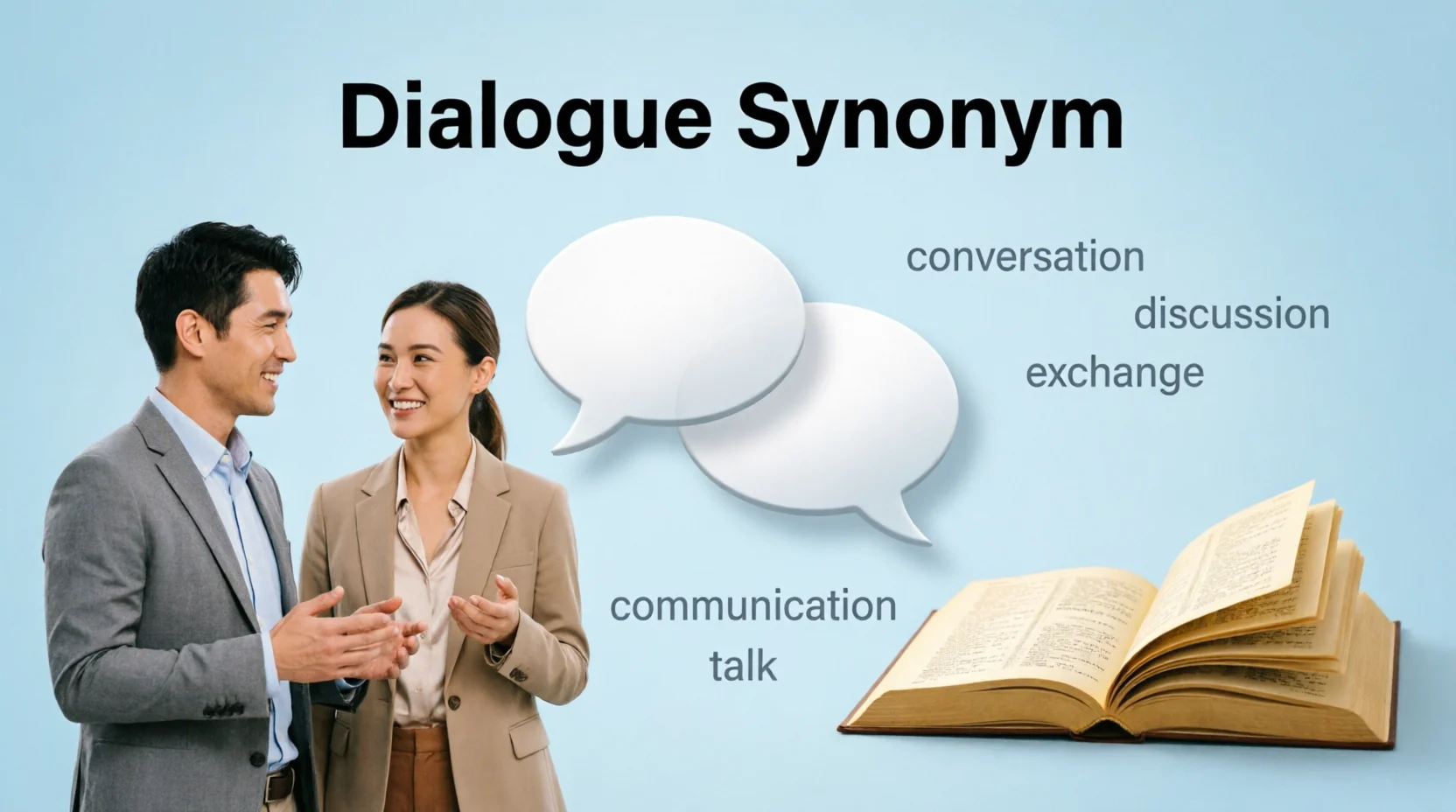
Finding the right dialogue synonym can make your writing more natural, precise, and engaging. Depending on the context, alternatives such as conversation, discussion, exchange, talk, discourse, communication, and interaction can express slightly different meanings. The best choice depends on whether you are describing casual speech, a formal exchange of ideas, a literary conversation, or communication between people.
For students, ESL learners, writers, and content creators, understanding these differences is useful because “dialogue” does not always fit every situation. Choosing a more specific word can improve clarity and help your writing sound more natural.
Quick Answer: What Is a Good Synonym for Dialogue?
The most common synonym for dialogue is conversation. Other useful alternatives include discussion, talk, exchange, discourse, communication, interaction, debate, consultation, and conversation.
However, these words are not always interchangeable. For example, conversation usually suggests an informal exchange between people, while discourse is more formal and often relates to a subject or field of thought. Debate implies opposing opinions, whereas consultation focuses on seeking advice or professional input.
What Does Dialogue Mean?
Dialogue means a conversation or exchange of words between two or more people. It can happen in everyday life, professional settings, literature, theater, films, or other forms of storytelling.
For example:
“The two friends had a long dialogue about their future.”
In fiction, dialogue specifically refers to the words spoken by characters.
“The dialogue between the two characters made the scene more emotional.”
The word can also describe a constructive exchange of ideas, especially when people are trying to understand one another.
“The leaders opened a dialogue to resolve the disagreement.”
Dialogue as a Noun
As a noun, dialogue refers to a conversation or exchange.
Example:
“The dialogue between the teacher and student was helpful.”
Dialogue as a Verb
As a verb, dialogue means to communicate or discuss something with another person or group.
Example:
“The two organizations continued to dialogue about the proposed changes.”
The verb form is more common in formal or professional writing than in everyday speech.
30 Best Dialogue Synonyms
1. Conversation
Simple meaning: An informal exchange of words between two or more people.
Example:
“We had a friendly conversation after class.”
Best usage/context: Everyday speech, casual writing, personal communication, and general situations.
Difference from dialogue: “Conversation” usually sounds more natural for ordinary communication, while “dialogue” can sound more literary or formal.
2. Talk
Simple meaning: Speaking with someone about something.
Example:
“I need to have a talk with my brother.”
Best usage/context: Informal speech and everyday situations.
Difference from dialogue: “Talk” is simpler and more casual than “dialogue.”
3. Discussion
Simple meaning: A conversation in which people consider or examine a topic.
Example:
“The students had a discussion about climate change.”
Best usage/context: Education, meetings, workplaces, academic settings, and organized conversations.
Difference from dialogue: A discussion usually focuses on a particular topic, while dialogue can be broader.
4. Exchange
Simple meaning: A sharing of words, ideas, opinions, or information.
Example:
“The two writers had an interesting exchange of ideas.”
Best usage/context: Formal writing, journalism, professional communication, and situations involving mutual sharing.
Difference from dialogue: “Exchange” emphasizes the back-and-forth nature of communication.
5. Discourse
Simple meaning: Formal communication or discussion about a particular subject.
Example:
“The article contributed to the public discourse on education.”
Best usage/context: Academic, political, professional, philosophical, and formal writing.
Difference from dialogue: “Discourse” is generally more formal and broader than a simple conversation.
6. Communication
Simple meaning: The act of sharing information, thoughts, or feelings.
Example:
“Good communication is important in every relationship.”
Best usage/context: Business, relationships, psychology, education, technology, and general writing.
Difference from dialogue: Communication can happen through speech, writing, gestures, or other methods, whereas dialogue normally involves an exchange between speakers.
7. Interaction
Simple meaning: The way people communicate or respond to one another.
Example:
“The teacher encouraged interaction between students.”
Best usage/context: Education, psychology, business, technology, social situations, and professional writing.
Difference from dialogue: Interaction is broader and does not necessarily involve a sustained conversation.
8. Debate
Simple meaning: A formal discussion in which people express opposing views.
Example:
“The candidates participated in a debate about economic policy.”
Best usage/context: Politics, education, competitions, public speaking, and controversial subjects.
Difference from dialogue: A debate involves opposing positions, while dialogue does not require disagreement.
9. Conversation
Simple meaning: A spoken exchange between people.
Example:
“Our conversation lasted for nearly an hour.”
Best usage/context: Everyday communication and general writing.
Difference from dialogue: This is one of the closest and most natural alternatives to “dialogue.”
10. Consultation
Simple meaning: A conversation in which someone seeks advice or professional guidance.
Example:
“She scheduled a consultation with her lawyer.”
Best usage/context: Medical, legal, business, professional, and advisory situations.
Difference from dialogue: Consultation has a specific purpose, usually getting advice or making a decision.
11. Interview
Simple meaning: A structured conversation in which one person asks another questions.
Example:
“The journalist conducted an interview with the author.”
Best usage/context: Journalism, employment, research, media, and academic settings.
Difference from dialogue: An interview usually has a clearer question-and-answer structure.
12. Chat
Simple meaning: A friendly and informal conversation.
Example:
“We had a quick chat over coffee.”
Best usage/context: Casual conversations, social media, messaging, and friendly writing.
Difference from dialogue: “Chat” is much more informal.
13. Parley
Simple meaning: A discussion between people or groups, especially to settle a disagreement.
Example:
“The two sides agreed to a parley before continuing negotiations.”
Best usage/context: Formal, historical, diplomatic, or literary writing.
Difference from dialogue: Parley often suggests negotiation or an attempt to resolve conflict.
14. Negotiation
Simple meaning: A discussion intended to reach an agreement.
Example:
“The companies entered negotiations over the contract.”
Best usage/context: Business, diplomacy, law, employment, and conflict resolution.
Difference from dialogue: Negotiation has the specific goal of reaching an agreement.
15. Deliberation
Simple meaning: Careful discussion before making a decision.
Example:
“After several hours of deliberation, the committee reached a decision.”
Best usage/context: Legal, governmental, professional, academic, and formal contexts.
Difference from dialogue: Deliberation emphasizes careful consideration and decision-making.
16. Debate
Simple meaning: A structured argument between people with different opinions.
Example:
“The classroom debate focused on the value of social media.”
Best usage/context: Formal arguments, public discussions, academic settings, and competitions.
Difference from dialogue: Debate is more argumentative and structured than general dialogue.
17. Argument
Simple meaning: A disagreement expressed through spoken or written words.
Example:
“The couple had an argument about money.”
Best usage/context: Conflict, disagreements, relationships, and informal writing.
Difference from dialogue: Not every dialogue is an argument; an argument specifically involves disagreement.
18. Dispute
Simple meaning: A disagreement or conflict between people or groups.
Example:
“The two companies are involved in a dispute over the contract.”
Best usage/context: Legal, business, political, and formal contexts.
Difference from dialogue: “Dispute” emphasizes disagreement rather than communication itself.
19. Conference
Simple meaning: A formal meeting for discussion and exchange of information.
Example:
“She attended a conference on modern education.”
Best usage/context: Academic, professional, business, and organizational settings.
Difference from dialogue: A conference is an event or meeting, not simply a conversation between two people.
20. Meeting
Simple meaning: An organized gathering where people discuss something.
Example:
“We have a meeting with the project team tomorrow.”
Best usage/context: Workplace, education, organizations, and planning.
Difference from dialogue: A meeting can contain several dialogues, discussions, or presentations.
21. Consultation
Simple meaning: A professional conversation intended to receive advice or information.
Example:
“The patient arranged a consultation with a specialist.”
Best usage/context: Professional services, healthcare, law, business, and advisory situations.
Difference from dialogue: Consultation is more purposeful and usually involves an expert or adviser.
22. Interchange
Simple meaning: A mutual exchange of ideas, information, or communication.
Example:
“The conference encouraged an interchange of ideas among researchers.”
Best usage/context: Formal, academic, professional, and intellectual writing.
Difference from dialogue: Interchange emphasizes mutual exchange rather than simply speaking.
23. Monologue
Simple meaning: A long speech by one person.
Example:
“The actor delivered an emotional monologue.”
Best usage/context: Theater, literature, film, storytelling, and dramatic writing.
Difference from dialogue: Dialogue normally involves two or more speakers, while a monologue centers on one speaker.
24. Soliloquy
Simple meaning: A speech in which a character expresses private thoughts aloud, usually while alone.
Example:
“The character’s soliloquy revealed his deepest fears.”
Best usage/context: Drama, literature, Shakespearean studies, and literary analysis.
Difference from dialogue: A soliloquy is spoken by one character rather than exchanged between characters.
25. Address
Simple meaning: A formal speech given to an audience.
Example:
“The president delivered an address to the nation.”
Best usage/context: Politics, ceremonies, public speaking, and formal events.
Difference from dialogue: An address is generally one-way communication rather than a two-way exchange.
26. Speech
Simple meaning: Spoken words given to an audience or expressed by a person.
Example:
“Her graduation speech inspired the audience.”
Best usage/context: Public speaking, ceremonies, politics, education, and presentations.
Difference from dialogue: A speech can be one-sided, whereas dialogue requires an exchange.
27. Rapport
Simple meaning: A friendly and comfortable relationship that allows people to communicate well.
Example:
“The teacher quickly developed a strong rapport with her students.”
Best usage/context: Relationships, teaching, counseling, business, and professional communication.
Difference from dialogue: Rapport describes the quality of a relationship, not the conversation itself.
28. Contact
Simple meaning: Communication or connection with another person or group.
Example:
“The organization maintained regular contact with local communities.”
Best usage/context: Business, professional communication, relationships, and general contexts.
Difference from dialogue: Contact is broader and may involve occasional communication rather than a conversation.
29. Liaison
Simple meaning: Communication or cooperation between people or organizations.
Example:
“She acts as a liaison between the two departments.”
Best usage/context: Business, government, organizations, administration, and professional writing.
Difference from dialogue: Liaison usually describes an ongoing communication role or relationship.
30. Symposium
Simple meaning: A formal meeting where experts discuss a particular subject.
Example:
“The university hosted a symposium on artificial intelligence and education.”
Best usage/context: Academic, scientific, professional, and educational contexts.
Difference from dialogue: A symposium is a formal event involving multiple speakers and discussions rather than a simple conversation.
Dialogue Synonyms Comparison Table
| Synonym | Main Meaning | Tone | Best Context |
|---|---|---|---|
| Conversation | Informal exchange | Neutral | Everyday speech |
| Talk | Casual speaking | Informal | Daily communication |
| Discussion | Examination of a topic | Neutral/Formal | School and work |
| Exchange | Mutual sharing | Neutral/Formal | Ideas and information |
| Discourse | Formal discussion | Formal | Academic and public topics |
| Communication | Sharing information | Neutral | General use |
| Interaction | Mutual response | Neutral | Social and professional |
| Debate | Opposing viewpoints | Formal | Politics and education |
| Consultation | Seeking advice | Formal | Professional settings |
| Interview | Structured questions | Formal | Jobs, journalism, research |
| Chat | Friendly conversation | Informal | Social situations |
| Parley | Discussion to resolve conflict | Formal | Diplomacy and literature |
| Negotiation | Discussion for agreement | Formal | Business and diplomacy |
| Deliberation | Careful decision-making discussion | Formal | Committees and law |
| Argument | Disagreement | Informal/Neutral | Conflict |
| Dispute | Serious disagreement | Formal | Legal and business |
| Conference | Organized discussion event | Formal | Professional and academic |
| Meeting | Organized gathering | Neutral/Formal | Workplace |
| Interchange | Mutual exchange | Formal | Academic and professional |
| Monologue | One-person speech | Literary | Drama |
| Soliloquy | Character’s private speech | Literary | Theater |
| Address | Formal public speech | Formal | Politics and ceremonies |
| Speech | Spoken presentation | Neutral/Formal | Public speaking |
| Rapport | Positive communication relationship | Neutral | Teaching and business |
| Contact | Communication or connection | Neutral | Professional use |
| Liaison | Ongoing communication link | Formal | Organizations |
| Symposium | Expert discussion event | Formal | Academic and scientific |
How to Choose the Right Dialogue Synonym
Choosing the right word depends on tone, meaning, audience, and intent. A useful synonym should communicate not only that people are speaking but also why and how they are communicating.
For Casual and Friendly Communication
Use:
- Talk
- Chat
- Conversation
- Contact
These words work well in everyday English.
Example:
“We had a quick chat before the movie.”
Instead of:
“We engaged in a dialogue before the movie.”
The second sentence sounds unnecessarily formal for an ordinary social situation.
For Academic or Professional Communication
Use:
- Discussion
- Discourse
- Exchange
- Interchange
- Conference
- Symposium
These words are useful when discussing ideas, research, education, or professional subjects.
Example:
“The discussion focused on renewable energy.”
For Conflict or Opposing Opinions
Use:
- Debate
- Argument
- Dispute
- Negotiation
- Parley
The choice depends on the nature of the disagreement.
Use debate when opposing opinions are being presented formally.
Use argument for a disagreement between people.
Use negotiation when the participants are trying to reach an agreement.
Use parley when the discussion involves attempts to settle a conflict, especially in formal or historical contexts.
For Professional Advice
Use:
- Consultation
- Interview
- Meeting
- Discussion
For example:
“I have a consultation with my doctor tomorrow.”
Here, “dialogue” would be too general because the conversation has a specific professional purpose.
For Literature and Drama
Use:
- Dialogue
- Conversation
- Monologue
- Soliloquy
- Speech
These terms are especially important when analyzing fiction, plays, movies, and storytelling.
Remember that monologue and soliloquy are not true synonyms for dialogue. They are related literary forms but normally involve one speaker.
Common Usage Mistakes With Dialogue Synonyms
Mistake 1: Using “debate” for every discussion
A debate involves opposing viewpoints. A normal discussion does not necessarily include disagreement.
Incorrect choice:
“We had a debate about our weekend plans.”
Better:
“We had a discussion about our weekend plans.”
Mistake 2: Using “conversation” in highly formal contexts
“Conversation” is perfectly correct in many situations, but formal writing may require a more specific word.
Example:
“The researchers held a discussion about the findings.”
This sounds more appropriate than:
“The researchers had a chat about the findings.”
Mistake 3: Treating “monologue” as a synonym for dialogue
A monologue is primarily a speech by one person. Dialogue involves an exchange between speakers.
Mistake 4: Confusing communication with conversation
Communication is a broad concept. It can include writing, gestures, emails, signs, facial expressions, and spoken language.
Conversation is specifically an exchange of spoken words.
Mistake 5: Using “argument” when you mean a neutral discussion
An argument often suggests conflict or disagreement.
If people are calmly sharing ideas, discussion, conversation, or exchange may be better choices.
Mistake 6: Choosing a formal word when a simple one works
Words such as discourse, parley, liaison, and deliberation have specific uses. Using them in ordinary situations can make your writing sound unnatural.
For example:
“I had a parley with my friend.”
This sounds unusual unless the context is intentionally formal or humorous.
A natural sentence would be:
“I had a conversation with my friend.”
Dialogue Synonyms in Different Sentences
The same basic idea can be expressed differently depending on context.
Everyday:
“We had a conversation after dinner.”
Casual:
“I had a quick chat with Sarah.”
Academic:
“The discussion focused on language development.”
Professional:
“The company opened negotiations with its partners.”
Political:
“The two parties began a dialogue.”
Argumentative:
“The candidates participated in a debate.”
Literary:
“The dialogue between the characters revealed their different personalities.”
Dramatic:
“The actor delivered a powerful monologue.”
These examples show why choosing a synonym based only on dictionary meaning is not always enough. Context determines which word sounds most natural.
Dialogue vs Conversation
Dialogue and conversation are very close in meaning, but there is a subtle difference.
Conversation is the more common word for ordinary spoken communication between people.
Dialogue can refer to ordinary conversation, but it is also frequently used for character speech in books, plays, television, and films. It can additionally suggest a purposeful exchange intended to improve understanding.
Example:
“The friends had a conversation about school.”
This sounds natural and casual.
“The novel contains realistic dialogue.”
Here, “dialogue” is the better choice because the sentence concerns spoken words between fictional characters.
Dialogue vs Discussion
A discussion usually focuses on a particular subject.
A dialogue can be more open-ended and may focus on mutual understanding or communication.
Discussion:
“The team discussed the new project.”
Dialogue:
“The two groups began a dialogue to improve their relationship.”
The first emphasizes a topic. The second emphasizes communication between groups.
Dialogue vs Debate
A debate is a structured exchange involving different or opposing opinions.
A dialogue does not require disagreement.
Dialogue:
“The community held a dialogue about local development.”
Debate:
“The candidates debated the proposed development plan.”
Use debate when competing arguments are central to the situation.
Dialogue vs Discourse
Discourse is more formal and often refers to communication or discussion surrounding a particular subject, idea, or social issue.
Dialogue:
“The students engaged in dialogue about their experiences.”
Discourse:
“The paper examines political discourse in modern society.”
For everyday writing, dialogue or conversation is usually easier and more natural.
FAQs:
What is the closest synonym for dialogue?
Conversation is usually the closest and most natural synonym for dialogue. Depending on context, discussion, exchange, talk, or communication may also work.
What is a simple word for dialogue?
Talk is one of the simplest alternatives. Conversation is another common and beginner-friendly choice.
Is conversation the same as dialogue?
They are very similar, but they are not always identical. Conversation usually refers to ordinary spoken communication, while dialogue can also refer to character speech in literature and purposeful communication between groups.
What is a formal synonym for dialogue?
Useful formal alternatives include discourse, discussion, interchange, negotiation, consultation, deliberation, and communication. The correct choice depends on the context.
What is the opposite of dialogue?
There is no single perfect opposite. Depending on context, possible contrasts include silence, monologue, isolation, or one-way communication.
Is discussion a synonym for dialogue?
Yes, in some contexts. Both can describe an exchange of ideas, but discussion usually focuses more strongly on a specific topic, while dialogue can emphasize communication and mutual understanding.
Is debate a synonym for dialogue?
Sometimes, but they are not exact synonyms. A debate involves opposing arguments or viewpoints, whereas dialogue can be cooperative and does not require disagreement.
What is the difference between dialogue and monologue?
Dialogue involves an exchange between two or more speakers. A monologue is a long speech delivered by one person. In literature and drama, both are important but serve different purposes.
Conclusion
The best dialogue synonym depends on what you want to express. Conversation is usually the safest choice for everyday communication, while talk and chat create a more informal tone. Discussion works well for focused topics, discourse suits formal or academic writing, and exchange emphasizes the sharing of ideas.
When disagreement is central, words such as debate, argument, dispute, or negotiation may be more precise. In professional settings, consultation, interview, or deliberation can communicate a specific purpose. In literature, dialogue, monologue, and soliloquy have distinct meanings that should not be confused.
Rather than replacing “dialogue” with the first synonym you find, consider the situation, tone, purpose, and relationship between the speakers. The most effective synonym is the one that expresses your intended meaning clearly and naturally.

I am Camden Thomas, an Administrator at SaysReply. I help maintain our platform and ensure readers find clear, natural, and useful alternative ways to express their thoughts every day.







3 thoughts on “Dialogue Synonym: 30 Best Alternatives for Clear and Natural”