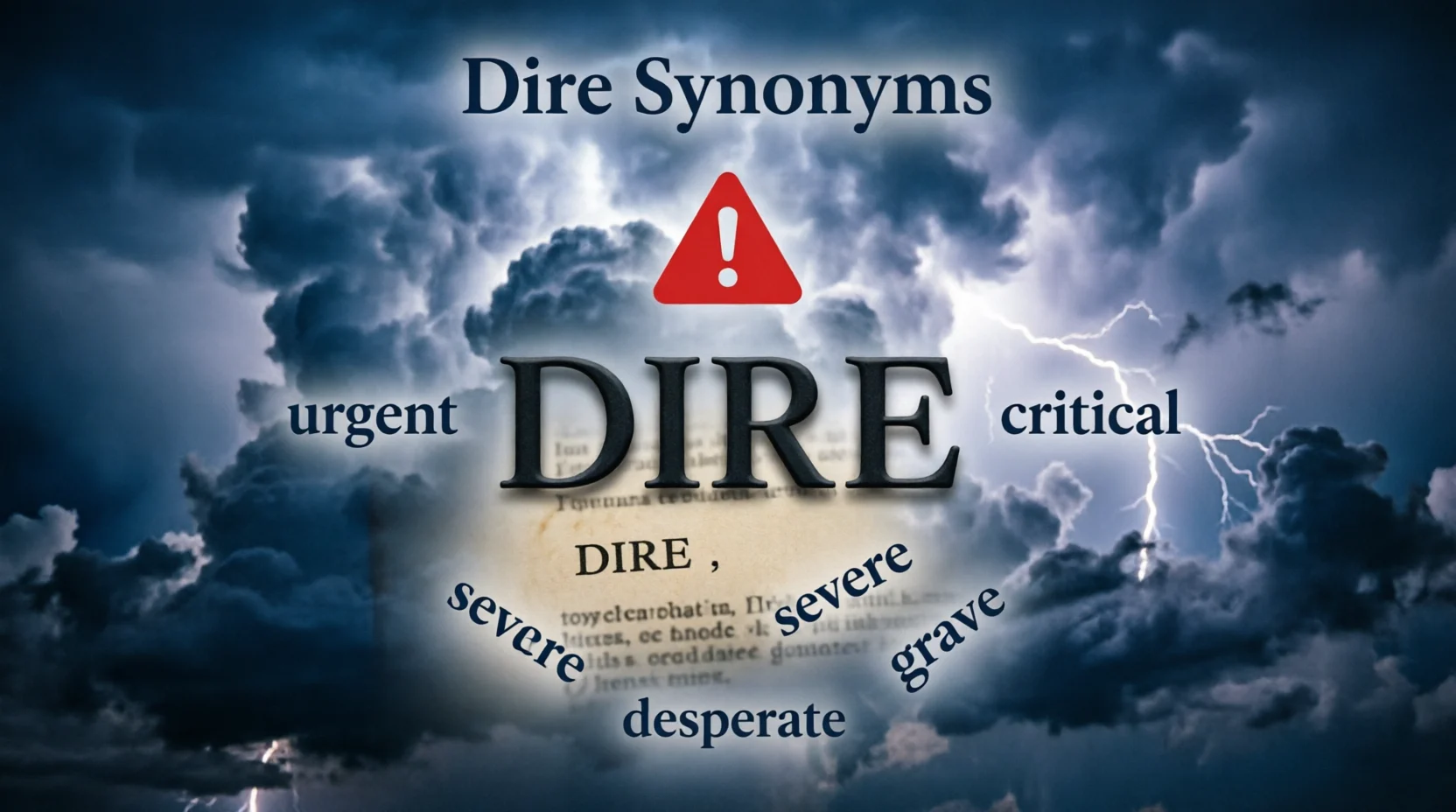
When you need a dire synonym, the best choice depends on what you mean by “dire.” The word usually describes something extremely serious, urgent, dangerous, or worrying. Common alternatives include desperate, critical, grave, severe, urgent, alarming, disastrous, perilous, and dreadful. However, these words are not always interchangeable. Some emphasize danger, while others focus on urgency, seriousness, or terrible consequences.
Quick Answer: What Is a Synonym for Dire?
The most useful synonyms for dire include desperate, critical, grave, severe, urgent, serious, alarming, dangerous, perilous, dreadful, disastrous, catastrophic, calamitous, bleak, grim, terrible, extreme, pressing, acute, and distressing.
The right synonym depends on context. For example, “a dire situation” can become “a critical situation,” “a desperate situation,” “a grave situation,” or “a dangerous situation.” Each alternative adds a slightly different meaning.
What Does Dire Mean?
Dire is an adjective used to describe something extremely serious, urgent, frightening, or likely to have very bad consequences.
Simple Definition of Dire
In simple English, dire means very serious, very bad, or urgently needing attention.
For example:
- The country was facing a dire economic crisis.
- The patient was in dire need of medical care.
- The company was in dire financial trouble.
- The storm created dire conditions for travelers.
The word often suggests that a situation has reached an unusually serious level.
Dire as an Adjective
“Dire” commonly appears before nouns:
- dire situation
- dire consequences
- dire warning
- dire need
- dire circumstances
- dire shortage
- dire emergency
- dire threat
It is especially useful when ordinary words such as “bad” or “serious” do not seem strong enough.
30 Synonyms for Dire
Not every synonym has exactly the same meaning. Some emphasize urgency, while others emphasize danger, fear, seriousness, or terrible consequences.
1. Desperate
Simple meaning: Extremely serious and leaving very few options.
Example: The family was in desperate need of financial assistance.
Best usage/context: Use desperate when someone has an urgent problem and feels that immediate help or action is necessary.
2. Critical
Simple meaning: Extremely serious and requiring immediate attention.
Example: The hospital reported that the patient’s condition was critical.
Best usage/context: Excellent for medical conditions, emergencies, situations, decisions, and problems requiring immediate action.
3. Grave
Simple meaning: Very serious and worrying.
Example: The officials warned of the grave consequences of the decision.
Best usage/context: Common in formal, serious, legal, political, and professional writing.
4. Severe
Simple meaning: Very serious, intense, or harmful.
Example: The region experienced severe flooding after several days of rain.
Best usage/context: Particularly useful for weather, damage, pain, symptoms, criticism, shortages, and problems.
5. Urgent
Simple meaning: Needing immediate attention or action.
Example: The doctor said that the patient needed urgent treatment.
Best usage/context: Choose urgent when time is the main concern.
6. Serious
Simple meaning: Important, concerning, or potentially harmful.
Example: The investigation uncovered serious safety problems.
Best usage/context: A broad and natural replacement for dire, especially in everyday English.
7. Alarming
Simple meaning: Causing worry or fear.
Example: Scientists reported an alarming increase in pollution levels.
Best usage/context: Use it when something creates concern because it appears dangerous or unexpectedly bad.
8. Dangerous
Simple meaning: Likely to cause harm.
Example: The hikers faced dangerous conditions on the mountain.
Best usage/context: Best when the main idea is physical, emotional, or other forms of danger.
9. Perilous
Simple meaning: Extremely dangerous or risky.
Example: The climbers continued their perilous journey through the mountains.
Best usage/context: More literary or formal than dangerous; useful for risks, journeys, situations, and circumstances.
10. Dreadful
Simple meaning: Extremely bad, unpleasant, or frightening.
Example: The region suffered dreadful conditions during the prolonged drought.
Best usage/context: Useful when emphasizing how terrible or distressing something is.
11. Disastrous
Simple meaning: Causing great damage or failure.
Example: The company made a disastrous financial decision.
Best usage/context: Best when an action or event produces extremely bad results.
12. Catastrophic
Simple meaning: Causing enormous damage or destruction.
Example: The earthquake had catastrophic effects on nearby communities.
Best usage/context: Use for events or outcomes involving exceptionally serious damage or consequences.
13. Calamitous
Simple meaning: Causing serious damage, suffering, or disaster.
Example: The war had calamitous effects on the country’s economy.
Best usage/context: A formal and somewhat literary word for disastrous events and consequences.
14. Bleak
Simple meaning: Unpromising, hopeless, or unlikely to improve.
Example: The economic outlook appeared bleak after months of declining investment.
Best usage/context: Choose bleak when the focus is on a poor or hopeless future rather than immediate danger.
15. Grim
Simple meaning: Very serious, depressing, or unlikely to improve.
Example: The report presented a grim picture of the industry’s future.
Best usage/context: Excellent for situations, predictions, news, statistics, and future prospects.
16. Terrible
Simple meaning: Extremely bad or unpleasant.
Example: The accident resulted in terrible injuries.
Best usage/context: A common everyday alternative, although it is usually less formal than dire.
17. Extreme
Simple meaning: Far beyond what is normal or ordinary.
Example: The workers faced extreme conditions during the heatwave.
Best usage/context: Useful when emphasizing an unusually high degree of difficulty, severity, or hardship.
18. Pressing
Simple meaning: Requiring immediate attention.
Example: Housing shortages have become a pressing concern for the city.
Best usage/context: Best for problems, concerns, needs, questions, and matters that cannot be postponed.
19. Acute
Simple meaning: Very serious, intense, or strongly felt.
Example: The region is experiencing an acute shortage of clean water.
Best usage/context: Common in formal, medical, economic, and academic contexts.
20. Distressing
Simple meaning: Causing sadness, anxiety, or emotional pain.
Example: The family received distressing news about the accident.
Best usage/context: Use when the emotional effect of a situation is particularly important.
21. Troubling
Simple meaning: Causing concern or worry.
Example: The survey revealed some troubling trends among young workers.
Best usage/context: A natural choice when something is worrying but does not necessarily involve immediate danger.
22. Threatening
Simple meaning: Showing signs of possible harm or danger.
Example: Dark clouds created a threatening atmosphere over the town.
Best usage/context: Suitable for situations, weather, behavior, circumstances, or developments that suggest danger.
23. Direful
Simple meaning: Extremely dreadful or terrible.
Example: The novel describes the direful consequences of the war.
Best usage/context: A rare and literary word. It can work in creative or historical writing but sounds unnatural in everyday conversation.
24. Direful
Simple meaning: Extremely dreadful or terrible.
Example: The story warned of direful consequences if the warning was ignored.
Best usage/context: Mostly literary or old-fashioned contexts. In modern writing, dire, dreadful, or disastrous is usually more natural.
25. Horrific
Simple meaning: Extremely shocking, frightening, or disturbing.
Example: The accident had horrific consequences for everyone involved.
Best usage/context: Best for events or experiences that cause intense shock, fear, or emotional distress.
26. Devastating
Simple meaning: Causing severe damage, suffering, or emotional pain.
Example: The wildfire had a devastating effect on the surrounding communities.
Best usage/context: Strong for disasters, losses, injuries, news, and emotional consequences.
27. Direst
Simple meaning: The most serious, urgent, or dangerous.
Example: The organization acted quickly during the direst stage of the crisis.
Best usage/context: Direst is the superlative form of dire and is useful when comparing several levels of seriousness.
28. Ominous
Simple meaning: Suggesting that something bad may happen.
Example: The sudden drop in temperatures was an ominous sign for farmers.
Best usage/context: Use when warning signs suggest future trouble rather than describing an already disastrous situation.
29. Direful
Simple meaning: Extremely bad, frightening, or dreadful.
Example: The poem describes the direful consequences of human conflict.
Best usage/context: Mostly literary. For normal modern writing, dreadful or terrible is usually a better choice.
30. Direst
Simple meaning: The most extreme or serious form of something dire.
Example: The emergency team was called upon during the direst moments of the crisis.
Best usage/context: Use direst when you need the superlative form of dire, especially in formal or dramatic writing.
Note: Some entries above, such as direful and direst, are related forms rather than direct one-word replacements for dire. For precise modern writing, prefer critical, grave, severe, desperate, urgent, pressing, alarming, or serious.
Comparison Table: Dire Synonyms at a Glance
| Synonym | Main idea | Tone | Best context |
| Desperate | Very serious with few options | Strong | Needs, circumstances |
| Critical | Requiring immediate attention | Formal | Medical, emergencies |
| Grave | Extremely serious | Formal | Consequences, concerns |
| Severe | Very intense or harmful | Neutral/Formal | Weather, damage, problems |
| Urgent | Needs immediate action | Neutral | Requests, needs, problems |
| Serious | Important or concerning | Neutral | General situations |
| Alarming | Causes worry | Neutral | Trends, developments |
| Dangerous | Likely to cause harm | Neutral | Risks, conditions |
| Perilous | Extremely risky | Literary/Formal | Journeys, situations |
| Dreadful | Extremely bad | Strong | Conditions, experiences |
| Disastrous | Producing great failure or damage | Strong | Decisions, outcomes |
| Catastrophic | Causing enormous damage | Very strong | Disasters, consequences |
| Bleak | Hopeless or unpromising | Neutral/Formal | Future prospects |
| Grim | Depressing or serious | Formal | Reports, outlooks |
| Pressing | Cannot be delayed | Formal | Needs, concerns |
| Acute | Intensely serious | Formal | Shortages, problems |
| Distressing | Emotionally painful | Neutral | News, experiences |
| Troubling | Causes concern | Neutral | Trends, issues |
| Ominous | Suggests future trouble | Formal | Signs, warnings |
| Devastating | Causes severe harm or loss | Strong | Disasters, losses |
Dire vs. Desperate
Dire and desperate are closely related, but they focus on different ideas.
- Dire situation: A very serious or dangerous situation.
- Desperate situation: A situation in which there seem to be very few options.
For example:
The country faced a dire economic crisis.
This emphasizes the seriousness of the crisis.
The family was in a desperate financial situation.
This emphasizes the family’s lack of options.
Dire vs. Critical
Critical often suggests that immediate action is necessary.
- Dire: extremely serious or worrying.
- Critical: extremely serious and often requiring immediate attention.
For example:
The shortage was dire.
The shortage had reached a critical level.
The second sentence places greater emphasis on the need for immediate action.
Dire vs. Severe
These words overlap, but severe is especially common for describing intensity or extent.
Compare:
- dire circumstances
- severe weather
- dire consequences
- severe pain
- dire shortage
- severe damage
Dire often describes the seriousness of a situation, while severe commonly describes the intensity of a condition or problem.
Dire vs. Urgent
The difference is mainly about seriousness versus time.
Dire means extremely serious or bad.
Urgent means requiring immediate action.
For example:
The hospital faced a dire shortage of supplies.
The hospital made an urgent request for supplies.
The first focuses on the seriousness of the shortage. The second focuses on the need for quick action.
How to Choose the Right Dire Synonym
Choosing the best synonym becomes easier when you identify the exact meaning you want to express.
For Seriousness
Choose:
- grave
- serious
- critical
- severe
Example:
The committee discussed the grave consequences of the decision.
These words work well in professional, academic, and formal contexts.
For Urgency
Choose:
- urgent
- pressing
- critical
- acute
Example:
Finding clean drinking water is a pressing concern.
Use these alternatives when immediate action is important.
For Danger
Choose:
- dangerous
- perilous
- threatening
- ominous
Example:
The rescue team entered a perilous area.
These words emphasize risk or the possibility of harm.
For Disaster or Destruction
Choose:
- disastrous
- catastrophic
- calamitous
- devastating
Example:
The storm had devastating consequences for coastal communities.
These are stronger choices when an event has caused major damage or loss.
For Hopelessness
Choose:
- bleak
- grim
- desperate
Example:
Without additional funding, the project’s future looks bleak.
These words work best when the main idea is poor prospects or limited hope.
For Emotional Distress
Choose:
- distressing
- horrific
- dreadful
- terrible
Example:
The family received distressing news about the accident.
These alternatives emphasize emotional suffering or shock.
Common Usage Mistakes with Dire Synonyms
1. Using “urgent” When You Mean “Dangerous”
Not everything urgent is dangerous.
An urgent email needs a quick response, but it may not involve any danger.
Use dangerous, perilous, or threatening when physical or other harm is the main idea.
2. Using “Catastrophic” for Minor Problems
Catastrophic is extremely strong.
Saying “a catastrophic inconvenience” can sound exaggerated unless the inconvenience genuinely produces enormous consequences.
For a smaller problem, use serious, troubling, or severe.
3. Confusing “Bleak” With “Urgent”
A bleak outlook means the future appears unfavorable.
An urgent problem requires immediate attention.
They can describe the same situation, but they highlight different aspects.
4. Using Literary Words in Casual Conversation
Words such as perilous and calamitous can sound formal or dramatic.
In everyday conversation, dangerous, serious, terrible, or urgent will often sound more natural.
5. Assuming Every Synonym Has the Same Strength
Synonyms are rarely perfect substitutes.
For example:
- troubling = concerning
- serious = important or concerning
- critical = extremely serious
- catastrophic = causing enormous damage
Choosing the correct level of intensity makes your writing more accurate.
How to Use Dire in a Sentence
Here are several natural examples:
- The organization was in dire need of additional funding.
- The region faced a dire water shortage.
- The report warned of dire consequences.
- The patient’s condition became dire overnight.
- The company was experiencing dire financial difficulties.
- The warning highlighted the dire risks of ignoring the problem.
- Many families were living in dire circumstances.
- The emergency created a dire situation for local residents.
Common Expressions With Dire
Some combinations with dire are particularly common:
Dire need: An extreme need for something.
The shelter was in dire need of food and medicine.
Dire consequences: Extremely serious negative results.
Ignoring the warning could have dire consequences.
Dire situation: A very serious or dangerous condition.
The rescue workers arrived during a dire situation.
Dire circumstances: Extremely difficult conditions.
They continued working despite their dire circumstances.
Dire warning: A serious warning about possible bad results.
The scientist issued a dire warning about the changing conditions.
Which Dire Synonym Is Best for Formal Writing?
For formal writing, the best alternatives are usually grave, critical, severe, acute, pressing, and serious.
For example:
Instead of:
The organization had a dire problem.
You could write:
The organization faced a critical challenge.
Or:
The organization faced a grave problem.
Or:
The organization faced an acute shortage of resources.
The best choice depends on whether you want to emphasize seriousness, urgency, or intensity.
Which Dire Synonym Is Best for Everyday English?
In everyday English, the most natural alternatives are:
- serious
- urgent
- dangerous
- terrible
- severe
- desperate
- alarming
For example:
We are in a serious situation.
sounds more conversational than:
We are in a calamitous situation.
The second sentence is grammatically possible but much more dramatic and formal.
FAQs:
What is the best synonym for dire?
Serious is one of the broadest alternatives, but critical, grave, desperate, severe, urgent, or dangerous may be more accurate depending on the context.
What is a simple synonym for dire?
A simple synonym for dire is very serious or very bad. In everyday English, serious is often the easiest replacement.
Is desperate a synonym for dire?
Yes, in some contexts. Desperate emphasizes a situation in which there are few options or someone urgently needs help, while dire emphasizes extreme seriousness.
Is critical stronger than dire?
Not always. Critical usually emphasizes that immediate attention is needed, whereas dire emphasizes extreme seriousness or bad consequences. The strength depends on context.
What is the opposite of dire?
Possible opposites include good, safe, favorable, hopeful, manageable, promising, and mild, depending on the sentence.
For example:
- dire circumstances → favorable circumstances
- dire outlook → promising outlook
- dire situation → manageable situation
Can “dire” describe a person?
Usually, dire describes a situation, condition, need, consequence, warning, or circumstance rather than a person.
It is more natural to say:
He was in dire need of help.
rather than:
He was a dire person.
Is “dire” formal or informal?
Dire is suitable for both everyday and formal English, although it often has a serious or dramatic tone. Expressions such as dire need and dire consequences are common.
What is the strongest synonym for dire?
Words such as catastrophic, devastating, calamitous, and horrific can be stronger than dire when describing extreme destruction, suffering, or consequences. However, the strongest choice depends on the specific context.
Conclusion
The best dire synonym depends on the exact idea you want to communicate. Use critical or urgent when immediate action matters, grave or serious when emphasizing importance, severe for intense conditions, desperate when options are limited, and dangerous or perilous when risk is central.
For major damage or terrible outcomes, disastrous, catastrophic, calamitous, and devastating are stronger choices. Learning these distinctions helps you choose words that sound natural, precise, and appropriate for your audience.

I am Camden Thomas, an Administrator at SaysReply. I help maintain our platform and ensure readers find clear, natural, and useful alternative ways to express their thoughts every day.