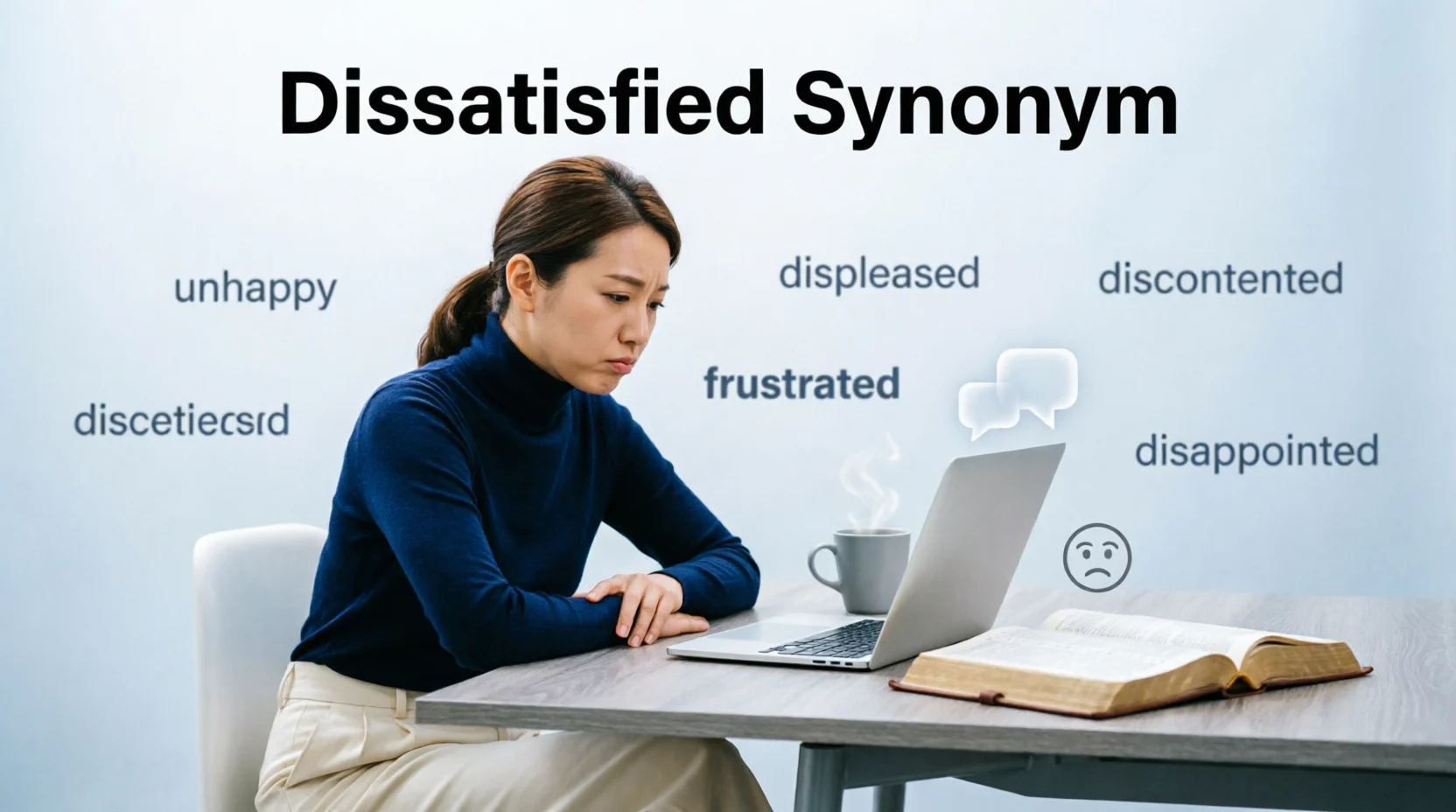
Looking for a dissatisfied synonym? Useful alternatives include unhappy, discontented, displeased, unsatisfied, frustrated, disappointed, discontent, disgruntled, displeased, and dissatisfied itself. However, these words are not always interchangeable. Some describe a general lack of satisfaction, while others express annoyance, disappointment, frustration, or resentment.
Choosing the right synonym depends on what caused the negative feeling and how strongly you want to express it. This guide explains 30 alternatives with simple meanings, examples, and practical usage advice.
Quick Answer: What Is a Good Synonym for Dissatisfied?
The best general synonyms for dissatisfied are unhappy, discontented, unsatisfied, displeased, and disgruntled.
- Unhappy — simple and broad
- Discontented — unhappy because something does not meet expectations
- Unsatisfied — not having received enough or not having one’s needs met
- Displeased — formally unhappy or annoyed about something
- Disgruntled — annoyed because of poor treatment or an unsatisfactory situation
- Disappointed — unhappy because reality was worse than expected
- Frustrated — upset because something is difficult, blocked, or unsuccessful
- Dissatisfied — a neutral, direct term for lacking satisfaction
The best choice depends on whether you want to emphasize unhappiness, unmet expectations, annoyance, disappointment, frustration, or resentment.
What Does Dissatisfied Mean?
Dissatisfied means unhappy because something did not meet your expectations, needs, wishes, or standards.
For example:
The customer was dissatisfied with the quality of the product.
This means the customer expected better quality and was not pleased with what they received.
The word can describe people, customers, employees, results, services, experiences, or situations.
Dissatisfied in Different Contexts
At work:
“She was dissatisfied with her current position.”
With a product:
“The buyer was dissatisfied with the phone’s battery life.”
With a service:
“Several guests were dissatisfied with the slow service.”
With a result:
“He was dissatisfied with his exam performance.”
With personal circumstances:
“She felt dissatisfied with the direction of her career.”
The word is usually stronger and more specific than simply saying something is “not good.” It indicates that a person expected or wanted something better.
30 Synonyms for Dissatisfied
1. Unhappy
Simple meaning: Not pleased or feeling bad about something.
Example sentence:
“The customer was unhappy with the service.”
Best usage/context:
Use unhappy in everyday English when you want a simple, natural alternative to dissatisfied.
2. Discontented
Simple meaning: Not satisfied with a situation or condition.
Example sentence:
“The employees became discontented with the new workplace rules.”
Best usage/context:
Use discontented when someone has an ongoing feeling that their circumstances are not good enough.
3. Unsatisfied
Simple meaning: Not satisfied because a need, desire, or expectation has not been met.
Example sentence:
“She was unsatisfied with the explanation.”
Best usage/context:
Use unsatisfied for needs, expectations, requirements, or results that remain incomplete or inadequate.
4. Displeased
Simple meaning: Feeling unhappy or annoyed about something.
Example sentence:
“The manager was displeased with the team’s performance.”
Best usage/context:
Use displeased in formal, professional, or polite contexts.
5. Disgruntled
Simple meaning: Annoyed or dissatisfied, especially because of poor treatment or conditions.
Example sentence:
“Several disgruntled employees complained about the policy.”
Best usage/context:
Use disgruntled when dissatisfaction has developed into noticeable annoyance or resentment.
6. Disappointed
Simple meaning: Unhappy because something was not as good as expected.
Example sentence:
“She was disappointed by the final result.”
Best usage/context:
Use disappointed when there is a clear difference between expectations and reality.
7. Frustrated
Simple meaning: Upset because something is difficult, blocked, delayed, or unsuccessful.
Example sentence:
“He felt frustrated by the repeated technical problems.”
Best usage/context:
Use frustrated when the problem involves obstacles, failure, delay, or inability to achieve something.
8. Discontent
Simple meaning: A feeling of dissatisfaction with a situation.
Example sentence:
“There was growing discontent among the workers.”
Best usage/context:
Use discontent as a noun, especially when discussing dissatisfaction shared by a group.
9. Dissatisfied
Simple meaning: Not satisfied or pleased with something.
Example sentence:
“The client was dissatisfied with the final design.”
Best usage/context:
Use dissatisfied when you want the clearest and most direct expression.
10. Unfulfilled
Simple meaning: Not achieved, completed, or satisfied.
Example sentence:
“He felt unfulfilled in his current career.”
Best usage/context:
Use unfulfilled for desires, ambitions, goals, expectations, or personal experiences that have not provided the hoped-for satisfaction.
11. Aggrieved
Simple meaning: Feeling that you have been treated unfairly.
Example sentence:
“The aggrieved employee requested a formal review.”
Best usage/context:
Use aggrieved when dissatisfaction comes from perceived unfairness or mistreatment.
12. Resentful
Simple meaning: Angry or bitter because of unfair treatment or disappointment.
Example sentence:
“She became resentful after being repeatedly overlooked for promotion.”
Best usage/context:
Use resentful when dissatisfaction has developed into lasting bitterness or anger.
13. Irritated
Simple meaning: Slightly angry or annoyed.
Example sentence:
“He was irritated by the constant interruptions.”
Best usage/context:
Use irritated when dissatisfaction produces mild or moderate annoyance.
14. Annoyed
Simple meaning: Slightly angry because something bothers you.
Example sentence:
“The customer was annoyed by the long waiting time.”
Best usage/context:
Use annoyed for everyday situations involving inconvenience, interruptions, or irritating behavior.
15. Perturbed
Simple meaning: Worried, disturbed, or upset.
Example sentence:
“She was perturbed by the unexpected change.”
Best usage/context:
Use perturbed in more formal writing when dissatisfaction is mixed with concern or disturbance.
16. Disenchanted
Simple meaning: No longer impressed, hopeful, or enthusiastic about something.
Example sentence:
“Many readers became disenchanted with the series after several disappointing releases.”
Best usage/context:
Use disenchanted when someone’s positive belief or enthusiasm has gradually disappeared.
17. Disillusioned
Simple meaning: Disappointed after discovering that something is not as good or ideal as believed.
Example sentence:
“He became disillusioned with the organization after seeing how it operated.”
Best usage/context:
Use disillusioned for a deeper loss of trust or idealism.
18. Critical
Simple meaning: Expressing negative judgments about something.
Example sentence:
“The reviewer was critical of the restaurant’s service.”
Best usage/context:
Use critical when dissatisfaction is expressed through evaluation, judgment, or criticism.
19. Complaining
Simple meaning: Frequently expressing dissatisfaction or annoyance.
Example sentence:
“The complaining customer asked to speak with the manager.”
Best usage/context:
Use complaining when the important point is that someone openly expresses dissatisfaction.
20. Restless
Simple meaning: Unable to feel comfortable or satisfied with a current situation.
Example sentence:
“She felt restless in her routine job and wanted a new challenge.”
Best usage/context:
Use restless when dissatisfaction creates a desire for change, movement, or something different.
21. Impatient
Simple meaning: Annoyed because something is taking too long.
Example sentence:
“The passengers became impatient after the flight was delayed.”
Best usage/context:
Use impatient when dissatisfaction is connected to waiting or delay.
22. Malcontent
Simple meaning: A person who is dissatisfied with an existing situation or authority.
Example sentence:
“The political leader faced several malcontents within the organization.”
Best usage/context:
Use malcontent mainly in formal, literary, historical, or political contexts.
23. Peeved
Simple meaning: Slightly annoyed or irritated.
Example sentence:
“She was peeved when her colleague canceled the meeting without warning.”
Best usage/context:
Use peeved in informal English for relatively minor annoyance.
24. Miffed
Simple meaning: Slightly annoyed or offended.
Example sentence:
“He was miffed that nobody had told him about the schedule change.”
Best usage/context:
Use miffed in casual conversation when the dissatisfaction is relatively mild.
25. Sour
Simple meaning: Negative, bitter, or unfriendly because of dissatisfaction.
Example sentence:
“The disagreement left him with a sour attitude toward the project.”
Best usage/context:
Use sour when dissatisfaction has affected someone’s mood, attitude, or relationship.
26. Bitter
Simple meaning: Very unhappy and angry because of something perceived as unfair or hurtful.
Example sentence:
“She felt bitter after years of being ignored at work.”
Best usage/context:
Use bitter for strong, lasting resentment rather than ordinary dissatisfaction.
27. Unimpressed
Simple meaning: Not impressed or excited by something.
Example sentence:
“The audience was unimpressed by the presentation.”
Best usage/context:
Use unimpressed when something fails to create the positive reaction someone expected.
28. Disapproving
Simple meaning: Showing that you think something is wrong or unacceptable.
Example sentence:
“Her disapproving expression showed that she disliked the decision.”
Best usage/context:
Use disapproving when dissatisfaction is connected to judgment or rejection.
29. Unenthusiastic
Simple meaning: Not excited, interested, or eager.
Example sentence:
“The students were unenthusiastic about the proposed activity.”
Best usage/context:
Use unenthusiastic when dissatisfaction appears as a lack of excitement rather than direct anger.
30. Agitated
Simple meaning: Very upset, restless, or emotionally disturbed.
Example sentence:
“The dissatisfied customers became agitated after waiting for several hours.”
Best usage/context:
Use agitated when dissatisfaction has become visibly intense or emotionally charged.
Dissatisfied Synonyms Comparison Table
| Synonym | Main Meaning | Strength | Best Context |
| Unhappy | Not pleased | Mild | Everyday English |
| Discontented | Ongoing dissatisfaction | Moderate | Life, work, society |
| Unsatisfied | Needs not met | Mild–Moderate | Expectations and needs |
| Displeased | Unhappy or annoyed | Moderate | Formal situations |
| Disgruntled | Annoyed dissatisfaction | Moderate–Strong | Work and complaints |
| Disappointed | Expectations not met | Moderate | Results and experiences |
| Frustrated | Blocked or unsuccessful | Moderate | Problems and obstacles |
| Resentful | Bitter about unfairness | Strong | Relationships and work |
| Irritated | Mild anger | Mild | Everyday situations |
| Disillusioned | Lost idealism | Strong | Beliefs and institutions |
| Unfulfilled | Desires not realized | Moderate | Goals and personal life |
| Aggrieved | Feels unfairly treated | Strong | Formal complaints |
| Disenchanted | Lost enthusiasm | Moderate | People, ideas, experiences |
| Bitter | Deep resentment | Strong | Long-term disappointment |
| Unimpressed | Not impressed | Mild | Performances and products |
| Peeved | Slightly annoyed | Mild | Informal conversation |
| Miffed | Slightly offended | Mild | Casual situations |
| Agitated | Highly upset | Strong | Emotional situations |
Dissatisfied vs. Unsatisfied
Dissatisfied and unsatisfied are very close, but they often emphasize different ideas.
Dissatisfied usually describes a person’s negative reaction to something that did not meet expectations.
“The customer was dissatisfied with the service.”
Unsatisfied can focus more directly on an unmet need, requirement, desire, or condition.
“The demand for additional information remained unsatisfied.”
In everyday writing, the two words can often be used interchangeably.
Dissatisfied vs. Disappointed
These words are related but not identical.
Dissatisfied means something does not provide enough satisfaction.
Disappointed means something turned out worse than expected.
For example:
“I am dissatisfied with the quality of the meal.”
This focuses on the quality.
“I am disappointed because I expected the meal to be better.”
This focuses on the gap between expectation and reality.
Dissatisfied vs. Disgruntled
Disgruntled is generally more emotionally charged than dissatisfied.
A dissatisfied employee may simply want better working conditions. A disgruntled employee may be openly annoyed, resentful, or critical.
“The employee was dissatisfied with the salary.”
“The disgruntled employee complained publicly about the company’s policies.”
Dissatisfied vs. Frustrated
Frustrated usually involves an obstacle or failure.
“She was frustrated because the software kept crashing.”
Dissatisfied focuses more broadly on a lack of satisfaction.
“She was dissatisfied with the software’s overall performance.”
A person can therefore be both dissatisfied and frustrated, but the words highlight different aspects of the experience.
Dissatisfied vs. Unhappy
Unhappy is broader and more natural in casual conversation.
“I’m unhappy with the decision.”
Dissatisfied sounds more precise and is especially common in professional, customer-service, workplace, and formal contexts.
“The client was dissatisfied with the proposed solution.”
How to Choose the Right Dissatisfied Synonym
The best synonym depends on your tone, meaning, and intent.
For Everyday Conversation
Choose:
- Unhappy
- Annoyed
- Irritated
- Peeved
- Miffed
These words sound natural in casual conversations.
Example:
“I was annoyed by the delay.”
For Formal or Professional Writing
Choose:
- Dissatisfied
- Displeased
- Discontented
- Aggrieved
- Critical
These alternatives work well in reports, business communication, reviews, and formal complaints.
Example:
“The client was displeased with the proposed changes.”
When Expectations Were Not Met
Choose:
- Disappointed
- Unsatisfied
- Dissatisfied
- Unimpressed
These words work when someone expected a better result.
Example:
“The audience was disappointed by the ending.”
When Something Is Blocking Progress
Choose:
- Frustrated
- Impatient
- Agitated
These words are appropriate when delays, obstacles, or repeated problems are causing emotional distress.
Example:
“Customers became frustrated after the system stopped working.”
When Someone Feels Treated Unfairly
Choose:
- Aggrieved
- Resentful
- Bitter
- Disgruntled
These terms suggest that the dissatisfaction is connected to unfair treatment or perceived injustice.
Example:
“She became resentful after being repeatedly excluded from important meetings.”
When Someone Has Lost Faith or Enthusiasm
Choose:
- Disillusioned
- Disenchanted
- Unenthusiastic
- Unfulfilled
These words are useful when dissatisfaction develops gradually.
Example:
“He became disillusioned with the organization after several broken promises.”
Common Usage Mistakes
1. Treating Every Synonym as Identical
Words such as disappointed, frustrated, resentful, and unhappy overlap with dissatisfied, but they emphasize different emotions.
Always consider the reason behind the dissatisfaction.
2. Using “Disappointed” for Every Complaint
Disappointed usually involves an expectation that was not met.
If someone simply dislikes a service, dissatisfied may be more accurate.
3. Using “Disgruntled” for Mild Discomfort
Disgruntled often suggests noticeable annoyance or resentment. It may sound too strong for a minor inconvenience.
For example, “I was peeved by the five-minute delay” may sound more natural than “I was disgruntled by the five-minute delay.”
4. Confusing “Unsatisfied” With “Dissatisfying”
Unsatisfied describes a person or their state.
“The customer was unsatisfied.”
Dissatisfying describes something that causes a lack of satisfaction.
“The experience was dissatisfying.”
5. Using Informal Words in Formal Writing
Words such as miffed and peeved are useful in casual English but may sound inappropriate in a formal report.
In professional writing, consider dissatisfied, displeased, discontented, or disappointed.
6. Choosing a Strong Word When a Mild One Is Better
Bitter, resentful, and agitated suggest stronger emotions than unhappy or dissatisfied.
Choose the word that accurately reflects the person’s emotional intensity.
FAQs:
What is the closest synonym for dissatisfied?
The closest general synonyms are unsatisfied, discontented, unhappy, and displeased. The best choice depends on the sentence and context.
What is a professional synonym for dissatisfied?
Displeased, discontented, unsatisfied, and dissatisfied itself are useful in professional communication. “Displeased” can sound particularly formal and polite.
What is a strong synonym for dissatisfied?
Disgruntled, resentful, bitter, aggrieved, and agitated can express stronger forms of dissatisfaction, although each emphasizes a different emotion.
Is unhappy a synonym for dissatisfied?
Yes. Unhappy can mean dissatisfied, especially in everyday English. However, unhappy is broader and can describe sadness or general emotional unhappiness as well.
Is disappointed the same as dissatisfied?
Not exactly. Disappointed emphasizes that expectations were not met, while dissatisfied emphasizes a lack of satisfaction.
What is the difference between dissatisfied and discontented?
Dissatisfied often describes a specific reaction to something, while discontented can suggest a more general or continuing feeling that one’s circumstances are inadequate.
What is the opposite of dissatisfied?
Common opposites include satisfied, content, pleased, happy, fulfilled, and delighted. The best opposite depends on the original context.
Can dissatisfied describe a person?
Yes. For example: “The customer was dissatisfied with the service.” It can also describe a person’s attitude or response toward a particular situation.
Conclusion
The best dissatisfied synonym depends on exactly what you want to communicate. Unhappy is simple and conversational, displeased is more formal, disappointed highlights unmet expectations, and frustrated focuses on obstacles or failure.
For stronger emotions, disgruntled, resentful, bitter, aggrieved, or agitated may be appropriate. If someone has lost faith or enthusiasm, disillusioned or disenchanted can communicate that deeper change.
Understanding these differences helps you choose words that are more precise, natural, and effective. Instead of replacing “dissatisfied” with any random synonym, first identify the emotion behind the dissatisfaction and then select the word that communicates it most accurately.

I am Camden Thomas, an Administrator at SaysReply. I help maintain our platform and ensure readers find clear, natural, and useful alternative ways to express their thoughts every day.






3 thoughts on “Dissatisfied Synonym: 30 Better Words for Different Situations”