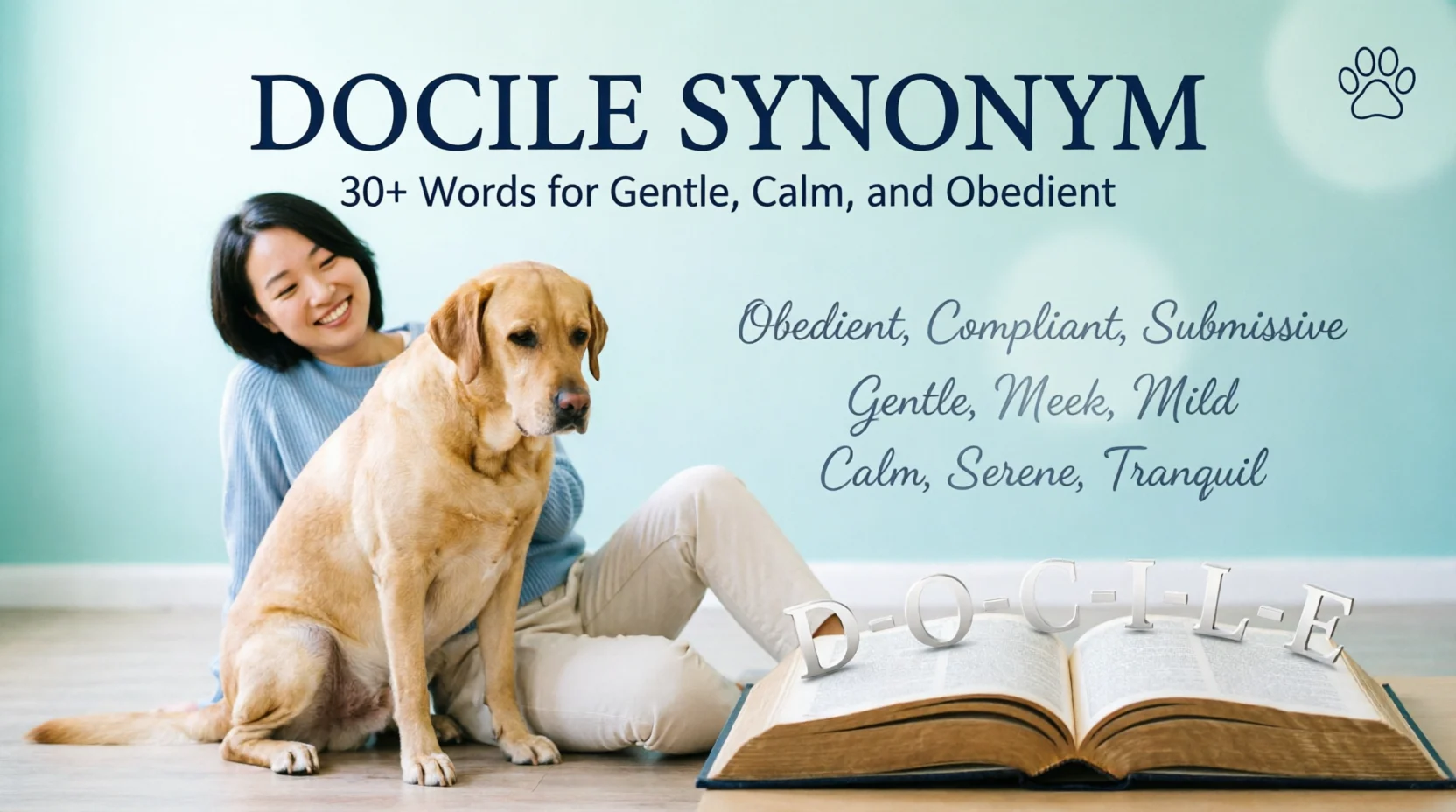
The word docile describes someone or something that is calm, easy to manage, and willing to follow instructions. Common docile synonyms include obedient, gentle, compliant, submissive, mild, and meek. However, each word carries a slightly different meaning, tone, or emotional impression.
If you are writing an essay, improving your English vocabulary, describing an animal, or discussing someone’s personality, choosing the right synonym for docile helps you express your meaning accurately. Some alternatives sound positive and friendly, while others suggest excessive obedience or a lack of independence.
Quick Answer: What Is a Synonym for Docile?
The best synonyms for docile include:
- Obedient: Willing to follow instructions or rules.
- Gentle: Calm, kind, and unlikely to cause harm.
- Compliant: Willing to follow requests, rules, or requirements.
- Submissive: Willing to accept another person’s authority.
- Meek: Quiet, humble, and not likely to argue.
- Mild: Gentle in behavior, manner, or temperament.
- Manageable: Easy to control or handle.
- Tractable: Easy to guide, train, or control.
Best overall choice: Use gentle when you want a warm, positive meaning, obedient when you mean following instructions, and compliant in formal or professional contexts.
What Does Docile Mean?
Docile is an adjective that describes a person or animal that is easy to manage, teach, or control because they are calm and willing to follow direction.
For example, a docile dog may respond peacefully to training, while a docile student may listen carefully to a teacher’s instructions.
The word can have a positive or negative tone depending on context. It may describe a gentle temperament, but it can also suggest that someone follows others without questioning their authority.
How Is Docile Used in a Sentence?
Here are three examples that show its different uses:
- Animals: The horse was docile and allowed the children to approach it.
- People: The new employee was docile and followed the manager’s instructions.
- General behavior: The usually energetic dog became docile after a long walk.
Is Docile Positive or Negative?
Docile is generally neutral, but its tone depends on the situation.
- Positive: It suggests gentleness, patience, and an easygoing temperament.
- Neutral: It describes someone or something that is easy to manage.
- Negative: It may imply passivity, excessive obedience, or a lack of independence.
For example, calling a horse docile is usually a compliment. Calling a person docile may sound critical if it suggests that they never express their own opinions.
30 Synonyms for Docile With Meanings and Examples
The following alternatives will help you describe gentle behavior, obedience, cooperation, and willingness to follow direction.
1. Obedient
Simple meaning: Willing to follow rules, orders, or instructions.
Example: The obedient puppy sat when its owner gave the command.
Best usage/context: Use when someone follows instructions or respects authority. It is especially common when describing children, pets, students, or employees.
2. Gentle
Simple meaning: Kind, calm, and not rough or aggressive.
Example: The gentle horse allowed the young rider to brush its coat.
Best usage/context: Best when you want a positive description of a person’s character, an animal’s temperament, or someone’s manner.
3. Compliant
Simple meaning: Willing to follow instructions, rules, or requests.
Example: The compliant employee completed the required training.
Best usage/context: Suitable for professional, legal, medical, and administrative contexts. It emphasizes following requirements rather than being naturally gentle.
4. Submissive
Simple meaning: Willing to let another person take control or make decisions.
Example: He adopted a submissive attitude during the disagreement.
Best usage/context: Use when describing relationships involving authority, power, or control. It can suggest a lack of assertiveness.
5. Meek
Simple meaning: Quiet, humble, and unlikely to argue or demand attention.
Example: The meek young man rarely challenged anyone’s opinion.
Best usage/context: Appropriate for describing a quiet personality. It may sound critical when it suggests excessive timidity or weakness.
6. Mild
Simple meaning: Gentle, calm, or not severe.
Example: The dog had a mild temperament and rarely barked at strangers.
Best usage/context: Use for personalities, behavior, reactions, and temperaments that are not harsh or aggressive.
7. Manageable
Simple meaning: Easy to handle, control, or deal with.
Example: With regular training, the energetic puppy became more manageable.
Best usage/context: Best when emphasizing ease of handling rather than obedience or personality.
8. Tractable
Simple meaning: Easy to guide, teach, or control.
Example: The tractable horse learned the new routine quickly.
Best usage/context: A more formal synonym, particularly useful for animals, learners, materials, or situations that respond well to guidance.
9. Docile-minded
Simple meaning: Inclined to accept direction without much resistance.
Example: The character was portrayed as docile-minded and reluctant to disagree.
Best usage/context: An uncommon expression that may sound awkward in everyday English. Prefer compliant, submissive, or easily influenced when those meanings are intended.
10. Tame
Simple meaning: Accustomed to people and no longer wild or difficult to handle.
Example: The tame rabbit calmly accepted food from the keeper.
Best usage/context: Best for animals that have become accustomed to human contact. Figuratively, it can describe behavior that seems restrained or lacking excitement.
11. Passive
Simple meaning: Not taking action or resisting what others do.
Example: He remained passive while the group made its decision.
Best usage/context: Use when someone does not actively respond, lead, or resist. Unlike docile, it does not necessarily mean that the person is easy to train.
12. Acquiescent
Simple meaning: Willing to accept something without protest.
Example: She was acquiescent when the team agreed to change the schedule.
Best usage/context: Suitable for formal writing about agreement, acceptance, or a lack of opposition.
13. Yielding
Simple meaning: Willing to give way or accept another person’s wishes.
Example: His yielding nature helped him avoid unnecessary arguments.
Best usage/context: Use when someone gives in during disagreements or allows others to take the lead.
14. Mild-mannered
Simple meaning: Calm, gentle, and not easily angered.
Example: Our mild-mannered neighbor always speaks politely.
Best usage/context: Ideal for describing a person’s usual behavior, especially when emphasizing kindness and a calm temperament.
15. Peaceable
Simple meaning: Peaceful and unlikely to fight or cause conflict.
Example: The peaceable dog lived comfortably with other pets.
Best usage/context: Useful for people, animals, and groups that avoid aggression or conflict.
16. Amiable
Simple meaning: Friendly, pleasant, and easy to like.
Example: The amiable teacher made every student feel welcome.
Best usage/context: Choose this word when you want to emphasize friendliness rather than obedience or controllability.
17. Agreeable
Simple meaning: Pleasant or willing to agree with others.
Example: He was agreeable and accepted the group’s suggestion.
Best usage/context: Suitable for cooperative personalities, pleasant interactions, and situations in which people readily accept proposals.
18. Cooperative
Simple meaning: Willing to work with others toward a shared goal.
Example: The cooperative child helped organize the classroom.
Best usage/context: Best when describing teamwork, assistance, and a willingness to participate. It is more active and positive than passive.
19. Compliant-minded
Simple meaning: Inclined to follow requirements or instructions.
Example: The training program encouraged compliant-minded behavior among new recruits.
Best usage/context: An uncommon phrase. In most cases, compliant or willing to follow instructions sounds more natural.
20. Pliant
Simple meaning: Easily bent, influenced, or guided.
Example: The pliant young apprentice accepted advice from the experienced craftsperson.
Best usage/context: Useful in formal or literary writing. When applied to people, it can imply that they are easily influenced.
21. Amenable
Simple meaning: Willing to agree, cooperate, or accept suggestions.
Example: The manager was amenable to changing the meeting time.
Best usage/context: Particularly useful in professional communication and negotiations. It emphasizes openness to suggestions rather than unquestioning obedience.
22. Unresisting
Simple meaning: Not resisting or opposing something.
Example: The unresisting animal allowed the veterinarian to examine its leg.
Best usage/context: Use when emphasizing an absence of resistance. It does not necessarily mean that someone is friendly or naturally gentle.
23. Composed
Simple meaning: Calm and in control of one’s emotions.
Example: She remained composed while answering difficult questions.
Best usage/context: Best for calm behavior under pressure. Unlike docile, it does not imply that someone follows another person’s instructions.
24. Temperate
Simple meaning: Moderate, restrained, or not extreme.
Example: His temperate response prevented the discussion from becoming heated.
Best usage/context: Suitable for formal writing about behavior, reactions, or habits that remain moderate and controlled.
25. Unaggressive
Simple meaning: Not inclined to attack, threaten, or confront others.
Example: The unaggressive dog showed no signs of hostility toward visitors.
Best usage/context: Useful when describing nonviolent or nonconfrontational behavior. It does not necessarily imply obedience.
26. Inoffensive
Simple meaning: Not likely to upset, offend, or bother others.
Example: The inoffensive remark helped keep the conversation friendly.
Best usage/context: Best for comments, behavior, and actions that do not cause offense. It is not a direct synonym for being easy to control.
27. Subdued
Simple meaning: Quiet, restrained, or less energetic than usual.
Example: The usually playful dog was subdued after a busy day.
Best usage/context: Use when describing reduced energy, quiet behavior, or restrained emotions. It may describe a temporary state rather than a lasting personality trait.
28. Unassuming
Simple meaning: Modest and not trying to attract attention.
Example: The unassuming student accepted the award without boasting.
Best usage/context: Suitable for humble people who do not seek attention. It describes modesty rather than obedience.
29. Easygoing
Simple meaning: Relaxed, flexible, and not easily upset.
Example: Our easygoing coach listened patiently to different opinions.
Best usage/context: An excellent everyday alternative when describing someone who is relaxed, tolerant, and pleasant to work with.
30. Trainable
Simple meaning: Able to learn instructions, skills, or expected behaviors.
Example: The puppy was intelligent, friendly, and highly trainable.
Best usage/context: Particularly appropriate for animals, students, and people learning new skills. It emphasizes the ability to learn rather than an existing willingness to obey.
Comparison Table: Which Docile Synonym Should You Use?
| Synonym | Main meaning | Tone | Best context |
| Obedient | Follows instructions | Neutral | Rules and authority |
| Gentle | Kind and calm | Positive | People and animals |
| Compliant | Follows requirements | Formal | Work and procedures |
| Submissive | Accepts another’s control | Often negative | Power relationships |
| Meek | Quiet and humble | Mixed | Personality |
| Mild | Not harsh or aggressive | Positive | Temperament |
| Manageable | Easy to handle | Neutral | Tasks and animals |
| Tractable | Easy to guide or train | Formal | Training and behavior |
| Tame | Accustomed to people | Neutral | Animals |
| Passive | Does not take action | Often negative | Behavior and decisions |
| Acquiescent | Accepts without protest | Formal | Agreement |
| Yielding | Gives way to others | Mixed | Disagreements |
| Mild-mannered | Calm and gentle | Positive | Personality |
| Peaceable | Avoids conflict | Positive | People and animals |
| Amiable | Friendly and pleasant | Positive | Social situations |
| Agreeable | Pleasant or willing to agree | Positive | Cooperation |
| Cooperative | Works well with others | Positive | Teamwork |
| Pliant | Easily influenced | Mixed | Formal descriptions |
| Amenable | Open to suggestions | Positive | Negotiations |
| Composed | Calm under pressure | Positive | Emotional control |
| Temperate | Moderate and restrained | Formal | Reactions and habits |
| Unaggressive | Not confrontational | Neutral | Behavior |
| Inoffensive | Not upsetting to others | Neutral | Speech and conduct |
| Subdued | Quiet or less energetic | Mixed | Mood and behavior |
| Unassuming | Modest and unobtrusive | Positive | Personality |
| Easygoing | Relaxed and flexible | Positive | Everyday descriptions |
| Trainable | Able to learn | Positive | Education and animals |
How to Choose the Right Synonym for Docile
The most accurate synonym depends on the quality you want to emphasize.
1. Choose by Tone
Positive and friendly: Use gentle, amiable, peaceable, easygoing, or mild-mannered.
Example: The gentle dog was comfortable around children.
Neutral and descriptive: Choose manageable, obedient, tame, or trainable.
Example: The trainable puppy quickly learned basic commands.
Formal and professional: Consider compliant, amenable, acquiescent, or tractable.
Example: The team was amenable to the proposed changes.
Critical or negative: Use submissive, meek, or passive when the context genuinely suggests a lack of independence or resistance.
Example: His passive response prevented him from defending his position.
2. Choose by Meaning
- Willing to follow rules: Obedient, compliant, acquiescent.
- Naturally calm and kind: Gentle, mild, mild-mannered.
- Easy to train or control: Tractable, manageable, trainable.
- Willing to accept authority: Submissive, yielding, pliant.
- Friendly and pleasant: Amiable, agreeable, easygoing.
- Unlikely to fight: Peaceable, unaggressive, inoffensive.
- Calm under pressure: Composed, temperate.
- Quiet or inactive: Passive, subdued.
3. Choose by Intent
If you are describing an animal’s temperament, use gentle, tame, peaceable, or tractable, depending on the situation.
If you are describing a person who follows instructions, use obedient or compliant.
If you want to describe a friendly personality, use amiable, agreeable, or easygoing.
If you are describing someone who rarely challenges authority, use submissive or meek when that implication is intended.
If you want to emphasize openness to suggestions, use amenable.
Common Mistakes When Using Docile Synonyms
1. Confusing Docile With Obedient
Although these words overlap, docile often describes a general temperament, while obedient emphasizes following commands or rules.
- Docile: The docile horse remained calm around visitors.
- Obedient: The obedient horse followed the rider’s commands.
2. Using Submissive as a Positive Synonym Every Time
Submissive often suggests accepting another person’s authority or giving up control. It can sound negative when describing a person.
Instead of saying, “She is submissive and helpful,” consider “She is cooperative and helpful” if you mean that she works well with others.
3. Confusing Gentle With Passive
A gentle person can still be confident, independent, and assertive. A passive person may avoid taking action or expressing disagreement.
Use gentle for kindness and passive for limited action or resistance.
4. Using Compliant When You Mean Friendly
A compliant person follows rules or requirements, but that does not necessarily mean they are warm or pleasant.
If you want to describe friendliness, amiable or agreeable may be more accurate.
5. Treating Docile and Trainable as Identical
A docile animal is generally calm and easy to handle. A trainable animal is capable of learning and responding to training. An animal can be trainable without being naturally docile.
FAQs:
1. What is the best synonym for docile?
Gentle is an excellent choice when describing a calm and kind temperament. Obedient is better when you mean following instructions, while compliant suits formal situations.
2. What is the opposite of docile?
Common antonyms include aggressive, unruly, defiant, rebellious, stubborn, and unmanageable. The best opposite depends on whether you mean unwillingness to obey, difficulty controlling behavior, or hostility.
3. Is docile a positive or negative word?
Docile is generally neutral. It can be positive when describing a gentle animal or calm personality, but negative when it suggests excessive obedience or a lack of independence.
4. What is a synonym for docile in animals?
Common choices include gentle, tame, obedient, tractable, and manageable. Use tame when emphasizing familiarity with people and tractable when emphasizing ease of training or control.
5. What is a formal word for docile?
Tractable, compliant, acquiescent, and amenable are useful formal alternatives. Their meanings differ: tractable emphasizes ease of guidance, while amenable emphasizes willingness to accept suggestions.
6. What is a synonym for docile in a person?
Depending on the intended meaning, use gentle, mild-mannered, obedient, cooperative, meek, or easygoing. Choose a word that reflects the person’s actual behavior rather than assuming that calmness means weakness.
7. What is the difference between docile and submissive?
Docile generally describes someone who is calm and easy to guide or manage. Submissive more specifically suggests accepting another person’s control or authority. A docile person does not necessarily lack confidence or independence.
8. Can docile be used to describe children?
Yes. Docile can describe children who are calm and easy to guide. However, cooperative, gentle, or well-behaved may sound more natural when you want to emphasize positive behavior without implying unquestioning obedience.
Conclusion
The best docile synonym depends on the meaning you want to convey. Choose gentle for kindness, obedient for following instructions, compliant for meeting requirements, and tractable for being easy to guide or train.
Words such as submissive and meek carry stronger implications about authority and independence, so use them carefully. By understanding these differences, you can describe people’s personalities, animal behavior, and willingness to cooperate with greater clarity and confidence.

I am Camden Thomas, an Administrator at SaysReply. I help maintain our platform and ensure readers find clear, natural, and useful alternative ways to express their thoughts every day.