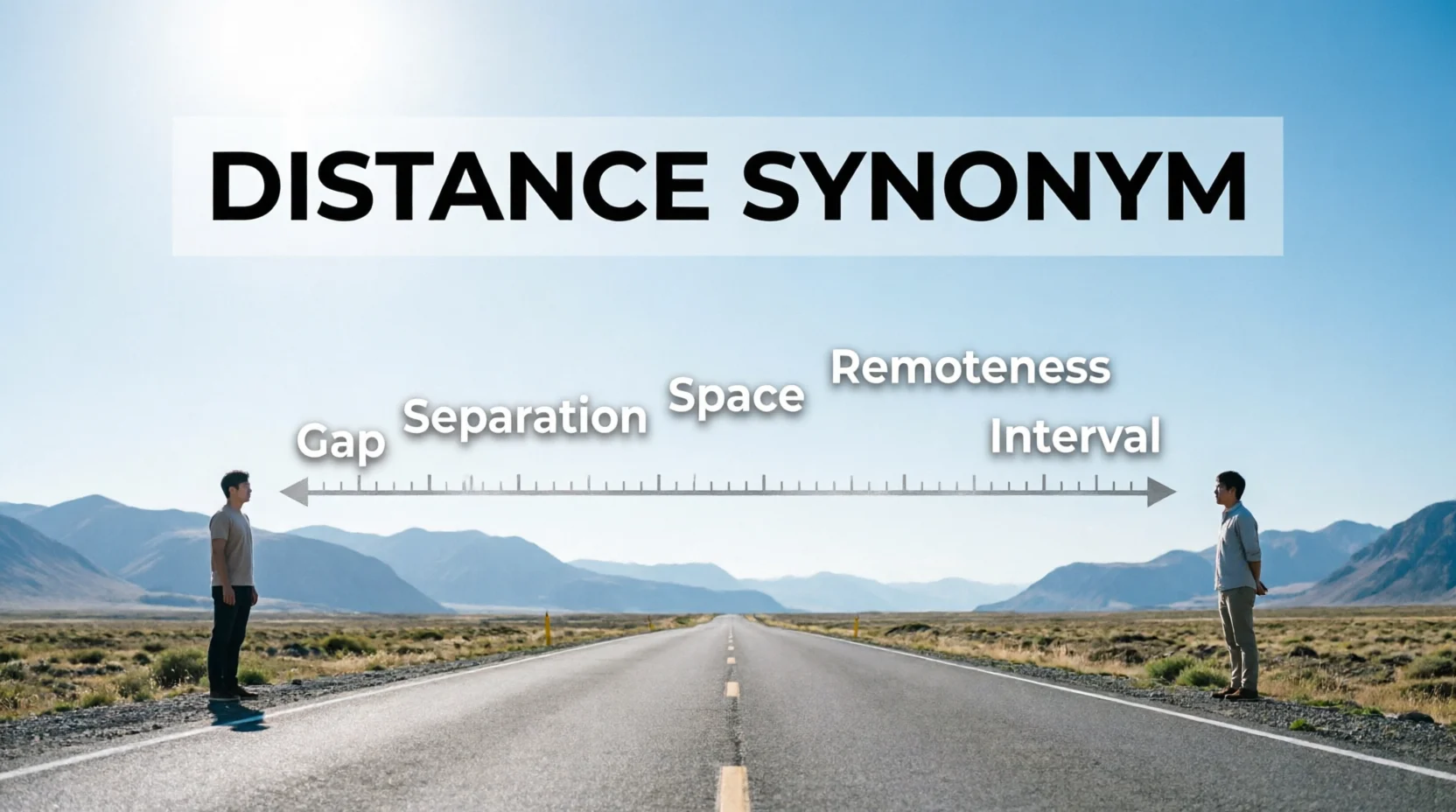
The word distance describes the space between two places, people, or things. It can also refer to emotional separation, differences in relationships, or the amount of progress between two points. Choosing the right distance synonym depends on what you want to express, whether you are discussing physical space, social relationships, or figurative differences.
Writers, students, and English learners can use alternatives such as gap, separation, space, interval, and remoteness to make their sentences clearer and more expressive. Although these words share similar meanings, each has a specific use.
Quick Answer: What Is Another Word for Distance?
The best synonyms for distance include gap, separation, space, interval, remoteness, length, range, span, expanse, and stretch.
- Gap: An empty space or difference between two things.
- Separation: The state of being apart.
- Space: The area between or around objects.
- Interval: The space or period between two points or events.
- Remoteness: The quality of being far away.
- Length: The measurement of something from end to end.
- Range: The extent between limits or points.
- Span: The total extent or distance covered.
For physical measurements, length or mileage may be appropriate. For emotional separation, estrangement or detachment may fit better. For differences between ideas or abilities, gap or divide can communicate the meaning more precisely.
What Does Distance Mean?
Distance is the amount of space between two points, places, objects, or people. It can be measured in units such as meters, kilometers, miles, or feet.
The word also has figurative meanings. For example, emotional distance describes a lack of closeness between people, while a distance between opinions refers to a difference in beliefs or perspectives.
Different Types of Distance
1. Physical distance: The measurable space between locations or objects.
Example: The distance between the school and the library is two kilometers.
2. Emotional distance: A lack of emotional closeness, trust, or connection.
Example: Their friendship developed emotional distance after the disagreement.
3. Social distance: The degree of separation between individuals or groups.
Example: The new community project helped reduce social distance.
4. Figurative distance: A difference between ideas, achievements, opinions, or goals.
Example: There is still a considerable distance between the team’s current performance and its target.
30 Synonyms for Distance With Meanings and Examples
The following words offer useful alternatives to distance. Some describe physical space, while others express separation, remoteness, differences, or figurative gaps.
1. Gap
Simple meaning: An empty space or difference between two things.
Example: There is a small gap between the two buildings.
Best usage/context: Use gap for physical openings, differences in knowledge, unequal opportunities, or differences between expectations and reality.
2. Separation
Simple meaning: The state of being apart from someone or something.
Example: The separation between the two towns makes daily travel difficult.
Best usage/context: Suitable for physical divisions, relationships, family situations, and the act of keeping things apart.
3. Space
Simple meaning: An area between or around people or objects.
Example: Leave some space between the chairs.
Best usage/context: Use space for physical room, personal boundaries, and situations where people need time or privacy.
4. Interval
Simple meaning: The space or period between two points or events.
Example: The houses are separated by a short interval of open land.
Best usage/context: Appropriate for measured spaces, time periods, mathematical discussions, and regularly occurring events.
5. Remoteness
Simple meaning: The quality of being far away from other places.
Example: The remoteness of the village makes transportation challenging.
Best usage/context: Best for isolated locations, distant areas, and figurative descriptions of something difficult to access.
6. Length
Simple meaning: The measurement from one end of something to the other.
Example: We measured the length between the two markers.
Best usage/context: Use when discussing measurable dimensions, routes, journeys, or the extent of a physical object.
7. Range
Simple meaning: The extent between two limits or the area something covers.
Example: The mountain range extends for hundreds of kilometers.
Best usage/context: Suitable for geographical coverage, measurable limits, prices, abilities, and the reach of something.
8. Span
Simple meaning: The total extent or length of something.
Example: The bridge spans the distance between the two riverbanks.
Best usage/context: Use for physical stretches, time periods, geographical coverage, and the extent of a person’s experience.
9. Expanse
Simple meaning: A large, open area of land, water, or space.
Example: A vast expanse of desert lay before us.
Best usage/context: Best for describing broad landscapes, open spaces, oceans, fields, and large areas.
10. Stretch
Simple meaning: A continuous length or section of something.
Example: We drove along a long stretch of empty road.
Best usage/context: Use for roads, rivers, land, journeys, and continuous sections of physical space.
11. Remoteness from
Simple meaning: The condition of being far removed from a place, person, or situation.
Example: The island’s remoteness from the mainland affects its supply deliveries.
Best usage/context: Appropriate when emphasizing isolation or a lack of convenient access.
12. Mileage
Simple meaning: The number of miles between places or traveled during a journey.
Example: The mileage between the two cities is higher than we expected.
Best usage/context: Best for driving routes, road trips, transportation, and travel measurements. It is not a general replacement for every meaning of distance.
13. Extent
Simple meaning: The amount, size, or degree of something.
Example: We did not realize the extent of the journey until we checked the map.
Best usage/context: Use for the overall size or degree of something, including physical areas, responsibilities, and differences.
14. Divide
Simple meaning: A boundary or difference that separates things or groups.
Example: The river forms a natural divide between the two regions.
Best usage/context: Appropriate for geographical boundaries, political differences, social divisions, and contrasting opinions.
15. Disparity
Simple meaning: A noticeable difference or inequality between things.
Example: The report revealed a disparity between rural and urban services.
Best usage/context: Best for differences in income, resources, opportunities, performance, and social conditions rather than literal physical space.
16. Disjunction
Simple meaning: A lack of connection or a separation between things.
Example: There was a disjunction between the company’s promises and its actions.
Best usage/context: Use in formal writing when ideas, expectations, or actions do not align.
17. Detachment
Simple meaning: A state of being emotionally or physically separate.
Example: His emotional detachment made the conversation difficult.
Best usage/context: Suitable for emotional distance, objective thinking, and a lack of personal involvement.
18. Estrangement
Simple meaning: A state of becoming distant or disconnected in a relationship.
Example: Years of misunderstandings led to estrangement between the brothers.
Best usage/context: Best for relationships affected by conflict, reduced communication, or a loss of closeness.
19. Alienation
Simple meaning: A feeling of being isolated or disconnected from others.
Example: The lack of communication created a sense of alienation among employees.
Best usage/context: Use for social exclusion, emotional isolation, and disconnection from a group or community.
20. Separation gap
Simple meaning: The space or difference separating two things.
Example: The separation gap between the panels was too wide.
Best usage/context: May be used in technical or descriptive contexts, but gap or spacing is usually more natural in everyday English.
21. Intervallic space
Simple meaning: Space understood in relation to an interval between points.
Example: The designer adjusted the intervallic space between the repeated elements.
Best usage/context: A specialized descriptive expression, particularly for technical or artistic discussions. In ordinary writing, interval or spacing is clearer.
22. Clearance
Simple meaning: The open space between objects or between an object and a surface.
Example: The truck needed more clearance beneath the bridge.
Best usage/context: Best for engineering, vehicles, construction, machinery, and safety requirements.
23. Buffer
Simple meaning: A space or barrier that keeps two things apart.
Example: A row of trees provides a buffer between the homes and the highway.
Best usage/context: Use for protective space, safety zones, boundaries, and measures that reduce conflict or impact.
24. Leeway
Simple meaning: Extra room or freedom to act.
Example: We left some leeway in the schedule in case the journey took longer.
Best usage/context: Appropriate for flexibility in time, planning, decisions, and rules. It is a figurative alternative rather than a direct synonym for physical distance.
25. Offset
Simple meaning: A difference in position between two points or objects.
Example: The two markings have a slight horizontal offset.
Best usage/context: Best for design, engineering, measurement, positioning, and technical descriptions.
26. Trajectory
Simple meaning: The path followed by a moving object or a developing process.
Example: The satellite’s trajectory carried it farther from Earth.
Best usage/context: Use for movement paths, spaceflight, project development, and figurative progress toward a goal. It describes a path rather than distance itself.
27. Reach
Simple meaning: The extent to which something can extend or influence an area.
Example: The radio signal has a reach of several kilometers.
Best usage/context: Suitable for communication signals, influence, physical extension, and the area covered by a service.
28. Proximity gap
Simple meaning: A difference in how close or far apart two things are.
Example: The proximity gap between the two facilities affects response times.
Best usage/context: This is an uncommon expression. In most situations, distance, gap, or difference in proximity sounds more natural.
29. Separation distance
Simple meaning: The measured space between two objects or locations.
Example: Maintain a safe separation distance between the vehicles.
Best usage/context: Best for technical instructions, transportation, safety procedures, and engineering.
30. Far-offness
Simple meaning: The quality of being far away.
Example: The far-offness of the mountain village gave it a peaceful atmosphere.
Best usage/context: A rare, literary-sounding expression. Remoteness or distance is more natural in everyday English.
Comparison Table: Which Distance Synonym Fits Best?
Not every synonym can replace distance in every sentence. Use this table to choose a word that matches your intended meaning.
| Synonym | Main meaning | Best context |
| Gap | Empty space or difference | Physical or figurative |
| Separation | State of being apart | People, objects, relationships |
| Space | Room between objects | Everyday conversation |
| Interval | Space or time between points | Formal or measured contexts |
| Remoteness | Being far away | Isolated places |
| Length | End-to-end measurement | Physical dimensions |
| Range | Extent between limits | Measurements and coverage |
| Span | Total extent | Physical space or time |
| Expanse | Large open area | Landscapes and geography |
| Stretch | Continuous section | Roads and routes |
| Mileage | Distance in miles | Driving and travel |
| Extent | Size or degree | Formal descriptions |
| Divide | Boundary or separation | Regions and social groups |
| Disparity | Unequal difference | Statistics and social issues |
| Detachment | Emotional separation | Relationships and feelings |
| Estrangement | Loss of closeness | Family and friendships |
| Alienation | Social disconnection | Community and workplace |
| Clearance | Open space for passage | Engineering and safety |
| Buffer | Protective space | Safety and boundaries |
| Leeway | Freedom or flexibility | Planning and decisions |
| Offset | Difference in position | Technical descriptions |
| Reach | Distance something extends | Signals and influence |
| Trajectory | Path of movement | Motion and development |
| Separation distance | Measured space apart | Technical instructions |
How to Choose the Right Synonym for Distance
The best alternative depends on your tone, intended meaning, and the situation in which you are writing.
1. Choose by Tone
For everyday English: Use space, gap, length, or stretch. These words are simple and easy to understand.
Example: There is a small gap between the doors.
For formal or academic writing: Consider interval, extent, disparity, or separation.
Example: The study examined the disparity between the two measurements.
For descriptive or literary writing: Use expanse, remoteness, or span to create a stronger sense of scale.
Example: An endless expanse of water surrounded the boat.
For emotional writing: Choose detachment, estrangement, or alienation when describing disconnection between people.
Example: Their lack of communication gradually led to estrangement.
2. Choose by Meaning
- Physical space: Gap, space, length, clearance, stretch.
- Long geographical distance: Remoteness, expanse, span, mileage.
- Separation between people: Separation, detachment, estrangement.
- Differences between things: Gap, disparity, divide.
- A protective boundary: Buffer, clearance.
- A path or direction of movement: Trajectory, reach.
3. Choose by Intent
If you want to measure how far apart two places are, use distance, length, or mileage.
If you want to describe a difference, use gap, disparity, or divide.
If you want to explain emotional disconnection, use detachment, alienation, or estrangement.
If you want to describe a large open area, use expanse.
If you want to describe flexibility in a plan, use leeway rather than distance.
Common Mistakes When Using Distance Synonyms
Even closely related words have different meanings. Avoid these common mistakes to keep your writing accurate and natural.
1. Using Every Synonym Interchangeably
Incorrect: The remoteness between the two chairs is ten centimeters.
Better: The distance between the two chairs is ten centimeters.
Remoteness usually refers to being far away or isolated, not a small measurable gap between nearby objects.
2. Confusing Distance With Time
Incorrect: The distance between the two meetings was three hours.
Better: The interval between the two meetings was three hours.
Use interval when referring to the time separating events. Use distance for physical space.
3. Using Disparity for Physical Measurements
Incorrect: The disparity between the two houses is 500 meters.
Better: The distance between the two houses is 500 meters.
Disparity usually means a significant difference or inequality, not a literal measurement of space.
4. Confusing Emotional Distance With Physical Separation
Incorrect: Their emotional mileage increased after the argument.
Better: They became emotionally distant after the argument.
When discussing feelings, distance, detachment, and estrangement are more natural choices than mileage.
5. Choosing Uncommon Expressions When Simple Words Work Better
Incorrect: The far-offness between the shops is short.
Better: The distance between the shops is short.
Words such as far-offness and intervallic space are uncommon. In everyday writing, choose familiar words that communicate the intended meaning clearly.
FAQs:
1. What is the most common synonym for distance?
Gap and separation are common alternatives, but the best choice depends on the sentence. Gap often refers to an empty space or difference, while separation emphasizes the state of being apart.
2. What is another word for distance in English?
Other words for distance include space, interval, length, range, span, remoteness, and stretch. Each has a slightly different meaning and usage.
3. What is a formal synonym for distance?
Formal alternatives include interval, separation, extent, and remoteness. In academic writing, the best word depends on whether you mean physical space, a difference, or a degree of separation.
4. What is a synonym for emotional distance?
Useful alternatives include detachment, estrangement, and alienation. Detachment suggests reduced emotional involvement, estrangement often describes a damaged relationship, and alienation emphasizes isolation or disconnection.
5. What is another word for a long distance?
Depending on the context, you can use remoteness, great span, long stretch, or considerable distance. For example, “The village is in a remote region” emphasizes its isolation.
6. What is the difference between distance and separation?
Distance generally refers to the space between two points or a lack of closeness. Separation emphasizes the condition or act of being apart. Distance can exist without complete separation, such as when two friends live in different cities.
7. What is a synonym for distance in a relationship?
Emotional distance, detachment, and estrangement are useful expressions. Emotional distance suggests reduced closeness, detachment indicates less emotional involvement, and estrangement often implies a deeper breakdown in a relationship.
8. Can distance mean a difference between two things?
Yes. Distance can describe a figurative difference between opinions, achievements, expectations, or goals. For example, “There is a considerable distance between what we planned and what we achieved.” Depending on the context, gap, divide, or disparity may express this meaning more precisely.
Conclusion
Choosing the right distance synonym makes your writing more precise, natural, and expressive. Words such as gap, space, separation, and interval work well for physical measurements, while remoteness describes isolation and detachment or estrangement expresses emotional separation.
For differences between ideas or achievements, gap and disparity may be more appropriate. Consider the context, tone, and intended meaning before selecting an alternative. Understanding these distinctions will help you communicate clearly in everyday conversations, academic assignments, professional writing, and creative work.

I’m Jaxon James, an author at SaysReply, where I share simple, clear, and natural alternative ways to say things and help readers express their thoughts better.