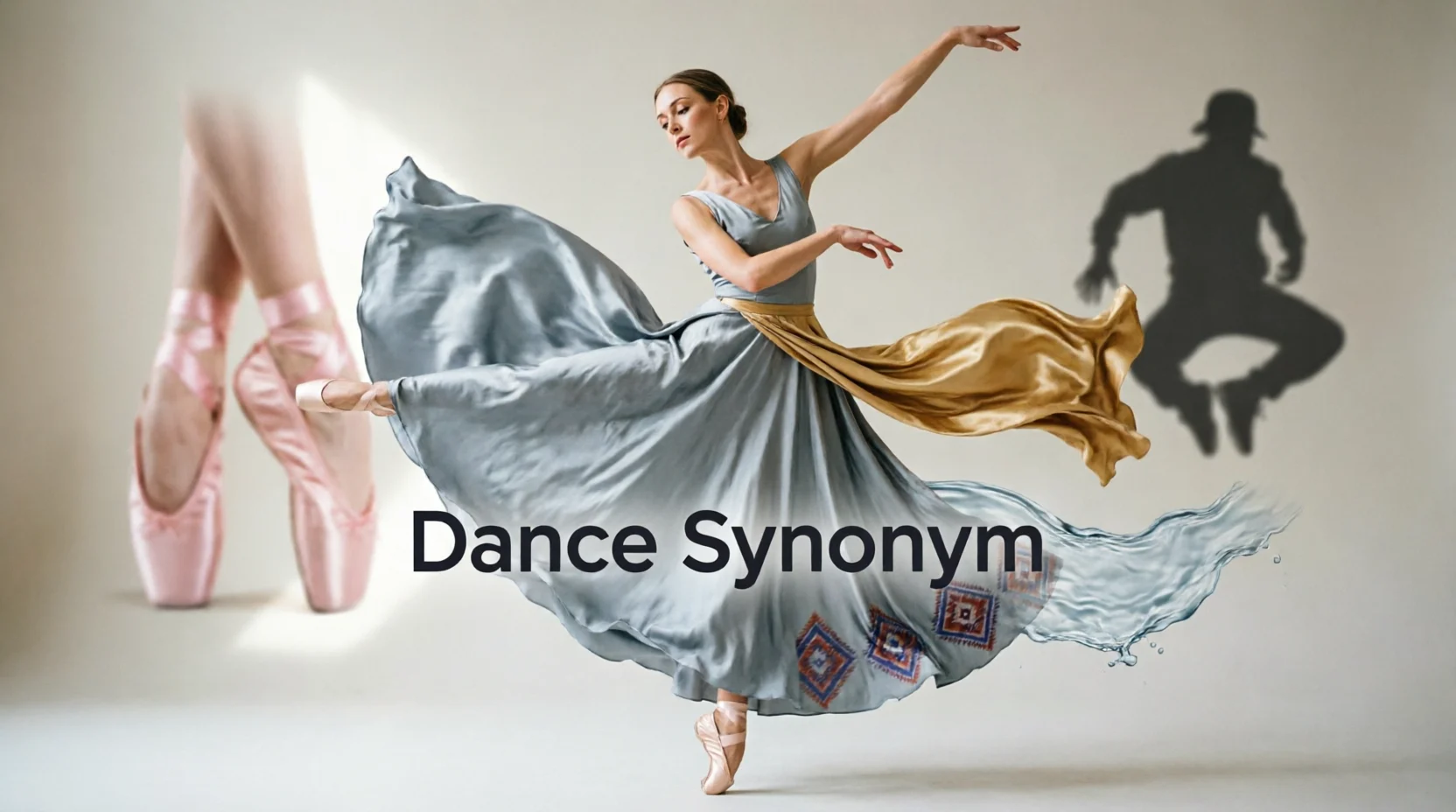
Finding the right dance synonym can make your writing more precise, vivid, and natural. Depending on the context, you might use words such as sway, twirl, whirl, spin, move, groove, prance, or choreograph. However, these words are not always interchangeable because each one describes a different kind of movement, style, or purpose.
If you are a student improving your vocabulary, an ESL learner, a writer describing a scene, or a content creator looking for better wording, understanding these alternatives can help you communicate more clearly.
Quick Answer: What Is a Synonym for Dance?
Common synonyms for dance include move, sway, twirl, spin, whirl, groove, prance, jig, waltz, step, and cavort. The best synonym depends on what you mean.
For example, sway suggests gentle side-to-side movement, while twirl suggests turning around. Groove is informal and often relates to moving naturally with music, while waltz refers specifically to a traditional dance style.
What Does Dance Mean?
The word dance generally means to move the body rhythmically, often in response to music. It can be used as both a verb and a noun.
As a verb:
- The children danced to the music.
- She danced across the stage.
- They danced together at the wedding.
As a noun:
- We watched a beautiful dance performance.
- The couple performed their first dance.
- Traditional dance is an important part of the celebration.
Dance can also describe movement that is graceful, energetic, playful, or carefully organized.
30 Dance Synonyms and Related Words
Not every word below is a perfect replacement for dance. Some describe particular movements, dance styles, moods, or forms of physical expression.
1. Move
Simple meaning: To change position or move the body.
Example:
She began to move to the rhythm of the music.
Best usage/context:
Use move when you want a broad, simple alternative to dance without specifying a particular style.
2. Sway
Simple meaning: To move gently from side to side.
Example:
The couple swayed slowly to the romantic song.
Best usage/context:
Use sway for soft, relaxed, rhythmic movement.
3. Twirl
Simple meaning: To turn around quickly or gracefully.
Example:
The ballerina twirled across the stage.
Best usage/context:
Use twirl when someone repeatedly turns their body, clothing, or an object.
4. Spin
Simple meaning: To turn around quickly.
Example:
The dancer spun several times before finishing the routine.
Best usage/context:
Use spin when the important feature is fast rotation.
5. Whirl
Simple meaning: To move or turn around rapidly.
Example:
The dancers whirled around the room.
Best usage/context:
Use whirl for energetic, fast, or visually dramatic movement.
6. Groove
Simple meaning: To dance or move naturally to music.
Example:
Everyone was grooving to the upbeat song.
Best usage/context:
Groove is informal and works well in casual conversations and modern music contexts.
7. Prance
Simple meaning: To move with lively, high steps.
Example:
The performers pranced across the stage with exaggerated movements.
Best usage/context:
Use prance for lively, energetic, sometimes playful movement.
8. Jig
Simple meaning: To perform a lively traditional dance.
Example:
The musicians played while the dancers performed a lively jig.
Best usage/context:
Use jig when referring to a specific traditional dance, especially one associated with Irish or British traditions.
9. Waltz
Simple meaning: To perform or move in the style of a waltz.
Example:
The newlyweds waltzed around the reception hall.
Best usage/context:
Use waltz when the movement resembles the formal partner dance traditionally performed in triple meter.
10. Step
Simple meaning: To move the feet in a particular way.
Example:
The dancers stepped forward together as the music changed.
Best usage/context:
Use step when focusing on footwork or a particular movement in a routine.
11. Jiggle
Simple meaning: To move with small, quick, irregular movements.
Example:
The performer jiggled playfully to the beat.
Best usage/context:
Use jiggle for humorous, informal, or playful movement. It is not a general synonym for dance.
12. Hop
Simple meaning: To jump lightly on one foot or with small jumps.
Example:
The children hopped around the circle.
Best usage/context:
Use hop when jumping is a noticeable part of the movement.
13. Bounce
Simple meaning: To move up and down repeatedly.
Example:
The crowd bounced along with the music.
Best usage/context:
Use bounce for energetic rhythmic movement, particularly in informal descriptions.
14. Leap
Simple meaning: To jump high or a long distance.
Example:
The dancer leaped gracefully across the stage.
Best usage/context:
Use leap when describing dramatic or athletic jumping, especially in ballet and stage performance.
15. Cavort
Simple meaning: To move around energetically and playfully.
Example:
The children cavorted around the garden while music played.
Best usage/context:
Use cavort for energetic, playful, and sometimes uncontrolled movement.
16. Revel
Simple meaning: To celebrate or enjoy oneself enthusiastically.
Example:
The crowd revelled in the music and celebration.
Best usage/context:
Revel is not a direct synonym for dance. It works when dancing is part of a larger celebration or joyful experience.
17. Frolic
Simple meaning: To play or move in a lively, cheerful way.
Example:
The children frolicked to the music during the festival.
Best usage/context:
Use frolic for carefree and playful movement rather than formal dancing.
18. Skip
Simple meaning: To move with light jumps or steps.
Example:
She skipped across the floor to the cheerful music.
Best usage/context:
Use skip when the movement is light, playful, and springy.
19. Strut
Simple meaning: To walk proudly and confidently.
Example:
The performer strutted across the stage with confidence.
Best usage/context:
Use strut when dancing or movement involves exaggerated confidence and attitude.
20. Glide
Simple meaning: To move smoothly and effortlessly.
Example:
The skaters seemed to glide across the floor.
Best usage/context:
Use glide when describing smooth, graceful movement with little apparent effort.
21. Sashay
Simple meaning: To walk or move in a confident, showy way.
Example:
The performer sashayed across the stage.
Best usage/context:
Use sashay for stylish, theatrical, or exaggerated movement.
22. Waltz Around
Simple meaning: To move around in a relaxed or carefree way.
Example:
He waltzed around the room as though he owned the place.
Best usage/context:
This expression can describe literal dancing or figurative casual movement.
23. Trip the Light Fantastic
Simple meaning: To dance.
Example:
The guests gathered on the floor to trip the light fantastic.
Best usage/context:
This is an old-fashioned, literary, or playful expression. It is not suitable for ordinary everyday writing.
24. Choreograph
Simple meaning: To plan and arrange dance movements.
Example:
She choreographed the routine for the school performance.
Best usage/context:
Use choreograph when someone creates or organizes a dance rather than simply performs it.
25. Perform
Simple meaning: To present an activity or artistic work before an audience.
Example:
The dancers performed a traditional routine.
Best usage/context:
Use perform when the focus is on presenting a dance publicly.
26. Execute
Simple meaning: To carry out a planned movement or action.
Example:
The dancer executed the difficult turn perfectly.
Best usage/context:
Use execute in technical, formal, or performance-focused writing when discussing how successfully a movement is completed.
27. Interpret
Simple meaning: To express the meaning or feeling of something through performance.
Example:
The dancer interpreted the music through controlled movements.
Best usage/context:
Use interpret when dance is being used to communicate emotion, music, a story, or an artistic idea.
28. Romp
Simple meaning: To move or play energetically and noisily.
Example:
The performers romped across the stage during the comic scene.
Best usage/context:
Use romp for lively, playful movement rather than elegant or formal dancing.
29. Sashay Along
Simple meaning: To move in a relaxed, confident, or theatrical manner.
Example:
The performers sashayed along to the lively music.
Best usage/context:
This expression works particularly well in creative writing when you want a vivid and stylish image.
30. Rhythmically Move
Simple meaning: To move the body in time with a rhythm.
Example:
The audience began to move rhythmically with the music.
Best usage/context:
Use this phrase when you want a clear descriptive expression without suggesting a particular dance style.
Dance Synonyms Comparison Table
| Synonym | Main Idea | Tone | Best Context |
| Move | General body movement | Neutral | Everyday writing |
| Sway | Gentle side-to-side movement | Soft | Slow music |
| Twirl | Graceful turning | Expressive | Dance and performance |
| Spin | Fast rotation | Neutral | Dance, sports, movement |
| Whirl | Rapid turning | Dramatic | Creative writing |
| Groove | Enjoyable movement to music | Informal | Music and conversation |
| Prance | Lively high steps | Playful | Descriptive writing |
| Jig | Traditional lively dance | Traditional | Folk dance |
| Waltz | Formal partner dance | Elegant | Weddings, ballroom |
| Step | Foot movement | Neutral | Dance instruction |
| Bounce | Rhythmic up-and-down movement | Informal | Parties, concerts |
| Leap | High or long jump | Dramatic | Ballet, performance |
| Cavort | Energetic playful movement | Playful | Creative writing |
| Frolic | Carefree movement | Cheerful | Children, celebrations |
| Strut | Proud, confident movement | Stylish | Fashion, performance |
| Glide | Smooth movement | Elegant | Ballet, skating |
| Sashay | Stylish, theatrical movement | Playful | Performance |
| Choreograph | Plan dance movements | Formal | Dance production |
| Perform | Present a dance | Neutral | Stage performances |
| Interpret | Express meaning through movement | Artistic | Contemporary dance |
How to Choose the Right Dance Synonym
The best synonym depends on meaning, movement, tone, and intent. Before replacing the word dance, ask what you want the reader to picture.
For General or Neutral Writing
Choose:
- Move
- Step
- Perform
- Rhythmically move
These words are useful when you do not need to describe a specific dance style.
Example:
Instead of: The students danced during the activity.
You could write:
The students moved to the rhythm during the activity.
For Gentle or Graceful Movement
Choose:
- Sway
- Glide
- Twirl
- Waltz
These words create a softer and more elegant image.
Example:
The couple swayed beneath the soft lights.
This sounds more specific than simply saying:
The couple danced beneath the soft lights.
For Fast or Energetic Movement
Choose:
- Spin
- Whirl
- Bounce
- Leap
- Prance
These alternatives emphasize energy, speed, or physical action.
Example:
The dancers whirled across the stage.
This creates a stronger visual impression than:
The dancers danced across the stage.
For Playful Movement
Choose:
- Frolic
- Cavort
- Romp
- Skip
- Prance
These words are useful when the movement feels cheerful, carefree, or humorous.
For Informal Modern Contexts
Choose:
- Groove
- Move
- Bounce
- Jiggle
These words fit casual conversations, entertainment writing, and descriptions of people enjoying music.
Example:
Everyone was grooving to the beat.
For Formal or Artistic Writing
Choose:
- Perform
- Interpret
- Choreograph
- Execute
- Glide
These words are useful when writing about professional dance, theater, competitions, or artistic performances.
For Traditional Dance
Choose a word that identifies the actual style when possible:
- Waltz
- Jig
- Step
Using the name of a specific dance is often more precise than using a broad word such as dance.
Dance Synonyms by Tone
Casual
- Groove
- Move
- Bounce
- Jiggle
Elegant
- Glide
- Waltz
- Sway
- Twirl
Energetic
- Whirl
- Spin
- Leap
- Prance
Playful
- Frolic
- Cavort
- Romp
- Skip
Formal
- Perform
- Interpret
- Execute
- Choreograph
Literary or Old-Fashioned
- Trip the light fantastic
- Cavort
- Revel
Dance Synonyms by Intent
Your choice can also depend on what you want to communicate.
Want to describe movement?
Use move, step, sway, spin, or glide.
Want to describe confidence?
Use strut or sashay.
Want to describe happiness?
Use frolic, cavort, or groove.
Want to describe elegance?
Use glide, twirl, sway, or waltz.
Want to describe athletic ability?
Use leap, spin, or execute.
Want to describe professional performance?
Use perform, interpret, or choreograph.
Common Mistakes When Using Dance Synonyms
1. Treating Every Synonym as an Exact Replacement
Words that are related to dance do not necessarily have the same meaning.
For example:
- Dance = general rhythmic movement.
- Sway = gentle side-to-side movement.
- Spin = turning around.
- Leap = jumping.
- Choreograph = planning dance movements.
Replacing dance with any of these words without considering context can change the meaning of your sentence.
2. Using Informal Words in Formal Writing
Words such as groove and jiggle can sound casual.
For a formal academic or professional context, perform, interpret, or move rhythmically may be more appropriate.
3. Confusing Choreograph With Dance
Choreograph does not mean simply to dance.
A choreographer creates or arranges movements, while a dancer performs them.
Correct:
Maria choreographed the routine.
Also correct:
Maria danced the routine.
These sentences describe different actions.
4. Using a Specific Dance Word Too Broadly
Waltz, jig, and similar terms refer to particular dance forms or movement patterns.
For example, saying someone “waltzed” is more specific than saying someone “danced.”
5. Ignoring Tone
A word can be technically related to dance but still create the wrong feeling.
Compare:
She glided across the stage.
and
She romped across the stage.
The first suggests grace and elegance. The second suggests energetic, playful movement.
Dance vs. Move: What Is the Difference?
Dance usually involves rhythmic or expressive body movement, often connected with music.
Move is much broader. It can describe almost any change in body position.
For example:
- She danced across the room. — rhythmic or expressive movement
- She moved across the room. — general movement
Therefore, move is a broader word, while dance gives the reader more information about the type of movement.
Dance vs. Sway: What Is the Difference?
Sway specifically suggests gentle movement from one side to another.
Someone can sway without actually performing a complete dance.
For example:
The audience swayed to the music.
This emphasizes relaxed, repetitive movement rather than a structured dance routine.
Dance vs. Groove: What Is the Difference?
Groove is an informal expression associated with enjoying music and moving naturally with its rhythm.
For example:
He was dancing at the party.
is neutral, while:
He was grooving at the party.
sounds more casual and energetic.
Dance vs. Twirl: What Is the Difference?
Twirl focuses on turning around.
A person may twirl as part of a dance, but twirling itself does not describe every element of dancing.
Example:
The dancer twirled across the stage.
The sentence highlights rotation rather than the entire performance.
Dance vs. Choreograph: What Is the Difference?
Dance means to perform rhythmic body movements.
Choreograph means to design, organize, or arrange those movements.
For example:
The dancers performed the routine.
The instructor choreographed the routine.
The first sentence describes performance; the second describes creation.
FAQs:
What is the best synonym for dance?
The best synonym depends on your sentence. Move is a broad alternative, while sway, twirl, spin, groove, glide, and waltz describe more specific types of movement.
What is a simple synonym for dance?
Move is one of the simplest alternatives. Depending on the context, step and sway can also work.
What is a fancy word for dance?
Words such as sashay, cavort, frolic, and glide can create a more expressive or literary description. Interpret and perform are useful in artistic contexts.
What is a synonym for dancing to music?
Depending on the style, you can use grooving, moving to the rhythm, swaying, or bouncing. The best choice depends on the type of movement.
What is a synonym for dancing gracefully?
Gliding, twirling, swaying, and waltzing can describe graceful movement, depending on the exact action.
What is a synonym for dancing happily?
Grooving, frolicking, cavorting, and romping can suggest joyful or energetic movement.
What is the difference between dance and choreography?
Dance refers to the movement or performance itself. Choreography refers to the planning and arrangement of dance movements.
Can “move” always replace “dance”?
No. Move has a much broader meaning. It can describe walking, shifting position, or any physical movement, while dance specifically suggests rhythmic or expressive movement.
Conclusion
The best dance synonym depends on the movement, mood, style, and purpose you want to express. Move is a general choice, while sway suggests gentle movement, twirl emphasizes turning, glide creates an elegant image, and groove gives a casual modern feeling.
For creative writing, specific verbs can make a scene more vivid. Instead of repeatedly writing that someone “danced,” you can describe exactly what the person did: they spun, swayed, leaped, glided, strutted, or twirled.
Choosing the right word is not about finding a replacement that looks similar in a dictionary. It is about selecting the word that communicates the exact movement and feeling you want your reader to understand.

I am Camden Thomas, an Administrator at SaysReply. I help maintain our platform and ensure readers find clear, natural, and useful alternative ways to express their thoughts every day.




1 thought on “Dance Synonym: 30 Powerful Words to Describe Movement,”