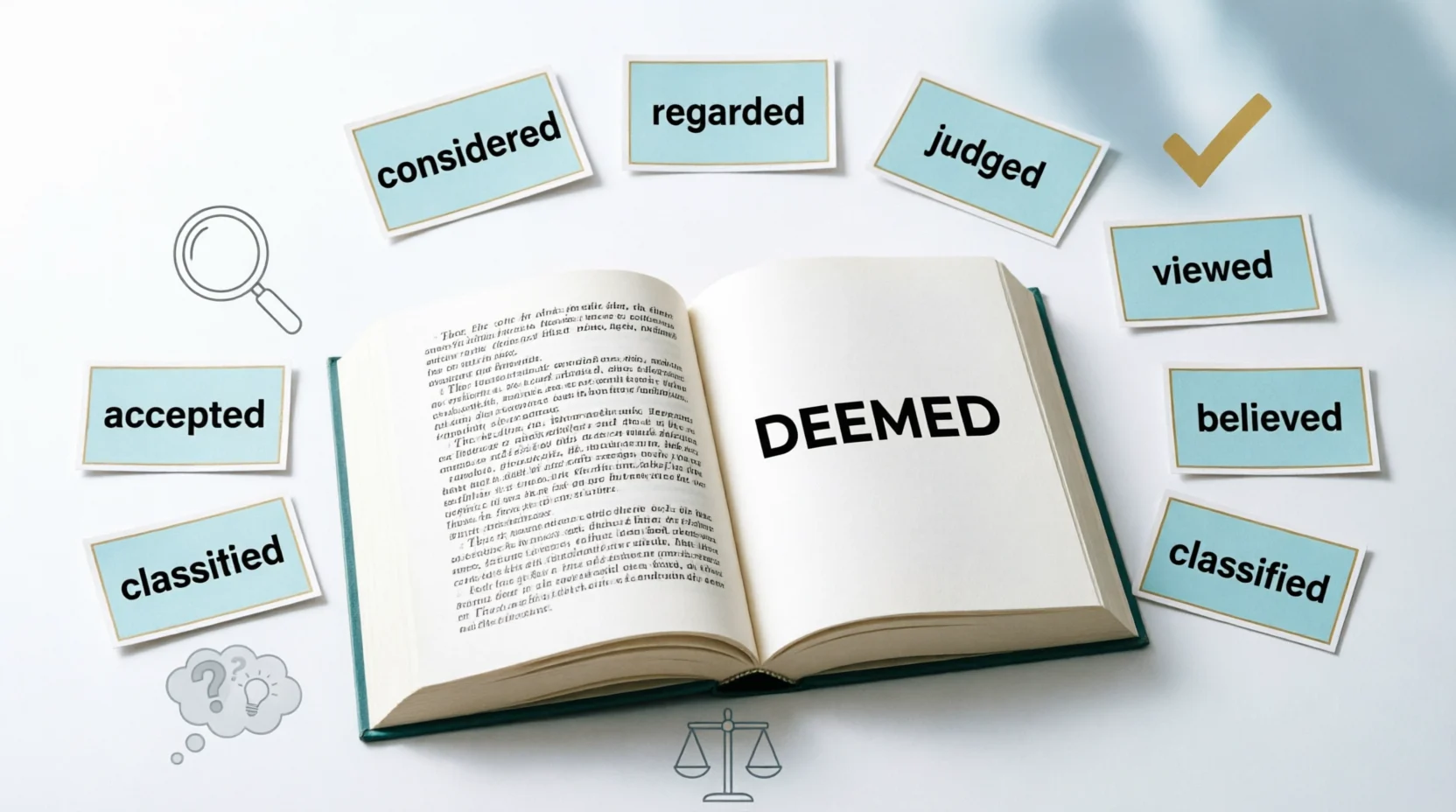
The word deemed means “considered,” “regarded,” or “judged to be something.” It is commonly used when a person, organization, rule, or authority treats something as having a particular status or quality. For example, “The application was deemed incomplete” means the application was considered incomplete.
Quick Answer
The closest synonyms for deemed are considered, regarded, judged, viewed, believed, thought, assumed, classified, treated, and determined. The best alternative depends on the context. For formal or legal writing, regarded, considered, classified, designated, or determined may work well. In everyday English, thought, believed, or seen as often sounds more natural.
What Does “Deemed” Mean?
Deemed is the past tense and past participle of deem. It means to consider or judge something to have a particular quality, status, or condition.
Simple definition
Deemed = considered or regarded as something.
Examples
- The building was deemed unsafe.
- She was deemed responsible for the project.
- The offer was deemed unacceptable.
- His actions were deemed inappropriate.
The word is especially common in formal, academic, legal, business, and official writing.
“Deemed” in different contexts
Formal:
The proposal was deemed unsuitable.
Legal:
The defendant was deemed liable under the agreement.
Academic:
The study was deemed significant because of its findings.
Everyday:
The movie was considered too long.
In many everyday situations, considered sounds more natural than deemed.
30 Synonyms for “Deemed”
The following alternatives are related to deemed, but they are not always interchangeable. Their exact meaning and tone can differ depending on the sentence.
1. Considered
Simple meaning: Thought of or judged to be something.
Example:
The plan was considered impractical.
Best usage/context:
General, academic, professional, and everyday writing.
2. Regarded
Simple meaning: Thought of or viewed in a particular way.
Example:
She is regarded as an excellent teacher.
Best usage/context:
Formal, professional, academic, and descriptive writing.
3. Judged
Simple meaning: Decided or evaluated after considering something.
Example:
The proposal was judged unsuitable for the project.
Best usage/context:
Evaluations, competitions, decisions, and formal contexts.
4. Viewed
Simple meaning: Seen or understood in a particular way.
Example:
The change was viewed as a major improvement.
Best usage/context:
General, academic, professional, and analytical writing.
5. Believed
Simple meaning: Thought that something was true.
Example:
The witness was believed to be telling the truth.
Best usage/context:
Situations involving opinions, assumptions, or perceived facts.
6. Thought
Simple meaning: Had an opinion or belief about something.
Example:
The decision was thought to be unfair.
Best usage/context:
Everyday English and informal writing.
7. Assumed
Simple meaning: Accepted something as true without complete proof.
Example:
The missing document was assumed to have been lost.
Best usage/context:
Situations involving expectations or unverified beliefs.
8. Viewed as
Simple meaning: Considered to have a particular identity or quality.
Example:
The discovery was viewed as a breakthrough.
Best usage/context:
General and professional writing.
9. Seen as
Simple meaning: Considered to be something.
Example:
The decision was seen as a positive development.
Best usage/context:
Everyday, journalistic, and professional English.
10. Treated as
Simple meaning: Handled or regarded as if something were true.
Example:
The document was treated as confidential.
Best usage/context:
Rules, procedures, business, legal matters, and practical situations.
11. Classified
Simple meaning: Put into a particular group or category.
Example:
The material was classified as hazardous.
Best usage/context:
Science, government, business, technical writing, and official categories.
12. Designated
Simple meaning: Officially given a particular status, role, or name.
Example:
The area was designated as a protected zone.
Best usage/context:
Official, administrative, legal, and governmental contexts.
13. Determined
Simple meaning: Decided or established after consideration.
Example:
The committee determined that the application was incomplete.
Best usage/context:
Formal, professional, legal, and administrative writing.
14. Established
Simple meaning: Shown, confirmed, or officially decided.
Example:
The investigation established that the claim was false.
Best usage/context:
Research, investigations, law, business, and formal writing.
15. Identified
Simple meaning: Recognized or determined to be something.
Example:
The substance was identified as a common chemical compound.
Best usage/context:
Science, research, investigations, and factual descriptions.
16. Defined
Simple meaning: Described or established as having a particular meaning or quality.
Example:
The policy defined the behavior as unacceptable.
Best usage/context:
Rules, policies, academic writing, and technical contexts.
17. Decreed
Simple meaning: Officially ordered or declared.
Example:
The ruler decreed that the law would take effect immediately.
Best usage/context:
Historical, legal, governmental, or authoritative contexts.
18. Declared
Simple meaning: Announced or stated officially.
Example:
The organization declared the area a protected site.
Best usage/context:
Official statements, government, law, and public announcements.
19. Pronounced
Simple meaning: Officially declared or stated.
Example:
The court pronounced him responsible for the damages.
Best usage/context:
Legal and formal contexts.
20. Concluded
Simple meaning: Reached a decision or opinion after consideration.
Example:
Researchers concluded that the treatment was effective.
Best usage/context:
Research, analysis, investigations, and academic writing.
21. Evaluated
Simple meaning: Carefully assessed or judged.
Example:
The proposal was evaluated for its potential risks.
Best usage/context:
Education, business, research, performance reviews, and professional contexts.
22. Assessed
Simple meaning: Examined and judged the quality, value, or condition of something.
Example:
The property was assessed as being in good condition.
Best usage/context:
Finance, education, business, health-related general contexts, and professional assessments.
23. Appraised
Simple meaning: Carefully evaluated, especially for value or quality.
Example:
The painting was appraised as highly valuable.
Best usage/context:
Property, antiques, art, finance, and professional valuation.
24. Interpreted
Simple meaning: Understood or explained in a particular way.
Example:
His silence was interpreted as agreement.
Best usage/context:
Communication, literature, research, law, and analysis.
25. Perceived
Simple meaning: Understood or experienced in a particular way.
Example:
The policy was perceived as unfair by some employees.
Best usage/context:
Academic, social, professional, and analytical writing.
26. Accepted
Simple meaning: Agreed to or recognized as valid or true.
Example:
The explanation was accepted as reasonable.
Best usage/context:
General, academic, professional, and social contexts.
27. Acknowledged
Simple meaning: Recognized or admitted that something exists or is true.
Example:
The problem was acknowledged as a serious concern.
Best usage/context:
Formal, professional, academic, and diplomatic writing.
28. Classified as
Simple meaning: Officially placed into a particular category.
Example:
The substance was classified as toxic.
Best usage/context:
Technical, scientific, regulatory, and official writing.
29. Designated as
Simple meaning: Officially identified or assigned a particular status.
Example:
The building was designated as a historical landmark.
Best usage/context:
Government, law, history, administration, and official documents.
30. Treated as
Simple meaning: Considered or handled in a particular way.
Example:
The information was treated as confidential.
Best usage/context:
Business, legal, professional, and everyday contexts.
Comparison Table: “Deemed” vs. Its Synonyms
| Synonym | Main idea | Tone | Example |
| Considered | Thought to be | Neutral | It was considered necessary. |
| Regarded | Thought of as | Formal | He was regarded as a leader. |
| Judged | Evaluated and decided | Formal | The entry was judged unsuitable. |
| Viewed | Seen in a certain way | Neutral/Formal | It was viewed as beneficial. |
| Believed | Thought to be true | Neutral | He was believed to be honest. |
| Assumed | Accepted without full proof | Neutral | It was assumed to be correct. |
| Classified | Put into a category | Technical | It was classified as hazardous. |
| Designated | Officially assigned a status | Formal | It was designated a protected area. |
| Determined | Decided after consideration | Formal | The committee determined it was valid. |
| Perceived | Understood or experienced as | Analytical | It was perceived as unfair. |
| Declared | Officially stated | Formal | The area was declared protected. |
| Treated as | Handled or regarded as | Neutral/Formal | It was treated as confidential. |
Deemed vs. Considered
Deemed and considered are often interchangeable, but their tone can be different.
- The proposal was deemed unacceptable.
- The proposal was considered unacceptable.
Both sentences communicate a similar idea. However, deemed often sounds more formal, official, or authoritative.
For everyday conversation, considered is usually the simpler choice.
Deemed vs. Regarded
Regarded usually describes how someone or something is viewed by people.
- She is regarded as a leading expert.
- The discovery was regarded as important.
Deemed can suggest a particular judgment or determination.
- The building was deemed unsafe.
The distinction is subtle, so context matters.
Deemed vs. Judged
Judged emphasizes evaluation.
- The performance was judged excellent.
Deemed emphasizes the resulting status or conclusion.
- The performance was deemed excellent.
In formal writing, both can work, but judged may draw more attention to the evaluation process.
How to Choose the Right Synonym for “Deemed”
The best synonym depends on tone, meaning, and intent.
For neutral everyday English
Use:
- Considered
- Thought
- Seen as
- Viewed
- Believed
Example:
“The idea was considered useful.”
These choices are easy to understand and sound natural in ordinary communication.
For formal or professional writing
Use:
- Regarded
- Determined
- Assessed
- Evaluated
- Acknowledged
Example:
“The proposal was assessed for its potential impact.”
These words fit reports, workplace documents, and formal discussions.
For legal or official writing
Use:
- Deemed
- Designated
- Declared
- Classified
- Determined
- Pronounced
Example:
“The property was designated as a protected site.”
These words can communicate an official decision or status.
For scientific or technical writing
Use:
- Classified
- Identified
- Determined
- Assessed
- Evaluated
- Established
Example:
“The sample was classified as non-toxic.”
When expressing belief or perception
Use:
- Believed
- Assumed
- Perceived
- Thought
- Regarded
- Viewed
Example:
“The behavior was perceived as threatening.”
When emphasizing an official status
Use:
- Designated
- Classified
- Declared
- Defined
- Treated as
Example:
“The area was designated as a conservation zone.”
Common Mistakes When Using “Deemed” Synonyms
1. Treating every synonym as identical
Not every synonym can replace deemed without changing the meaning.
For example, assumed suggests something is accepted without complete evidence, while determined can suggest a conclusion reached after investigation.
2. Using “deemed” in casual conversation
Although grammatically correct, deemed can sound formal.
Instead of:
“I deemed the movie too long.”
A natural conversational alternative is:
“I thought the movie was too long.”
3. Confusing “believed” with “determined”
Believed communicates a belief or opinion.
Determined generally suggests that a conclusion was reached through examination, evidence, or a decision-making process.
Compare:
- The report was believed to be accurate.
- The investigation determined that the report was accurate.
4. Using “classified” when there is no category
Classified works best when something is placed into a recognized category or group.
- The substance was classified as hazardous.
It is not always a natural replacement for deemed:
- The movie was deemed excellent.
- The movie was classified as excellent. ❌
The second sentence changes the meaning and sounds unnatural in most contexts.
5. Forgetting the difference between “seen as” and “officially designated”
“Seen as” often describes perception, while “designated as” generally indicates an official assignment or status.
- The city is seen as an important cultural center.
- The building was designated as a historical landmark.
FAQs:
What is the closest synonym for “deemed”?
The closest general synonym is considered. Depending on the context, regarded, judged, viewed, or determined may also work.
Is “deemed” a formal word?
Yes. Deemed is generally more formal than considered or thought. It is especially common in legal, official, academic, and professional writing.
What is a simple word for “deemed”?
A simple alternative is considered. In casual English, thought or seen as can also work.
Is “regarded” the same as “deemed”?
They have very similar meanings, but they are not always identical. Regarded often describes how people generally view something, while deemed can emphasize a specific judgment or determination.
What is the opposite of “deemed”?
There is no single opposite in every context. Depending on the sentence, possible contrasts include rejected, dismissed, disregarded, ignored, or not considered.
Can “deemed” be used in academic writing?
Yes. Deemed is common in formal academic writing, particularly when describing how something was judged or classified.
For example:
“The results were deemed significant.”
What is the difference between “deemed” and “assumed”?
Deemed usually means something was considered or judged to have a particular status. Assumed often means something was accepted as true without complete confirmation.
Conclusion
Deemed means considered, regarded, or judged to be something. It is a useful formal word, especially in legal, academic, professional, and official contexts.
The best synonym depends on the intended meaning. Choose considered for a general alternative, regarded for formal descriptions, judged for evaluation, believed for opinions, classified for categories, and designated for official status. Choosing the right alternative makes your writing more precise, natural, and appropriate for your audience.

I am Camden Thomas, an Administrator at SaysReply. I help maintain our platform and ensure readers find clear, natural, and useful alternative ways to express their thoughts every day.