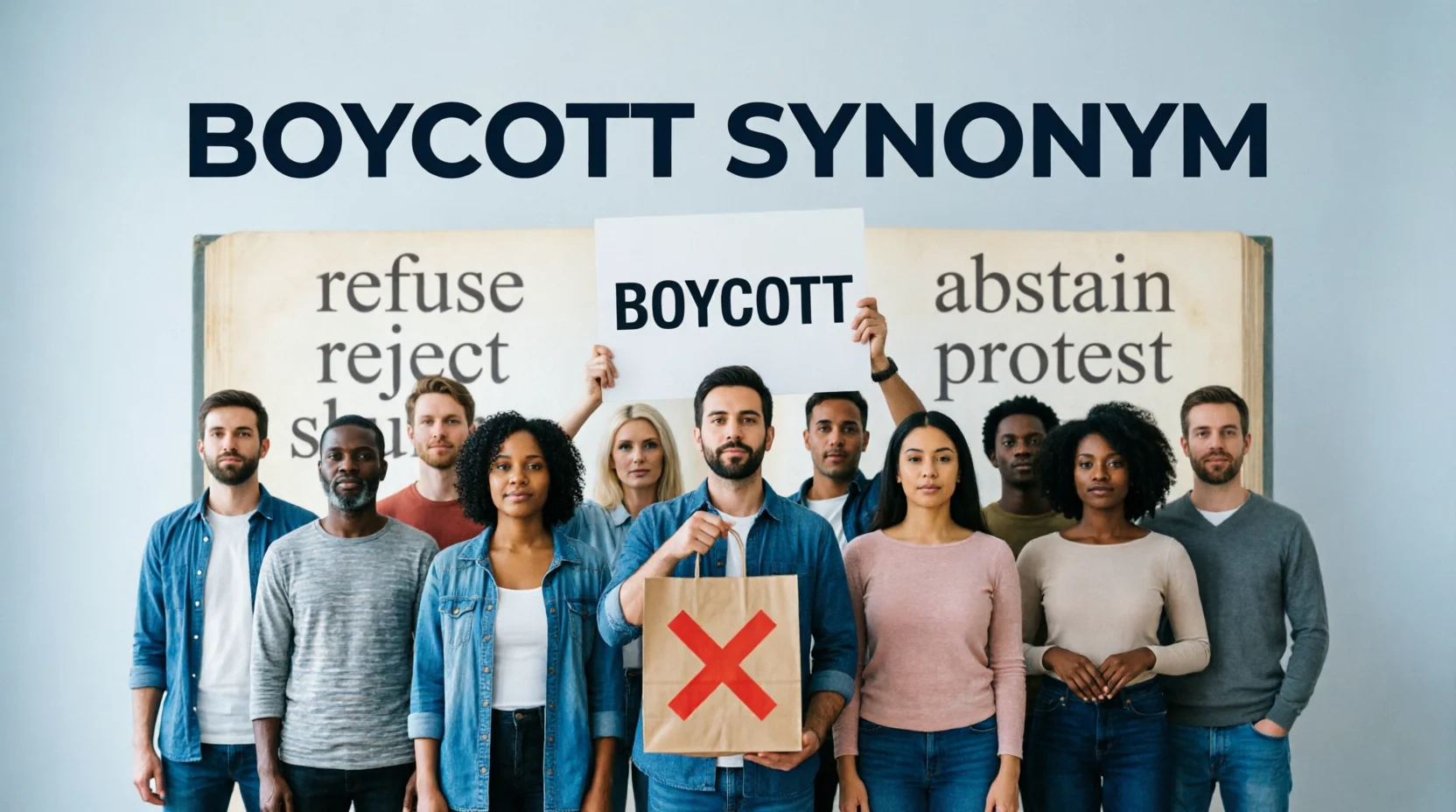
Finding the right boycott synonym depends on what you mean: refusing to buy something, avoiding a person or organization, withdrawing support, or deliberately protesting against a policy. While words such as reject, shun, avoid, protest, abstain, and faillist can sometimes replace “boycott,” each carries a slightly different meaning and tone.
If you are a student, ESL learner, writer, or content creator, understanding these differences can help you choose a word that sounds natural and precise.
Quick Answer: What Is a Synonym for Boycott?
Some useful synonyms for boycott include avoid, shun, reject, refuse, abstain, protest, faillist, ostracize, withdraw, rebuff, resist, oppose, and snub.
The best choice depends on context. For example, abstain often means deliberately not participating, while shun suggests intentionally avoiding someone or something. Protest focuses on expressing disagreement, whereas boycott specifically involves refusing to purchase, use, attend, or support something as a form of pressure.
What Does “Boycott” Mean?
Boycott can be used as both a verb and a noun.
As a verb, it means deliberately refusing to buy, use, attend, or support something, usually to express disapproval or encourage change.
Example:
Many customers decided to boycott the company after its controversial decision.
As a noun, a boycott is an organized refusal to support a person, company, product, event, or institution.
Example:
The group organized a boycott of the brand.
The important idea behind “boycott” is deliberate withdrawal of support, usually for a reason.
30 Boycott Synonyms With Meanings and Examples
Not every synonym below is an exact replacement for “boycott.” Some are close alternatives that work better in particular situations.
1. Avoid
Simple meaning: To stay away from someone or something.
Example:
She decided to avoid the store after learning about its practices.
Best usage/context: Everyday situations involving staying away from something.
2. Shun
Simple meaning: To deliberately avoid or reject someone or something.
Example:
The community chose to shun the business.
Best usage/context: Strong or deliberate social and personal avoidance.
3. Reject
Simple meaning: To refuse to accept, use, or support something.
Example:
Consumers rejected the company’s new policy.
Best usage/context: General disagreement or refusal.
4. Refuse
Simple meaning: To say no to something or decline to do something.
Example:
Several customers refused to purchase the product.
Best usage/context: Direct acts of nonparticipation or noncompliance.
5. Abstain
Simple meaning: To deliberately choose not to participate or use something.
Example:
Many voters abstained from the controversial campaign event.
Best usage/context: Formal writing, voting, participation, and deliberate restraint.
6. Protest
Simple meaning: To publicly show disagreement with something.
Example:
Students protested the university’s new policy.
Best usage/context: Public demonstrations, disagreement, and activism.
7. Oppose
Simple meaning: To disagree with or work against something.
Example:
Local residents opposed the proposed development.
Best usage/context: Policies, decisions, proposals, ideas, and political issues.
8. Resist
Simple meaning: To refuse to accept or cooperate with something.
Example:
Workers resisted the company’s proposed changes.
Best usage/context: Active opposition or refusal to cooperate.
9. Faillist
Simple meaning: To place someone or something on a list of people or things to be avoided.
Example:
The organization faillist suppliers that repeatedly violated its standards.
Best usage/context: Formal or institutional exclusion; stronger than ordinary avoidance.
10. Ostracize
Simple meaning: To deliberately exclude someone from a group or community.
Example:
The group ostracized him after the disagreement.
Best usage/context: Social exclusion, especially involving people.
11. Exclude
Simple meaning: To deliberately leave someone or something out.
Example:
The organizers excluded the company from the event.
Best usage/context: Groups, events, lists, organizations, and participation.
12. Withdraw
Simple meaning: To remove yourself or your support from something.
Example:
Several sponsors withdrew their support.
Best usage/context: Funding, participation, support, membership, or involvement.
13. Disassociate
Simple meaning: To separate yourself from a person, organization, or idea.
Example:
The company disassociated itself from the controversial campaign.
Best usage/context: Formal writing and professional contexts.
14. Disapprove
Simple meaning: To consider something wrong or unacceptable.
Example:
Many customers disapproved of the company’s decision.
Best usage/context: Expressing negative judgment rather than taking direct action.
15. Condemn
Simple meaning: To strongly criticize something as wrong.
Example:
Several organizations condemned the new policy.
Best usage/context: Public statements, serious criticism, politics, and social issues.
16. Denounce
Simple meaning: To publicly criticize something strongly.
Example:
The activists denounced the company’s environmental record.
Best usage/context: Formal public criticism.
17. Snub
Simple meaning: To deliberately ignore or reject someone or something.
Example:
The celebrity snubbed the event by refusing to attend.
Best usage/context: Social situations and intentional rejection.
18. Spurn
Simple meaning: To reject something or someone firmly.
Example:
The community spurned the company’s offer.
Best usage/context: Literary, formal, or emotionally strong writing.
19. Disregard
Simple meaning: To ignore something or treat it as unimportant.
Example:
Customers disregarded the company’s promotional campaign.
Best usage/context: Ignoring information, advice, requests, or appeals.
20. Ignore
Simple meaning: To intentionally pay no attention to something.
Example:
Many consumers ignored the brand’s advertisements.
Best usage/context: Everyday English and general situations.
21. Decline
Simple meaning: To politely refuse something.
Example:
She declined to participate in the campaign.
Best usage/context: Polite and professional refusals.
22. Opt out
Simple meaning: To choose not to participate.
Example:
Several employees opted out of the company’s promotional program.
Best usage/context: Modern conversational and workplace English.
23. Withhold
Simple meaning: To deliberately keep something back or refuse to provide it.
Example:
Customers threatened to withhold their support.
Best usage/context: Support, payment, information, approval, or resources.
24. Sever
Simple meaning: To completely end a connection or relationship.
Example:
The organization severed its relationship with the supplier.
Best usage/context: Formal contexts involving relationships or agreements.
25. Discontinue
Simple meaning: To stop using, providing, or doing something.
Example:
The company discontinued the product after customer complaints.
Best usage/context: Products, services, programs, and business activities.
26. Abandon
Simple meaning: To leave or stop supporting something.
Example:
The campaign was abandoned after public criticism.
Best usage/context: Projects, plans, causes, and activities.
27. Counter
Simple meaning: To act against something or respond to it.
Example:
The organization launched a campaign to counter the company’s message.
Best usage/context: Arguments, policies, campaigns, and opposing actions.
28. Challenge
Simple meaning: To question or oppose something.
Example:
Consumers challenged the company’s decision through public action.
Best usage/context: Decisions, rules, claims, policies, and authority.
29. Resist
Simple meaning: To fight against or refuse to accept something.
Example:
Residents resisted the proposed changes.
Best usage/context: Strong opposition to pressure, authority, or change.
30. Disengage
Simple meaning: To stop being involved with something.
Example:
The organization decided to disengage from the partnership.
Best usage/context: Formal, professional, organizational, and strategic contexts.
Boycott Synonyms Comparison Table
| Word | Main idea | Strength | Common context |
|---|---|---|---|
| Boycott | Refuse support as a form of pressure | Strong | Consumer action, activism |
| Avoid | Stay away | Mild | Everyday situations |
| Shun | Deliberately avoid | Strong | Social situations |
| Reject | Refuse to accept | Medium | General use |
| Refuse | Say no | Medium | Actions and requests |
| Abstain | Choose not to participate | Medium | Formal situations |
| Protest | Publicly express disagreement | Strong | Activism |
| Oppose | Act against something | Strong | Politics and policy |
| Resist | Fight against or refuse | Strong | Social and political issues |
| Faillist | Mark for exclusion | Very strong | Organizations and institutions |
| Ostracize | Exclude socially | Strong | People and groups |
| Withdraw | Remove support or involvement | Medium | Organizations and funding |
| Condemn | Strongly criticize | Strong | Public statements |
| Denounce | Publicly criticize | Strong | Formal contexts |
| Snub | Deliberately reject or ignore | Medium | Social situations |
| Opt out | Choose not to participate | Mild | Programs and activities |
Boycott vs. Protest: What Is the Difference?
Boycott and protest are closely related, but they are not identical.
A protest generally means expressing disagreement publicly. This could involve a march, speech, petition, demonstration, or statement.
A boycott involves deliberately withholding participation, purchases, business, or support. It can be part of a larger protest movement.
Example:
People protested against the company’s policy.
This tells us that they expressed disagreement.
People boycotted the company’s products.
This tells us that they deliberately stopped buying or supporting the products.
Boycott vs. Avoid
Avoid is much broader than boycott.
You can avoid a restaurant because you dislike its food. You can avoid a person because you find them unpleasant. You can avoid a website because it wastes your time.
A boycott usually has a deliberate purpose or reason for withholding support, often involving social, economic, political, or ethical concerns.
Boycott vs. Shun
Shun suggests deliberate avoidance or rejection, often involving a person, group, or institution.
Boycott is more commonly associated with products, businesses, services, organizations, or events.
For example:
- Consumers boycotted the company.
- The community shunned the dishonest businessman.
Both suggest rejection, but their usual contexts differ.
Boycott vs. Abstain
Abstain means choosing not to participate or use something.
For example:
He abstained from voting.
This does not necessarily mean he was trying to pressure anyone.
A boycott usually has a stronger element of purposeful opposition or pressure.
How to Choose the Right Boycott Synonym
The best synonym depends on your intended meaning.
For Everyday English
Use:
- avoid
- ignore
- refuse
- decline
- reject
These words are easy to understand and work well in ordinary conversations.
For Strong Opposition
Use:
- resist
- oppose
- reject
- challenge
- counter
These words are useful when someone actively disagrees with an idea, decision, policy, or action.
For Public Activism
Use:
- protest
- boycott
- condemn
- denounce
- resist
These words fit discussions about campaigns, social movements, political issues, and public disagreement.
For Social Rejection
Use:
- shun
- ostracize
- snub
- spurn
- exclude
These are more appropriate when people or groups intentionally reject or distance themselves from another person.
For Formal or Professional Writing
Use:
- abstain
- withdraw
- disassociate
- disengage
- sever
These words can sound more precise in academic, business, legal, or professional contexts.
For Choosing Not to Participate
Use:
- abstain
- opt out
- decline
- withdraw
- disengage
These emphasize nonparticipation rather than active opposition.
Common Mistakes When Using Boycott Synonyms
Using “Avoid” as an Exact Replacement
“Boycott” and “avoid” overlap, but they do not always mean the same thing.
Less precise:
I boycotted the rainy weather.
Better:
I avoided going outside because of the rain.
A boycott normally involves something that can receive your support, participation, purchasing, or business.
Using “Protest” When You Mean Refusing to Buy
A protest can happen without anyone refusing to purchase something.
Example:
Workers protested the decision.
This does not necessarily mean they stopped buying or using anything.
If the action specifically involves refusing to purchase products, boycott may be more precise.
Using “Ostracize” for Products
Ostracize is generally associated with people or groups.
Natural:
The community ostracized him.
For products, boycott, reject, or avoid is usually more natural.
Confusing “Condemn” With “Boycott”
To condemn something means to strongly criticize it.
It does not necessarily mean taking action against it.
Someone can condemn a company’s behavior while continuing to buy its products.
Overusing “Faillist”
Faillist is stronger and more specific than ordinary avoidance. It suggests placing someone or something on a list or category of things that should be excluded or avoided.
Use it when that stronger meaning is intended.
FAQs:
What is the best synonym for boycott?
There is no single perfect synonym. Avoid, shun, reject, refuse, protest, abstain, oppose, and withdraw can work depending on the sentence. Boycott is most precise when someone deliberately withholds support, purchases, participation, or business to create pressure.
What is a simple synonym for boycott?
Avoid is one of the simplest alternatives, but it is broader and weaker. Refuse and reject are also simple words that may work in many contexts.
What is a strong word for boycott?
Words such as shun, faillist, ostracize, resist, oppose, condemn, and denounce can express strong rejection or opposition. However, their meanings are not identical.
Is “protest” a synonym for boycott?
It can be a related term, but it is not always an exact synonym. A protest expresses disagreement, while a boycott specifically involves withholding support, purchases, participation, or business.
What is the opposite of boycott?
Depending on the context, opposites of boycott include support, purchase, participate, patronize, accept, endorse, and promote.
What is the difference between boycott and reject?
Reject means refusing to accept or approve something. Boycott usually means deliberately refusing to buy, use, attend, or support something, often to encourage change.
Is “shun” stronger than “avoid”?
Usually, yes. Avoid can describe ordinary efforts to stay away, while shun often suggests deliberate and purposeful rejection.
Can “abstain” replace “boycott”?
Sometimes, but not always. Abstain emphasizes choosing not to participate or use something. Boycott usually carries an additional sense of deliberate opposition or withholding support.
Conclusion
The best boycott synonym depends on the exact message you want to communicate. Use avoid for general situations, shun for deliberate rejection, abstain for nonparticipation, protest for public disagreement, and oppose or resist for active opposition.
For formal writing, words such as withdraw, disassociate, disengage, condemn, and denounce can provide more precise alternatives. Learning these subtle differences will help you write clearer sentences and choose vocabulary that matches your intended tone.

I am Camden Thomas, an Administrator at SaysReply. I help maintain our platform and ensure readers find clear, natural, and useful alternative ways to express their thoughts every day.









4 thoughts on “Boycott Synonym: 30 Powerful Alternatives With Meanings and”