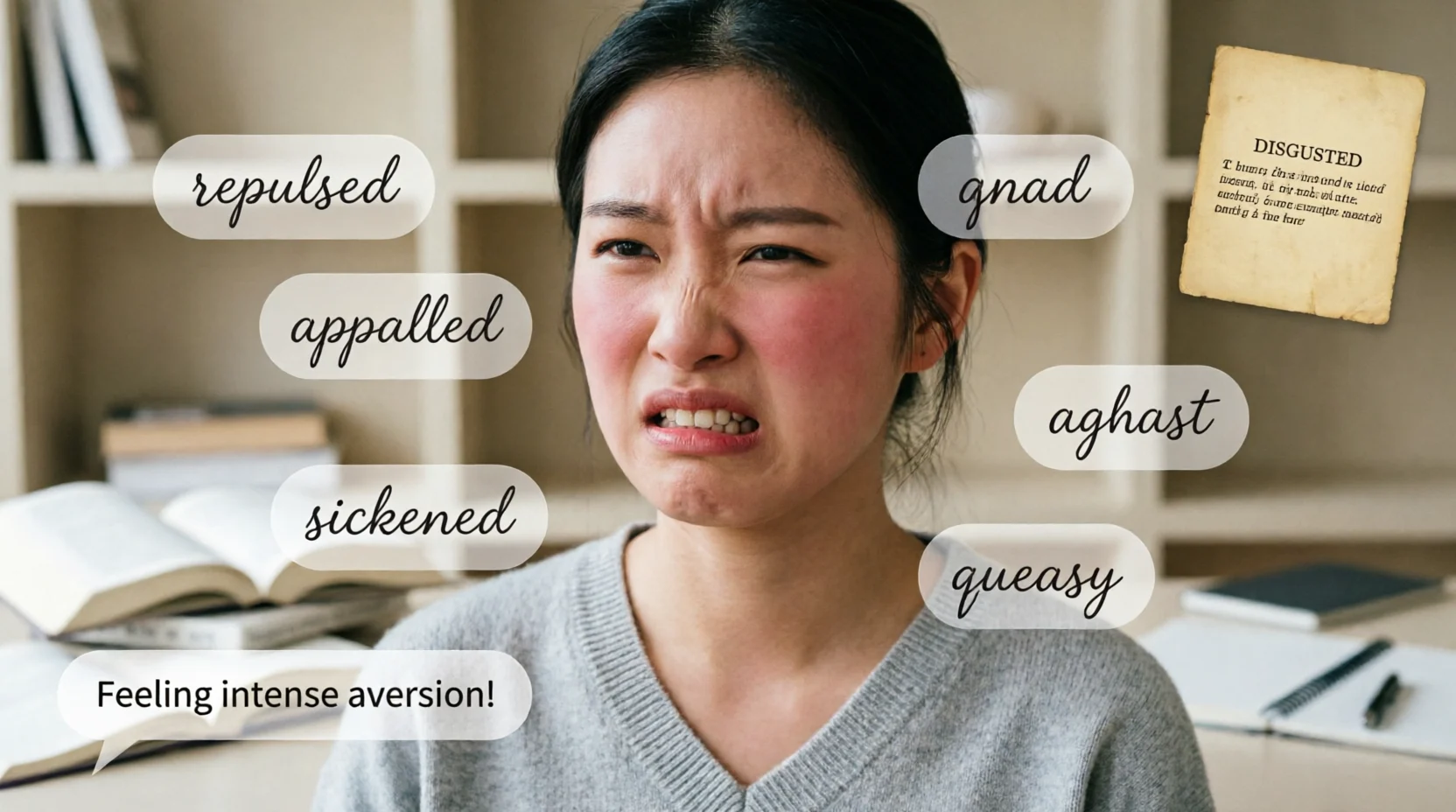
If you need a disgusted synonym, the best choice depends on exactly what you mean. Common alternatives include repulsed, revolted, nauseated, sickened, appalled, horrified, offended, and repelled. Some describe a physical reaction, while others express strong emotional dislike or moral outrage.
Quick Answer: What Is a Synonym for Disgusted?
A disgusted synonym is a word that describes a strong feeling of dislike, revulsion, nausea, or moral offense. The most useful alternatives are:
- Repulsed — strongly pushed away by something unpleasant
- Revolted — filled with intense disgust
- Nauseated — feeling physically sick or sickened
- Sickened — made to feel physically or emotionally sick
- Repelled — strongly attracted away from something
- Appalled — extremely shocked and disturbed
- Horrified — deeply shocked, frightened, or disgusted
- Offended — upset because something violates your values or feelings
For everyday writing, repulsed, revolted, and sickened are especially close to disgusted.
What Does Disgusted Mean?
Disgusted is an adjective that describes a strong feeling of dislike, revulsion, or physical or emotional discomfort caused by something unpleasant.
For example:
She was disgusted by the smell coming from the refrigerator.
The word can describe a reaction to food, smells, behavior, actions, situations, ideas, or people. The exact meaning depends on context.
Disgusted in Simple English
When you are disgusted, something makes you think, “That is unpleasant, horrible, or unacceptable.”
The feeling can be physical, emotional, or moral.
- A terrible smell can make you disgusted.
- Seeing spoiled food can make you disgusted.
- Cruel behavior can leave you disgusted.
- A dishonest action can make someone disgusted with another person.
Disgusted vs. Disgusting
These two words are easy to confuse.
Disgusted describes how someone feels:
I was disgusted by the dirty room.
Disgusting describes something that causes the feeling:
The dirty room was disgusting.
A useful rule is:
Person = disgusted
Thing or situation = disgusting
30 Synonyms for Disgusted
The following words are related to disgusted, but they are not all perfect replacements. Some emphasize physical sickness, some emotional rejection, and others moral outrage.
1. Repulsed
Simple meaning: Feeling strongly pushed away by something unpleasant.
Example: She was repulsed by the sight of the spoiled meat.
Best usage/context: Use it for strong physical or emotional rejection.
2. Revolted
Simple meaning: Feeling extremely disgusted or deeply offended.
Example: He was revolted by the cruel treatment of the animals.
Best usage/context: Best for intense disgust, especially when something seems morally wrong.
3. Nauseated
Simple meaning: Feeling physically sick or likely to vomit.
Example: The strong smell made me nauseated.
Best usage/context: Use it mainly for physical reactions such as smells, illness, food, or motion.
4. Sickened
Simple meaning: Made physically or emotionally sick.
Example: The disturbing story sickened everyone in the room.
Best usage/context: Useful for both physical disgust and strong emotional reactions.
5. Repelled
Simple meaning: Made to strongly dislike or avoid something.
Example: She felt repelled by his dishonest behavior.
Best usage/context: Good when disgust causes someone to withdraw, avoid, or reject something.
6. Appalled
Simple meaning: Extremely shocked and disturbed.
Example: The community was appalled by the shocking decision.
Best usage/context: Best for serious, shocking, or morally troubling situations.
7. Horrified
Simple meaning: Extremely shocked, frightened, or disturbed.
Example: She was horrified by what she saw.
Best usage/context: Use when disgust is mixed with fear, shock, or deep distress.
8. Offended
Simple meaning: Upset because something feels insulting, inappropriate, or disrespectful.
Example: He was offended by the rude comment.
Best usage/context: Best for social, personal, or moral situations rather than physical disgust.
9. Loathing
Simple meaning: An extremely strong feeling of dislike or hatred.
Example: She felt deep loathing toward the corrupt official.
Best usage/context: Use for powerful and lasting dislike.
10. Abhorrent
Simple meaning: Extremely unpleasant, hateful, or morally unacceptable.
Example: They considered the practice abhorrent.
Best usage/context: More formal; especially useful for serious moral judgments.
11. Averse
Simple meaning: Having a strong dislike of or opposition to something.
Example: He is averse to unnecessary cruelty.
Best usage/context: Formal or neutral writing about strong dislike or unwillingness.
12. Sickened
Simple meaning: Filled with a strong feeling of physical or emotional sickness.
Example: I was sickened by the amount of waste.
Best usage/context: Particularly effective when something causes a powerful emotional reaction.
13. Disapproving
Simple meaning: Showing that you believe something is wrong or unacceptable.
Example: She gave him a disapproving look.
Best usage/context: Useful when the reaction is negative but not necessarily physically disgusting.
14. Disturbed
Simple meaning: Emotionally troubled or upset by something.
Example: He was deeply disturbed by the violent images.
Best usage/context: Good when disgust is combined with worry, sadness, or emotional discomfort.
15. Repugnant
Simple meaning: Extremely unpleasant or unacceptable.
Example: The behavior was repugnant to everyone present.
Best usage/context: Formal writing, especially for behavior, ideas, or moral issues.
16. Antipathetic
Simple meaning: Showing a strong feeling of dislike or opposition.
Example: She was antipathetic toward the proposal.
Best usage/context: Formal or academic contexts involving strong opposition.
17. Hostile
Simple meaning: Showing strong dislike, opposition, or aggression.
Example: His hostile reaction surprised the entire team.
Best usage/context: Use when disgust develops into opposition or aggression.
18. Contemptuous
Simple meaning: Showing that you believe someone or something is beneath respect.
Example: She gave him a contemptuous glance.
Best usage/context: Best when disgust includes disrespect or a feeling of superiority.
19. Scornful
Simple meaning: Showing strong disrespect or rejection.
Example: His scornful response made the conversation uncomfortable.
Best usage/context: Useful when disgust is mixed with contempt.
20. Revolting
Simple meaning: Extremely disgusting or unpleasant.
Example: The smell from the drain was revolting.
Best usage/context: Strong everyday language for something physically or emotionally disgusting.
21. Loathsome
Simple meaning: Extremely unpleasant or deserving strong dislike.
Example: The character’s loathsome behavior shocked the readers.
Best usage/context: Strong descriptive writing, especially for people, behavior, or fictional characters.
22. Repulsive
Simple meaning: Causing intense dislike or disgust.
Example: The creature’s appearance was repulsive.
Best usage/context: Use when something actively creates a strong feeling of disgust.
23. Offensive
Simple meaning: Causing anger, upset, or moral discomfort.
Example: Many people found the comment offensive.
Best usage/context: Best for words, behavior, jokes, images, or actions that violate social expectations.
24. Unsavory
Simple meaning: Unpleasant, questionable, or morally undesirable.
Example: The investigation revealed some unsavory details.
Best usage/context: Useful in polite or indirect descriptions of unpleasant behavior or situations.
25. Distasteful
Simple meaning: Unpleasant or offensive to your feelings or sense of appropriateness.
Example: His joke was considered distasteful.
Best usage/context: Good when you want a milder and more restrained alternative to disgusting.
26. Sickening
Simple meaning: Causing intense physical or emotional disgust.
Example: The news contained some sickening details.
Best usage/context: Strong descriptive language for disturbing events, sights, smells, or actions.
27. Detestable
Simple meaning: Extremely disliked or hated.
Example: The dictator became detestable to many citizens.
Best usage/context: Formal or forceful writing about people, actions, or ideas that inspire intense dislike.
28. Abhorring
Simple meaning: Strongly hating or rejecting something because it is considered wrong or terrible.
Example: She was abhorring the injustice she witnessed.
Best usage/context: More formal and less common in everyday conversation; often use abhor or abhorrent instead.
29. Repellent
Simple meaning: Causing strong dislike or making someone want to move away.
Example: The chemical had a repellent odor.
Best usage/context: Useful for smells, appearances, behaviors, or qualities that drive people away.
30. Displeased
Simple meaning: Unhappy or dissatisfied with something.
Example: The manager was displeased with the team’s careless work.
Best usage/context: A much milder alternative when disgusted would sound too strong.
Comparison Table: Disgusted Synonyms
| Synonym | Strength | Main feeling | Common context |
| Repulsed | Strong | Physical or emotional rejection | Sights, smells, behavior |
| Revolted | Very strong | Intense disgust | Cruelty, immoral actions |
| Nauseated | Strong | Physical sickness | Food, smells, illness |
| Sickened | Strong | Physical or emotional sickness | Disturbing events |
| Repelled | Strong | Desire to avoid | People, behavior, situations |
| Appalled | Very strong | Shock and distress | Serious events |
| Horrified | Very strong | Fear, shock, disgust | Violence, disturbing events |
| Offended | Moderate | Personal or moral upset | Words, actions, manners |
| Disturbed | Moderate | Emotional discomfort | News, images, events |
| Distasteful | Mild–moderate | Dislike or discomfort | Humor, behavior, comments |
| Repugnant | Very strong | Moral or emotional rejection | Ideas, conduct |
| Loathsome | Very strong | Intense dislike | People, behavior, characters |
| Displeased | Mild | General dissatisfaction | Work, decisions, service |
How to Choose the Right Disgusted Synonym
The best synonym depends on why someone feels disgusted and how strong the reaction is.
For Physical Disgust
Choose nauseated, sickened, revolting, repulsive, or repulsed when something produces a physical reaction.
The rotten smell made me nauseated.
He was repulsed by the sight of the spoiled food.
These words work especially well for unpleasant smells, tastes, sights, and bodily reactions.
For Moral Disgust
Choose revolted, appalled, repugnant, abhorrent, or sickened when something is morally wrong or deeply disturbing.
She was revolted by the corruption she discovered.
Here, the person is not necessarily physically sick. The disgust comes from a strong moral reaction.
For Shock and Distress
Use appalled, horrified, or disturbed when disgust is connected with shock, fear, sadness, or emotional distress.
The witnesses were horrified by the accident.
Horrified is stronger than ordinary disgusted because it often includes fear or intense shock.
For Social or Personal Offense
Choose offended, distasteful, or disapproving when something violates social expectations or personal standards.
Many readers found the comment offensive.
This is different from physical disgust because the problem is usually the meaning, behavior, or social impact of something.
For Strong Dislike
Use loathing, detestable, loathsome, contemptuous, or scornful when the feeling is intense and lasting.
He felt deep loathing toward the corrupt organization.
These choices are stronger than ordinary displeasure.
For a Mild Reaction
Choose displeased, distasteful, or unsavory when you want a softer expression.
The proposal was distasteful to several members.
These words are useful when disgusted sounds unnecessarily dramatic.
Disgusted Synonyms by Tone
| Tone | Best choices |
| Mild | Displeased, distasteful, disapproving |
| Neutral | Repelled, sickened, disturbed |
| Strong | Repulsed, revolted, repugnant |
| Very strong | Appalled, horrified, loathsome |
| Formal | Abhorrent, repugnant, antipathetic |
| Moral | Revolted, abhorrent, repugnant |
| Physical | Nauseated, sickened, repulsed |
| Social | Offended, distasteful, displeased |
Common Usage Mistakes
Mistake 1: Confusing Disgusted and Disgusting
Incorrect:
The woman was disgusting by the smell.
Correct:
The woman was disgusted by the smell.
Use disgusted for the person’s feeling and disgusting for the thing causing that feeling.
Mistake 2: Using Nauseated for Every Type of Disgust
Nauseated usually emphasizes physical sickness.
The smell made me nauseated.
If you are describing moral outrage, revolted or appalled may be more precise.
Mistake 3: Treating Every Synonym as Exactly Equal
Synonyms often overlap without having identical meanings.
For example, offended means someone feels personally or morally upset, while nauseated usually describes physical sickness. Horrified can include fear, whereas repulsed emphasizes rejection or disgust.
Choosing the most precise word makes your writing clearer.
Mistake 4: Using Very Strong Words in Mild Situations
Calling a slightly disappointing meal revolting can sound exaggerated.
If you simply dislike something, displeased, distasteful, or unpleasant may be more natural.
Mistake 5: Ignoring the Preposition
Common patterns include:
- disgusted by something
- disgusted with someone or something
- disgusted at something
Examples:
She was disgusted by the smell.
He was disgusted with his friend’s behavior.
They were disgusted at the unfair treatment.
The exact choice can vary with context and regional usage, but disgusted by and disgusted with are especially common.
FAQs:
What is the strongest synonym for disgusted?
There is no single strongest synonym in every situation, but revolted, repulsed, appalled, horrified, and repugnant can express very intense reactions. The best choice depends on whether the feeling is physical, emotional, moral, or connected with shock.
What is a polite synonym for disgusted?
Distasteful, displeased, uncomfortable, or disapproving can sound more restrained. They are useful when you want to express negative feelings without sounding overly dramatic.
What is a synonym for disgusted with someone?
Depending on the situation, you can use repelled, disappointed, offended, appalled, contemptuous, or disapproving. For intense moral rejection, revolted may be appropriate.
Is repulsed the same as disgusted?
They are very close, but repulsed often emphasizes a strong desire to move away from or reject something. Disgusted is broader and can describe physical, emotional, or moral reactions.
Is revolted stronger than disgusted?
Usually, revolted suggests a particularly intense form of disgust. It is often used when something is morally offensive, shocking, or deeply unpleasant.
What is the difference between disgusted and nauseated?
Disgusted can describe emotional or moral dislike as well as physical revulsion. Nauseated primarily refers to feeling physically sick or as though you might vomit.
What is the opposite of disgusted?
Possible opposites include pleased, attracted, delighted, satisfied, comfortable, and interested, depending on the context. The exact opposite depends on whether disgusted describes physical, emotional, or moral rejection.
Which disgusted synonym is best for formal writing?
Repugnant, abhorrent, appalled, and distasteful can work well in formal writing. However, the best choice should match the exact meaning rather than simply sounding sophisticated.
Conclusion
The best disgusted synonym depends on the type and intensity of the reaction you want to express. Repulsed and revolted are strong general alternatives, while nauseated focuses on physical sickness, appalled emphasizes shock, and offended focuses on personal or moral upset.
For precise writing, consider the reason behind the feeling before choosing a synonym. A careful word choice can make your sentence more natural, accurate, and expressive.

I’m Amelia Rose, an enthusiastic writer who enjoys exploring better, clearer, and more natural ways to express ideas. I create helpful content that makes finding alternative phrases simple, useful, and enjoyable for everyone.