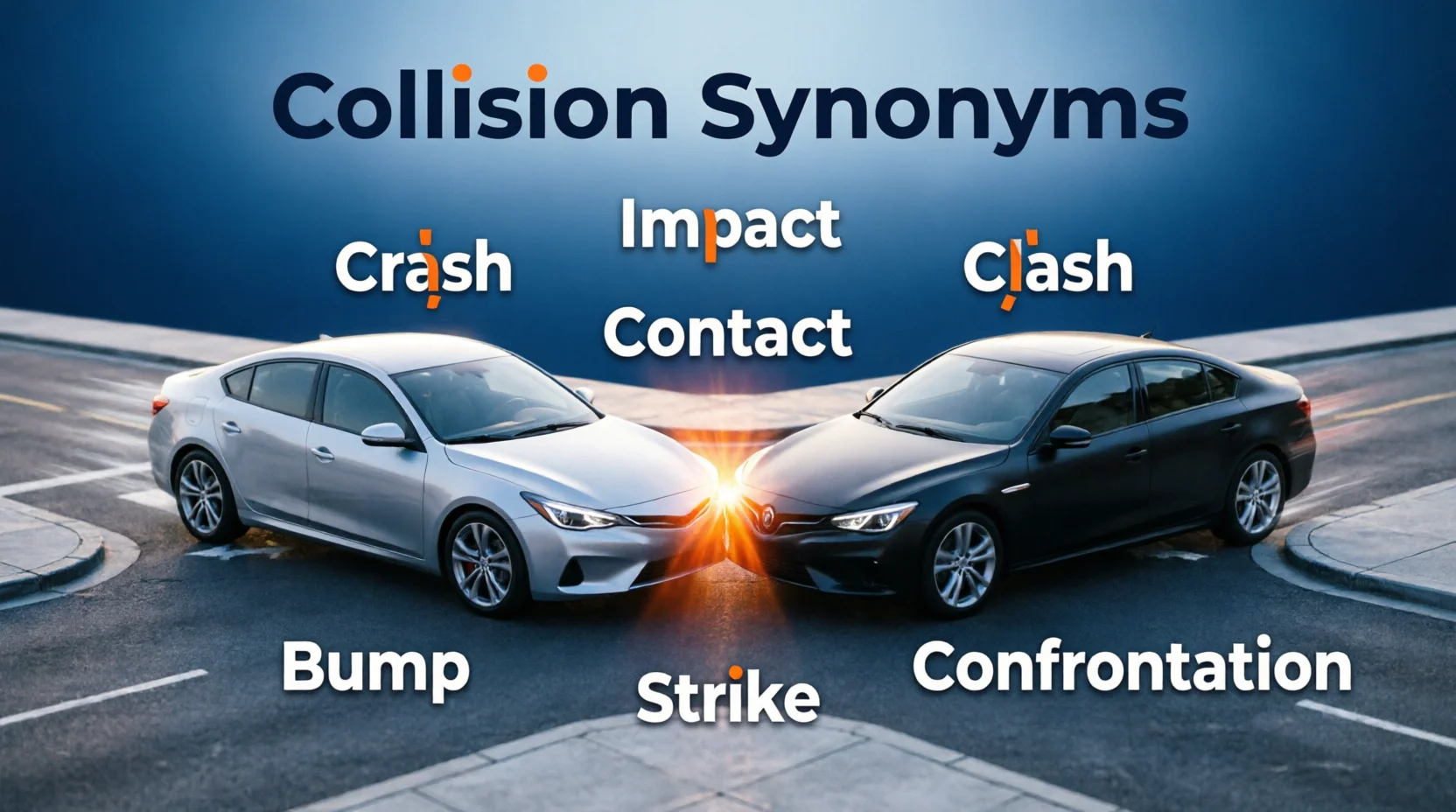
When you need a collision synonym, the best choice depends on the situation. Words such as crash, impact, clash, accident, contact, confrontation, and smash can describe different types of collisions, but they are not always interchangeable. This guide explains 30 useful alternatives in simple English, with examples and context so you can choose the right word confidently.
Quick Answer
A collision is an event in which two or more people, vehicles, objects, or forces hit or come together with force. Common synonyms include crash, impact, clash, accident, contact, bump, smash, wreck, strike, and confrontation.
The most suitable synonym depends on meaning. For example, crash is common for vehicles, impact emphasizes the force of hitting, clash often describes opposing people or ideas, and bump usually suggests a lighter collision.
What Does Collision Mean?
Collision means an instance of two or more things hitting each other, usually with some degree of force.
It can describe a physical event:
The two cars were involved in a collision.
It can also have a figurative meaning:
The meeting resulted in a collision of opposing ideas.
The word is common in everyday conversation, journalism, science, engineering, sports, and technical writing.
Collision as a Noun
As a noun, collision refers to the event itself.
Example:
“The collision damaged both vehicles.”
Collision as a Figurative Idea
Collision can also describe disagreement or conflict.
Example:
“The novel explores the collision between tradition and modern life.”
30 Collision Synonyms
1. Crash
Simple meaning: A violent or sudden collision, especially involving vehicles.
Example: The truck was involved in a serious crash.
Best usage/context: Vehicles, transportation, accidents, and everyday speech.
2. Impact
Simple meaning: The force or event of one thing hitting another.
Example: The impact damaged the front of the car.
Best usage/context: Formal, technical, scientific, and accident-related writing.
3. Clash
Simple meaning: A forceful meeting or conflict between two opposing things.
Example: The two teams clashed during the final match.
Best usage/context: Physical conflict, disagreements, opposing opinions, or groups.
4. Accident
Simple meaning: An unexpected event that causes damage, injury, or harm.
Example: She was delayed because of a road accident.
Best usage/context: Everyday descriptions of unexpected harmful events.
5. Contact
Simple meaning: Physical touching or meeting between two things.
Example: The ball made contact with the player’s foot.
Best usage/context: Sports, science, medicine, engineering, and situations where the force of the collision is not the main focus.
6. Bump
Simple meaning: A light or relatively minor collision.
Example: The two cyclists bumped into each other.
Best usage/context: Casual speech and minor physical collisions.
7. Smash
Simple meaning: A violent collision that causes something to break or become damaged.
Example: The car smashed into the barrier.
Best usage/context: Strong, vivid descriptions of crashes or impacts.
8. Wreck
Simple meaning: A serious accident or badly damaged vehicle.
Example: The collision left the vehicle a complete wreck.
Best usage/context: Serious vehicle accidents and descriptions of damaged objects.
9. Strike
Simple meaning: To hit something or someone with force.
Example: The vehicle struck a concrete wall.
Best usage/context: Formal writing, accident reports, sports, and physical impacts.
10. Hit
Simple meaning: To come into contact with something forcefully.
Example: The car hit a tree.
Best usage/context: Everyday English and straightforward descriptions.
11. Blow
Simple meaning: A strong hit or physical impact.
Example: The machine suffered a heavy blow during the accident.
Best usage/context: Physical impacts, fighting, sports, and figurative descriptions.
12. Contact Event
Simple meaning: An occurrence in which two objects or bodies touch.
Example: Researchers recorded the contact event between the two particles.
Best usage/context: Scientific and technical writing.
13. Encounter
Simple meaning: A meeting between people, objects, or forces.
Example: The spacecraft had an unexpected encounter with debris.
Best usage/context: Formal writing and situations involving an unusual meeting or interaction.
14. Confrontation
Simple meaning: A direct meeting or conflict between opposing people or groups.
Example: The argument developed into a confrontation.
Best usage/context: Human conflict, social situations, politics, and figurative writing.
15. Conflict
Simple meaning: A serious disagreement or struggle between opposing sides.
Example: The story focuses on the conflict between two families.
Best usage/context: Ideas, people, groups, interests, and abstract situations.
16. Altercation
Simple meaning: A heated argument or physical fight.
Example: The disagreement ended in a brief altercation.
Best usage/context: Formal descriptions of disputes or physical confrontations.
17. Collision Course
Simple meaning: A situation in which two things are moving toward an eventual conflict or meeting.
Example: The two organizations appeared to be on a collision course.
Best usage/context: Figurative writing about developing conflict.
18. Convergence
Simple meaning: The movement of two or more things toward the same point.
Example: The convergence of the two vehicles created a dangerous situation.
Best usage/context: Mathematics, science, geography, technology, and formal writing.
19. Meeting
Simple meaning: The point or event where two things come together.
Example: The meeting of the two moving objects caused a sudden change in direction.
Best usage/context: General and scientific descriptions, depending on context.
20. Contact
Simple meaning: The state of two things touching each other.
Example: The wheels lost contact with the ground.
Best usage/context: Physical, scientific, mechanical, and technical contexts.
21. Jolt
Simple meaning: A sudden strong movement or shock.
Example: Passengers felt a sharp jolt when the vehicles collided.
Best usage/context: Describing the sensation or movement caused by an impact.
22. Shock
Simple meaning: A sudden physical or emotional effect caused by an unexpected event.
Example: The collision caused a severe shock to the vehicle’s structure.
Best usage/context: Physical impacts and emotional reactions.
23. Contact Impact
Simple meaning: The effect produced when two objects touch or strike each other.
Example: Engineers measured the contact impact during the test.
Best usage/context: Technical descriptions involving physical force.
24. Scrape
Simple meaning: A light collision in which surfaces rub against each other.
Example: The car scraped against the parking barrier.
Best usage/context: Minor vehicle damage and surface contact.
25. Knock
Simple meaning: A hit or strike, usually less severe than a crash.
Example: The bicycle knocked against the fence.
Best usage/context: Everyday speech and minor impacts.
26. Tangle
Simple meaning: A situation where things become mixed together through contact or movement.
Example: The two cyclists became tangled after the collision.
Best usage/context: Objects, vehicles, people, wires, and figurative situations.
27. Pileup
Simple meaning: A crash involving several vehicles, often one after another.
Example: Heavy rain contributed to a major highway pileup.
Best usage/context: Roads, highways, traffic reports, and vehicle accidents.
28. Fender-Bender
Simple meaning: A minor vehicle accident, usually involving limited damage.
Example: They had a small fender-bender in the parking lot.
Best usage/context: Informal American English and minor car accidents.
29. Run-In
Simple meaning: An unexpected encounter or minor conflict.
Example: The two drivers had a run-in at the intersection.
Best usage/context: Informal English, interpersonal conflict, and minor incidents.
30. Concussion
Simple meaning: An injury caused by a blow or sudden movement of the head.
Example: The player suffered a concussion after the collision.
Best usage/context: Medical contexts involving head injuries.
Important: “Concussion” is not a direct synonym for “collision.” It describes a possible injury resulting from an impact.
Collision Synonyms Comparison Table
| Synonym | Main Meaning | Typical Context | Tone |
|---|---|---|---|
| Crash | Serious physical collision | Vehicles | Common |
| Impact | Force of hitting | Technical/formal | Formal |
| Clash | Physical or figurative conflict | People, ideas, groups | Neutral |
| Accident | Unexpected harmful event | Roads, workplaces | Common |
| Contact | Touching or meeting | Science, sports | Neutral |
| Bump | Minor collision | Everyday situations | Informal |
| Smash | Violent impact | Accidents, objects | Vivid |
| Wreck | Serious accident/damage | Vehicles | Common |
| Strike | Forceful hit | Reports, sports | Formal |
| Hit | Physical contact | Everyday English | Simple |
| Blow | Strong hit | Sports, fighting | Neutral |
| Encounter | Meeting | Formal/general | Formal |
| Confrontation | Direct conflict | People/groups | Formal |
| Conflict | Opposition or disagreement | Ideas/groups | Broad |
| Altercation | Heated dispute | People | Formal |
| Convergence | Movement toward one point | Science/math | Technical |
| Jolt | Sudden movement | Vehicles, machines | Descriptive |
| Shock | Sudden physical/emotional effect | Accidents | Broad |
| Scrape | Light rubbing collision | Vehicles | Informal |
| Knock | Minor hit | Everyday English | Simple |
| Pileup | Multi-vehicle crash | Highways | Common |
| Fender-bender | Minor car accident | Vehicles | Informal |
| Run-in | Minor encounter/conflict | People | Informal |
How to Choose the Right Collision Synonym
The best word depends on what collided, how strongly they collided, and what you want to emphasize.
For Vehicle Accidents
Use crash, accident, wreck, pileup, or fender-bender.
- Serious event → crash
- General unexpected event → accident
- Several vehicles → pileup
- Minor car accident → fender-bender
- Heavily damaged vehicle → wreck
Example:
“The highway was closed after a major pileup.”
For Formal or Technical Writing
Choose impact, contact, convergence, or strike.
Example:
“Engineers examined the impact between the two structures.”
These words are often more precise than casual terms such as “crash.”
For Minor Collisions
Use bump, knock, or scrape.
Example:
“The cyclist accidentally bumped into the pedestrian.”
These words are useful when the collision is not particularly serious.
For Physical or Violent Collisions
Use smash, strike, blow, or crash.
Example:
“The vehicle smashed into the barrier.”
These choices create a stronger impression of force.
For Ideas or Opinions
Use clash, conflict, confrontation, or collision itself.
Example:
“The debate revealed a clash between traditional and modern values.”
Here, “collision” is being used figuratively rather than literally.
For Scientific Contexts
Use impact, contact, collision, convergence, or encounter, depending on the exact situation.
Example:
“The researchers observed a collision between two particles.”
In scientific writing, precision matters, so replacing “collision” with a casual word like “crash” may change the intended meaning.
Collision vs. Crash
Collision is a broad term for two things hitting each other.
Crash usually suggests a sudden, forceful, and often damaging collision.
- “The two vehicles were involved in a collision.” → Neutral
- “The two vehicles crashed into each other.” → More dramatic
Collision vs. Impact
These words are closely related but emphasize different ideas.
Collision focuses on the event of things hitting each other.
Impact often focuses on the force or effect produced by that contact.
- “The collision occurred at an intersection.”
- “The impact damaged the front bumper.”
Collision vs. Clash
A collision can be physical, while a clash can be either physical or figurative.
- Physical: “The cars collided.”
- Figurative: “Their opinions clashed.”
Therefore, clash is especially useful when discussing disagreements, cultures, personalities, or ideas.
Collision vs. Accident
A collision describes two things hitting each other.
An accident describes an unexpected event that may involve a collision but does not necessarily require one.
For example, someone could have an accident by slipping on a wet floor without colliding with anything.
Common Mistakes When Using Collision Synonyms
Using “Concussion” as a Direct Synonym
A concussion is an injury, not the collision itself.
Incorrect:
“The cars had a concussion.”
Better:
“The cars were involved in a collision, and one driver suffered a concussion.”
Using “Crash” for Every Situation
“Crash” is natural for vehicles and some physical impacts, but it may sound inappropriate in scientific or abstract contexts.
Instead of:
“The particles crashed.”
A technical context may prefer:
“The particles collided.”
Confusing “Clash” With “Collision”
A clash can describe disagreement.
“Their personalities clashed.”
A collision usually refers to physical contact, although it can also be used figuratively.
Using “Fender-Bender” for a Serious Accident
A fender-bender suggests a relatively minor vehicle accident. It should not normally describe a severe crash involving major injuries or extensive damage.
Assuming All Synonyms Have the Same Strength
Words such as bump, scrape, crash, and smash communicate different levels of force.
Choose the word that matches the seriousness of the event.
FAQs:
What is the closest synonym for collision?
Crash is one of the closest everyday synonyms, especially when talking about vehicles. Impact is also closely related but emphasizes the force or effect of hitting.
What is a simple synonym for collision?
Crash, hit, bump, and contact are simple alternatives, although each has a slightly different meaning.
What is a synonym for collision in a formal context?
Impact, contact, confrontation, strike, and convergence can work in formal contexts depending on the subject.
What is a synonym for a minor collision?
Bump, scrape, knock, and fender-bender can describe relatively minor collisions.
What is the difference between collision and crash?
A collision is any event in which things hit each other. A crash usually suggests a sudden, forceful, and potentially damaging collision.
Can clash be a synonym for collision?
Yes, in some contexts. Clash can describe a physical meeting, but it is also commonly used for disagreements between people, groups, ideas, or cultures.
What is a synonym for collision between ideas?
Useful choices include clash, conflict, confrontation, and opposition. The best option depends on whether you want to emphasize disagreement, tension, or direct confrontation.
What is the plural of collision?
The plural is collisions. For example: “The report examined several collisions on the highway.”
Conclusion
Choosing the right collision synonym makes your writing more precise and natural. Crash works well for serious vehicle accidents, bump suits minor impacts, impact fits formal and technical contexts, while clash is useful for physical or figurative conflict. Words such as scrape, strike, pileup, fender-bender, confrontation, and contact each carry their own meaning and tone.
The key is to consider the situation before replacing “collision.” Think about the force involved, the things that came together, if the meaning is literal or figurative, and how formal your writing needs to be.

I am Camden Thomas, an Administrator at SaysReply. I help maintain our platform and ensure readers find clear, natural, and useful alternative ways to express their thoughts every day.







3 thoughts on “Collision Synonym: 30 Powerful Alternatives for Clearer Writing”