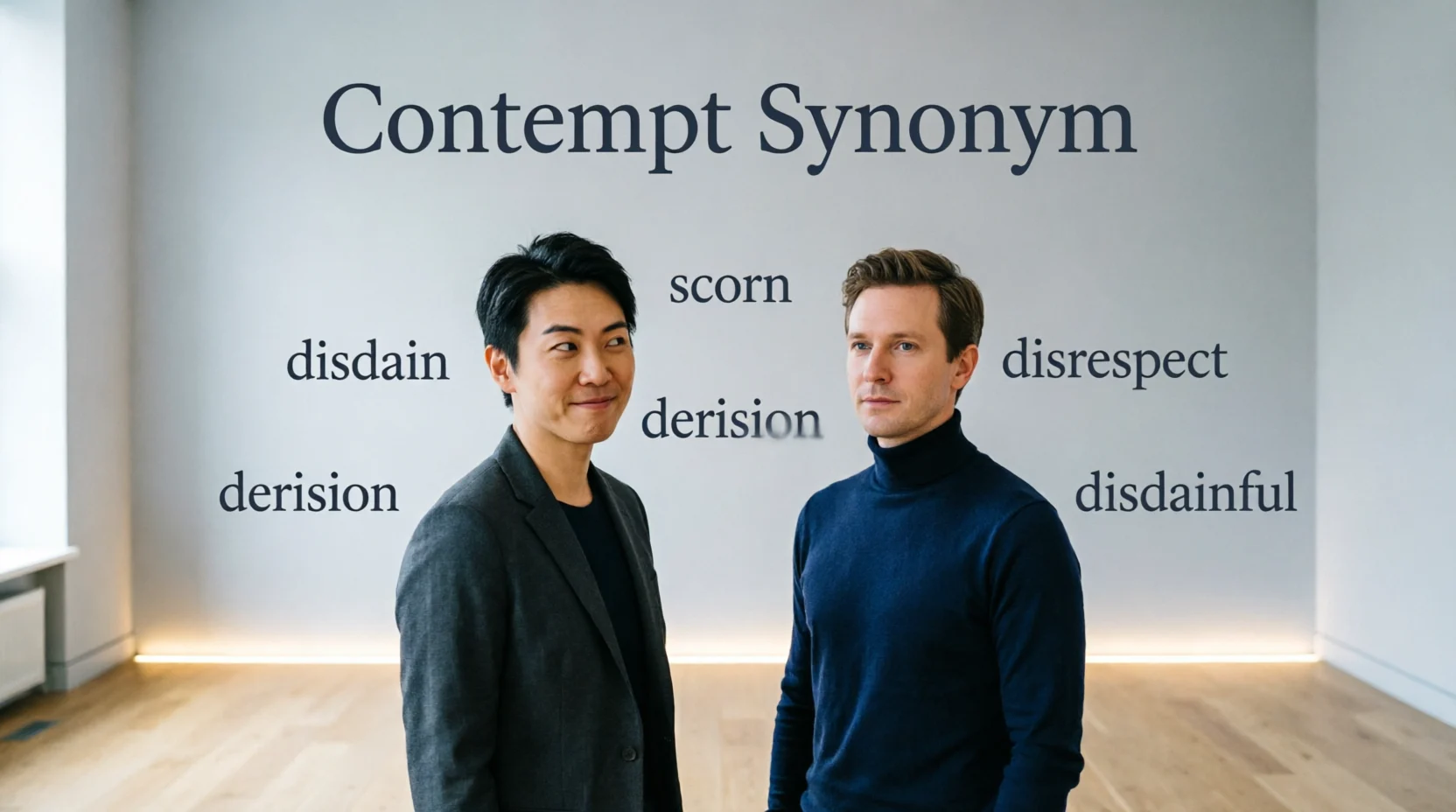
Finding the right contempt synonym depends on exactly what you mean. Contempt describes a strong feeling that someone or something is unworthy of respect, often mixed with scorn, disdain, or open disrespect. Common alternatives include scorn, disdain, disrespect, derision, mockery, disparagement, and loathing, but each carries a slightly different tone.
Choosing the right synonym can make your writing more precise. For example, disdain often sounds formal, mockery focuses on making fun of someone, while disrespect is broader and more direct. Understanding these differences helps students, ESL learners, writers, and content creators express negative attitudes accurately.
Quick Answer: What Is a Good Synonym for Contempt?
The best general synonyms for contempt are scorn, disdain, disrespect, derision, and disparagement.
- Scorn — strong rejection mixed with disrespect
- Disdain — a feeling that someone or something is beneath your respect
- Disrespect — lack of proper respect
- Derision — contempt expressed through ridicule or laughter
- Disparagement — speaking about someone or something in a belittling way
- Mockery — behavior that makes someone or something look foolish
- Loathing — intense dislike, often stronger than contempt
The best choice depends on whether you want to emphasize disrespect, ridicule, rejection, dislike, criticism, or superiority.
What Does Contempt Mean?
Contempt is a strong feeling of disrespect toward someone or something considered inferior, unworthy, or deserving of little regard.
For example:
She looked at the dishonest politician with contempt.
This sentence suggests more than simple dislike. She considers the person’s behavior beneath her respect.
Contempt can describe an internal feeling, an attitude, or behavior that shows a lack of respect.
Contempt as a Noun
As a noun, contempt refers to the feeling itself.
Example:
He treated the dishonest business practice with contempt.
Contempt as an Attitude
Contempt can also describe an attitude that communicates superiority or disrespect.
Example:
Her tone revealed contempt for anyone who disagreed with her.
Contempt in Legal Language
In legal contexts, contempt can have a more specific meaning. Contempt of court, for example, refers to conduct that disobeys or interferes with the authority or proceedings of a court.
This legal meaning is different from the ordinary emotional meaning of contempt.
30 Contempt Synonyms and Related Alternatives
Below are 30 useful words and closely related expressions. Some are direct synonyms, while others emphasize a particular aspect of contempt, such as ridicule, dislike, criticism, or disrespect.
1. Scorn
Simple meaning: Strong disrespect or rejection toward someone or something considered unworthy.
Example:
She expressed scorn for his dishonest excuses.
Best usage/context: Use scorn when contempt involves strong rejection or open disrespect.
2. Disdain
Simple meaning: A feeling that someone or something is beneath your respect.
Example:
He spoke with disdain about the unfair decision.
Best usage/context: Excellent for formal, literary, or polished writing.
3. Disrespect
Simple meaning: A lack of respect for someone or something.
Example:
His comments showed clear disrespect toward his teacher.
Best usage/context: Use it in everyday English when you want a direct and familiar word.
4. Derision
Simple meaning: Contempt expressed through ridicule or laughter.
Example:
The proposal was met with derision by several critics.
Best usage/context: Useful in formal writing when contempt is expressed by mocking someone.
5. Mockery
Simple meaning: Behavior or words that make someone or something seem foolish.
Example:
Her imitation of him was intended as mockery.
Best usage/context: Best when contempt is communicated through imitation, jokes, or ridicule.
6. Disparagement
Simple meaning: Speaking about someone or something in a way that makes them seem less valuable.
Example:
Constant disparagement of his coworkers damaged the team’s morale.
Best usage/context: Particularly useful in formal, professional, and academic writing.
7. Denigration
Simple meaning: The act of unfairly making someone or something seem less important or valuable.
Example:
The article was criticized for its denigration of local traditions.
Best usage/context: Use it for serious criticism or language that deliberately lowers someone’s reputation or value.
8. Belittlement
Simple meaning: Treating someone or something as less important or capable than they really are.
Example:
His constant belittlement of younger employees created tension in the office.
Best usage/context: Useful when contempt involves making another person feel inferior.
9. Disapproval
Simple meaning: A feeling that something is wrong or unacceptable.
Example:
She expressed strong disapproval of his behavior.
Best usage/context: Use this when you want a milder and more neutral alternative to contempt.
10. Dislike
Simple meaning: A feeling of not liking someone or something.
Example:
He has a strong dislike of arrogant behavior.
Best usage/context: Appropriate when the feeling is negative but not necessarily contemptuous.
11. Aversion
Simple meaning: A strong feeling of dislike or unwillingness toward something.
Example:
She has an aversion to dishonest business practices.
Best usage/context: Useful for formal writing and strong personal dislike.
12. Loathing
Simple meaning: An extremely strong feeling of dislike or hatred.
Example:
He felt deep loathing for the cruelty he witnessed.
Best usage/context: Use when the emotional intensity is stronger than ordinary contempt.
13. Hatred
Simple meaning: An intense feeling of dislike toward someone or something.
Example:
Years of conflict had created deep hatred between the groups.
Best usage/context: Use when the main idea is intense hostility rather than superiority or disrespect.
14. Antipathy
Simple meaning: A strong feeling of dislike toward someone or something.
Example:
She felt an immediate antipathy toward his arrogant attitude.
Best usage/context: A formal word suitable for essays, criticism, and sophisticated writing.
15. Disapprobation
Simple meaning: Strong criticism or expression of disapproval.
Example:
The decision received widespread disapprobation from the community.
Best usage/context: Best suited to formal or literary contexts.
16. Rejection
Simple meaning: Refusal to accept, approve, or support someone or something.
Example:
His proposal faced immediate rejection.
Best usage/context: Use when contempt involves refusing to accept or recognize something.
17. Disparity
Simple meaning: A noticeable difference between people or things.
Example:
The disparity between the two groups became difficult to ignore.
Best usage/context: This is not a direct synonym for contempt. It may be relevant when discussing perceived superiority or inequality, but should not normally replace contempt.
18. Disregard
Simple meaning: Lack of attention, concern, or respect.
Example:
His disregard for other people’s opinions frustrated his colleagues.
Best usage/context: Useful when contempt appears as deliberate lack of respect or consideration.
19. Neglect
Simple meaning: Failure to give proper attention or care.
Example:
Her neglect of basic safety rules caused problems.
Best usage/context: Use when the behavior involves ignoring something rather than actively despising it.
20. Sneering
Simple meaning: Showing disrespect or contempt through a mocking expression or tone.
Example:
His sneering response made the conversation uncomfortable.
Best usage/context: Strong choice when contempt is visible in someone’s facial expression or voice.
21. Ridicule
Simple meaning: Words or actions that make someone appear foolish or ridiculous.
Example:
The scientist faced ridicule after presenting the unusual theory.
Best usage/context: Use when contempt is expressed through public or private mockery.
22. Taunting
Simple meaning: Deliberately provoking or insulting someone.
Example:
The player’s taunting behavior angered his opponent.
Best usage/context: Useful when contempt is expressed through provocative remarks.
23. Jeering
Simple meaning: Shouting insults or mocking comments at someone.
Example:
The speaker continued despite the crowd’s jeering.
Best usage/context: Particularly useful for crowds, public events, sports, and hostile situations.
24. Insult
Simple meaning: A rude or offensive remark directed at someone.
Example:
His comment was intended as an insult.
Best usage/context: Use when contempt takes the form of a direct offensive statement.
25. Slighting
Simple meaning: Treating someone as unimportant or failing to give them proper respect.
Example:
She felt that his refusal to acknowledge her work was a slight.
Best usage/context: Useful when contempt is subtle rather than openly hostile.
26. Humiliation
Simple meaning: The experience of being made to feel ashamed, embarrassed, or inferior.
Example:
Public criticism caused considerable humiliation.
Best usage/context: Use when the focus is on the emotional effect rather than the contemptuous attitude itself.
27. Devaluation
Simple meaning: Treating someone or something as less valuable or important.
Example:
The repeated criticism led to the devaluation of her contributions.
Best usage/context: Useful in professional, social, economic, and analytical contexts.
28. Condescension
Simple meaning: An attitude of behaving as though you are more intelligent or important than someone else.
Example:
His condescension made the new employees uncomfortable.
Best usage/context: Excellent when contempt is communicated through an attitude of superiority.
29. Opprobrium
Simple meaning: Strong public criticism, blame, or disgrace.
Example:
The scandal brought widespread opprobrium upon the organization.
Best usage/context: Best for formal writing when strong public condemnation is involved.
30. Contemptuousness
Simple meaning: The quality of showing contempt or strong disrespect.
Example:
The contemptuousness of his response was obvious.
Best usage/context: Use when describing the attitude or manner in which someone shows contempt.
Contempt Synonyms Comparison Table
| Word | Main idea | Strength | Tone | Best context |
|---|---|---|---|---|
| Scorn | Strong rejection and disrespect | Strong | Formal/general | Writing and speech |
| Disdain | Feeling of superiority or unworthiness | Strong | Formal | Essays, literature |
| Disrespect | Lack of respect | Moderate–strong | Everyday | Conversation |
| Derision | Ridicule mixed with contempt | Strong | Formal | Criticism |
| Mockery | Making someone look foolish | Moderate–strong | General | Social situations |
| Disparagement | Belittling someone or something | Strong | Formal | Professional writing |
| Denigration | Lowering someone’s value or reputation | Strong | Formal | Academic writing |
| Belittlement | Making someone seem inferior | Moderate–strong | General | Relationships/work |
| Disapproval | Saying something is unacceptable | Mild–moderate | Neutral | General |
| Dislike | Not liking something | Mild | Neutral | Everyday English |
| Aversion | Strong dislike | Moderate–strong | Formal | Personal preferences |
| Loathing | Extremely strong dislike | Very strong | Emotional | Serious situations |
| Antipathy | Strong dislike | Strong | Formal | Essays/literature |
| Disregard | Lack of concern or respect | Moderate | Neutral | Behavior |
| Ridicule | Making someone seem foolish | Strong | General | Public criticism |
| Condescension | Acting superior | Strong | Formal/general | Social behavior |
| Opprobrium | Public condemnation | Strong | Formal | News and commentary |
Contempt vs. Scorn
Contempt and scorn are very close in meaning.
Contempt emphasizes the feeling that someone or something is beneath respect. Scorn often adds a stronger sense of rejection or open expression.
She regarded the dishonest behavior with contempt.
She dismissed the dishonest behavior with scorn.
Both sentences communicate strong disrespect, but scorn can sound more openly dismissive.
Contempt vs. Disdain
Disdain is one of the closest alternatives to contempt.
Both words can describe a feeling of superiority toward someone or something considered unworthy.
However, disdain often sounds more controlled or formal.
He showed contempt for the dishonest businessman.
He expressed disdain for the dishonest business practices.
The second sentence has a somewhat more formal tone.
Contempt vs. Disrespect
Disrespect is broader and more common in everyday English.
A person can show disrespect without necessarily feeling deep contempt.
For example:
Interrupting someone repeatedly can be disrespectful.
But contempt generally suggests a stronger negative attitude.
Contempt vs. Mockery
Mockery focuses on making someone or something look foolish.
Contempt focuses on the underlying attitude of disrespect.
Someone can mock another person because they hold that person in contempt, but mockery and contempt are not always identical.
Contempt vs. Hatred
Hatred describes intense hostility or dislike.
Contempt is different because it often involves the belief that the target is inferior, unworthy, or beneath respect.
Someone may hate an opponent while still respecting that opponent’s abilities. Contempt usually carries less respect.
How to Choose the Right Contempt Synonym
For Formal or Academic Writing
Choose words such as:
- Disdain
- Disparagement
- Denigration
- Antipathy
- Disapprobation
- Opprobrium
These words can provide greater precision in essays, analysis, and formal discussions.
For Everyday Conversation
Use:
- Disrespect
- Dislike
- Mockery
- Insult
- Ridicule
- Scorn
These are generally easier for everyday readers to understand.
When You Mean Superiority
Choose:
- Disdain
- Contempt
- Condescension
- Scorn
These words work well when someone behaves as though another person is beneath them.
When You Mean Ridicule
Choose:
- Derision
- Mockery
- Ridicule
- Jeering
- Taunting
These are better when contempt is expressed through jokes, laughter, insults, or provocative behavior.
When You Mean Strong Dislike
Choose:
- Loathing
- Aversion
- Antipathy
- Hatred
Remember that these words emphasize dislike more than superiority.
When You Mean Public Criticism
Choose:
- Opprobrium
- Disapprobation
- Denigration
- Disparagement
These work especially well when describing criticism from a group or community.
Common Usage Mistakes
Mistake 1: Treating Every Negative Feeling as Contempt
Not every negative emotion means contempt.
Dislike can be mild. Hatred emphasizes intense hostility. Contempt usually includes a strong lack of respect.
Mistake 2: Using “Mockery” as a Perfect Replacement
Mockery describes an action or form of expression, while contempt can exist as a private attitude.
Less precise:
He felt mockery toward his rival.
Better:
He felt contempt toward his rival.
Or:
He mocked his rival with open contempt.
Mistake 3: Confusing Disapproval with Contempt
Disapproval does not necessarily imply superiority or disrespect.
I disapprove of the decision.
This simply means you believe the decision is wrong or unacceptable.
I hold the decision in contempt.
This expresses a much stronger attitude.
Mistake 4: Using “Disparity” as a Synonym
Disparity means a significant difference or inequality. It does not normally mean contempt.
For example:
There is a disparity in income between the two groups.
It should not normally replace:
She showed contempt for the opposing view.
Mistake 5: Choosing a Word That Is Too Strong
Using loathing or hatred when you only mean mild disapproval can exaggerate your message.
Choose the word according to the emotional intensity you actually want to communicate.
FAQs:
What is the closest synonym for contempt?
Scorn and disdain are among the closest synonyms for contempt. Both can describe strong disrespect toward someone or something considered unworthy.
What is a simple synonym for contempt?
Disrespect is one of the simplest everyday alternatives. Depending on context, dislike can also work when the feeling is less intense.
What is a stronger word than contempt?
Words such as loathing or hatred can express stronger negative emotions, although they do not have exactly the same meaning. Contempt specifically emphasizes lack of respect and often a sense of superiority.
Is disdain the same as contempt?
They are very similar, but not always identical. Both can describe looking down on someone or something. Disdain often has a more formal or restrained tone.
What is the opposite of contempt?
Possible opposites include respect, admiration, appreciation, esteem, regard, and reverence, depending on the context.
Is disrespect a synonym for contempt?
Disrespect can be a synonym in many contexts, but it is broader. Contempt usually suggests a stronger and more deeply negative attitude.
What is contempt in simple English?
Contempt means a strong feeling that someone or something does not deserve your respect.
What is the difference between contempt and ridicule?
Contempt is primarily an attitude or feeling of strong disrespect. Ridicule is an action or form of communication that makes someone or something appear foolish.
Conclusion
The best contempt synonym depends on the exact meaning and tone you want. Scorn and disdain are close alternatives, while disrespect is more common in everyday English. Derision, mockery, and ridicule are useful when contempt is expressed through humor or criticism.
For formal writing, words such as disparagement, denigration, antipathy, and opprobrium can add precision. When you understand the small differences between these words, your writing becomes clearer, more natural, and more expressive.

I’m Amelia Rose, an enthusiastic writer who enjoys exploring better, clearer, and more natural ways to express ideas. I create helpful content that makes finding alternative phrases simple, useful, and enjoyable for everyone.