Verb mood is a grammatical feature that shows how a speaker or writer presents an action, idea, or statement. Mood in verbs helps readers understand if someone is stating a fact, giving a command, expressing a wish, or imagining a situation. It adds meaning and purpose to sentences beyond simply describing what happens.
Understanding verb moods is important for students, ESL learners, and anyone who wants to improve their English grammar. For example, She works every day expresses a fact, while Work every day gives a command. Similarly, I wish she were here expresses a hypothetical situation. Although these sentences use verbs differently, each one communicates a particular attitude or intention.
In this guide, you will learn what verb mood means, explore its main types, understand how they differ, and discover practical examples that make each type easier to recognize and use correctly.
Quick Answer: What Is Mood in Verbs?
Mood in verbs is the grammatical form that expresses the speaker’s attitude or intention toward an action or situation. The three main moods commonly taught in English grammar are indicative, imperative, and subjunctive. They help communicate facts, commands, requests, wishes, suggestions, and hypothetical situations.
Why Do People Confuse Mood in Verbs?
People often confuse verb mood because it is closely related to verb tense and sentence structure. However, these grammatical concepts have different purposes.
- Verb mood shows how the speaker presents an action or situation.
- Verb tense indicates when an action happens, such as in the past, present, or future.
- Verb voice shows whether the subject performs or receives an action.
For example:
- She writes a letter. (Indicative mood)
- Write a letter. (Imperative mood)
- I suggest that she write a letter. (Subjunctive mood)
All three sentences contain the verb write, but each communicates a different intention.
First Word: Mood in Verbs
The word mood in grammar refers to the attitude, feeling, or intention expressed through a verb.
It does not necessarily describe someone’s emotional condition. Instead, it explains how a sentence presents an action or idea.
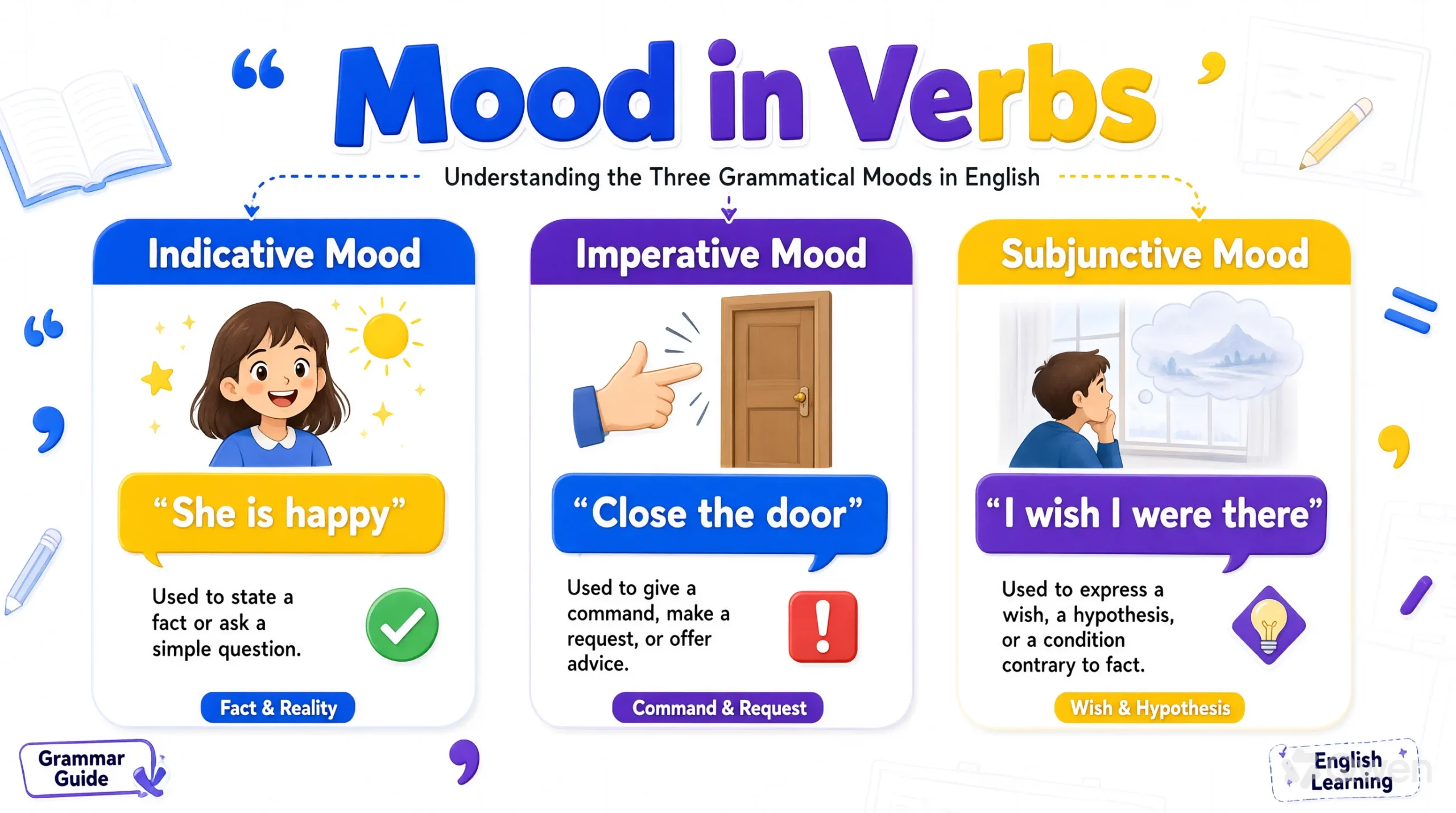
English grammar commonly identifies three main verb moods:
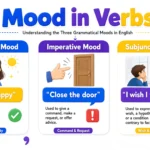
- Indicative mood: Used to state facts, opinions, and ask questions.
- Imperative mood: Used to give commands, instructions, and requests.
- Subjunctive mood: Used to express wishes, demands, recommendations, and hypothetical situations.
Some grammar resources also discuss conditional and interrogative constructions as additional moods or sentence patterns. However, the three traditional categories provide a useful foundation for learning English verb mood.
Second Word: Verbs
A verb is a word that expresses an action, occurrence, or state of being.
Examples include:
- Run
- Eat
- Write
- Think
- Become
- Is
- Have
- Believe
Verbs are essential to sentence construction because they communicate what a subject does, experiences, or is.
For example:
- Ali plays football.
- They are happy.
- She believes in herself.
The verb can change its form or function depending on the grammatical mood of the sentence.
When mood and verbs work together, they help communicate whether something is a fact, an instruction, a possibility, or a desired situation.
Comparison Table: Three Main Types of Verb Mood
The following table explains the three main verb moods and their purposes.
| Verb Mood | Main Purpose | Example |
| Indicative | States facts or asks questions | She sings beautifully. |
| Imperative | Gives commands or requests | Please sit down. |
| Subjunctive | Expresses wishes or hypothetical ideas | I wish I were taller. |
These moods make sentences more meaningful by showing the speaker’s intention.
When to Use Each Verb Mood
Choosing the correct verb mood depends on what you want to communicate.
1. When to Use the Indicative Mood
Use the indicative mood when you want to communicate information, describe something, express an opinion, or ask a question.
Examples:
- The sun rises in the east.
- My brother studies English.
- They are watching television.
- Do you like coffee?
The indicative mood is the most commonly used mood in everyday English.
2. When to Use the Imperative Mood
Use the imperative mood when you want someone to do something.
It is commonly used for:
- Commands
- Instructions
- Directions
- Requests
- Warnings
- Advice
Examples:
- Open the window.
- Please help me.
- Turn left at the next street.
- Be careful!
Imperative sentences usually use the base form of the verb. The subject you is understood rather than directly stated.
3. When to Use the Subjunctive Mood
Use the subjunctive mood when expressing wishes, recommendations, demands, requirements, or situations that are imagined rather than presented as facts.
Examples:
- I wish I were rich.
- The teacher suggested that he study harder.
- It is important that she be present.
- If I were you, I would apologize.
The subjunctive mood is particularly useful in formal writing and hypothetical expressions.
12 Examples of Mood in Verbs
Here are practical examples showing how different verb moods work in English sentences.
Indicative Mood Examples
- She teaches English at school.
- The children are playing outside.
- I enjoy reading books.
- Does your sister work here?
These sentences provide information or ask questions.
Imperative Mood Examples
- Close the door.
- Please bring me a glass of water.
- Study carefully for your examination.
- Never touch a hot stove.
These sentences communicate instructions, requests, and warnings.
Subjunctive Mood Examples
- I wish I were a professional singer.
- The manager requested that everyone arrive early.
- If he were here, he would help us.
- It is essential that the report be completed today.
These sentences express wishes, recommendations, requirements, and hypothetical situations.
Common Mistakes When Using Verb Mood
English learners sometimes make mistakes when choosing the correct verb mood. Understanding these common problems can help improve sentence construction.
1. Confusing Mood With Tense
Incorrect understanding: Mood and tense mean the same thing.
Correct understanding: Mood expresses the speaker’s attitude, while tense indicates the time of an action.
Example:
- She works. (Present tense, indicative mood)
- She worked. (Past tense, indicative mood)
2. Using the Wrong Verb Form in the Subjunctive
Incorrect: I wish I was taller.
Traditional formal subjunctive: I wish I were taller.
In everyday English, was is also widely used in some informal hypothetical expressions. However, were is the standard choice in formal subjunctive constructions.
3. Adding a Subject to Every Imperative Sentence
Incorrect: You open the door!
Correct: Open the door!
The subject you is normally understood in imperative sentences. It can be included for emphasis, but it is not usually necessary.
4. Using an Incorrect Verb Form After Suggestion
Incorrect: I suggest that he studies regularly.
Correct: I suggest that he study regularly.
In a mandative subjunctive construction, the verb uses its base form regardless of the subject.
5. Confusing Commands With Statements
- You should complete your homework. (Indicative construction expressing advice)
- Complete your homework. (Imperative mood)
Both sentences communicate advice or instructions, but their grammatical structures are different.
Memory Trick: How to Remember Verb Moods
A simple way to remember the three main verb moods is to associate each one with a different purpose.
Indicative = Information
Tell something or ask something.
Example: She is a teacher.
Imperative = Instruction
Tell someone to do something.
Example: Open your book.
Subjunctive = Imagination
Express wishes or hypothetical situations.
Example: I wish I were there.
Remember these three words: Information, Instruction, Imagination. They make the main verb moods easier to identify.
American vs British English: Is Verb Mood Different?
The basic system of verb moods is generally the same in American and British English. Both varieties use indicative, imperative, and subjunctive constructions.
However, some differences appear in everyday usage.
| Grammar Feature | American English | British English |
| Subjunctive after suggestions | Common | Common, with more variation in usage |
| Formal hypothetical expressions | I wish I were there. | I wish I were there. |
| Informal hypothetical expressions | I wish I was there. | I wish I was there. |
| Imperative instructions | Take a seat. | Take a seat. |
Both varieties accept the formal subjunctive construction:
– The doctor recommended that he rest.
British English also commonly uses should in this type of construction:
– The doctor recommended that he should rest.
These differences do not change the basic meaning of verb mood.
Similar Words and Related Grammar Terms
Several grammatical terms are closely connected to mood in verbs. Understanding them makes it easier to study English grammar.
| Related Term | Meaning | Example |
| Verb tense | Shows when an action happens | She walked. |
| Verb voice | Shows the relationship between the subject and action | The cake was baked. |
| Verb form | The different forms a verb can take | Go, goes, went |
| Indicative | Expresses facts or questions | He is sleeping. |
| Imperative | Expresses commands or requests | Come here. |
| Subjunctive | Expresses wishes or demands | I suggest that he go. |
| Conditional | Expresses a result depending on a condition | I would travel if I had money. |
| Interrogative | Describes a question structure | Are you ready? |
Important distinction: Conditional and interrogative are often taught alongside verb moods, but many traditional English grammar systems classify them as sentence structures or constructions rather than separate main verb moods.
Final Verdict: What Should You Know About Mood in Verbs?
Mood in verbs explains how a speaker or writer presents an action, statement, or situation. It helps distinguish between facts, commands, wishes, and hypothetical ideas.
The three main moods in traditional English grammar are indicative, imperative, and subjunctive. Each has a different purpose and follows particular grammatical patterns.
Learning these moods makes it easier to understand sentences, express ideas clearly, and avoid common grammar mistakes.
FAQs:
1. What are the three main moods of verbs?
The three main moods of verbs in traditional English grammar are indicative, imperative, and subjunctive. Indicative expresses facts and questions, imperative gives commands or requests, and subjunctive expresses wishes, demands, and hypothetical situations.
2. What is an example of mood in a verb?
An example is the sentence I wish I were taller. The verb were expresses a hypothetical or imagined situation, making this a subjunctive construction.
3. What is the difference between verb mood and verb tense?
Verb mood expresses the speaker’s attitude or intention toward an action, while verb tense shows when the action occurs. For example, She works and She worked use different tenses but both are in the indicative mood.
4. Is imperative a mood in English grammar?
Yes. Imperative is one of the three main traditional verb moods. It is used to give instructions, commands, warnings, and requests. For example, Please close the window is an imperative sentence.
5. What is the subjunctive mood used for?
The subjunctive mood is used to express wishes, hypothetical situations, suggestions, recommendations, and demands. Examples include I wish I were there and The teacher suggested that he study more.
6. Is the indicative mood the most common verb mood?
Yes. The indicative mood is the most commonly used mood in everyday English. People use it to share information, describe events, express opinions, and ask questions.
7. Can one verb have different moods?
Yes. The same verb can appear in different moods depending on how it is used in a sentence.
For example:
- She writes every morning. (Indicative)
- Write your name here. (Imperative)
- I suggest that she write daily. (Subjunctive)
Remember This
- Indicative mood communicates facts, opinions, and questions.
- Imperative mood communicates commands, instructions, and requests.
- Subjunctive mood communicates wishes, demands, and hypothetical situations.
- Mood and tense are different grammatical concepts.
- The same verb can be used in different moods depending on the sentence.
Conclusion
Understanding mood in verbs is an important part of learning English grammar. It helps you recognize how sentences communicate facts, instructions, wishes, and imaginary situations. The three main verb moods—indicative, imperative, and subjunctive—each serve a different purpose in communication.
With regular practice and simple examples, you can identify these moods and use them correctly in speaking and writing. If you are a student, ESL learner, or beginner, learning verb moods will help you build clearer sentences and become a more confident English communicator.

I am Camden Thomas, an Administrator at SaysReply. I help maintain our platform and ensure readers find clear, natural, and useful alternative ways to express their thoughts every day.