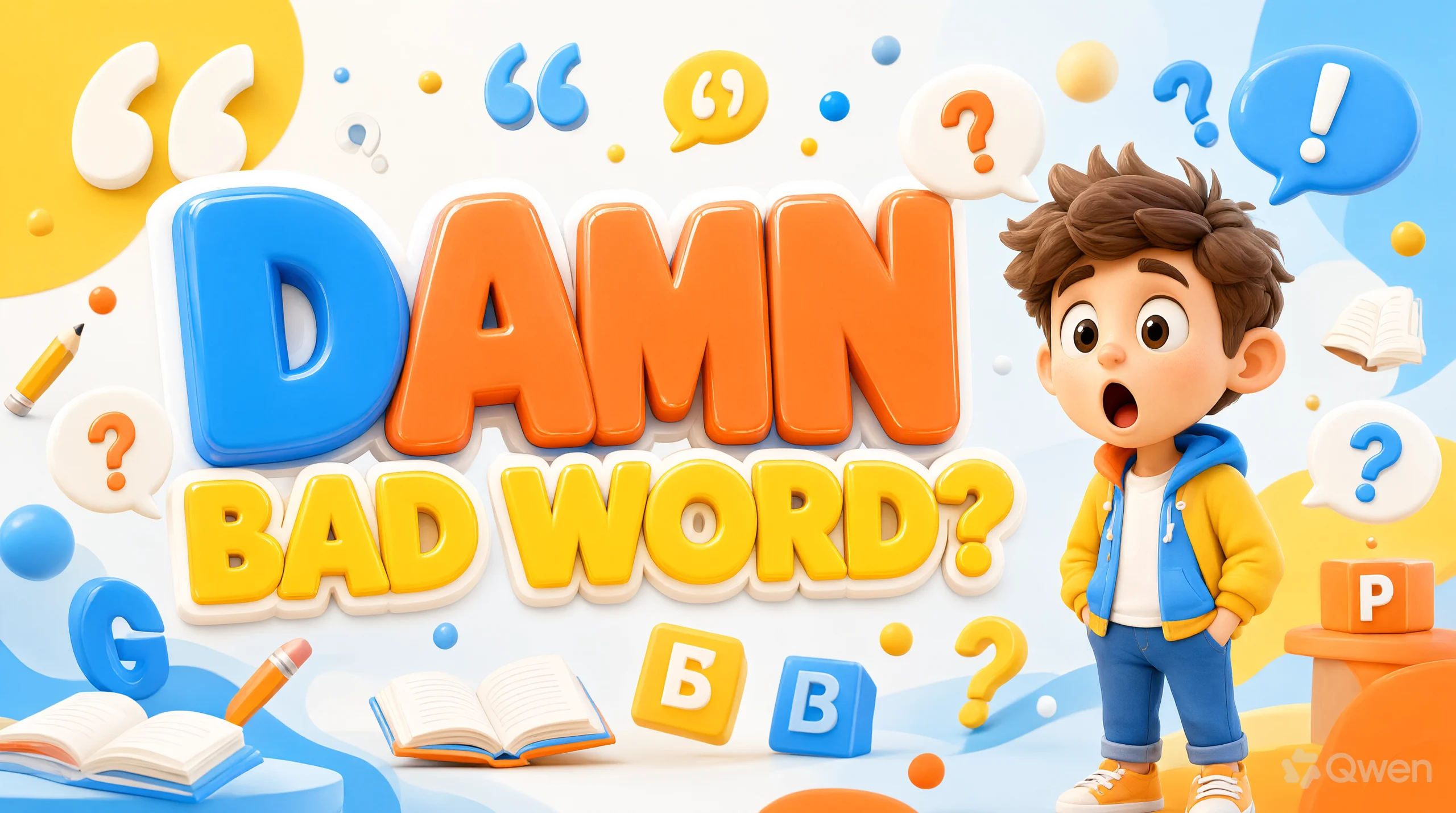
The word “damn” is common in everyday English, movies, television shows, music, and casual conversations. However, many people wonder if it is a bad word, a swear word, or simply an informal expression. If you are learning English, understanding when and how to use “damn” can help you communicate naturally without accidentally offending someone.
The answer depends on the situation, your tone, and the people around you. Damn is generally considered a mild swear word or profanity. It is not as offensive as stronger curse words, but some people consider it inappropriate, especially in formal settings, religious environments, schools, or conversations with children. It can express anger, frustration, surprise, disappointment, or emphasis. Understanding its different uses will help you decide when it is acceptable and when another word would be better.
Quick Answer: Is Damn a Bad Word?
Yes, “damn” is considered a mild swear word in English. It can express frustration, anger, surprise, or emphasis. Although it is less offensive than stronger profanity, some people find it disrespectful or inappropriate. It is generally acceptable in casual conversations but best avoided in formal, professional, and religious settings.
Why Do People Confuse Whether Damn Is a Bad Word?
People disagree about the word “damn” because its meaning and level of offensiveness depend on cultural background, personal beliefs, and context.
There are three main reasons for this confusion:
- Religious background: Some people consider “damn” offensive because of its historical connection to divine punishment and condemnation.
- Everyday language: Many English speakers use it casually, making it sound less serious than other swear words.
- Different situations: Saying “Damn, I forgot my keys” is usually less offensive than using the word to insult another person.
The word can also appear in positive expressions, such as “That was a damn good performance.” In this sentence, it adds emphasis rather than expressing anger.
First Word: Damn
Damn is an informal expression that can function as a verb, interjection, adjective-like intensifier, or part of a fixed expression.
What Does Damn Mean?
The word “damn” generally means to condemn, criticize, express frustration, or add strong emphasis.
Historically, it is connected to the idea of condemning someone to punishment. In modern everyday English, it often has a much lighter meaning.
Is Damn Considered a Swear Word?
Yes. Most dictionaries and language references classify “damn” as a mild swear word, curse word, or informal exclamation.
However, its offensiveness varies:
- In casual conversations, it is often accepted.
- In professional environments, it may sound unprofessional.
- In religious settings, it may be considered disrespectful.
- Around young children, some adults prefer not to use it.
Examples of Damn
- Damn, I missed the bus!
- That was a damn good movie.
- Where is my damn phone?
- Damn it, I forgot the meeting.
- He was determined to damn his critics.
Second Word: Bad Word
A bad word is a word that people consider rude, offensive, inappropriate, insulting, or socially unacceptable.
Bad words can include profanity, vulgar expressions, insults, and words that disrespect particular people or groups.
What Makes a Word Bad?
A word may be considered inappropriate because of:
- Its historical or religious meaning.
- Its connection to insulting or disrespectful behavior.
- The emotions it communicates.
- The social setting in which it is used.
- The cultural or personal beliefs of the listener.
Not every bad word has the same level of offensiveness. Some are mildly inappropriate, while others are extremely offensive.
Damn vs. Bad Word: Comparison Table
| Feature | Damn | Bad Word |
| Meaning | A mild swear word or expression | A general category of inappropriate language |
| Word type | Interjection, verb, intensifier | General language category |
| Offensiveness | Usually mild | Can range from mild to severe |
| Formal usage | Generally avoided | Depends on the word |
| Casual usage | Common in many settings | Depends on the expression |
| Example | Damn, that’s expensive! | An offensive insult |
Important: “Damn” is one example of a bad word, but not every bad word has the same meaning or level of offensiveness.
When Should You Use Damn?
You can use “damn” when speaking informally with people who are comfortable with mild profanity.
However, it is important to understand your audience.
1. Casual Conversations
Using “damn” among friends is common in many English-speaking communities.
Example: “Damn, that football match was exciting!”
2. Expressing Frustration
You can use it when something goes wrong.
Example: “Damn, I left my wallet at home.”
3. Expressing Surprise
It can communicate shock or amazement.
Example: “Damn! You finished the project already?”
4. Adding Emphasis
It can make an adjective or statement stronger.
Example: “That is a damn difficult question.”
5. When You Should Avoid It
Avoid using “damn” when speaking to:
- Your teacher during a formal discussion.
- Your employer during a professional meeting.
- People who dislike profanity.
- Young children, especially when their parents discourage swearing.
- Religious audiences where the expression may be considered disrespectful.
12 Examples of Damn in Everyday English
Here are practical examples showing how people use “damn” in different situations.
| Sentence | Meaning or Purpose |
| 1. Damn, I am late! | Expresses frustration. |
| 2. That was a damn good meal. | Adds emphasis. |
| 3. Damn it, I lost my keys. | Expresses annoyance. |
| 4. Where is that damn book? | Shows irritation. |
| 5. Damn! You look amazing. | Expresses surprise or admiration. |
| 6. It is damn cold today. | Emphasizes the weather. |
| 7. I don’t give a damn. | Shows that someone does not care. |
| 8. He is a damn good teacher. | Expresses strong praise. |
| 9. What a damn shame! | Expresses disappointment. |
| 10. Well, damn, that was unexpected. | Expresses surprise. |
| 11. Don’t damn someone without knowing the truth. | Uses the verb meaning to condemn. |
| 12. She said, “Damn, I forgot my appointment.” | Shows frustration. |
Common Mistakes When Using Damn
English learners sometimes misunderstand how “damn” works. Here are common mistakes to avoid.
Mistake 1: Thinking Damn Is an Extremely Offensive Word
“Damn” is generally mild compared with stronger swear words. However, it can still offend people.
Mistake 2: Using Damn in Every Conversation
Repeating the word too often can make your speech sound aggressive, careless, or unprofessional.
Mistake 3: Thinking Damn Is Always an Insult
The word does not always insult someone.
For example:
“That was a damn beautiful sunset.”
Here, it adds emphasis rather than expressing disrespect.
Mistake 4: Using It in Formal Writing
Avoid expressions such as “damn good” in academic essays, professional reports, and formal letters.
Use alternatives such as “excellent,” “very good,” or “remarkable.”
Mistake 5: Confusing Damn and Dam
These words have different meanings:
- Damn: A mild swear word or expression of frustration.
- Dam: A structure built to hold back water.
Example: “The dam controls the river.”
Memory Trick: How to Remember Whether Damn Is a Bad Word
Remember this simple rule:
Damn = Mild profanity + Strong emotion.
When someone says “Damn!”, they may be expressing frustration, surprise, or disappointment.
Think of three simple situations:
- You lose your phone: “Damn!”
- You watch an amazing movie: “That was damn good!”
- You attend a formal meeting: “That was excellent!”
The third example is more appropriate in professional communication.
American vs. British English: Is Damn a Bad Word?
The word “damn” is used in both American and British English. Its spelling and basic meaning remain the same.
However, its perceived offensiveness can vary depending on the speaker, listener, and situation.
| Feature | American English | British English |
| Common usage | Very common in casual speech | Common in casual speech |
| Meaning | Frustration, surprise, emphasis | Frustration, surprise, emphasis |
| Offensiveness | Generally mild profanity | Generally mild profanity |
| Formal settings | Usually avoided | Usually avoided |
| Example | Damn, that’s expensive! | Damn, that’s expensive! |
Neither variety has a universal rule that makes “damn” acceptable in every situation. Personal and cultural attitudes matter more than nationality.
Similar Words to Damn
If you want to express the same emotions without using profanity, several alternatives are available.
| Alternative | Meaning | Example |
| Darn | A softer version of damn | Darn, I forgot! |
| Dang | An informal, mild substitute | Dang, that’s expensive! |
| Shoot | A mild expression of frustration | Shoot, I missed the bus. |
| Drat | Expresses disappointment | Drat, it didn’t work. |
| Gosh | Expresses surprise | Gosh, that’s amazing! |
| Oh no | Expresses concern | Oh no, I lost my keys. |
| Goodness | Expresses surprise | Goodness, what happened? |
| Blast | Expresses annoyance | Blast, I missed the train. |
| Frustrating | Describes annoyance | This situation is frustrating. |
| Terrible | Describes something very bad | That’s a terrible mistake. |
These alternatives are generally more suitable for polite, family-friendly, and professional conversations.
Final Verdict: Is Damn a Bad Word?
Yes, “damn” is technically a bad word because it is classified as mild profanity. However, it is not considered highly offensive by many English speakers.
Its acceptability depends on the context, audience, and tone. It is commonly used in informal conversations to express frustration, surprise, disappointment, or emphasis.
If you want to sound polite and professional, alternatives such as “darn,” “dang,” “gosh,” or “oh no” are safer choices.
FAQs:
1. Is Damn a Curse Word?
Yes. “Damn” is generally classified as a mild curse word or swear word. It is less offensive than stronger profanity but may still be inappropriate in certain environments.
2. Is Damn a Bad Word for Kids?
Many parents consider “damn” inappropriate for children, even though it is relatively mild profanity. Whether children are allowed to say it depends on family rules and cultural expectations.
3. Is Damn a Bad Word in School?
It can be considered inappropriate at school, especially during lessons, formal discussions, or conversations with teachers. Students should use polite alternatives such as “darn” or “oh no.”
4. Is Damn a Bad Word in the Bible?
The word has religious associations with condemnation and divine judgment. However, the acceptability of saying it depends on religious interpretation and personal beliefs. Some Christians avoid it because of its association with damnation.
5. Is Damn Worse Than Darn?
Yes, generally. “Darn” is a softer, more socially acceptable substitute for “damn.” Both can express frustration, but “darn” is usually considered family-friendly.
6. Can You Say Damn in Public?
Yes, in many everyday public situations, people use “damn” without causing serious offense. However, it may be inappropriate in workplaces, schools, religious gatherings, or around people who dislike profanity.
7. What Is a Polite Alternative to Damn?
Some polite alternatives include “darn,” “dang,” “gosh,” “shoot,” “goodness,” and “oh no.” These expressions communicate frustration or surprise without using the same level of profanity.
Remember This
- “Damn” is a mild swear word.
- It can express anger, frustration, surprise, or emphasis.
- It is commonly used in informal English.
- Some people consider it offensive because of its religious associations.
- Avoid it in formal and professional situations.
- “Darn,” “dang,” and “gosh” are softer alternatives.
Conclusion
So, is damn a bad word? Yes, it is considered mild profanity, but its level of offensiveness depends on the situation and the people listening. Many English speakers use it casually, while others prefer to avoid it because of personal, cultural, or religious beliefs.
If you are learning English, the best approach is to understand its meaning and use it carefully. Choose “damn” only when the situation and audience make it appropriate. When in doubt, use polite alternatives such as “darn,” “gosh,” or “oh no” to express yourself naturally and respectfully.

I am Camden Thomas, an Administrator at SaysReply. I help maintain our platform and ensure readers find clear, natural, and useful alternative ways to express their thoughts every day.