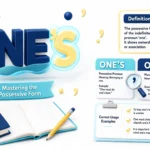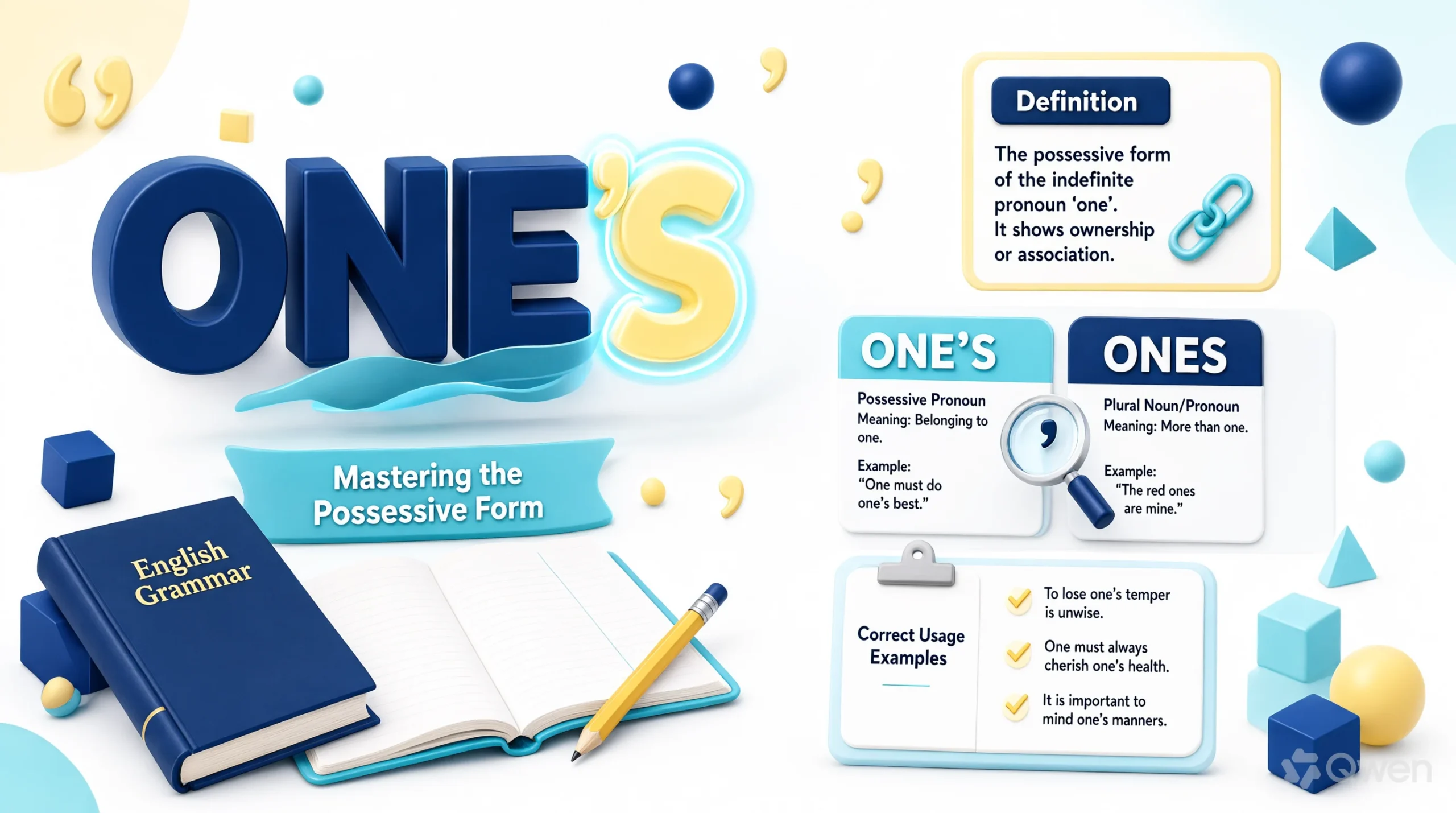
The phrase one’s possessive refers to the possessive form of the indefinite pronoun one. It is used to show ownership, connection, responsibility, or association when talking about people in a general sense. For example, in the sentence “One should take care of one’s health,” the word “one’s” shows that the health belongs to the person being discussed. It is similar to using “your” when speaking generally, but it sounds more formal.
Many English learners find this expression confusing because it looks different from ordinary possessive forms such as my, your, his, and her. They may also wonder why an apostrophe and the letter s are added to the word one. Understanding this small grammatical difference can help you write clearer sentences, avoid common mistakes, and use formal English more confidently. This guide explains the meaning, grammar rules, examples, and differences between one, one’s, and other related words.
Quick Answer
One’s is the possessive form of the indefinite pronoun one. It shows that something belongs or relates to a person in general. For example, “One should respect one’s parents” means that every person should respect their own parents. The apostrophe and s indicate possession.
Why Do People Confuse One’s Possessive?
People often confuse one’s because it has an apostrophe, and its grammatical role is not immediately obvious.
There are three main reasons for this confusion:
- Unfamiliar structure: Many learners know possessive words such as my, your, and his, but may not recognize one’s.
- Similar-looking words: The words ones, one’s, and one look almost identical but have different meanings.
- Formal usage: The pronoun one is more common in formal English than in everyday conversation.
The easiest way to understand it is to remember that one’s means something belonging to or associated with a person in general.
First Word: One
One is an indefinite pronoun used to refer to a person without identifying a particular individual.
It can mean any person, someone in general, or people generally.
Examples:
- One should always speak politely.
- One must work hard to achieve success.
- One cannot predict everything in life.
- One should respect other people’s opinions.
In these sentences, one refers to a person in a general sense rather than a specific individual.
Grammatical role: One is a subject or object pronoun, depending on how it is used in a sentence.
Second Word: One’s
One’s is the possessive form of one. It indicates that something belongs to, concerns, or is associated with a person in general.
It is commonly used before nouns.
Examples:
- One should protect one’s privacy.
- It is important to understand one’s responsibilities.
- One must believe in one’s abilities.
- One should learn from one’s mistakes.
In these examples, one’s indicates a relationship between a person and something connected to that person.
Grammatical role: One’s is a possessive determiner.
One vs One’s vs Ones: Comparison Table
These three forms have different grammatical functions and meanings.
| Word | Meaning | Example |
| One | A person in general | One should be kind. |
| One’s | Belonging to a person | Respect one’s elders. |
| Ones | Plural of one, replacing plural nouns | Choose the red ones. |
Important: One’s shows possession, while ones is a plural form used to avoid repeating a noun. The apostrophe changes the meaning.
When to Use One and One’s?
Understanding when to use each form makes your sentences grammatically correct.
When to Use One
Use one when referring to a person generally.
Examples:
- One should always tell the truth.
- One needs patience to succeed.
- One cannot control everything.
When to Use One’s
Use one’s when showing ownership, responsibility, or association.
Examples:
- One should value one’s time.
- Everyone should understand one’s limitations.
- One must take responsibility for one’s actions.
When to Use Ones
Use ones when referring to more than one person or thing of a previously mentioned type.
Examples:
- I prefer the blue ones.
- The smaller ones are cheaper.
- These shoes are better than the old ones.
12+ Examples of One’s Possessive in Sentences
Here are practical examples showing how to use one’s naturally in different situations.
- One should always respect one’s parents.
- It is important to protect one’s personal information.
- One must take responsibility for one’s decisions.
- Success often depends on one’s determination.
- One should never underestimate one’s abilities.
- Education plays an important role in shaping one’s future.
- One must learn from one’s past mistakes.
- Taking care of one’s health should be a priority.
- One should be honest about one’s feelings.
- Everyone should have confidence in one’s own abilities.
- One can improve one’s communication skills through practice.
- It is wise to manage one’s money carefully.
- One should appreciate one’s opportunities.
- Reading regularly can improve one’s knowledge.
- One must understand one’s duties before accepting responsibility.
These examples demonstrate that one’s can be used with nouns related to health, education, personal development, responsibilities, and everyday life.
Common Mistakes When Using One’s
Even though one’s is a simple possessive form, learners sometimes use it incorrectly.
1. Confusing One’s with Ones
Incorrect: One should respect ones parents.
Correct: One should respect one’s parents.
The possessive form requires an apostrophe.
2. Using One Instead of One’s
Incorrect: One should protect one privacy.
Correct: One should protect one’s privacy.
Use one’s before a noun when expressing possession.
3. Confusing One’s with Oneself
Incorrect: One should believe in one’s abilities and take care of one’s.
Correct: One should believe in one’s abilities and take care of oneself.
Oneself is a reflexive pronoun, while one’s is possessive.
4. Mixing One with You
Incorrect: One should take care of your health.
Better: One should take care of one’s health.
Keep the pronoun consistent in formal writing.
5. Forgetting the Apostrophe
Incorrect: Ones responsibility is to work honestly.
Correct: One’s responsibility is to work honestly.
The apostrophe is necessary to show possession.
Memory Trick: How to Remember One’s Possessive
Use this simple trick:
One = Person
One’s = Something belonging to that person
Ones = More than one
For example:
- One is learning English.
- One should improve one’s English.
- The difficult ones need more practice.
Remember that the apostrophe in one’s indicates possession, just as it does in someone’s or everyone’s.
American vs British English: Is One’s Used Differently?
There is no significant difference between American and British English when it comes to the spelling or grammatical function of one’s.
Both varieties use one’s as the possessive form of the pronoun one.
| Feature | American English | British English |
| Correct spelling | One’s | One’s |
| Possessive meaning | Ownership or association | Ownership or association |
| Apostrophe | Required | Required |
| Formal usage | Common in formal writing | Common in formal writing |
Examples:
- American: One should consider one’s options carefully.
- British: One should consider one’s options carefully.
The spelling and meaning remain the same in both varieties.
Similar Words Related to One’s
Several English words have similar possessive meanings or grammatical functions.
| Word | Meaning | Example |
| My | Belonging to me | My book is new. |
| Your | Belonging to you | Your idea is excellent. |
| His | Belonging to a male person | His car is outside. |
| Her | Belonging to a female person | Her dress is beautiful. |
| Their | Belonging to people | Their house is large. |
| Someone’s | Belonging to an unspecified person | Someone’s phone is ringing. |
| Everyone’s | Belonging to every person | Everyone’s opinion matters. |
| Oneself | Refers back to one | One should trust oneself. |
These words help express possession, but they are not always interchangeable. The appropriate choice depends on the subject and context.
Final Verdict: What Does One’s Possessive Mean?
One’s is the correct possessive form of the indefinite pronoun one. It shows that something belongs to or is associated with a person in general.
It is especially useful in formal English, educational writing, instructions, and general statements. Remember that one refers to a person, one’s indicates possession, and ones is the plural form used to replace a noun.
FAQs:
1. What is the possessive form of one?
The possessive form of one is one’s. It indicates ownership or association with a person in general. For example, “One should respect one’s responsibilities.”
2. Is one’s grammatically correct?
Yes, one’s is grammatically correct. It is the standard possessive form of the indefinite pronoun one and is commonly used in formal English.
3. What is the difference between one’s and ones?
One’s is a possessive form that shows ownership, while ones is the plural of one and replaces plural nouns. For example, “One should value one’s time” and “I like the red ones.”
4. Is one’s singular or plural?
One’s is singular because it comes from the singular indefinite pronoun one. It refers to one person in a general sense.
5. Can I use one’s in everyday conversation?
Yes, you can use one’s in everyday English, but it often sounds formal. In casual conversations, people generally prefer your or their, depending on the sentence.
6. What is the difference between one’s and oneself?
One’s is a possessive determiner used before a noun, while oneself is a reflexive pronoun. For example, “One should protect one’s health” and “One should believe in oneself.”
7. Does one’s need an apostrophe?
Yes. The apostrophe is essential because one’s is the possessive form of one. Without the apostrophe, ones has a different grammatical meaning.
Remember This
- One: Refers to a person generally.
- One’s: Shows possession or association.
- Ones: Refers to multiple items or people previously mentioned.
- Oneself: A reflexive pronoun referring back to one.
The most important rule is that you should use one’s when you want to show that something belongs to or relates to a person in general.
Conclusion
Understanding one’s possessive is an important part of learning English grammar. Although it may look unusual at first, its meaning is simple: it shows ownership, responsibility, or association with a person in general. It is particularly useful when making formal statements or discussing general human experiences.
By learning the difference between one, one’s, ones, and oneself, you can avoid common grammatical mistakes and write more naturally. Practice using these forms in everyday sentences, and you will become more confident in choosing the correct word.

I’m Sawyer Michael, a writer passionate about language and communication. I enjoy helping readers discover clearer, more natural, and creative ways to express their thoughts through words.