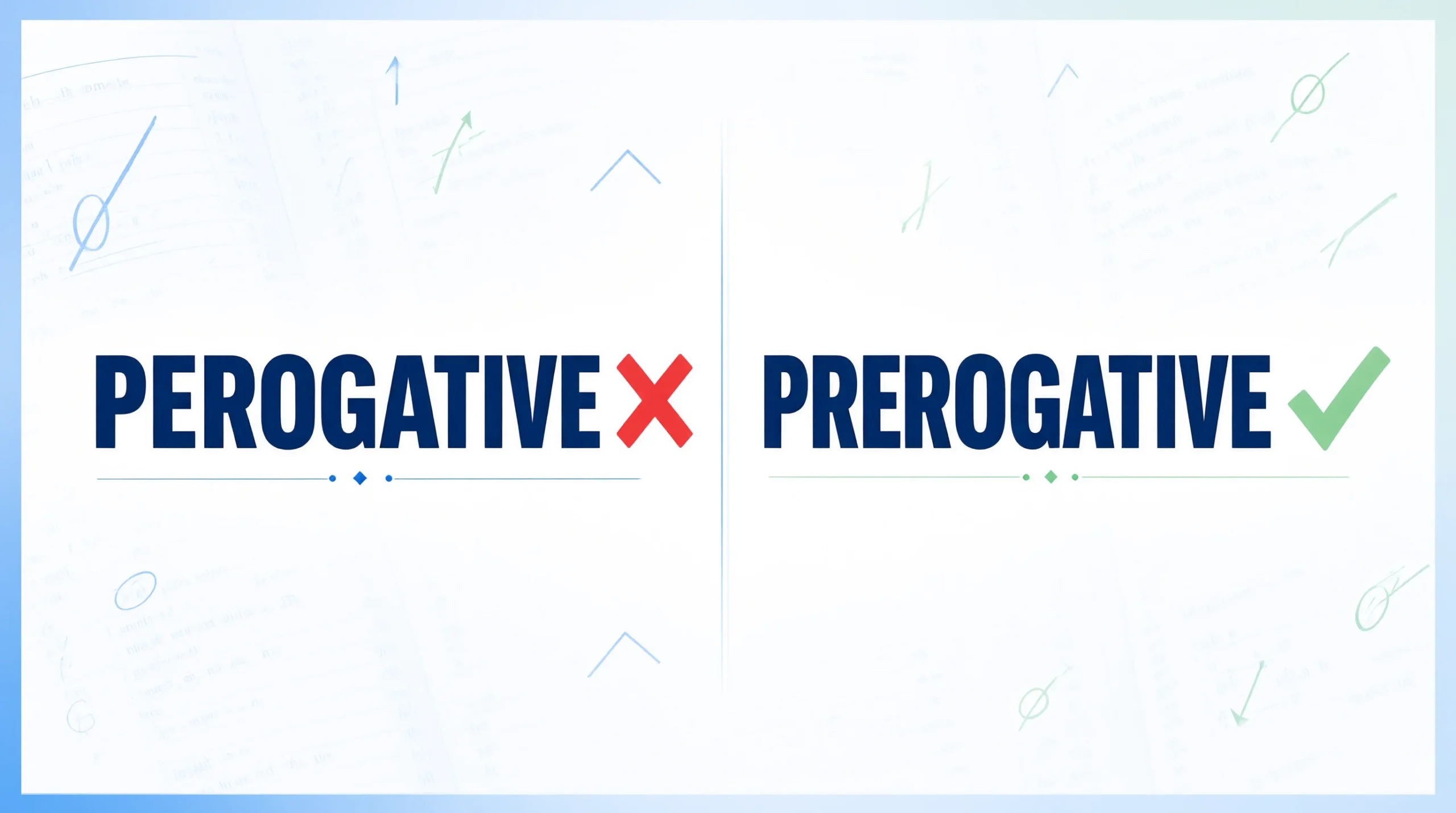
Have you ever written perogative or prerogative and wondered which spelling is correct? These two forms look and sound similar, but only one is accepted in standard English. The correct spelling is prerogative, while perogative is a common misspelling. Understanding the difference can help you write more clearly and avoid spelling mistakes in emails, essays, academic assignments, and professional documents.
The word prerogative refers to a special right, privilege, authority, or freedom that belongs to a particular person or group. For example, choosing how to spend your free time is your prerogative. Although many people accidentally leave out the first letter combination, remembering the correct spelling is easier when you understand its meaning and pronunciation. In this guide, you will learn why the confusion happens, how to use prerogative correctly, and how to remember its spelling.
Quick Answer: Perogative or Prerogative?
Prerogative is the correct spelling in standard English. It means a special right, privilege, or authority that someone has. Perogative is a misspelling and should not be used in formal or informal writing. Remember the extra r after the initial “p” to spell the word correctly.
Why Do People Confuse Perogative and Prerogative?
People often confuse these spellings because the word prerogative is not pronounced exactly as its spelling might suggest.
In everyday conversation, the first part of the word can sound less distinct, making it easy to forget the second letter combination.
There are three main reasons for this confusion:
- Pronunciation: The beginning of prerogative may sound like “per,” especially when spoken quickly.
- Unfamiliar spelling: The word contains an unusual combination of letters that some learners find difficult to remember.
- Typing mistakes: People sometimes write the word as they hear it rather than following its standard spelling.
The important point is that perogative is not an alternative spelling. Always write prerogative.
First Word: Perogative
Perogative is an incorrect spelling of prerogative.
Although you may see this spelling in online conversations, informal messages, or user-generated content, it is not accepted as the standard English form.
Is Perogative a Real Word?
No. Perogative is not recognized as the standard spelling of the English word.
If you want to describe someone’s special right, privilege, or authority, use prerogative instead.
Incorrect: It is my perogative to make this decision.
Correct: It is my prerogative to make this decision.
Second Word: Prerogative
Prerogative is the correct English word. It is a noun that describes a special right, privilege, power, or authority given to someone because of their position, role, or personal freedom.
Meaning of Prerogative
According to its common usage, prerogative refers to something a person has the right or freedom to decide or control.
For example:
- It is your prerogative to accept or reject the offer.
- The final decision is the manager’s prerogative.
- Choosing your own career is a personal prerogative.
Pronunciation
Prerogative is commonly pronounced:
pri-ROG-uh-tiv
Its pronunciation can vary slightly between accents.
Part of Speech
- Word: Prerogative
- Part of speech: Noun
- Plural: Prerogatives
- Meaning: A special right, privilege, or authority
Perogative vs Prerogative: Comparison Table
| Feature | Perogative | Prerogative |
| Spelling | Incorrect | Correct |
| Dictionary usage | Nonstandard misspelling | Standard English word |
| Part of speech | Not standard | Noun |
| Meaning | No accepted standard meaning | Special right or privilege |
| Formal writing | Avoid | Recommended |
| Example | Perogative to decide | Prerogative to decide |
Remember: Prerogative is always the correct choice when referring to a special right or privilege.
When to Use Each Word
Knowing when to use these spellings is simple because only one is correct.
When to Use Perogative
You should not use perogative in standard English writing.
Avoid it in:
- School assignments
- Business emails
- Academic essays
- Professional documents
- Social media posts
If you accidentally type it, replace it with prerogative.
When to Use Prerogative
Use prerogative when discussing someone’s personal freedom, special rights, or decision-making authority.
For example:
- Personal choices: Everyone has the prerogative to make personal decisions.
- Workplace authority: Hiring employees is the director’s prerogative.
- Government authority: Certain powers are the prerogative of the president.
- Individual freedom: It is your prerogative to keep your opinions private.
12 Examples of Prerogative in Sentences
Here are practical examples showing how to use prerogative correctly.
- It is my prerogative to choose what I want to study.
- Every individual has the prerogative to express an opinion.
- The final decision is entirely the manager’s prerogative.
- It is your prerogative to accept or decline the invitation.
- The president exercised his constitutional prerogative.
- Choosing your own lifestyle is a personal prerogative.
- Parents have the prerogative to make certain decisions for their children.
- The company director has the prerogative to approve the budget.
- You have the prerogative to change your mind.
- It is not my prerogative to interfere in their personal matters.
- The committee reserved the prerogative to review the proposal.
- Whether she attends the meeting is her prerogative.
These examples show that the word can describe personal freedom, professional authority, and official powers.
Common Mistakes to Avoid
Even experienced English speakers sometimes make spelling and usage mistakes with prerogative.
Here are some common errors:
1. Leaving out the first r
Incorrect: Perogative
Correct: Prerogative
2. Treating both spellings as acceptable
Incorrect: Both perogative and prerogative are correct.
Correct: Only prerogative is the standard spelling.
3. Using the word as an adjective
Incorrect: He has a prerogative decision.
Correct: He has the prerogative to make the decision.
Prerogative is a noun, not an adjective.
4. Confusing prerogative with privilege
Although these words have similar meanings, they are not always interchangeable. A prerogative often emphasizes a particular right or authority, while privilege can refer more broadly to an advantage or benefit.
5. Forgetting the correct pronunciation
Practice saying “pri-ROG-uh-tiv” to become more familiar with the word.
Memory Trick: How to Remember Prerogative
The easiest way to remember the correct spelling is to focus on the beginning:
P + RE + ROGATIVE = PREROGATIVE
Remember these three points:
- Start with the letter P.
- Include RE immediately after P.
- Finish with ROGATIVE.
Another helpful trick is to associate prerogative with the word privilege. Both relate to special rights or freedoms.
Whenever you are unsure, remember that prerogative has an extra R compared with the common misspelling perogative.
American vs British English
Is there a spelling difference between American and British English?
No. Both American and British English use the same spelling: prerogative.
| English Variety | Correct Spelling | Example |
| American English | Prerogative | It is your prerogative. |
| British English | Prerogative | It is your prerogative. |
| Canadian English | Prerogative | That decision is your prerogative. |
| Australian English | Prerogative | It is a personal prerogative. |
The spelling does not change according to English variety. You should use prerogative regardless of your location or preferred English style.
Similar Words to Prerogative
Understanding related vocabulary can help you use prerogative more confidently.
Here are some words with similar meanings:
| Word | Simple Meaning |
| Privilege | A special advantage or right |
| Right | Something you are legally or morally allowed to do |
| Authority | The power to make decisions |
| Entitlement | A right to receive or do something |
| Freedom | The ability to act or choose independently |
| Liberty | Freedom from unnecessary restrictions |
| Discretion | The freedom to make your own judgment |
| Power | The ability or authority to control something |
| Permission | Approval to do something |
| Jurisdiction | Official authority over a particular area |
Although these words are related, their meanings differ slightly. For example, authority emphasizes decision-making power, while freedom emphasizes the ability to act without unnecessary restrictions.
Final Verdict: Perogative or Prerogative?
The correct spelling is prerogative, not perogative.
Use prerogative when referring to a special right, privilege, freedom, or authority. The incorrect spelling perogative should be avoided in all standard English writing.
Whether you are writing an academic essay, professional email, or everyday message, remember to include the extra r.
FAQs:
1. Is it perogative or prerogative?
Prerogative is the correct spelling. Perogative is a common misspelling that should be avoided in standard English writing.
2. What does prerogative mean in simple English?
Prerogative means a special right, freedom, or authority that allows someone to make a particular decision or take a particular action.
3. Why do people spell prerogative as perogative?
People often leave out the first “r” because the pronunciation of prerogative can make its opening letters difficult to distinguish, especially during fast speech.
4. Is prerogative a noun or an adjective?
Prerogative is a noun. It describes a special right, privilege, or authority.
Example: It is her prerogative to make that choice.
5. What is the plural of prerogative?
The plural form is prerogatives.
Example: The organization has certain prerogatives under its constitution.
6. Is prerogative the same as privilege?
They have similar meanings, but they are not exactly the same. A privilege is generally a special advantage or benefit, while a prerogative is a particular right, freedom, or authority.
7. Is prerogative spelled differently in American and British English?
No. Both American and British English use the spelling prerogative. There is no standard regional spelling difference.
Remember This
- Prerogative = Correct spelling.
- Perogative = Incorrect spelling.
- Meaning = A special right, privilege, or authority.
- Part of speech = Noun.
- Plural = Prerogatives.
- American and British English = Same spelling.
The simplest rule is to remember the extra R in prerogative.
Conclusion
The difference between perogative and prerogative is simple: only prerogative is the correct spelling in standard English. It describes a special right, privilege, or authority that allows someone to make decisions or exercise personal freedom. Although the incorrect version may appear in everyday writing, it should not be used in formal communication.
To avoid this common spelling mistake, remember the pronunciation, practice writing the word, and connect its meaning with the idea of a special privilege. With a little practice, you will be able to spell and use prerogative confidently in everyday conversations, academic work, and professional writing.

I’m Jaxon James, an author at SaysReply, where I share simple, clear, and natural alternative ways to say things and help readers express their thoughts better.