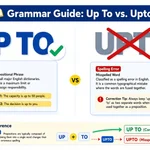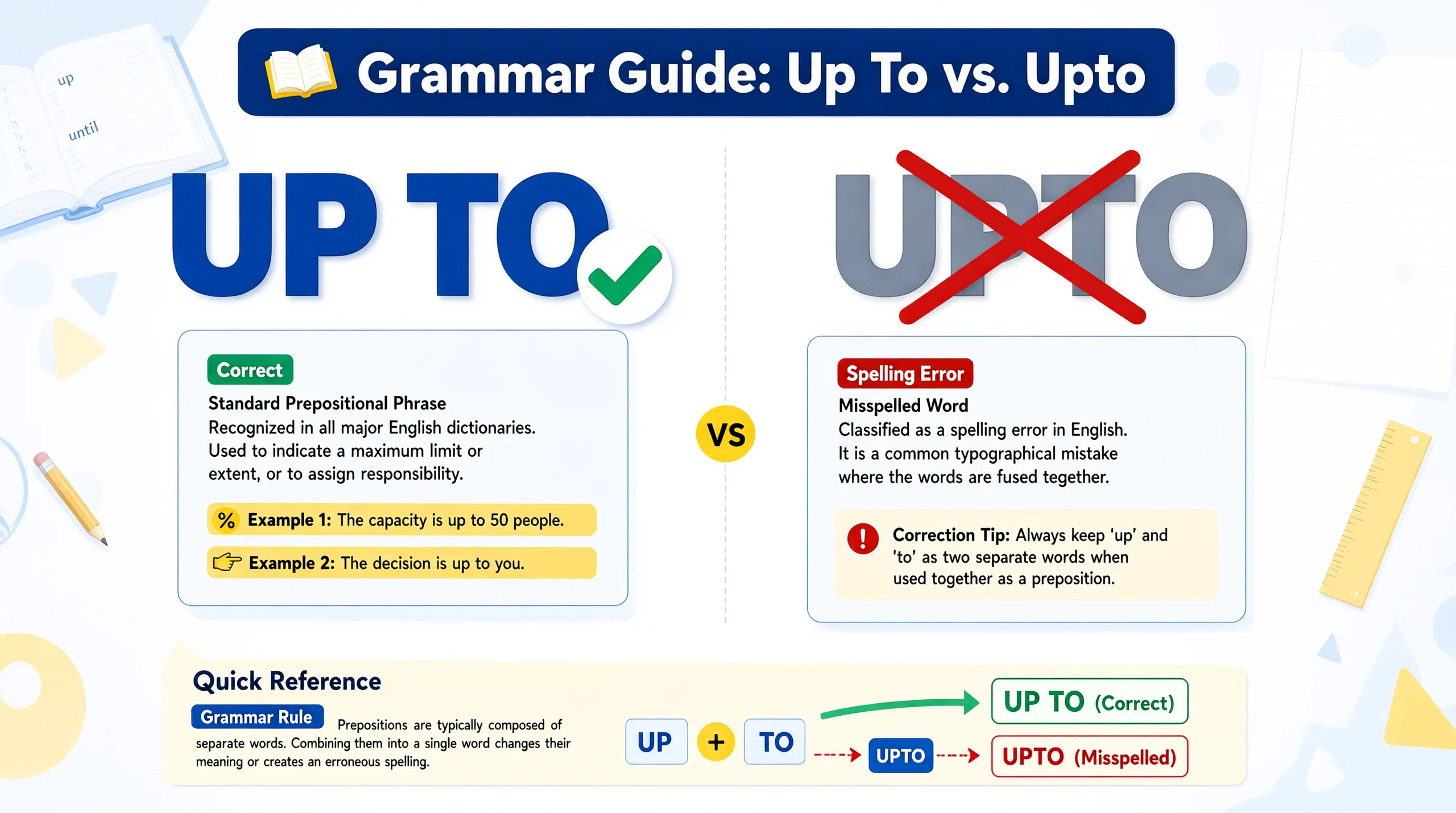
The correct spelling is “up to”, written as two separate words. “Upto” is incorrect in standard English, if you are writing in American or British English. Although many people use “upto” in text messages, emails, and informal writing, it is not the accepted spelling in standard dictionaries and formal communication.
The confusion happens because “up to” is often used as a single expression with a specific meaning. People may assume that it should be written as one word, just like “into” or “upon.” However, English spelling rules do not always combine words simply because they work together in a sentence. Understanding the difference will help you avoid spelling mistakes in essays, professional emails, academic assignments, and everyday conversations.
Quick Answer: Up To or Upto?
“Up to” is the correct spelling, and it must always be written as two separate words. “Upto” is a common spelling mistake and is not accepted in standard English. Use “up to” when referring to a maximum amount, a limit, responsibility, or something that depends on a person or situation.
Why Do People Confuse Up To and Upto?
People confuse “up to” and “upto” because both forms look similar and are pronounced in the same way.
There are several reasons behind this confusion:
- Similar appearance: Both spellings contain the same letters.
- Fast typing: People sometimes combine words when writing quickly.
- Informal communication: Incorrect spellings can spread through social media and text messages.
- Word combinations: English contains similar expressions that are written as one word, such as “into,” “upon,” and “within.”
- Lack of awareness: Some learners do not realize that “up to” is a two-word expression.
The easiest solution is to remember that the correct expression always contains a space.
First Word: Up To
Up to is the correct expression in standard English. It is commonly used to describe a maximum quantity, a limit, responsibility, or a decision that someone can make.
It consists of two separate words:
- Up: An adverb or preposition that can indicate a higher position, level, or amount.
- To: A preposition or infinitive marker used to express direction, limits, or relationships.
Together, they create the expression “up to,” which has several meanings depending on the context.
Common Meanings of Up To
1. A maximum amount or limit
It describes the highest possible number, quantity, or level.
Example: You can invite up to 20 guests.
2. Responsibility or decision
It indicates that someone has the authority or responsibility to make a choice.
Example: It is up to you to decide.
3. Occupied or involved in something
It can describe what someone is doing, sometimes suggesting suspicious or secretive behavior.
Example: What are you up to?
4. Reaching a particular point
It can describe how far something extends or progresses.
Example: The water came up to my knees.
Second Word: Upto
Upto is an incorrect spelling of “up to” in standard English. It is not the accepted form for formal writing, academic work, professional communication, or published content.
Although you may encounter “upto” online, in advertisements, or in informal messages, that does not make it grammatically correct.
Why Is Upto Incorrect?
The expression “up to” functions as two separate words. Standard English spelling preserves this separation.
For example:
- Incorrect: You can save upto 50%.
- Correct: You can save up to 50%.
- Incorrect: It is upto you.
- Correct: It is up to you.
Whenever you want to express a maximum, responsibility, or involvement, write “up to” with a space.
Up To vs Upto: Comparison Table
| Feature | Up To | Upto |
| Spelling | Correct | Incorrect |
| Word form | Two words | One word |
| Standard English | Accepted | Not accepted |
| Formal writing | Appropriate | Avoid |
| Meaning | Maximum, limit, responsibility, etc. | No standard meaning |
| Academic writing | Correct choice | Incorrect choice |
| Professional emails | Recommended | Avoid |
Remember: The correct spelling is always “up to,” not “upto.”
When Should You Use Up To or Upto?
The choice is simple because only one spelling is correct in standard English.
When to Use Up To
Use “up to” in sentences involving:
- Maximum quantities: The room can accommodate up to 100 people.
- Price limits: The discount is up to $50.
- Personal responsibility: It is up to the manager.
- Choices and decisions: The final decision is up to you.
- Activities: What have you been up to?
- Physical limits: The water reached up to the window.
When to Use Upto
You should not use “upto” in standard English writing.
Instead, use the two-word expression “up to” in every appropriate context.
15 Examples of Up To in Sentences
Here are practical examples showing how to use “up to” correctly in everyday English.
- You can bring up to three friends to the party.
- The company offers discounts of up to 40%.
- It is up to you to make the final decision.
- The journey can take up to five hours.
- What are you up to this weekend?
- This laptop can support up to 16 GB of additional memory.
- The children played in the garden up to sunset.
- You can choose up to five different colors.
- The responsibility is up to the team leader.
- The temperature may rise up to 35 degrees Celsius.
- I have saved up to $200 for my vacation.
- The swimming pool is open to visitors up to 8 p.m.
- It is up to the teacher to decide the final grade.
- The project may require up to six months to complete.
- The water reached up to his waist.
Incorrect vs Correct Examples
| Incorrect | Correct |
| Upto 10 people can enter. | Up to 10 people can enter. |
| It is upto you. | It is up to you. |
| Save upto 30%. | Save up to 30%. |
| What are you upto? | What are you up to? |
| The price is upto $100. | The price is up to $100. |
Common Mistakes When Using Up To
Even though “up to” is a simple expression, English learners sometimes make mistakes when writing it.
1. Writing Upto as One Word
Incorrect: You can apply for upto five jobs.
Correct: You can apply for up to five jobs.
2. Forgetting the Space
Incorrect: The offer is upto $500.
Correct: The offer is up to $500.
3. Confusing Up To With Into
“Up to” and “into” are different expressions.
- Up to: The decision is up to you.
- Into: She walked into the room.
4. Using Up To Without Understanding the Context
“Up to” can have different meanings depending on the sentence.
For example:
- You can invite up to 10 people. (Maximum number)
- What are you up to? (Activity or involvement)
- It is up to you. (Responsibility or choice)
Understanding the context helps you use the expression naturally.
Memory Trick: How to Remember Up To
A simple way to remember the correct spelling is:
UP + TO = UP TO
Always keep a space between the two words.
Think of the phrase “up to 10 people.” The expression describes a limit, but its spelling remains two separate words.
You can also remember this rule:
- Up to = Correct
- Upto = Incorrect
Whenever you are unsure, choose “up to.”
American vs British English: Is Up To Different?
No. There is no spelling difference between American and British English when using “up to.”
Both varieties use the same two-word spelling.
| English Variety | Correct Spelling | Incorrect Spelling |
| American English | Up to | Upto |
| British English | Up to | Upto |
| Australian English | Up to | Upto |
| Canadian English | Up to | Upto |
For example:
- American English: You can purchase up to five tickets.
- British English: You can purchase up to five tickets.
The spelling remains the same regardless of the English variety.
Similar Words and Expressions
Understanding related expressions can help improve your vocabulary and spelling accuracy.
Here are some common English expressions that may be useful:
| Expression | Meaning | Example |
| Up to | Maximum limit or responsibility | It is up to you. |
| Up until | Continuing until a particular time | I worked up until midnight. |
| Upward | Toward a higher position | The balloon moved upward. |
| Upwards | In a higher direction | Prices moved upwards. |
| Into | Movement toward the inside | She walked into the house. |
| Upon | On or immediately after | Once upon a time. |
| Within | Inside a particular limit | Finish within an hour. |
| Up against | Facing a difficulty | We are up against a deadline. |
| Up for | Available or willing to do something | Are you up for a challenge? |
| Up and down | Moving between higher and lower positions | He walked up and down. |
These expressions have different meanings and spelling patterns, so it is important to learn them individually.
Final Verdict: Up To or Upto?
The correct spelling is up to, written as two separate words. “Upto” is a misspelling in standard English and should be avoided in academic, professional, and everyday formal writing.
Whether you are describing a maximum number, a personal decision, a responsibility, or someone’s activities, always use “up to.” This simple spelling rule will make your writing clearer and more accurate.
FAQs:
1. Is it up to or upto?
“Up to” is correct. It consists of two separate words. “Upto” is an incorrect spelling in standard English and should not be used in formal writing.
2. Is upto one word or two words?
“Upto” is written as one word, but it is not the accepted standard spelling. The correct expression is “up to,” which contains two separate words.
3. Is up to grammatically correct?
Yes, “up to” is grammatically correct. It can describe a maximum amount, a limit, responsibility, or someone’s activities, depending on the context.
4. Is up to correct in American English?
Yes. American English uses “up to” as two separate words. The spelling is the same in British, Australian, and Canadian English.
5. Is up to formal or informal?
“Up to” is acceptable in both formal and informal English. You can use it in academic assignments, business emails, professional documents, and everyday conversations.
6. What does up to mean in a sentence?
“Up to” can mean a maximum limit, responsibility, or involvement in an activity. For example, “You can invite up to 15 people” describes a maximum of 15 guests.
7. How do you use up to in a sentence?
Use “up to” as two separate words. For example, “It is up to you to choose the best option.” Here, it means that the decision is your responsibility.
Remember This
- Up to = Correct spelling.
- Upto = Incorrect spelling in standard English.
- Always write “up to” as two separate words.
- Use it for limits, maximum amounts, responsibility, and activities.
- The spelling is identical in American and British English.
Conclusion
Choosing between “up to” and “upto” is easy once you understand the spelling rule. “Up to” is the only correct form in standard English, while “upto” is a common spelling mistake. Remember to keep the two words separate whenever you use this expression.
If you are writing an academic essay, sending a professional email, or having a casual conversation, using “up to” correctly will make your English more accurate and natural. Practice it in everyday sentences to remember the correct spelling.

I’m Amelia Rose, an enthusiastic writer who enjoys exploring better, clearer, and more natural ways to express ideas. I create helpful content that makes finding alternative phrases simple, useful, and enjoyable for everyone.