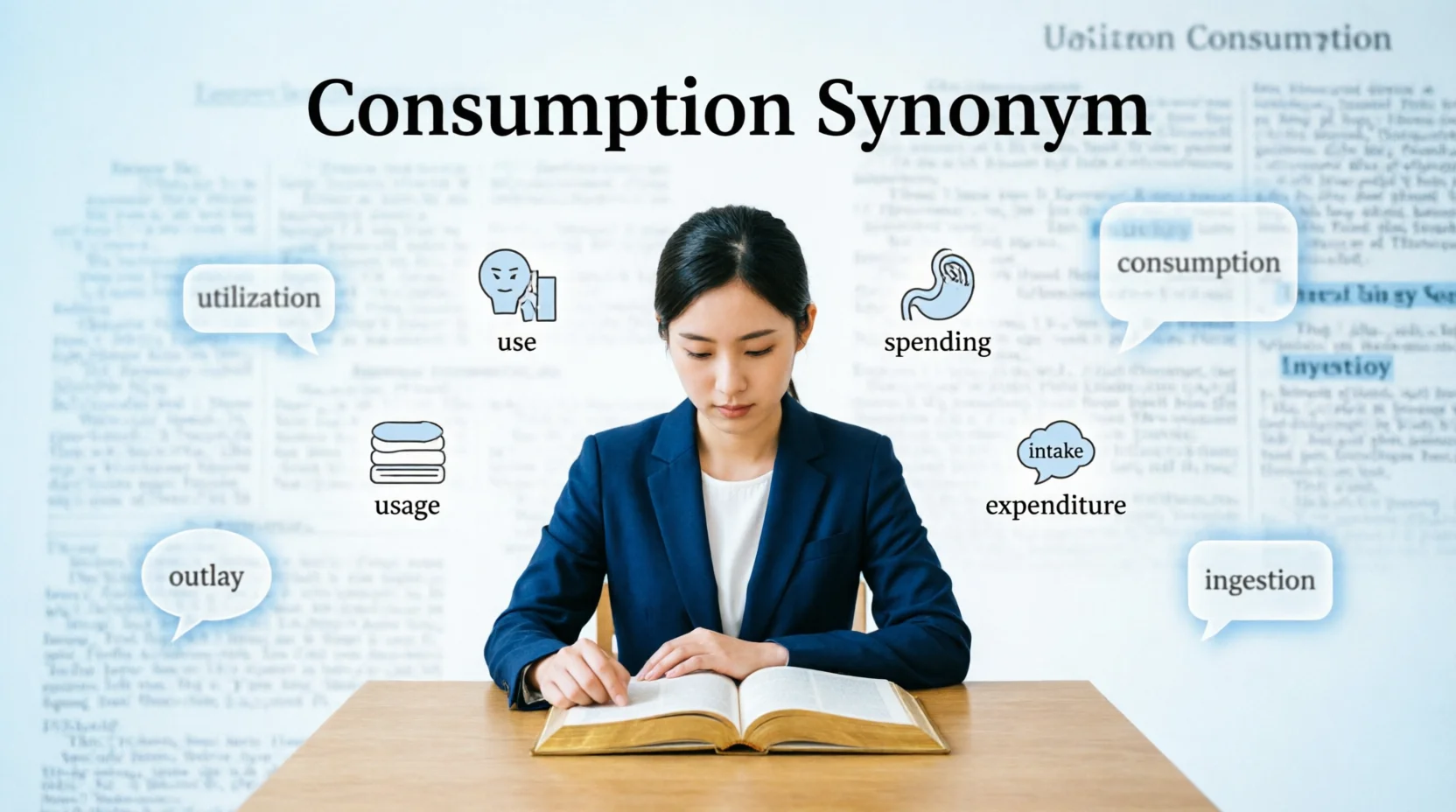
The best consumption synonyms depend on what you mean. Common alternatives include use, usage, expenditure, spending, intake, eating, drinking, absorption, depletion, and utilization. The right word changes with context: “energy consumption” means energy use, while “food consumption” refers to eating or intake.
Quick Answer
A consumption synonym is a word that can replace consumption when you want to describe using, eating, drinking, spending, or taking in something.
Here are some of the most useful alternatives:
- Use — general use of something
- Usage — the amount or way something is used
- Utilization — practical or effective use
- Expenditure — spending money or resources
- Spending — using money
- Intake — the amount taken into the body
- Ingestion — taking food, drink, or medicine into the body
- Eating — consuming food
- Drinking — consuming liquids
- Absorption — taking something in
- Depletion — using up a supply
- Exhaustion — complete or near-complete use
- Use-up — informal expression for using something completely
The most natural synonym is usually use, but more precise alternatives are often better in formal, academic, medical, financial, or technical writing.
What Does “Consumption” Mean?
Consumption generally means the act or process of using, taking in, or spending something.
The meaning changes according to the subject.
For example:
- Energy consumption = the amount of energy used
- Water consumption = the amount of water used or taken in
- Food consumption = the act or amount of eating food
- Alcohol consumption = drinking alcohol
- Consumer consumption = purchasing and using goods and services
- Resource consumption = using natural or other resources
- Fuel consumption = the amount of fuel a vehicle or machine uses
The word can therefore describe both an action and the amount involved in that action.
30 Consumption Synonyms With Meanings and Examples
1. Use
Simple meaning: To do something with an object, resource, or service.
Example: The new system reduces the use of electricity.
Best usage/context: Everyday, business, academic, and technical writing.
Note: Use is the closest general-purpose alternative to consumption.
2. Usage
Simple meaning: The way or amount in which something is used.
Example: The company monitors its monthly water usage.
Best usage/context: Utilities, technology, business, and technical writing.
3. Utilization
Simple meaning: The practical or effective use of something.
Example: Better utilization of available resources can reduce waste.
Best usage/context: Formal, academic, professional, and technical contexts.
4. Expenditure
Simple meaning: The act of spending money or resources.
Example: Household energy expenditure increased during the winter.
Best usage/context: Finance, economics, government, and formal writing.
5. Spending
Simple meaning: The act of using money to buy something.
Example: Consumer spending increased during the holiday season.
Best usage/context: Personal finance, economics, retail, and everyday language.
6. Intake
Simple meaning: The amount of something taken into the body.
Example: She reduced her daily sugar intake.
Best usage/context: Nutrition, medicine, health, and food-related writing.
7. Ingestion
Simple meaning: The act of taking food, drink, medicine, or another substance into the body.
Example: Excessive ingestion of salt may be undesirable.
Best usage/context: Medical, scientific, nutritional, and formal contexts.
8. Eating
Simple meaning: The act of putting food into your body.
Example: Healthy eating can support overall well-being.
Best usage/context: Everyday conversation, nutrition, lifestyle, and health education.
9. Drinking
Simple meaning: The act of taking a liquid into the body.
Example: Drinking enough water is important during hot weather.
Best usage/context: Everyday, health, nutrition, and lifestyle contexts.
10. Absorption
Simple meaning: The process of taking something in.
Example: The body needs adequate nutrients for proper absorption.
Best usage/context: Biology, medicine, chemistry, and scientific writing.
11. Assimilation
Simple meaning: The process of taking something in and incorporating it.
Example: The body begins the assimilation of nutrients after digestion.
Best usage/context: Biology, nutrition, science, and figurative writing.
12. Depletion
Simple meaning: The reduction or using up of a supply.
Example: Excessive water consumption can contribute to the depletion of local supplies.
Best usage/context: Natural resources, supplies, energy, and environmental writing.
13. Exhaustion
Simple meaning: The complete or nearly complete use of something.
Example: The rapid consumption of fuel led to the exhaustion of the reserve.
Best usage/context: Resources, supplies, energy, and formal writing.
14. Spending
Simple meaning: Using money for purchases or other purposes.
Example: His spending on entertainment decreased this month.
Best usage/context: Money, household budgets, economics, and personal finance.
15. Outlay
Simple meaning: An amount of money spent on something.
Example: The initial outlay for the equipment was substantial.
Best usage/context: Business, finance, investments, and formal writing.
16. Disbursement
Simple meaning: The payment or distribution of money.
Example: The organization recorded the disbursement of funds.
Best usage/context: Accounting, banking, government, and formal financial contexts.
17. Expenditure of Resources
Simple meaning: The use of available resources.
Example: The project requires careful expenditure of resources.
Best usage/context: Formal business, government, environmental, and academic writing.
18. Deployment
Simple meaning: The use or placement of something for a particular purpose.
Example: The deployment of additional resources improved the response.
Best usage/context: Business, technology, military, and organizational contexts.
19. Application
Simple meaning: The act of using something for a particular purpose.
Example: The application of renewable energy can reduce fossil-fuel dependence.
Best usage/context: Academic, technical, professional, and scientific writing.
20. Employment
Simple meaning: The act of using something.
Example: The employment of advanced technology improved production.
Best usage/context: Formal and technical writing.
Important: In this sense, employment means use, not having a job.
21. Exploitation
Simple meaning: The use of something, especially resources, for a particular purpose.
Example: The exploitation of natural resources has environmental consequences.
Best usage/context: Environmental, economic, political, and academic writing.
Important: This word can carry a negative meaning when it suggests excessive or unfair use.
22. Drain
Simple meaning: The gradual use or reduction of a supply.
Example: Constant demand can drain the region’s water reserves.
Best usage/context: Resources, money, energy, and informal or descriptive writing.
23. Depletion of Supplies
Simple meaning: The process of using a supply until little remains.
Example: Heavy fuel consumption caused the depletion of supplies.
Best usage/context: Resources, logistics, emergency planning, and technical writing.
24. Absorption of Resources
Simple meaning: The process of taking in or using available resources.
Example: The growing industry led to greater absorption of available resources.
Best usage/context: Economics, business, and formal analysis.
25. Assimilation of Nutrients
Simple meaning: The body’s process of taking nutrients in and making use of them.
Example: Proper digestion supports the assimilation of nutrients.
Best usage/context: Biology, nutrition, and health science.
26. Acquisition and Use
Simple meaning: Obtaining something and then using it.
Example: The acquisition and use of digital services have changed consumer behavior.
Best usage/context: Business, economics, technology, and research.
27. Resource Use
Simple meaning: The use of natural or available resources.
Example: Efficient resource use can help reduce unnecessary waste.
Best usage/context: Environmental studies, business, sustainability, and policy writing.
28. Resource Utilization
Simple meaning: The way resources are used.
Example: Efficient resource utilization can improve productivity.
Best usage/context: Academic, business, engineering, and environmental writing.
29. Demand
Simple meaning: The amount of something that people want or need.
Example: Rising demand increased fuel consumption.
Best usage/context: Economics, business, marketing, and commerce.
Important: Demand is related to consumption but is not always a direct synonym. Demand describes desire or need, whereas consumption describes actual use.
30. Use-Up
Simple meaning: The complete use of something.
Example: The use-up of emergency supplies created a serious problem.
Best usage/context: Informal English.
Note: In polished formal writing, depletion or exhaustion will often sound more natural.
Comparison Table: Consumption vs. Similar Words
| Word | Core Meaning | Best Context | Formality |
|---|---|---|---|
| Consumption | Using, taking in, or spending something | General/formal | Medium |
| Use | Doing something with something | General | Neutral |
| Usage | Amount or manner of use | Technical/business | Neutral |
| Utilization | Practical use | Professional/academic | Formal |
| Expenditure | Spending money/resources | Finance/economics | Formal |
| Spending | Using money | Finance/everyday | Neutral |
| Intake | Amount taken into the body | Nutrition/health | Neutral |
| Ingestion | Taking something into the body | Medical/scientific | Formal |
| Eating | Taking food into the body | Food/everyday | Neutral |
| Drinking | Taking liquids into the body | Food/health | Neutral |
| Depletion | Using up a supply | Resources/environment | Formal |
| Exhaustion | Complete use | Resources/supplies | Formal |
| Outlay | Amount spent | Finance/business | Formal |
| Application | Use for a purpose | Academic/technical | Formal |
| Deployment | Putting something into use | Business/technology | Formal |
| Exploitation | Use, often intensive or potentially harmful | Resources/economics | Formal |
Consumption Synonyms by Context
Choosing a synonym becomes easier when you first identify what is being consumed.
For Energy Consumption
Good alternatives include:
- energy use
- energy usage
- energy utilization
- energy expenditure
- power use
Example:
The building reduced its energy consumption.
Possible alternatives:
The building reduced its energy use.
The building reduced its energy usage.
Here, energy use sounds especially natural and clear.
For Food Consumption
Useful alternatives include:
- food intake
- eating
- ingestion
- dietary intake
- food consumption
Example:
Excessive food consumption may affect overall health.
A more specific version is:
Excessive food intake may affect overall health.
For Water Consumption
Useful alternatives include:
- water use
- water usage
- water intake
- water utilization
- water demand
The correct choice depends on whether you mean water used by households and industries or water taken into the body.
For Money Consumption
When discussing money, consumption can often be replaced by:
- spending
- expenditure
- outlay
- purchasing
- buying
Example:
Consumer spending increased this year.
Here, spending is more natural than consumer consumption in many everyday contexts.
For Natural Resources
Useful alternatives include:
- resource use
- resource utilization
- resource depletion
- exploitation
- use of resources
The distinction matters. Resource use is neutral, while depletion emphasizes reduction of available supplies.
How to Choose the Right Consumption Synonym
For Simple, Everyday English
Choose:
- use
- spending
- eating
- drinking
- buying
These words are easy to understand and usually sound natural.
Example:
We need to reduce our use of plastic.
For Academic Writing
Choose:
- utilization
- expenditure
- intake
- ingestion
- resource use
- absorption
- depletion
These terms can provide greater precision when the subject requires it.
Example:
Researchers examined daily nutrient intake among participants.
For Business Writing
Choose:
- usage
- expenditure
- spending
- utilization
- deployment
- outlay
Example:
The company analyzed software usage across departments.
For Medical or Nutrition Writing
Choose:
- intake
- ingestion
- eating
- drinking
- absorption
- assimilation
Example:
Patients were asked to record their daily food intake.
For Environmental Writing
Choose:
- resource use
- utilization
- depletion
- exploitation
- energy use
Example:
Efficient resource use can reduce pressure on natural ecosystems.
When You Mean “Using Something Up”
Choose:
- depletion
- exhaustion
- drain
- use-up
Example:
Continued extraction resulted in the depletion of groundwater supplies.
When You Mean “Spending Money”
Choose:
- spending
- expenditure
- outlay
- disbursement
Example:
The project required a large initial outlay.
Common Usage Mistakes
1. Treating Every Synonym as Interchangeable
Not every alternative works in every sentence.
For example:
“I reduced my energy ingestion.”
This is incorrect because ingestion normally concerns taking something into the body.
Better:
“I reduced my energy use.”
2. Using “Demand” When You Mean Actual Consumption
Demand and consumption are connected but different.
Demand refers to the desire or need for a product, service, or resource.
Consumption refers to actual use or intake.
For example:
Rising demand for electricity can lead to higher electricity consumption.
3. Using “Expenditure” for Food
Expenditure normally refers to money or resources spent, not simply eating food.
Instead of:
My food expenditure was 2,000 calories.
Use:
My food intake was 2,000 calories.
4. Confusing “Usage” With “Use”
Both are correct, but they are often used differently.
Use is broader and more common:
The use of technology is widespread.
Usage often emphasizes the amount, frequency, or manner of use:
The software tracks internet usage.
5. Using “Exploitation” as a Neutral Replacement
Exploitation can suggest excessive, unfair, or harmful use.
For neutral writing, use, utilization, or resource use may be more appropriate.
FAQs:
What is the best synonym for consumption?
Use is the best general synonym because it works in many everyday and professional contexts. However, more specific words such as intake, spending, or depletion may be better depending on the subject.
What is a synonym for consumption in food?
Common alternatives include food intake, eating, ingestion, dietary intake, and nutrient intake. Intake is especially useful in nutrition and health contexts.
What is a synonym for energy consumption?
Useful alternatives include energy use, energy usage, energy utilization, and power use. Energy use is generally the simplest choice.
What is a synonym for consumer consumption?
Depending on the intended meaning, alternatives include consumer spending, purchasing, buying, use of goods, and consumer use. The exact choice depends on whether you mean purchasing or actual use.
Is “usage” the same as “consumption”?
They can overlap, but they are not always identical. Usage usually describes how or how much something is used, while consumption can emphasize the actual amount used, taken in, or spent.
Is “utilization” a synonym for consumption?
Sometimes. Utilization means the practical use of something, particularly a resource, tool, or system. It is common in formal, technical, and academic writing.
What is the opposite of consumption?
Depending on context, possible opposites include production, creation, conservation, saving, preservation, or restoration. There is no single opposite that fits every use of consumption.
Which consumption synonym is best for formal writing?
There is no single best option. Utilization, expenditure, intake, ingestion, depletion, and resource use can all work well when they accurately express the intended meaning.
Conclusion
The word consumption has several meanings, so its best synonym depends on context. Use is the broadest and simplest alternative, while usage works well for patterns or amounts of use. For food and nutrition, intake and ingestion are more precise. For money, spending and expenditure are usually better. For natural resources, resource use, utilization, and depletion can communicate different aspects of the process.
Choosing the right synonym is less about finding a word that looks similar and more about identifying the exact meaning you want your reader to understand.

I am Camden Thomas, an Administrator at SaysReply. I help maintain our platform and ensure readers find clear, natural, and useful alternative ways to express their thoughts every day.