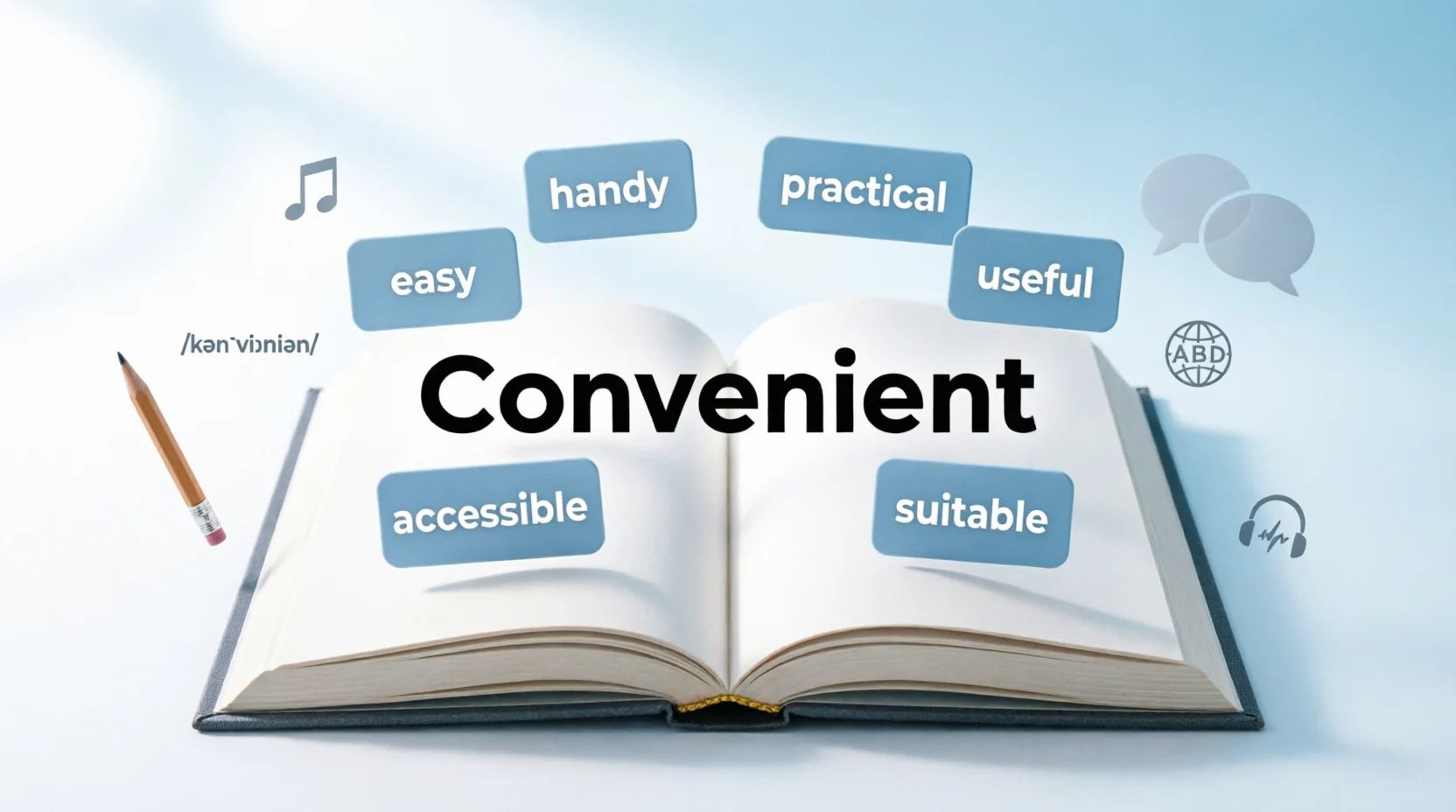
Finding the right convenient synonym can make your English more precise and natural. Words such as handy, practical, accessible, useful, suitable, easy, and efficient can replace “convenient” depending on the situation. However, these words are not always interchangeable because “convenient” can describe something that saves time, requires little effort, is easy to access, or fits a person’s needs.
If you are a student, ESL learner, writer, or content creator, understanding these differences helps you choose vocabulary that communicates your exact meaning.
Quick Answer: What Is a Convenient Synonym?
A convenient synonym is a word or phrase that expresses a similar idea to convenient, usually meaning easy to use, easy to access, suitable, practical, or helpful because it saves time or effort.
Some of the most useful synonyms for convenient are:
- Handy
- Practical
- Useful
- Accessible
- Suitable
- Easy
- Effortless
- Efficient
- Time-saving
- User-friendly
- Expedient
- Advantageous
The best synonym depends on what you mean by “convenient.”
What Does “Convenient” Mean?
Convenient describes something that makes a situation easier, more comfortable, or less time-consuming.
For example:
The grocery store is convenient because it is close to my house.
Here, “convenient” means easy to reach.
Consider another example:
Online banking is convenient for busy people.
In this sentence, “convenient” means easy and practical to use.
The word can describe places, times, services, methods, tools, arrangements, and situations.
Common Meanings of Convenient
“Convenient” commonly expresses these ideas:
- Easy to access — a convenient location.
- Easy to use — a convenient app or tool.
- Suitable for a person’s needs — a convenient arrangement.
- Saving time or effort — a convenient service.
- Occurring at a suitable time — a convenient appointment.
- Practical or useful — a convenient method.
Because the word has several meanings, choosing a synonym requires attention to context.
30 Convenient Synonyms With Meanings and Examples
1. Handy
Simple meaning: Easy to use, find, carry, or access.
Example:
A small flashlight is handy during a power outage.
Best usage/context:
Use “handy” in casual and everyday English when something is particularly useful or readily available.
2. Practical
Simple meaning: Useful and sensible in real situations.
Example:
A backpack is a practical choice for traveling.
Best usage/context:
Use “practical” when you want to emphasize usefulness, realism, or suitability rather than simple ease.
3. Useful
Simple meaning: Helpful for a particular purpose.
Example:
This guide provides useful information for new students.
Best usage/context:
“Useful” is a broad replacement when something provides help or serves a valuable purpose.
4. Accessible
Simple meaning: Easy to reach, obtain, enter, or use.
Example:
The library is accessible by public transportation.
Best usage/context:
Use “accessible” for places, information, services, technology, and resources that are easy for people to reach or use.
5. Suitable
Simple meaning: Appropriate or right for a particular purpose.
Example:
Friday afternoon would be a suitable time for the meeting.
Best usage/context:
Use “suitable” when convenient means appropriate for someone’s needs or circumstances.
6. Easy
Simple meaning: Not difficult or requiring little effort.
Example:
The website makes it easy to book a hotel room.
Best usage/context:
Use “easy” in everyday English when you want simple, direct language.
7. Effortless
Simple meaning: Requiring very little effort.
Example:
The automatic payment system makes bill management almost effortless.
Best usage/context:
Use “effortless” when emphasizing how little physical or mental effort something requires.
8. Efficient
Simple meaning: Working well without wasting time, energy, or resources.
Example:
The new system provides a more efficient way to process applications.
Best usage/context:
Use “efficient” for methods, systems, processes, tools, and procedures that accomplish something effectively.
9. Time-saving
Simple meaning: Helping someone complete something in less time.
Example:
Meal preparation apps can be a useful time-saving tool.
Best usage/context:
Use “time-saving” when the main benefit of convenience is reducing the amount of time required.
10. User-friendly
Simple meaning: Easy for people to understand or operate.
Example:
The new banking app has a user-friendly design.
Best usage/context:
Use “user-friendly” for websites, software, apps, devices, instructions, and systems.
11. Expedient
Simple meaning: Convenient and practical for achieving a particular result.
Example:
Taking the train was the most expedient solution.
Best usage/context:
“Expedient” is more formal than “convenient” and often emphasizes a practical solution to a specific problem.
12. Advantageous
Simple meaning: Providing a benefit or advantage.
Example:
Working remotely can be advantageous for employees with long commutes.
Best usage/context:
Use “advantageous” when the focus is on the benefit something provides rather than ease alone.
13. Favorable
Simple meaning: Helpful, positive, or suitable.
Example:
The company offered favorable payment terms.
Best usage/context:
Use “favorable” for conditions, circumstances, terms, opportunities, or situations that work well for someone.
14. Accommodating
Simple meaning: Willing or able to adjust to someone’s needs.
Example:
The hotel staff were accommodating when we requested a later checkout.
Best usage/context:
Use “accommodating” when convenience comes from flexibility or consideration of another person’s needs.
15. Flexible
Simple meaning: Able to change according to different needs or circumstances.
Example:
The flexible schedule is convenient for working parents.
Best usage/context:
Use “flexible” for schedules, arrangements, policies, plans, and systems that can adapt.
16. Comfortable
Simple meaning: Making something physically or emotionally easy and pleasant.
Example:
The convenient seating arrangement made everyone comfortable.
Best usage/context:
Use “comfortable” when convenience is closely connected with ease, relaxation, or physical comfort.
17. Serviceable
Simple meaning: Good enough to be useful or effective.
Example:
The old laptop is still serviceable for basic tasks.
Best usage/context:
Use “serviceable” when something works adequately, especially when perfection is not necessary.
18. Functional
Simple meaning: Designed or able to work properly.
Example:
The apartment has a simple but functional kitchen.
Best usage/context:
Use “functional” when discussing design, equipment, systems, spaces, or features that work effectively.
19. Available
Simple meaning: Ready to be used, obtained, or accessed.
Example:
Customer support is available 24 hours a day.
Best usage/context:
Use “available” when convenience comes from something being ready or accessible when needed.
20. Within reach
Simple meaning: Close enough or easy enough to obtain.
Example:
The pharmacy is within reach of most residents.
Best usage/context:
Use this phrase for physical locations, opportunities, resources, or goals that are easily accessible.
21. Nearby
Simple meaning: Close in distance.
Example:
There is a nearby restaurant where we can have lunch.
Best usage/context:
Use “nearby” specifically for physical proximity rather than general convenience.
22. Well-located
Simple meaning: Situated in a useful or desirable place.
Example:
The hotel is well-located near several tourist attractions.
Best usage/context:
Use “well-located” for homes, offices, hotels, stores, restaurants, and other physical places.
23. Amenable
Simple meaning: Open, agreeable, or willing to accept a particular arrangement.
Example:
The manager was amenable to changing the meeting time.
Best usage/context:
Use “amenable” in formal contexts when a person or situation is receptive to an arrangement or change.
24. Agreeable
Simple meaning: Pleasant or acceptable.
Example:
We reached an agreeable arrangement for both sides.
Best usage/context:
Use “agreeable” when convenience involves acceptance, cooperation, or pleasant circumstances.
25. Expediently
Simple meaning: In a practical or convenient way.
Example:
The issue was resolved expediently.
Best usage/context:
Use “expediently” as an adverb when describing an action completed in a practical and efficient manner.
26. Prompt
Simple meaning: Done quickly or without unnecessary delay.
Example:
The company provided prompt customer service.
Best usage/context:
Use “prompt” when convenience relates to speed or quick response.
27. Accessible
Simple meaning: Easy for people to reach, obtain, or use.
Example:
The online database makes academic research more accessible.
Best usage/context:
This word is especially useful for locations, information, technology, services, and resources.
28. Straightforward
Simple meaning: Simple and easy to understand or do.
Example:
The registration process is straightforward.
Best usage/context:
Use “straightforward” when something is convenient because it is simple, clear, or uncomplicated.
29. Conveniently located
Simple meaning: Situated in a place that is easy to reach.
Example:
The clinic is conveniently located near the train station.
Best usage/context:
Use this phrase when specifically describing the useful location of a building, business, service, or facility.
30. No-fuss
Simple meaning: Simple, easy, and without unnecessary complications.
Example:
The service offers a no-fuss way to return unwanted items.
Best usage/context:
Use “no-fuss” in informal and promotional writing when you want to emphasize simplicity and ease.
Convenient Synonyms Comparison Table
| Synonym | Main Meaning | Tone | Best Context |
|---|---|---|---|
| Handy | Easy and useful | Casual | Everyday objects |
| Practical | Sensible and useful | Neutral | Choices and solutions |
| Useful | Helpful | Neutral | General situations |
| Accessible | Easy to reach or use | Neutral/Formal | Places and resources |
| Suitable | Appropriate | Neutral | Times and arrangements |
| Easy | Requires little effort | Casual | General situations |
| Effortless | Requires almost no effort | Neutral | Tasks and experiences |
| Efficient | Saves time or resources | Professional | Systems and processes |
| Time-saving | Reduces time needed | Neutral | Methods and tools |
| User-friendly | Easy to operate | Modern/Professional | Technology |
| Expedient | Practical for a purpose | Formal | Solutions and decisions |
| Advantageous | Provides a benefit | Formal | Opportunities and conditions |
| Favorable | Positive or suitable | Neutral/Formal | Terms and circumstances |
| Accommodating | Adjusts to needs | Neutral | People and services |
| Flexible | Adaptable | Neutral | Schedules and arrangements |
| Comfortable | Pleasant and easy | Neutral | Experiences and settings |
| Serviceable | Adequately useful | Formal | Equipment and objects |
| Functional | Works effectively | Neutral | Design and systems |
| Available | Ready to use | Neutral | Services and resources |
| Within reach | Easy to obtain or access | Neutral | Places and opportunities |
| Nearby | Close by | Neutral | Physical locations |
| Well-located | In a useful place | Neutral | Buildings and businesses |
| Amenable | Open to an arrangement | Formal | People and agreements |
| Agreeable | Acceptable or pleasant | Neutral | Arrangements |
| Prompt | Quick | Neutral/Formal | Services and responses |
| Straightforward | Simple and clear | Neutral | Processes and instructions |
| No-fuss | Simple and uncomplicated | Informal | Services and experiences |
Convenient vs. Practical
“Convenient” and “practical” are closely related, but they focus on different qualities.
Convenient emphasizes ease, accessibility, timing, or reduced effort.
Practical emphasizes usefulness, reasonableness, and effectiveness in real situations.
For example:
Online shopping is convenient because you can order from home.
A reusable shopping bag is practical because it can be used repeatedly.
Something can be practical without being especially convenient, and something can be convenient without being the most practical long-term choice.
Convenient vs. Useful
“Useful” means something helps you accomplish a purpose. “Convenient” often adds the idea that something makes the process easier or more comfortable.
This dictionary is useful for learning vocabulary.
This dictionary app is convenient because I can use it on my phone anywhere.
The first sentence focuses on usefulness. The second focuses on ease and accessibility.
Convenient vs. Accessible
“Accessible” specifically emphasizes the ability to reach, obtain, enter, or use something.
The hospital is accessible by bus.
“Convenient” is broader:
The hospital is convenient because it is close to my home and offers evening appointments.
Therefore, “accessible” can describe one aspect of convenience, but it does not always replace “convenient.”
Convenient vs. Easy
“Easy” means something requires little difficulty or effort. “Convenient” can include ease but may also involve location, timing, availability, or practicality.
Compare:
The instructions are easy to follow.
The online booking system is convenient.
The instructions are easy because they are simple. The booking system is convenient because it makes arranging an appointment easier.
How to Choose the Right Convenient Synonym
The best synonym depends on the exact idea you want to communicate.
For Casual Everyday English
Choose:
- Handy
- Easy
- Useful
- Nearby
- No-fuss
Example:
This little travel bag is really handy.
These words sound natural in conversations and informal writing.
For Professional or Academic Writing
Choose:
- Practical
- Efficient
- Accessible
- Suitable
- Advantageous
- Expedient
- Functional
Example:
The revised procedure provides a more efficient method for processing applications.
These alternatives can sound more precise than simply repeating “convenient.”
When You Mean “Saves Time”
Choose:
- Time-saving
- Efficient
- Prompt
- Expedient
Example:
Digital forms provide a time-saving alternative to paper applications.
When You Mean “Easy to Use”
Choose:
- Easy
- User-friendly
- Straightforward
- Effortless
- Functional
Example:
The website has a straightforward registration process.
When You Mean “Easy to Reach”
Choose:
- Accessible
- Nearby
- Within reach
- Well-located
- Conveniently located
Example:
The restaurant is conveniently located near the city center.
When You Mean “Appropriate”
Choose:
- Suitable
- Favorable
- Agreeable
- Appropriate
Example:
Monday morning would be a suitable time for the interview.
When You Mean “Flexible”
Choose:
- Flexible
- Accommodating
- Amenable
Example:
The airline has a flexible cancellation policy.
Common Usage Mistakes With Convenient Synonyms
Mistake 1: Treating Every Synonym as Identical
Not every synonym has exactly the same meaning.
For example, “nearby” refers to physical distance, while “efficient” refers to effective use of time or resources.
Incorrect substitution:
The software is nearby.
Better:
The software is user-friendly.
Mistake 2: Using “Expedient” in Casual Conversation
“Expedient” is grammatically correct, but it sounds more formal than “convenient.”
Casual:
Taking a taxi was convenient.
Formal:
Taking a taxi was the most expedient option.
Choose vocabulary according to the audience and situation.
Mistake 3: Confusing Convenient With Comfortable
“Comfortable” usually relates to physical or emotional comfort.
The chair is comfortable.
“Convenient” relates more to ease, timing, location, or practicality.
The chair is conveniently located beside the desk.
Mistake 4: Using “Accessible” Only for Physical Places
“Accessible” can describe information, technology, services, education, and opportunities as well as physical locations.
The website makes important information accessible to users.
Mistake 5: Assuming “Useful” Always Means “Convenient”
A useful object may still be inconvenient.
For example, a specialized piece of equipment may be extremely useful but difficult to transport or operate.
FAQs:
What is the closest synonym for convenient?
There is no single synonym that works in every situation. Handy, practical, suitable, useful, accessible, and easy are among the closest common alternatives, depending on context.
What is a formal synonym for convenient?
Formal alternatives include expedient, advantageous, suitable, favorable, efficient, and accommodating. The best choice depends on the intended meaning.
What is a simple synonym for convenient?
Easy is one of the simplest alternatives. Handy and useful are also common in everyday English.
What is a synonym for convenient in terms of location?
Use accessible, nearby, within reach, well-located, or conveniently located when describing a place that is easy to reach.
What is a synonym for convenient in terms of time?
Use suitable, appropriate, favorable, or conveniently timed, depending on the sentence.
For example:
Is 3 p.m. a suitable time for you?
What is a synonym for convenient in business writing?
Efficient, practical, accessible, user-friendly, suitable, and expedient can work well in professional contexts, depending on the intended meaning.
Is “easy” the same as “convenient”?
Not always. “Easy” usually means requiring little difficulty or effort, while “convenient” can also refer to timing, location, accessibility, availability, or practicality.
Can “handy” replace “convenient”?
Often, especially in informal English. However, “handy” usually suggests that something is useful or readily available, while “convenient” has a broader range of meanings.
Conclusion
Choosing the right convenient synonym depends on the specific meaning you want to express. Use handy for something useful and readily available, practical for sensible choices, accessible for easy access, efficient for time or resource savings, and suitable for appropriate times or arrangements.
Learning these distinctions can make your English more precise and natural. Instead of repeating “convenient,” choose the word that communicates exactly why something is easy, useful, accessible, practical, or suitable.

I am Camden Thomas, an Administrator at SaysReply. I help maintain our platform and ensure readers find clear, natural, and useful alternative ways to express their thoughts every day.






1 thought on “Convenient Synonym: 30 Useful Alternatives for Clearer, More”