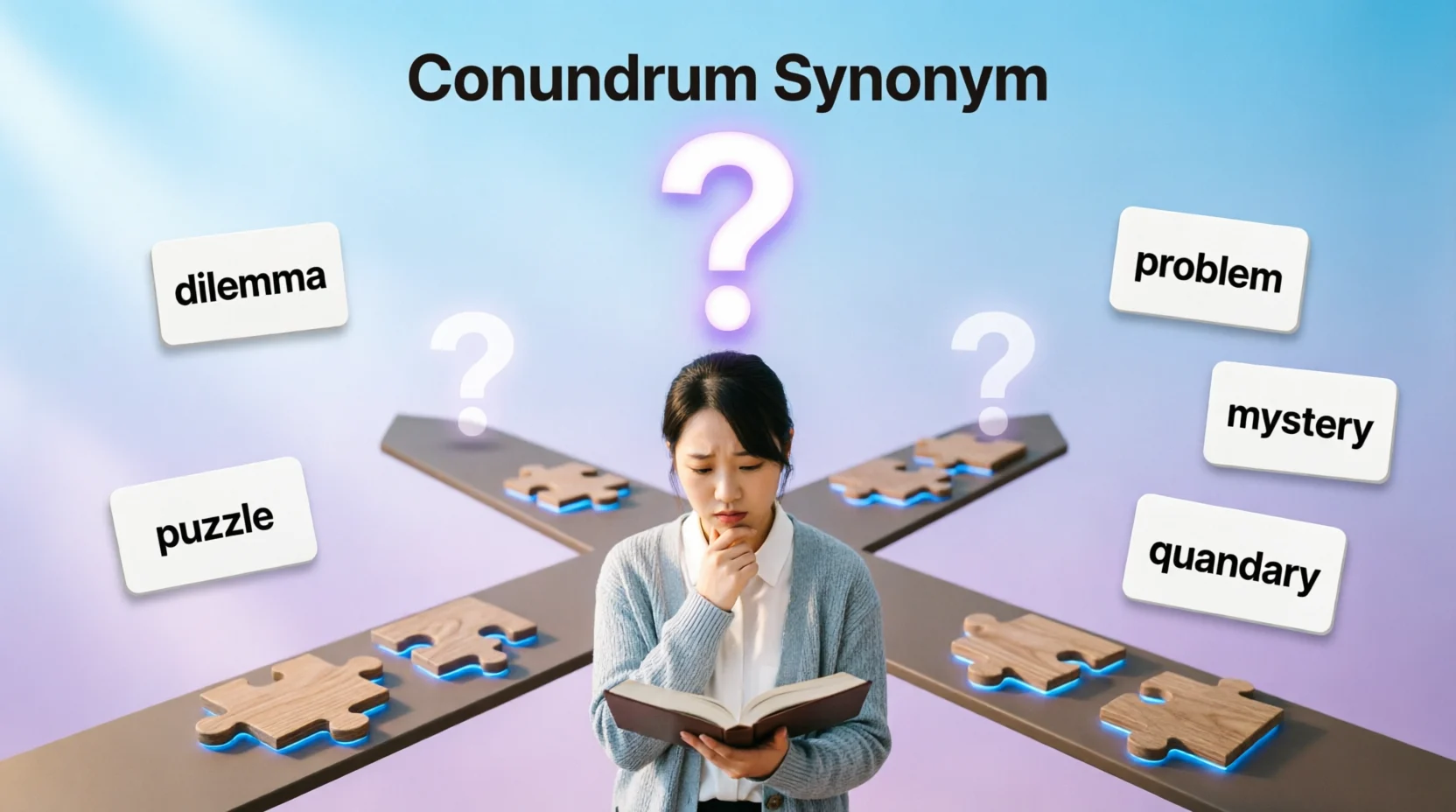
Finding the right conundrum synonym can make your writing clearer, more natural, and more precise. A conundrum is a difficult problem, question, or situation that is hard to understand or solve. Depending on the context, you might use words such as dilemma, quandary, predicament, puzzle, enigma, paradox, impasse, or challenge.
The best synonym depends on what you want to emphasize. Some alternatives focus on a difficult choice, while others describe a confusing mystery, a complicated problem, or a situation with no obvious solution.
Quick Answer: What Is a Good Synonym for Conundrum?
The most common synonyms for conundrum include dilemma, quandary, predicament, puzzle, problem, difficulty, complication, enigma, mystery, paradox, impasse, and challenge.
However, these words are not always interchangeable. For example, dilemma usually involves a difficult choice, while enigma describes something mysterious or difficult to understand. Impasse suggests that progress has stopped, whereas puzzle often refers to something that requires thought to solve.
What Does Conundrum Mean?
A conundrum is a difficult problem, question, or situation that does not have an obvious answer or solution.
In simple English, a conundrum is something confusing or difficult that makes you think carefully about what to do or what the answer might be.
Examples of Conundrum in a Sentence
- Choosing between two excellent job offers created a difficult conundrum.
- The scientist faced a conundrum that required several years of research.
- How to reduce costs without lowering quality remains a conundrum.
- The strange disappearance presented investigators with a serious conundrum.
The word can describe both everyday problems and complicated intellectual questions.
Conundrum: Meaning and Usage
The noun conundrum is often used when a problem is difficult because the answer is unclear, complicated, or seemingly contradictory.
For example:
The company faced a conundrum: it needed to reduce spending without reducing staff.
Here, conundrum emphasizes the difficulty of finding a solution that satisfies both requirements.
Is Conundrum Always Negative?
No. A conundrum is usually challenging, but it does not necessarily describe something harmful or unpleasant. It can be an interesting intellectual problem, a philosophical question, or a situation that encourages careful thinking.
For example:
The relationship between freedom and responsibility is a fascinating philosophical conundrum.
30 Best Conundrum Synonyms
1. Dilemma
Simple meaning: A difficult situation where you must choose between two or more options.
Example:
She faced a dilemma about whether to accept the new position.
Best usage/context:
Use dilemma when the main problem involves a difficult choice.
2. Quandary
Simple meaning: A state of uncertainty about what to do.
Example:
He was in a quandary about whether to stay or leave.
Best usage/context:
Use quandary for a situation where you cannot easily decide what action to take.
3. Predicament
Simple meaning: A difficult or unpleasant situation.
Example:
The lost hikers found themselves in a dangerous predicament.
Best usage/context:
Use predicament when someone is caught in a difficult circumstance, especially an undesirable one.
4. Puzzle
Simple meaning: Something difficult to understand or solve.
Example:
The unusual evidence was a puzzle for the investigators.
Best usage/context:
Use puzzle for problems, questions, or situations that require thought to solve.
5. Problem
Simple meaning: Something that is difficult and needs to be solved or dealt with.
Example:
Finding affordable housing is a serious problem in many cities.
Best usage/context:
Use problem as the broadest and most general alternative to conundrum.
6. Difficulty
Simple meaning: Something that makes a task hard to complete.
Example:
The team encountered several difficulties during the project.
Best usage/context:
Use difficulty when emphasizing the obstacles involved in completing something.
7. Complication
Simple meaning: Something that makes a situation more difficult.
Example:
A sudden change in the schedule created another complication.
Best usage/context:
Use complication when an additional issue makes an existing situation harder.
8. Enigma
Simple meaning: Something mysterious or difficult to understand.
Example:
The ancient inscription remains an enigma to historians.
Best usage/context:
Use enigma when mystery or lack of understanding is the main idea.
9. Mystery
Simple meaning: Something whose explanation or truth is unknown.
Example:
The disappearance remained a mystery for decades.
Best usage/context:
Use mystery when the answer or explanation is unknown.
10. Paradox
Simple meaning: A statement or situation that seems contradictory but may contain a deeper truth.
Example:
The paradox of choice is that having more options can sometimes make decisions harder.
Best usage/context:
Use paradox for apparently contradictory ideas or situations.
11. Impasse
Simple meaning: A situation where no progress is possible.
Example:
Negotiations reached an impasse after both sides rejected the proposal.
Best usage/context:
Use impasse when people or groups cannot move forward because they disagree or lack a solution.
12. Catch-22
Simple meaning: A difficult situation where solving one problem requires something that the situation itself prevents.
Example:
She needed experience to get the job, but she needed the job to gain experience—a classic Catch-22.
Best usage/context:
Use Catch-22 for a self-defeating situation with conflicting requirements.
13. Riddle
Simple meaning: A question or problem that requires clever thinking to answer.
Example:
The old inscription presented the researchers with a fascinating riddle.
Best usage/context:
Use riddle when the problem has a mysterious or puzzle-like quality.
14. Brainteaser
Simple meaning: A challenging question or problem designed to test thinking.
Example:
The interviewer gave the candidates a brainteaser.
Best usage/context:
Use brainteaser for puzzles, logic questions, games, or mental challenges.
15. Perplexity
Simple meaning: A state of being confused or uncertain.
Example:
The unexpected result caused considerable perplexity among the researchers.
Best usage/context:
Use perplexity when focusing on the feeling or state of confusion rather than the problem itself.
16. Uncertainty
Simple meaning: A lack of certainty about what will happen or what is correct.
Example:
The uncertainty surrounding the decision made planning difficult.
Best usage/context:
Use uncertainty when the central issue is doubt about an outcome, fact, or decision.
17. Bind
Simple meaning: A difficult situation from which it is hard to escape.
Example:
By agreeing to both deadlines, he put himself in a bind.
Best usage/context:
Use bind in informal English when someone is trapped by difficult circumstances.
18. Tight Spot
Simple meaning: A difficult situation.
Example:
The unexpected expense put the family in a tight spot.
Best usage/context:
Use tight spot in informal conversations and everyday writing.
19. Sticky Situation
Simple meaning: An awkward, complicated, or difficult situation.
Example:
He found himself in a sticky situation after giving conflicting explanations.
Best usage/context:
Use sticky situation for informal descriptions of awkward or complicated circumstances.
20. Plight
Simple meaning: A difficult or unfortunate situation.
Example:
The report highlighted the plight of families affected by the disaster.
Best usage/context:
Use plight when emphasizing hardship, suffering, or difficult circumstances.
21. Predicament
Simple meaning: A difficult situation that is hard to escape.
Example:
The unexpected cancellation left travelers in a difficult predicament.
Best usage/context:
Use it for circumstances that place someone in a challenging position.
Note: Predicament is listed once as a primary synonym; avoid repeating it in your own synonym lists.
22. Vexation
Simple meaning: Something that causes annoyance, worry, or frustration.
Example:
The repeated delays became a source of vexation for the staff.
Best usage/context:
Use vexation when the emotional frustration caused by a problem matters.
23. Trouble
Simple meaning: A problem or difficult situation.
Example:
The software update caused trouble for several users.
Best usage/context:
Use trouble for common, everyday problems in informal or general writing.
24. Obstacle
Simple meaning: Something that makes progress difficult.
Example:
Lack of funding became a major obstacle to the project.
Best usage/context:
Use obstacle when emphasizing something that blocks progress toward a goal.
25. Challenge
Simple meaning: Something difficult that requires effort or skill.
Example:
Learning a new language can be a rewarding challenge.
Best usage/context:
Use challenge when the difficulty is something that can be approached constructively or positively.
26. Issue
Simple meaning: A problem, concern, or matter that needs attention.
Example:
The committee discussed the issue for several hours.
Best usage/context:
Use issue in professional, academic, and general contexts when you want a neutral term.
27. Question
Simple meaning: Something that needs an answer or explanation.
Example:
The discovery raised an important question about how the system works.
Best usage/context:
Use question when the central concern is something that needs to be answered or explained.
28. Poser
Simple meaning: A difficult question or problem.
Example:
The unexpected result was a real poser for the research team.
Best usage/context:
Use poser when describing a particularly difficult question, especially in informal or literary contexts.
29. Knot
Simple meaning: A complicated problem or situation that is difficult to resolve.
Example:
The negotiations became a knot of competing demands.
Best usage/context:
Use knot metaphorically for complicated problems that need to be untangled.
30. Conundrum-Like Problem
Simple meaning: A complicated problem with no obvious answer.
Example:
Balancing privacy and convenience can become a conundrum-like problem for modern services.
Best usage/context:
Use this descriptive phrase when you need to explain the nature of a problem rather than replace conundrum with one exact synonym.
Conundrum Synonyms Comparison Table
| Synonym | Main Meaning | Formality | Best Context |
|---|---|---|---|
| Dilemma | Difficult choice | Neutral | Decisions |
| Quandary | Uncertainty about what to do | Formal/neutral | Difficult decisions |
| Predicament | Difficult situation | Neutral | Personal circumstances |
| Puzzle | Something difficult to solve | Neutral | Questions and problems |
| Problem | Something needing a solution | Neutral | General use |
| Difficulty | Something that makes a task hard | Neutral | Tasks and projects |
| Complication | An issue that makes something harder | Neutral | Complex situations |
| Enigma | Something mysterious | Formal/literary | Mysteries |
| Mystery | Something unexplained | Neutral | Unknown facts |
| Paradox | Apparent contradiction | Formal | Ideas and concepts |
| Impasse | No possibility of progress | Formal | Negotiations |
| Catch-22 | Self-defeating situation | Informal | Conflicting requirements |
| Riddle | Puzzle requiring thought | Neutral | Questions and mysteries |
| Brainteaser | Mental challenge | Informal | Games and interviews |
| Perplexity | Confusion | Formal | Intellectual uncertainty |
| Uncertainty | Lack of certainty | Neutral/formal | Predictions and decisions |
| Bind | Difficult position | Informal | Everyday situations |
| Tight spot | Difficult situation | Informal | Conversation |
| Sticky situation | Awkward problem | Informal | Social situations |
| Plight | Unfortunate circumstances | Formal | Hardship |
| Vexation | Frustrating problem | Formal | Annoyance |
| Trouble | General problem | Informal/neutral | Everyday problems |
| Obstacle | Something blocking progress | Neutral | Goals and projects |
| Challenge | Difficult task | Neutral/positive | Learning and work |
| Issue | Matter requiring attention | Neutral/formal | Business and academics |
| Question | Matter requiring an answer | Neutral | Research and discussion |
| Poser | Difficult question | Informal/literary | Challenging questions |
| Knot | Complicated problem | Literary | Complex situations |
Conundrum vs. Dilemma
These two words are closely related, but they emphasize different things.
A dilemma usually involves a difficult choice between alternatives.
A conundrum is broader. It can be a difficult choice, but it can also be a confusing question, complicated problem, or seemingly impossible situation.
Example:
- Choosing between two jobs is a dilemma.
- Finding a way to satisfy the competing demands of both employers may be a conundrum.
Conundrum vs. Quandary
A quandary focuses strongly on uncertainty about what to do.
A conundrum can describe uncertainty, but it often emphasizes the complexity of the problem itself.
Quandary:
I am in a quandary about which course to take.
Conundrum:
How can the university offer more courses without increasing costs? It is a difficult conundrum.
Conundrum vs. Predicament
A predicament is usually a difficult situation in which someone finds themselves.
A conundrum is more often a difficult problem or question requiring a solution.
Predicament:
The travelers were in a difficult predicament after missing the last train.
Conundrum:
How to get everyone home safely became a serious conundrum.
Conundrum vs. Enigma
An enigma is primarily something mysterious or difficult to understand.
A conundrum is generally a difficult problem or question.
Enigma:
Her sudden disappearance remained an enigma.
Conundrum:
Investigators faced a conundrum about how to explain the conflicting evidence.
How to Choose the Right Conundrum Synonym
Choose Based on Meaning
For a difficult choice:
Use dilemma, quandary, or Catch-22.
For a difficult situation:
Use predicament, bind, tight spot, or plight.
For a problem that needs solving:
Use problem, puzzle, difficulty, complication, or challenge.
For something mysterious:
Use enigma, mystery, or riddle.
For a contradictory idea:
Use paradox.
For a situation where progress has stopped:
Use impasse.
Choose Based on Tone
Formal or academic:
Enigma, paradox, perplexity, uncertainty, predicament, impasse, complication
Neutral and versatile:
Problem, difficulty, challenge, issue, puzzle, question
Informal:
Bind, tight spot, sticky situation, trouble, Catch-22, brainteaser
Literary or expressive:
Enigma, riddle, knot, poser, plight
Choose Based on Intent
If you want to sound neutral, choose problem or issue.
If you want to emphasize choice, choose dilemma.
If you want to emphasize confusion, choose perplexity or quandary.
If you want to emphasize mystery, choose enigma.
If you want to emphasize contradiction, choose paradox.
If you want to emphasize blocked progress, choose impasse.
If you want to emphasize hardship, choose predicament or plight.
If you want a positive or constructive tone, choose challenge.
Common Mistakes When Using Conundrum Synonyms
1. Using Dilemma for Every Difficult Problem
Not every difficult problem is a dilemma. A dilemma normally involves a difficult choice.
Incorrect:
The broken printer was a dilemma.
Better:
The broken printer was a problem.
2. Using Enigma When There Is No Mystery
Enigma suggests that something is mysterious or difficult to understand. It is not simply a fancy replacement for problem.
Better:
The origin of the ancient symbol remains an enigma.
3. Confusing an Impasse With a General Problem
An impasse specifically suggests that progress has stopped.
The two sides reached an impasse during negotiations.
A simple disagreement or challenge does not necessarily constitute an impasse.
4. Using Paradox for Any Contradiction
A paradox has a more specific meaning than an ordinary contradiction. It often describes an apparently contradictory statement or situation that invites deeper thought.
5. Ignoring Formality
Words such as tight spot and sticky situation work well in conversation but may sound too informal in academic writing. In formal contexts, terms such as predicament, complication, uncertainty, or dilemma may fit better.
How to Use Conundrum in a Sentence
Here are several natural examples:
- The scientists faced a difficult conundrum.
- Finding affordable housing has become a major conundrum.
- The unusual evidence presented a conundrum for investigators.
- She was trying to solve a complex conundrum.
- The ethical question created a serious conundrum for the committee.
- Balancing speed, cost, and quality can be a difficult conundrum.
FAQs:
What is the closest synonym for conundrum?
Dilemma, quandary, puzzle, predicament, and problem are among the closest alternatives. The best choice depends on the exact meaning and context.
What is a simple synonym for conundrum?
Problem is one of the simplest synonyms. Puzzle is also useful when the problem requires careful thought to solve.
Is dilemma a synonym for conundrum?
Yes, but the meanings are not identical. A dilemma normally involves a difficult choice, while a conundrum can describe a wider range of difficult problems or questions.
What is a formal synonym for conundrum?
Depending on context, predicament, enigma, paradox, perplexity, uncertainty, and impasse can work as formal alternatives.
What is the opposite of a conundrum?
Depending on context, possible opposites include solution, answer, certainty, clarity, simplicity, or resolution.
Is conundrum positive or negative?
Conundrum is generally neutral. It describes difficulty rather than automatically describing something as good or bad. An intellectual conundrum can even be interesting or stimulating.
Can conundrum be used in academic writing?
Yes. Conundrum can work well in academic writing when describing a complex question or problem. However, a more precise term such as dilemma, paradox, uncertainty, or problem may be preferable when the specific meaning matters.
What is the difference between a conundrum and a puzzle?
A puzzle is generally something designed or expected to be solved. A conundrum often describes a more complicated problem or situation with no obvious solution. The words can overlap in some contexts.
Conclusion
A conundrum is a difficult problem, question, or situation that does not have an obvious answer. Its synonyms include dilemma, quandary, predicament, puzzle, problem, enigma, paradox, impasse, challenge, and many others.
The key is to choose the word that matches your intended meaning. Use dilemma for difficult choices, enigma for mysteries, paradox for apparent contradictions, impasse for blocked progress, and challenge for difficulties that can be approached constructively.
Understanding these distinctions will help you write with greater precision and choose vocabulary that sounds natural in academic, professional, creative, and everyday English.

I’m Amelia Rose, an enthusiastic writer who enjoys exploring better, clearer, and more natural ways to express ideas. I create helpful content that makes finding alternative phrases simple, useful, and enjoyable for everyone.