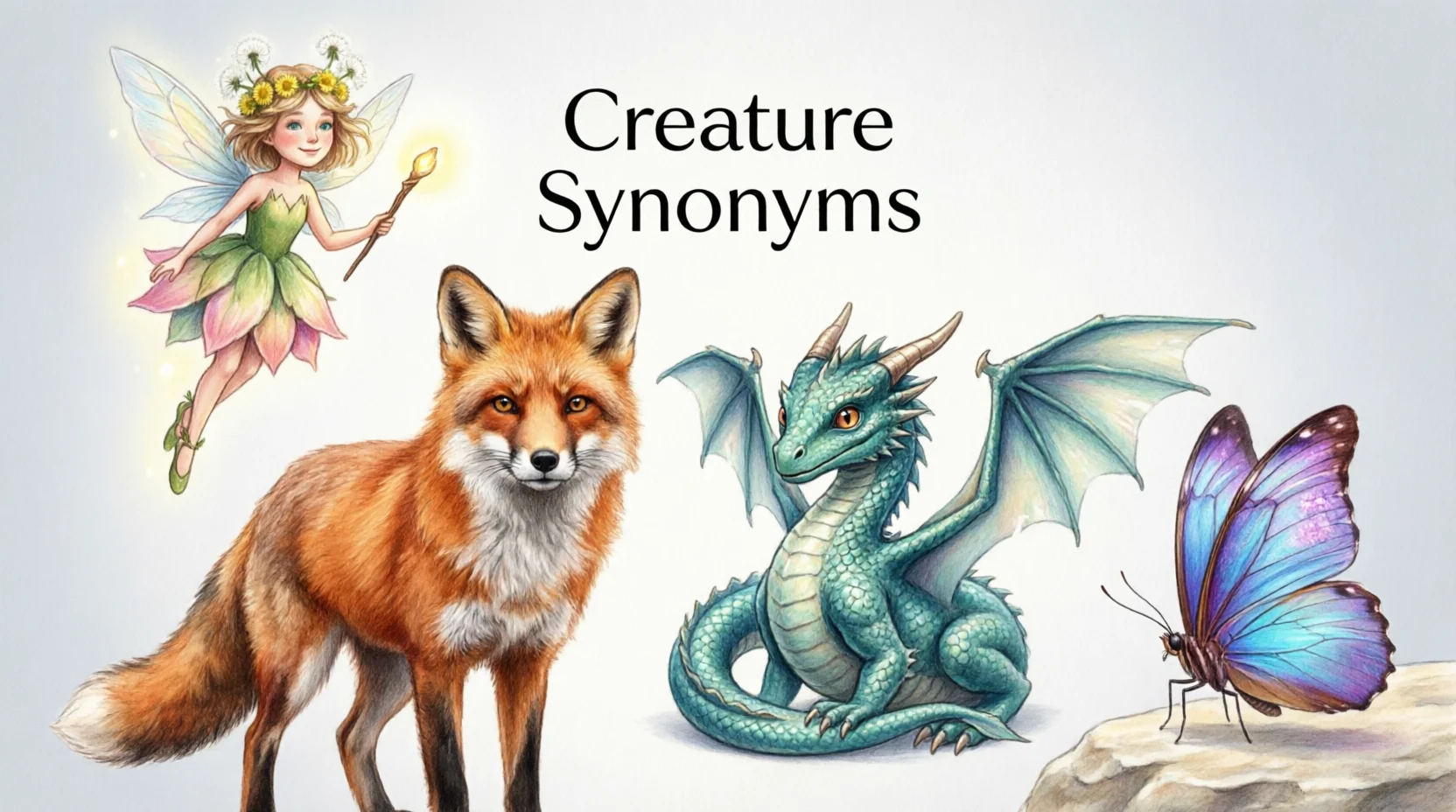
The best creature synonym depends on what you mean by “creature.” Common alternatives include animal, being, organism, living thing, beast, critter, entity, life-form, and monster. Some are neutral, while others suggest a particular size, personality, appearance, or fictional nature.
If you are writing an essay, story, article, conversation, or creative description, choosing the right synonym can make your meaning much clearer. This guide explains 30 useful alternatives to “creature,” with simple meanings, example sentences, and the situations where each word works best.
Quick Answer: What Is a Good Synonym for Creature?
A good general synonym for creature is being or animal, depending on the context.
- Animal — best for a real non-human living animal.
- Being — useful for any living or conscious individual.
- Organism — best for scientific or biological writing.
- Living thing — simple and broad.
- Beast — often suggests a large, powerful, or frightening animal.
- Critter — informal and friendly.
- Entity — useful for an unusual, supernatural, or mysterious presence.
- Life-form — useful when discussing biological existence or extraterrestrial possibilities.
- Monster — appropriate for a frightening fictional or legendary creature.
What Does “Creature” Mean?
The word creature generally refers to a living being, especially an animal. It can also describe a person, imaginary being, supernatural figure, or unusual life-form.
For example:
We saw a strange creature moving through the forest.
Here, “creature” could refer to an unidentified animal.
The word can also be used affectionately:
The little creature followed me around the garden.
In this sentence, “creature” may simply mean a small animal.
In fiction and mythology, creature often refers to something unusual, magical, frightening, or non-human:
The story describes a mysterious creature living beneath the castle.
Because the word has several meanings, the best synonym depends heavily on context.
Creature: Meaning and Usage
“Creature” is a flexible noun. It can refer to something real, imaginary, biological, supernatural, or even metaphorical.
Creature as an Animal
This is one of the most common uses.
Every creature in the forest needs water to survive.
Here, “creature” means an animal or living organism.
Creature as a Living Being
The word can have a broader meaning:
Every living creature deserves a safe environment.
In this context, “creature” means a living being rather than specifically an animal.
Creature as a Person
Older or literary writing sometimes uses “creature” to refer to a person.
She was a gentle creature who cared deeply for others.
This usage can sound poetic, affectionate, old-fashioned, or slightly unusual depending on context.
Creature as a Fictional Being
Fantasy, science fiction, mythology, and horror frequently use the word.
The heroes encountered a strange creature beneath the mountain.
Possible alternatives include monster, being, entity, beast, or life-form, depending on what the creature actually is.
30 Synonyms for Creature
The following alternatives are not identical in meaning. Each one carries its own tone and context.
1. Animal
Simple meaning: A living organism that is not a plant or human.
Example: The zoo rescued an injured animal.
Best usage/context: Use animal when you are specifically talking about non-human animals. It is one of the clearest and most common alternatives to “creature.”
2. Being
Simple meaning: A living or existing individual.
Example: Every living being needs energy to survive.
Best usage/context: Use being when you want a broad term that can refer to humans, animals, supernatural figures, or other conscious entities.
3. Organism
Simple meaning: An individual living thing.
Example: Scientists studied the tiny organism under a microscope.
Best usage/context: Best for biology, science, medicine, and academic writing.
4. Living Thing
Simple meaning: Anything that is alive.
Example: The forest contains many different living things.
Best usage/context: Use this simple phrase when writing for beginners or when you want a broad, easy-to-understand expression.
5. Beast
Simple meaning: A large, powerful, wild, or sometimes frightening animal.
Example: The hunters heard a strange beast moving through the woods.
Best usage/context: Common in fantasy, mythology, literature, and dramatic descriptions. It can also describe something extremely powerful metaphorically.
6. Critter
Simple meaning: An informal word for an animal or small creature.
Example: A little critter was hiding beneath the porch.
Best usage/context: Informal speech, friendly writing, children’s stories, and casual descriptions.
7. Life-Form
Simple meaning: Something that has a form of biological life.
Example: Researchers searched for signs of extraterrestrial life-forms.
Best usage/context: Science fiction, astronomy, biology, and discussions about possible extraterrestrial life.
8. Entity
Simple meaning: Something that exists as a distinct individual or presence.
Example: The investigators believed an unknown entity was inside the abandoned building.
Best usage/context: Useful for mysterious, supernatural, fictional, or abstract subjects. It is more formal than “creature.”
9. Monster
Simple meaning: A frightening or unusual imaginary creature.
Example: The children imagined a monster living under the bed.
Best usage/context: Horror, fantasy, folklore, mythology, children’s stories, and fictional descriptions.
10. Beastie
Simple meaning: An informal or playful word for a small animal or creature.
Example: A tiny beastie crawled across the windowsill.
Best usage/context: Playful, humorous, informal, or affectionate writing.
11. Fauna
Simple meaning: The animals found in a particular region or environment.
Example: The island is home to unique fauna.
Best usage/context: Scientific, environmental, geographical, and academic writing. Unlike “creature,” it usually refers collectively to animals rather than one individual.
12. Animal Life
Simple meaning: The animals living in a particular place or environment.
Example: The river supports abundant animal life.
Best usage/context: Environmental writing, geography, ecology, and educational material.
13. Specimen
Simple meaning: An individual example of a species or type studied by scientists.
Example: The researchers carefully examined the unusual specimen.
Best usage/context: Scientific research, museums, biology, zoology, and laboratory contexts.
14. Individual
Simple meaning: A single living member of a group or species.
Example: Each individual was observed for several hours.
Best usage/context: Formal, scientific, academic, and statistical writing.
15. Subject
Simple meaning: A person or animal being studied or observed.
Example: The researcher recorded the subject’s behavior.
Best usage/context: Research, psychology, biology, photography, and experimental contexts. It does not always mean “creature,” so context matters.
16. Character
Simple meaning: A person or being in a story, play, film, or game.
Example: The dragon is the most memorable character in the novel.
Best usage/context: Fiction and storytelling. Use it when the creature is part of a narrative.
17. Figure
Simple meaning: A person or being, especially one described as distinctive or mysterious.
Example: A shadowy figure appeared at the edge of the forest.
Best usage/context: Literary, mysterious, dramatic, or descriptive writing.
18. Monster
Simple meaning: A terrifying or unnatural being.
Example: The villagers feared that a monster lived in the cave.
Best usage/context: Horror, fantasy, mythology, and folklore. “Monster” is much more negative than the neutral “creature.”
19. Apparition
Simple meaning: A ghostly or supernatural appearance.
Example: An apparition appeared near the old cemetery.
Best usage/context: Ghost stories and supernatural writing. It should not normally replace “creature” when referring to an ordinary animal.
20. Spirit
Simple meaning: A supernatural or non-physical being.
Example: According to the legend, a forest spirit protected the ancient trees.
Best usage/context: Religious, spiritual, mythological, and fantasy contexts.
21. Demon
Simple meaning: A supernatural being traditionally associated with evil or harmful forces.
Example: The fantasy novel features a powerful demon.
Best usage/context: Religious, mythological, fantasy, and horror contexts. It is much more specific than “creature.”
22. Beastie
Simple meaning: A playful name for a small animal or creature.
Example: We found a harmless beastie hiding among the leaves.
Best usage/context: Informal, humorous, affectionate, and conversational writing.
23. Vermin
Simple meaning: Animals considered harmful, unwanted, or troublesome.
Example: The building had a serious problem with vermin.
Best usage/context: Pest-control, agricultural, and strongly negative contexts. Avoid it when you simply mean “animal.”
24. Brute
Simple meaning: A person or animal associated with physical strength or rough behavior.
Example: The story describes the creature as a massive brute.
Best usage/context: Dramatic or literary descriptions of powerful, aggressive beings.
25. Mammal
Simple meaning: A warm-blooded animal that belongs to the mammal group.
Example: The researcher identified the creature as a nocturnal mammal.
Best usage/context: Biology and zoology when the animal is specifically a mammal.
26. Species Member
Simple meaning: One individual belonging to a particular species.
Example: The researchers observed a rare species member in its natural habitat.
Best usage/context: Technical or explanatory contexts. In ordinary English, “individual” or the animal’s name usually sounds more natural.
27. Microbe
Simple meaning: A very small living organism, often microscopic.
Example: The scientist discovered a previously unknown microbe.
Best usage/context: Microbiology and scientific writing. It is appropriate only when discussing microscopic organisms.
28. Inhabitant
Simple meaning: A living thing that lives in a particular place.
Example: Every inhabitant of the reef depends on a healthy ecosystem.
Best usage/context: Environmental and geographical descriptions. It emphasizes where something lives rather than what it is.
29. Native
Simple meaning: A plant, animal, or organism naturally belonging to a particular area.
Example: The fox is a native species in this region.
Best usage/context: Ecology, geography, conservation, and environmental writing. “Native” is not a direct replacement for “creature” in every sentence.
30. Nonhuman Being
Simple meaning: A living or conscious being that is not human.
Example: The novel explores communication between humans and nonhuman beings.
Best usage/context: Science fiction, philosophy, animal studies, fantasy, and discussions about intelligent life.
Creature Synonyms Comparison Table
| Synonym | Meaning | Tone | Best Context |
|---|---|---|---|
| Animal | Non-human living animal | Neutral | Everyday writing |
| Being | Living or existing individual | Neutral | Broad/general use |
| Organism | Individual living thing | Formal | Science |
| Living thing | Anything alive | Simple | Educational writing |
| Beast | Powerful or wild animal | Dramatic | Fantasy/literature |
| Critter | Animal or small creature | Informal | Casual writing |
| Life-form | Biological form of life | Scientific | Science fiction/science |
| Entity | Distinct existing presence | Formal/mysterious | Supernatural contexts |
| Monster | Frightening fictional being | Negative | Horror/fantasy |
| Fauna | Animals of a region | Formal | Ecology |
| Specimen | Individual studied by researchers | Scientific | Biology |
| Character | Being in a story | Neutral | Fiction |
| Figure | Distinctive or mysterious being | Literary | Descriptive writing |
| Spirit | Supernatural being | Spiritual | Mythology/religion |
| Demon | Supernatural evil-associated being | Strong | Horror/religion |
| Vermin | Harmful or unwanted animals | Negative | Pest contexts |
| Brute | Powerful, rough being | Harsh | Dramatic writing |
| Mammal | Specific biological animal group | Scientific | Zoology |
| Microbe | Microscopic organism | Scientific | Microbiology |
| Inhabitant | Living thing in a place | Neutral | Ecology/geography |
Creature vs. Animal: What Is the Difference?
Creature and animal are closely related, but they are not interchangeable in every situation.
Animal is more precise when you know that you are referring to an animal.
The animal was injured.
Creature is broader and can suggest that the speaker does not know exactly what the living thing is.
A strange creature was moving in the darkness.
“Creature” can also refer to fictional, supernatural, or mythical beings, while “animal” generally refers to biological animals.
Creature vs. Being
Being is broader than “creature.”
A being can be a human, animal, supernatural figure, fictional character, or other conscious existence.
The story introduces an ancient being.
By contrast, “creature” often gives the reader a stronger sense of something living, physical, unusual, or non-human.
Creature vs. Beast
Beast usually has a stronger emotional tone.
Compare:
A creature entered the forest.
with:
A beast entered the forest.
The first sentence is neutral and mysterious. The second suggests something powerful, wild, or potentially dangerous.
Creature vs. Monster
A monster is generally a particular type of creature, especially one that is frightening, unnatural, or dangerous.
Therefore, every monster can be called a creature, but not every creature is a monster.
A butterfly is a creature.
A dragon described as terrifying may be a monster.
Creature vs. Organism
Organism is the preferred term in scientific contexts.
For example:
The researchers discovered a previously unknown organism.
This sounds more precise and academic than:
The researchers discovered a strange creature.
Use “organism” when biological classification or scientific accuracy matters.
How to Choose the Right Creature Synonym
The best alternative depends on meaning, tone, audience, and context.
For Neutral Everyday Writing
Choose:
- Animal
- Being
- Living thing
- Individual
Example:
The animal crossed the road.
These choices are straightforward and easy to understand.
For Scientific Writing
Choose:
- Organism
- Specimen
- Individual
- Mammal
- Microbe
- Life-form
Example:
Scientists identified the organism through genetic analysis.
These words provide greater scientific precision than the broad word “creature.”
For Fantasy Writing
Choose:
- Beast
- Being
- Entity
- Monster
- Spirit
- Life-form
Example:
A mysterious beast guarded the entrance to the ancient temple.
The best choice depends on whether the character is frightening, magical, supernatural, or simply unusual.
For Horror Writing
Choose:
- Monster
- Entity
- Beast
- Apparition
- Demon
- Figure
Example:
An unknown entity moved through the abandoned house.
These alternatives can create suspense without repeatedly using “creature.”
For Friendly or Informal Writing
Choose:
- Critter
- Beastie
- Animal
- Little one
- Living thing
Example:
A tiny critter was hiding beneath the flowerpot.
These words can make the description sound warmer and more conversational.
For Environmental Writing
Choose:
- Fauna
- Animal life
- Organism
- Inhabitant
- Native species
- Individual
Example:
The wetland supports diverse animal life.
These terms are more suitable for ecology and conservation topics.
For Literary or Poetic Writing
Choose:
- Being
- Figure
- Spirit
- Beast
- Entity
- Soul
Example:
A silent figure wandered beneath the moonlight.
The right choice depends on the emotional atmosphere you want to create.
Common Mistakes When Using Creature Synonyms
Using “Monster” for Every Creature
“Monster” is not a neutral synonym.
A rabbit, bird, or butterfly can be called a creature, but calling it a monster changes the meaning and tone.
Using “Organism” in Casual Conversation
“Organism” is grammatically correct but often sounds scientific.
Instead of:
Look at that fascinating organism!
you might naturally say:
Look at that fascinating creature!
Treating “Fauna” as a Singular Synonym
“Fauna” generally refers collectively to the animals of a particular place or period.
Natural:
The region has diverse fauna.
Less natural:
I saw one fauna in the forest.
For one animal, use animal, creature, or a specific animal name.
Using “Vermin” as a Neutral Term
“Vermin” normally carries a negative meaning. It describes animals that people consider harmful, unwanted, or troublesome.
Therefore, it should not casually replace “creature.”
Confusing a “Character” With a Real Animal
“Character” works especially well when a creature is part of a story, movie, game, or other fictional work.
For a real animal, animal or creature is usually more appropriate.
Choosing a Word That Is Too Specific
If you do not know whether something is a mammal, reptile, insect, or another type of organism, “creature” may be more suitable than making an unsupported identification.
FAQs:
What is the best synonym for creature?
Animal is one of the best synonyms when “creature” refers to a real non-human animal. Being is more suitable when the meaning is broader.
What is a simple synonym for creature?
Animal, living thing, and being are simple alternatives. The best choice depends on what the word refers to.
What is a formal synonym for creature?
Organism, entity, individual, and specimen can work in formal contexts, although each has a different meaning.
What is a synonym for creature in fantasy?
Useful fantasy alternatives include beast, monster, entity, being, spirit, and life-form. The correct choice depends on the creature’s nature and role.
What is a synonym for a small creature?
Critter and beastie are informal options. Animal and organism are more neutral or formal choices.
What is a synonym for a scary creature?
Monster, beast, entity, demon, or apparition may work, depending on what the frightening being actually is.
Can “being” replace “creature”?
Yes, in many contexts. However, being is broader. It can refer to humans, animals, supernatural figures, or other forms of existence.
Is “beast” a positive or negative word?
“Beast” can be neutral in some descriptions, but it often suggests something wild, powerful, dangerous, or difficult to control. Its tone depends on context.
Conclusion
The word creature is useful because it can describe many kinds of living or fictional beings. However, a more specific synonym can make your writing clearer and more expressive.
Choose animal for an ordinary non-human animal, organism for scientific writing, being for a broad reference, critter for an informal tone, beast for something wild or powerful, and monster for a frightening fictional being.
The most effective synonym is not necessarily the closest word in a dictionary. It is the word that accurately communicates your intended meaning, tone, and context.

I am Camden Thomas, an Administrator at SaysReply. I help maintain our platform and ensure readers find clear, natural, and useful alternative ways to express their thoughts every day.





3 thoughts on “Creature Synonym: 30 Best Alternatives for “Creature” With”