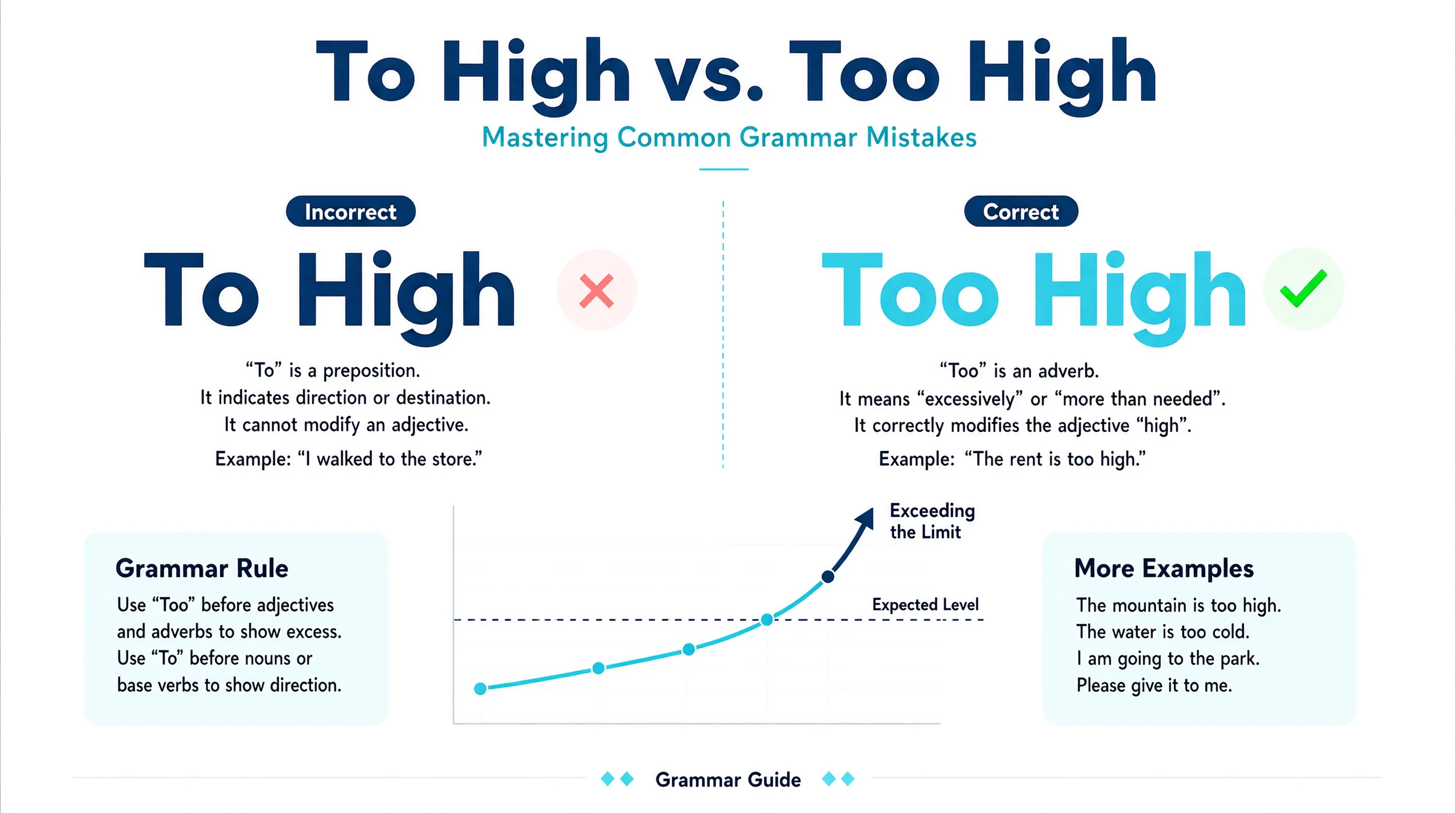
Have you ever wondered If to write “to high” or “too high”? These phrases sound exactly the same, but only one is correct when you want to describe something that exceeds a normal, expected, or acceptable level. The correct expression is “too high.” For example, “The price is too high” means the price is more than someone can afford or is willing to pay.
English learners and even native speakers sometimes confuse these expressions because the words to and too have similar pronunciations. However, they have different meanings and grammatical functions. Understanding the difference will help you avoid spelling mistakes in emails, school assignments, professional writing, and everyday conversations.
In this guide, you will learn what each word means, when to use it, how to recognize common mistakes, and how to choose the correct expression through simple explanations and practical examples.
Quick Answer: To High or Too High?
“Too high” is correct when describing something that exceeds a desired, normal, or acceptable level. The word “too” means excessively or more than necessary. “To” is generally used for direction, destination, or an infinitive verb, so “to high” is incorrect in ordinary sentences such as “The temperature is too high.”
Why Do People Confuse To High and Too High?
People confuse “to high” and “too high” because both expressions sound identical when spoken. Their pronunciation does not help writers recognize which spelling is correct.
However, their meanings are different:
- To: A preposition or part of an infinitive verb. It can indicate direction, destination, or purpose.
- Too: An adverb meaning excessively, additionally, or more than necessary.
When describing something that exceeds an acceptable level, you need “too.”
For example:
- Correct: The temperature is too high.
- Incorrect: The temperature is to high.
The confusion usually happens when people write quickly without considering the meaning of the sentence.
First Word: What Does “To” Mean?
“To” is a common English word that works as a preposition and as part of an infinitive verb.
It usually describes direction, movement, destination, purpose, or a relationship between things.
When Should You Use To?
Use “to” in these situations:
1. To show direction or movement
- She went to school.
- He walked to the market.
- We are traveling to London.
2. To identify a destination
- Send this letter to my office.
- Give the book to Sarah.
- They moved to another city.
3. Before a verb in its infinitive form
- I want to learn English.
- She likes to read books.
- We need to finish our homework.
4. To express a relationship or comparison
- This is important to me.
- The answer is similar to mine.
- The temperature rose to 40 degrees.
Can You Use To Before High?
Yes, but only when the sentence structure gives “to” a separate grammatical purpose.
For example:
- The airplane climbed to a high altitude.
- She wants to aim high in life.
- The road leads to high mountains.
In these examples, “to” is grammatically correct because it connects the sentence to another word or phrase. It does not mean “excessively.”
Second Word: What Does “Too” Mean?
“Too” is an adverb with two common meanings:
- Excessively or more than necessary.
- Also or in addition.
When used with “high,” it describes something that exceeds an acceptable or desired level.
When Should You Use Too?
1. To describe something excessive
- The price is too high.
- The ceiling is too high.
- The volume is too high.
2. To describe something beyond a comfortable level
- The water is too hot.
- The bag is too heavy.
- The music is too loud.
3. To mean also or in addition
- I want to come too.
- She likes chocolate too.
- He is coming to the party too.
What Does Too High Mean?
“Too high” means that something is higher than expected, acceptable, suitable, or desirable.
Examples:
- The rent is too high for my budget.
- The wall is too high to climb.
- The temperature is too high for outdoor activities.
In each example, “too” communicates excess.
To High vs Too High: Comparison Table
| Feature | To High | Too High |
| Word | To | Too |
| Meaning | Direction or purpose when grammatically connected | Excessively high |
| Grammar | Preposition or infinitive marker | Adverb + adjective |
| Correct expression for excess | No | Yes |
| Example | To a high level | The price is too high |
| Common use | Direction and purpose | Excessive height or level |
Important: “To high” is not the correct expression when you mean that something is excessively high. Use “too high” instead.
When to Use Each: To vs Too
Choosing between these words becomes easier when you understand what your sentence is trying to communicate.
Use To for Direction, Destination, or Purpose
Choose “to” when describing movement toward a place, connecting something to a person, or introducing an infinitive verb.
Examples:
- I am going to school.
- She gave the keys to her brother.
- They want to improve their skills.
Use Too for Excess or Addition
Choose “too” when something exceeds a suitable level or when you mean also.
Examples:
- The cost is too high.
- The mountain is too high to climb.
- I want to participate too.
Simple rule: If you mean excessively, use “too.” If you mean direction or purpose, use “to.”
12 Examples of To High and Too High in Sentences
Here are practical examples to help you understand the difference.
Correct Examples Using Too High
- The price of this phone is too high for me.
- The temperature is too high today.
- That building is too high to see its roof clearly.
- The electricity bill has become too high.
- The noise level is too high in this room.
- The mountain is too high for inexperienced climbers.
- Your expectations are too high.
- The water pressure is too high.
- The shelf is too high for the child to reach.
- The rent in this neighborhood is too high.
- The ball went too high into the air.
- The speed was too high for safe driving.
Correct Examples Using To
- She wants to aim high in her career.
- We are going to a high mountain.
- He climbed to high ground for safety.
- The temperature increased to a high level.
- They traveled to high-altitude areas.
Notice that “to” is correct in these sentences because it performs a grammatical function different from “too.”
Common Mistakes When Using To and Too
Many writers make spelling mistakes because they rely on pronunciation instead of understanding the meaning.
Here are some common errors and their corrections.
| Incorrect Sentence | Correct Sentence |
| The price is to high. | The price is too high. |
| The temperature is to high. | The temperature is too high. |
| This building is to high. | This building is too high. |
| The music is to loud. | The music is too loud. |
| The bag is to heavy. | The bag is too heavy. |
| I want to come to. | I want to come too. |
Mistake 1: Using To Instead of Too
Incorrect: The cost of living is to high.
Correct: The cost of living is too high.
Why? The sentence describes an excessive cost, so “too” is necessary.
Mistake 2: Using Too Instead of To
Incorrect: I want too learn English.
Correct: I want to learn English.
Why? “To” introduces the infinitive verb “learn.”
Mistake 3: Confusing Too With Very
Both words can emphasize an adjective, but they do not always communicate the same meaning.
- The price is very high.
- The price is too high.
“Very high” emphasizes the degree of height or cost. “Too high” suggests that the level is excessive or unsuitable.
Memory Trick: How to Remember To or Too
A simple memory trick can help you choose the correct word every time.
Remember that TOO has an extra O, just like the idea of MORE.
Think of it this way:
- To: Direction, destination, or purpose.
- Too: More than necessary or also.
For example:
- The price is too high. (More than acceptable.)
- I want to buy it. (Purpose or action.)
Another helpful trick is to replace “too” with “excessively.”
If the sentence still makes sense, “too” is probably correct.
Example:
The rent is excessively high.
Therefore:
The rent is too high.
American vs British English: To High or Too High
There is no spelling difference between American and British English when using “to” and “too.”
Both varieties use the same spelling and grammatical rules.
| Expression | American English | British English |
| Too high | Correct | Correct |
| To high (meaning excessively high) | Incorrect | Incorrect |
| Go to school | Correct | Correct |
| I want to come too | Correct | Correct |
For example:
- American English: The gas prices are too high.
- British English: The petrol prices are too high.
The vocabulary may differ, but the correct expression remains “too high” in both varieties.
Similar Words: To, Too, and Two
Another word that often causes confusion is “two.”
Although all three words sound alike, they have different meanings.
| Word | Meaning | Example |
| To | Direction, destination, or purpose | I am going to work. |
| Too | Excessively or also | The price is too high. |
| Two | The number 2 | I have two books. |
To vs Too
“To” connects words and expresses direction or purpose. “Too” describes excess or means also.
Too vs Two
“Too” means excessively or also, while “two” represents the number 2.
To vs Two
“To” is a grammatical word, whereas “two” is a number.
Learning these three words together can help you avoid many common English spelling mistakes.
Final Verdict: To High or Too High?
The correct expression is “too high” when you want to say that something exceeds a normal, suitable, or acceptable level.
Use “too” to describe excess:
- The price is too high.
- The temperature is too high.
- The wall is too high.
Use “to” for direction, destination, and infinitive verbs:
- I am going to school.
- She wants to learn.
- We traveled to the mountains.
Remember that “to high” is not correct when describing something as excessively high. In that situation, always write “too high.”
FAQs:
1. Is it to high or too high?
“Too high” is correct when describing something that exceeds an acceptable or desired level. For example, “The price is too high” means the price is more than someone considers reasonable.
2. Why is too high correct?
“Too” is an adverb that means excessively or more than necessary. It modifies the adjective “high” to describe something that exceeds a suitable level.
3. Is to high grammatically incorrect?
“To high” is incorrect when you mean excessively high. However, the words “to” and “high” can appear together in grammatically correct sentences, such as “to high ground.”
4. What is the difference between to and too?
“To” is a preposition or infinitive marker used for direction, destination, and purpose. “Too” is an adverb meaning excessively or also.
5. Is it too high for me or to high for me?
The correct expression is “too high for me.” It means something exceeds your acceptable or comfortable level, such as a price that is beyond your budget.
6. Can too high describe a price?
Yes. “Too high” commonly describes prices, costs, fees, rent, and bills. For example, “The price of this laptop is too high for my budget.”
7. Is too high correct in American and British English?
Yes. “Too high” is correct in both American and British English. There is no difference in spelling or grammatical usage between the two varieties.
Remember This
- Too high = Excessively high or higher than acceptable.
- To = Direction, destination, or purpose.
- Too = Excess or also.
- Two = The number 2.
If you are describing an excessive price, temperature, height, or level, always choose “too high.”
Conclusion
Understanding the difference between “to high” and “too high” is simple once you know how each word works. Although they sound the same, their meanings and grammatical functions are different. Use “too high” whenever you want to describe something that exceeds a suitable or acceptable level.
Keep the simple rule in mind: “to” expresses direction or purpose, while “too” means excessively or also. With regular practice and the examples in this guide, you can confidently use the correct expression in everyday conversations, emails, and professional writing.

I’m Sawyer Michael, a writer passionate about language and communication. I enjoy helping readers discover clearer, more natural, and creative ways to express their thoughts through words.