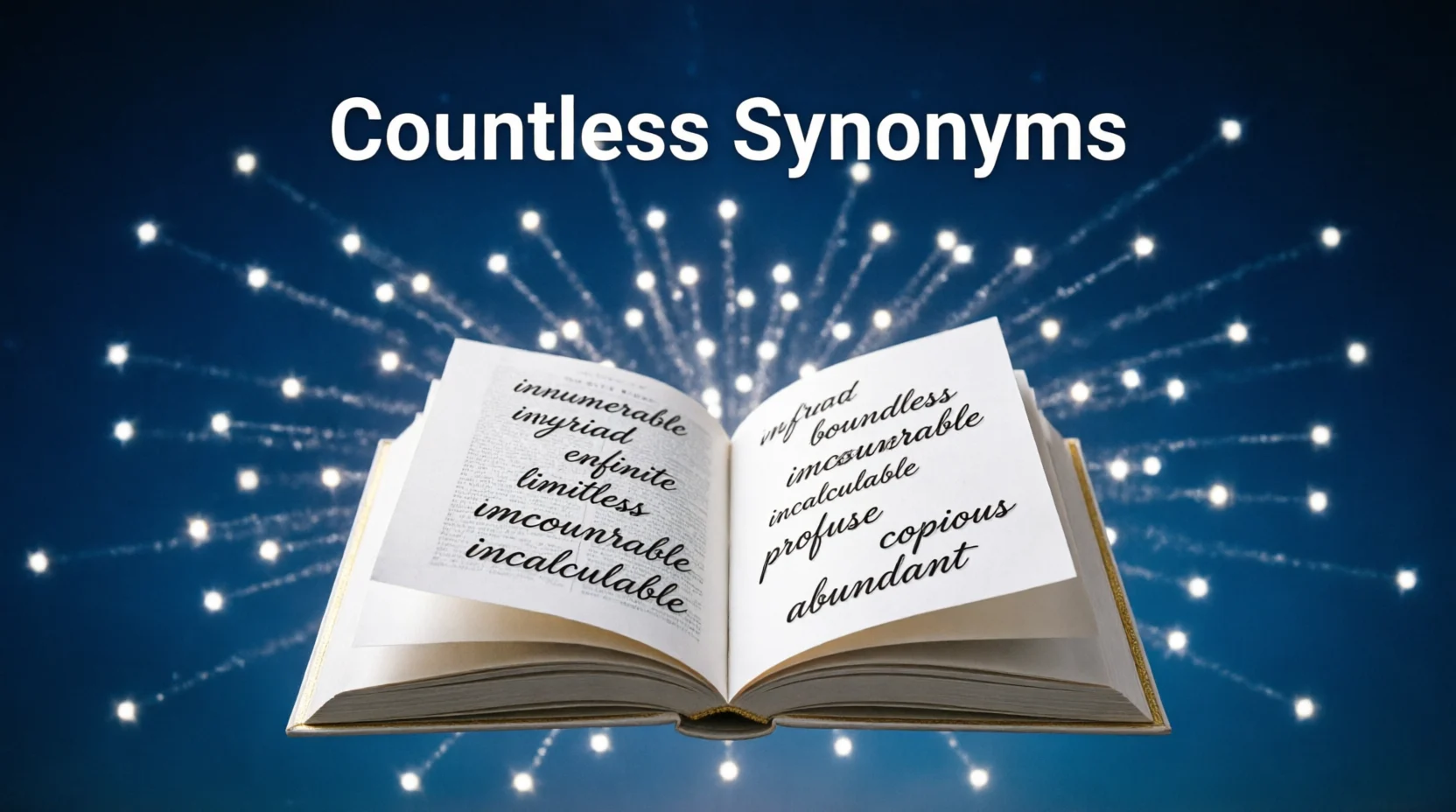
If you are looking for a countless synonym, you have many options depending on your meaning, tone, and context. Words such as innumerable, innumerous, numberless, myriad, endless, untold, and incalculable can describe something that is so numerous that it is difficult or impossible to count. However, each alternative carries a slightly different tone or emphasis.
Choosing the right synonym can make your writing more precise. For example, “countless opportunities” sounds natural and positive, while “an incalculable number of losses” sounds more formal and serious.
Quick Answer: What Is a Synonym for Countless?
The best general synonyms for countless are innumerable, innumerous, numberless, myriad, uncountable, incalculable, endless, untold, and limitless.
Countless means very many or too many to be counted. It is often used when the exact number is unknown, extremely large, or not important.
Example:
- She has helped countless people throughout her career.
- She has helped innumerable people throughout her career.
Both sentences communicate the idea of a very large number, but “innumerable” sounds more formal.
What Does “Countless” Mean?
Countless is an adjective meaning too many to count or an extremely large number of something.
It does not always mean that counting is literally impossible. Often, it is used for emphasis when something occurs or exists in very large numbers.
Examples of Countless
- We have received countless messages from readers.
- He made countless mistakes while learning.
- There are countless stars in the universe.
- She has given me countless reasons to be grateful.
The word can describe people, objects, events, experiences, opportunities, problems, memories, and many other things.
30 Countless Synonyms With Meanings and Examples
The best synonym depends on what you are describing. Some alternatives are formal, some literary, and others are casual or conversational.
| # | Synonym | Simple meaning | Example sentence | Best usage/context |
|---|---|---|---|---|
| 1 | Innumerable | Too many to count | The museum contains innumerable works of art. | Formal, academic, literary |
| 2 | Innumerous | Extremely numerous | The desert is home to innumerous forms of life. | Formal and literary |
| 3 | Numberless | So many that they cannot be counted | Numberless stars filled the night sky. | Literary and poetic |
| 4 | Myriad | A very large number | She faced a myriad of challenges. | General, formal, and literary |
| 5 | Uncountable | Too numerous to count | An uncountable number of people attended the event. | General and descriptive |
| 6 | Incalculable | Too large or complex to calculate | The discovery had incalculable value. | Formal and serious contexts |
| 7 | Endless | Seemingly without an end | He received endless requests for advice. | General and expressive |
| 8 | Untold | Very many and not precisely known | The invention brought untold benefits. | Formal and literary |
| 9 | Limitless | Without an apparent limit | Children have limitless opportunities to learn. | Abstract ideas and possibilities |
| 10 | Boundless | Having no apparent limits | She showed boundless enthusiasm. | Emotions, qualities, possibilities |
| 11 | Immeasurable | Too great to measure | His kindness had immeasurable value. | Abstract qualities and impact |
| 12 | Infinite | Without any limit or end | The night seemed to offer infinite possibilities. | Abstract, mathematical, philosophical |
| 13 | Multitudinous | Existing in very large numbers | Multitudinous birds gathered near the lake. | Formal and literary |
| 14 | Multitudinous | Extremely numerous | The city has a multitudinous population. | Formal description |
| 15 | Multitude | A very large number or crowd | A multitude of visitors entered the building. | People, things, formal writing |
| 16 | Profusion | A large amount or abundance | The garden contained a profusion of flowers. | Formal and descriptive |
| 17 | Plethora | A very large amount or number | The website offers a plethora of resources. | Formal and general writing |
| 18 | Abundance | A large quantity | The region has an abundance of natural resources. | Positive or neutral contexts |
| 19 | Plenty | More than enough | There are plenty of reasons to be optimistic. | Everyday English |
| 20 | Host | A large number or group | A host of questions remained unanswered. | Formal and polished writing |
| 21 | Legion | A very large number or group | He has a legion of loyal supporters. | Groups of people; literary |
| 22 | Throngs | Large crowds of people | Throngs of tourists visited the historic site. | Crowds and people |
| 23 | Masses | Very large groups or quantities | Masses of people gathered outside. | Groups; general description |
| 24 | Loads | A lot of something | She has loads of experience. | Informal conversation |
| 25 | Tons | A very large amount | We have tons of work to finish. | Informal English |
| 26 | Heaps | A large amount or number | Heaps of people enjoyed the festival. | Informal English |
| 27 | Zillions | An extremely large, indefinite number | I have told you zillions of times. | Very informal and exaggerated |
| 28 | Umpteen | A very large but unspecified number | She has visited that restaurant umpteen times. | Informal English |
| 29 | Gazillions | An extremely large imaginary number | There were gazillions of tiny stars in the drawing. | Humorous and informal |
| 30 | Scores | Many groups of twenty; often simply means many | Scores of volunteers joined the project. | Formal, historical, and literary |
Note: Not every synonym works in every sentence. For example, throngs normally refers to crowds of people, while immeasurable is usually better for abstract qualities such as value, love, or impact.
1. Innumerable
Innumerable is one of the closest formal synonyms for countless. It means there are so many of something that they cannot easily be counted.
Example:
“Researchers have documented innumerable examples of adaptation.”
Best for: Academic writing, formal descriptions, literature, and serious discussions.
2. Innumerous
Innumerous means existing in extremely large numbers. It is less common in everyday English than “innumerable.”
Example:
“Innumerous insects live beneath the forest canopy.”
Best for: Formal, literary, or descriptive writing.
3. Numberless
Numberless means so numerous that no exact number can be given.
Example:
“Numberless generations have looked up at the stars.”
Best for: Poetry, literature, history, and expressive writing.
4. Myriad
Myriad refers to a very large number or a great variety of things.
Example:
“The internet provides a myriad of learning resources.”
Best for: General, professional, academic, and polished writing.
Myriad vs. Countless
“Countless” emphasizes the inability or impracticality of counting. “Myriad” emphasizes a great number or variety.
- Countless memories
- A myriad of possibilities
5. Uncountable
Uncountable means something cannot be counted or is present in such a large quantity that counting is impractical.
Example:
“An uncountable number of microorganisms exist in the environment.”
Best for: Scientific, descriptive, and general contexts.
6. Incalculable
Incalculable means impossible or extremely difficult to calculate.
Example:
“The storm caused incalculable damage to the region.”
Best for: Formal writing, economics, science, history, and discussions of impact or loss.
7. Endless
Endless suggests something that seems to continue without stopping.
Example:
“The child asked endless questions.”
Best for: Repeated events, time, conversations, questions, tasks, and experiences.
8. Untold
Untold can mean a very large amount that has not been precisely counted or expressed.
Example:
“The project created untold opportunities for local businesses.”
Best for: Formal, literary, and expressive writing.
9. Limitless
Limitless emphasizes the absence of an apparent boundary or restriction.
Example:
“Technology creates limitless possibilities for communication.”
Best for: Opportunities, potential, imagination, possibilities, and resources.
10. Boundless
Boundless is similar to limitless but often describes an intense or seemingly unrestricted quality.
Example:
“She approached every challenge with boundless energy.”
Best for: Energy, enthusiasm, love, creativity, generosity, and potential.
11. Immeasurable
Immeasurable means impossible to measure accurately because something is extremely great or significant.
Example:
“The teacher’s influence had immeasurable value.”
Best for: Value, influence, impact, love, importance, and emotional qualities.
12. Infinite
Infinite literally means without an end or limit. In everyday writing, it can also be used figuratively for an extremely large range or number.
Example:
“There are infinite ways to approach a creative problem.”
Best for: Mathematics, philosophy, science, possibilities, and figurative writing.
13. Multitudinous
Multitudinous means very numerous or existing in great numbers.
Example:
“The region supports multitudinous species of birds.”
Best for: Formal, academic, and literary writing.
14. Multitude
A multitude is a very large number or a large group.
Example:
“A multitude of factors influenced the final decision.”
Best for: People, factors, reasons, objects, and formal writing.
15. Profusion
Profusion means a large amount or abundance of something.
Example:
“The artist used a profusion of bright patterns.”
Best for: Flowers, colors, details, decorations, ideas, and descriptive writing.
16. Plethora
Plethora means a very large number or amount of something.
Example:
“Students have a plethora of online resources available to them.”
Best for: Professional and formal writing.
In modern English, “plethora” is usually used to emphasize a large quantity, although it can sometimes imply an excessive amount.
17. Abundance
Abundance means a large quantity or plentiful supply.
Example:
“The valley has an abundance of fresh water.”
Best for: Resources, food, opportunities, nature, wealth, and positive contexts.
18. Plenty
Plenty is a simple, natural way to say that there is a large or sufficient amount.
Example:
“There are plenty of opportunities to practice English.”
Best for: Everyday conversation and accessible writing.
19. Host
In expressions such as “a host of,” the word means a large number or group.
Example:
“The report raises a host of important questions.”
Best for: Formal and professional writing.
20. Legion
Legion can describe a very large group or number, especially of people.
Example:
“The author has a legion of devoted readers.”
Best for: Supporters, followers, fans, readers, and literary descriptions.
21. Throngs
Throngs means large groups or crowds of people.
Example:
“Throngs of visitors filled the city center.”
Best for: Crowds, tourists, spectators, shoppers, and public gatherings.
22. Masses
Masses can describe very large groups or quantities.
Example:
“Masses of people gathered for the celebration.”
Best for: Large groups, crowds, and broad descriptions.
23. Loads
Loads means a lot of something and is informal.
Example:
“She has loads of experience working with children.”
Best for: Casual conversation and friendly writing.
24. Tons
Tons is an informal expression meaning a very large amount.
Example:
“We received tons of useful feedback.”
Best for: Conversation, social media, emails, and informal writing.
25. Heaps
Heaps means a large amount or number.
Example:
“There were heaps of interesting books at the market.”
Best for: Informal English, especially casual conversation.
26. Zillions
Zillions is an exaggerated informal expression for an extremely large number.
Example:
“I have seen that movie zillions of times.”
Best for: Humor, casual conversation, and exaggeration.
27. Umpteen
Umpteen means a large but unspecified number.
Example:
“She has reminded him umpteen times to bring his notebook.”
Best for: Informal speech when the exact number is unimportant.
28. Gazillions
Gazillions is a playful, exaggerated way to describe an extremely large number.
Example:
“There were gazillions of tiny details in the painting.”
Best for: Humor and very informal contexts.
29. Scores
Scores traditionally means groups of twenty, but the phrase “scores of” commonly means many.
Example:
“Scores of people attended the ceremony.”
Best for: Formal, historical, journalistic, and literary contexts.
30. Multitudinous
Multitudinous means existing in very large numbers and is particularly useful when you want a formal alternative to “countless.”
Example:
“The ocean contains multitudinous forms of life.”
Best for: Formal, literary, scientific, and descriptive writing.
Countless Synonyms Comparison Table
| Synonym | Formality | Main idea | Best for |
|---|---|---|---|
| Countless | Neutral | Too many to count | General use |
| Innumerable | Formal | Impossible to count | Academic writing |
| Innumerous | Formal | Extremely numerous | Literary writing |
| Numberless | Literary | Without a countable number | Poetry and literature |
| Myriad | Neutral/Formal | Very large number or variety | General and professional writing |
| Uncountable | Neutral | Cannot be counted | Descriptive and technical contexts |
| Incalculable | Formal | Cannot be calculated | Value, damage, impact |
| Endless | Neutral | Apparently without end | Repetition and duration |
| Untold | Formal | Very many or unknown | Benefits, stories, consequences |
| Limitless | Neutral | Without apparent limits | Potential and possibilities |
| Boundless | Literary/Neutral | Without boundaries | Emotions and qualities |
| Immeasurable | Formal | Cannot be measured | Value and impact |
| Infinite | Neutral/Formal | Without limits | Mathematics and possibilities |
| Plethora | Formal | Very large amount | Resources and options |
| Abundance | Neutral | Large supply | Resources and positive contexts |
| Plenty | Informal/Neutral | More than enough | Everyday English |
| Loads | Informal | A lot | Casual conversation |
| Tons | Informal | A very large amount | Casual conversation |
| Zillions | Very informal | Exaggerated huge number | Humor |
| Umpteen | Informal | Large unspecified number | Casual speech |
Countless vs. Innumerable
Countless and innumerable are very close in meaning.
“Countless” is more common in everyday English:
“She has countless reasons to be proud.”
“Innumerable” sounds more formal:
“The study identified innumerable examples of the phenomenon.”
Use countless for natural everyday writing and innumerable when you want a more formal tone.
Countless vs. Myriad
Both words can refer to a very large number.
Countless focuses on the huge number itself.
Myriad often emphasizes a large variety or collection.
- “He faced countless problems.”
- “He faced a myriad of problems.”
Both can work, but “myriad” can sound more polished in formal writing.
Countless vs. Endless
These words are sometimes interchangeable, but their meanings are not identical.
Countless focuses on quantity.
Endless focuses on continuation or lack of an apparent end.
Compare:
- “She has read countless books.” → A very large number.
- “She has spent endless hours reading.” → A seemingly unlimited amount of time.
Countless vs. Infinite
Infinite is stronger and more literal than countless.
“Countless” generally means an extremely large number that is difficult or impractical to count. “Infinite” means without any limit.
For example:
- “There are countless stars visible in the sky.”
- “An infinite mathematical set has no finite limit.”
For ordinary writing, “countless” is often the more natural choice.
Countless vs. Uncountable
Uncountable directly emphasizes the inability to count something, while countless is often used more broadly for emphasis.
- Countless opportunities
- An uncountable number of particles
“Uncountable” is especially useful in scientific or technical contexts.
How to Choose the Right Countless Synonym
The best synonym depends on tone, meaning, audience, and context.
For Formal Writing
Choose:
- Innumerable
- Innumerous
- Incalculable
- Multitudinous
- Profusion
- Plethora
- Untold
Example:
Instead of “The project created countless benefits,” you could write:
“The project created innumerable benefits.”
For Everyday English
Choose:
- Countless
- Plenty
- Loads
- Tons
- Heaps
Example:
“There are plenty of ways to improve your writing.”
For Literary or Poetic Writing
Choose:
- Numberless
- Endless
- Boundless
- Untold
- Infinite
Example:
“Numberless stars appeared above the silent landscape.”
For Large Groups of People
Choose:
- Throngs
- Multitude
- Masses
- Legion
- Scores
Example:
“Throngs of visitors gathered outside the museum.”
For Abstract Ideas and Qualities
Choose:
- Limitless
- Boundless
- Immeasurable
- Infinite
- Incalculable
Example:
“Her generosity had an immeasurable effect on the community.”
For a Very Casual Tone
Choose:
- Loads
- Tons
- Heaps
- Zillions
- Umpteen
- Gazillions
These are useful when writing dialogue, casual messages, social posts, or humorous content.
Common Mistakes When Using Countless Synonyms
1. Using “Infinite” When You Only Mean “Very Many”
Do not automatically replace “countless” with “infinite.”
Less precise:
“There are infinite customers at the store.”
Better:
“There are countless customers at the store.”
A real group of customers can be counted, even if the number is very large.
2. Using “Throngs” for Non-Human Objects
“Throngs” normally refers to large groups of people.
Natural:
“Throngs of tourists visited the monument.”
For objects, use alternatives such as countless, innumerable, myriad, or a multitude of.
3. Confusing “Endless” With “Countless”
“Endless” emphasizes continuation, while “countless” emphasizes quantity.
- Countless questions = a very large number of questions.
- Endless questions = questions that seem to keep continuing.
4. Overusing Informal Expressions
Words such as “tons,” “loads,” “heaps,” and “zillions” are useful in casual writing but may sound inappropriate in a formal report.
For professional writing, consider innumerable, numerous, myriad, abundance, or a multitude of.
5. Using “Plethora” for Every Large Number
“Plethora” is useful for large amounts, but it can sound overly formal if used repeatedly.
Instead of writing:
“There is a plethora of information.”
you might sometimes use the simpler:
“There is a lot of information.”
The best word is usually the one that sounds natural for your audience.
FAQs:
What is the closest synonym for “countless”?
Innumerable is one of the closest direct synonyms. It means too many to count and works particularly well in formal writing.
What is a simple synonym for “countless”?
Many, plenty, or a lot of can replace “countless” in simple everyday English, although they do not always convey the same strong sense of enormous quantity.
Is “myriad” a synonym for “countless”?
Yes. Myriad can describe a very large number or variety of things. It is especially useful in formal, professional, and descriptive writing.
What is a formal synonym for “countless”?
Good formal alternatives include innumerable, innumerous, incalculable, multitudinous, and untold.
What is the opposite of “countless”?
Depending on context, possible opposites include few, limited, scarce, finite, numbered, or countable.
Can “infinite” replace “countless”?
Sometimes, but not always. Infinite means having no limit, while countless usually means very numerous or too numerous to count. They should not be treated as exact equivalents in every context.
Is “a lot” the same as “countless”?
Not exactly. “A lot” simply means a large amount, while “countless” suggests an extremely large number that cannot easily be counted.
What is the best synonym for “countless” in academic writing?
Innumerable is often a strong choice, but numerous, myriad, multitude, or incalculable may be more appropriate depending on the sentence and intended meaning.
Conclusion
The best countless synonym depends on what you want to emphasize. Innumerable is an excellent formal alternative, myriad works well for large numbers or varieties, endless emphasizes continuation, and limitless highlights the absence of boundaries. For casual English, words such as plenty, loads, tons, and heaps sound more natural.
When choosing a synonym, consider whether you are describing people, objects, opportunities, emotions, time, or an abstract idea. The right word should match both the meaning and the tone of your sentence.

I am Camden Thomas, an Administrator at SaysReply. I help maintain our platform and ensure readers find clear, natural, and useful alternative ways to express their thoughts every day.