Understanding the difference between protagonist vs antagonist makes it easier to analyze stories, novels, films, plays, and other forms of literature. These two terms describe important character roles that help shape a story’s conflict and direction. Although they are often described as the hero and villain, their meanings are more flexible than that.
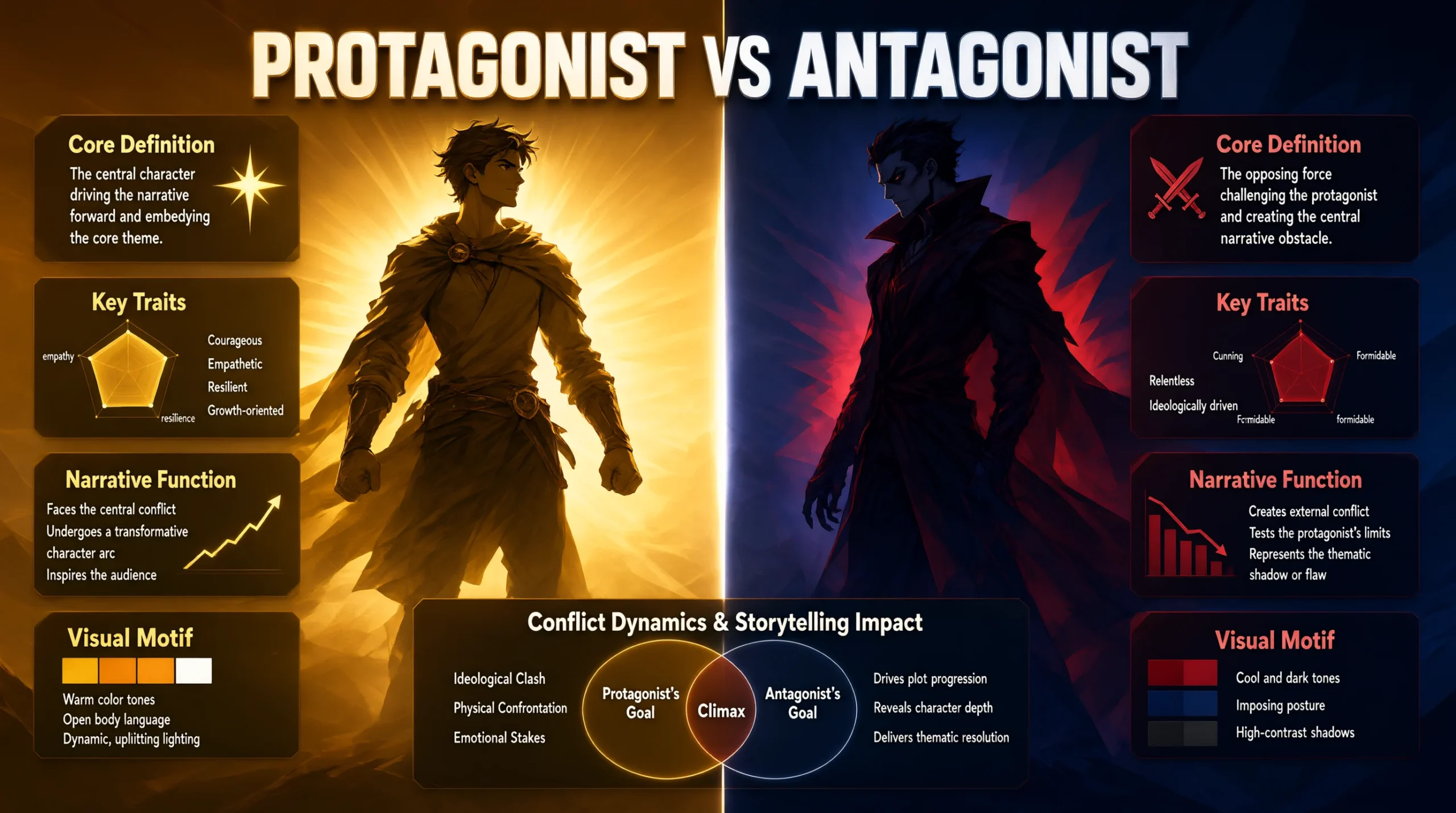
A protagonist is the central character whose journey, goals, and experiences drive the story. An antagonist is the character, group, force, or obstacle that opposes the protagonist and creates challenges. The protagonist does not always have to be good, and the antagonist does not always have to be evil.
For example, a story can follow a morally questionable main character while presenting a hero as the opposing force. Learning how these roles work helps readers understand character relationships, plot development, and conflict. In this guide, you will discover their meanings, differences, examples, common mistakes, and how to remember which is which.
Quick Answer: Protagonist vs Antagonist
A protagonist is the main character whose goals and experiences drive a story. An antagonist is the person, force, or obstacle that stands against the protagonist. The protagonist is not always a hero, and the antagonist is not always a villain. Their opposition creates the central conflict.
Why Do People Confuse Protagonist and Antagonist?
People often confuse these terms because both describe major characters in a story. They are closely connected and usually have opposing goals.
Another reason is that people commonly associate the protagonist with goodness and the antagonist with evil. However, this is not always accurate.
Consider these points:
- Both characters can play important roles in developing the plot.
- Both can have strong motivations and personal goals.
- The protagonist may make harmful or selfish decisions.
- The antagonist may have understandable reasons for opposing the protagonist.
- Neither role depends entirely on whether a character is morally good or bad.
The easiest way to understand the difference is to focus on their roles in the story rather than their personalities.
What Is a Protagonist?
A protagonist is the central character in a story. The plot usually follows this character’s experiences, decisions, struggles, and development.
The protagonist is often the person readers or viewers follow throughout the story. Their goals create the main direction of the plot.
Key Characteristics of a Protagonist
A protagonist commonly has the following characteristics:
- Central role: The story mainly focuses on this character.
- Personal goals: They want to achieve something important.
- Character development: They may learn lessons or change throughout the story.
- Challenges: They face problems that move the plot forward.
- Emotional connection: Readers may understand, support, or question their decisions.
Examples of Protagonists
Here are some familiar literary and fictional examples:
- Harry Potter in Harry Potter is the protagonist because the story follows his journey.
- Katniss Everdeen in The Hunger Games is the central character whose decisions shape the plot.
- Elizabeth Bennet in Pride and Prejudice is the protagonist whose relationships and experiences drive the novel.
- Simba in The Lion King is the protagonist because his journey forms the heart of the story.
Голодные игры: И вспыхнет пламя обои №16 1280×1024
4
Example sentence: The protagonist of the novel faces several challenges before discovering the truth about his family.
What Is an Antagonist?
An antagonist is a character, group, or force that opposes the protagonist. This opposition creates conflict and makes it difficult for the main character to achieve their goals.
An antagonist can be a villain, but the term has a broader meaning. Sometimes the opposing force is nature, society, technology, or even the protagonist’s own fears.
Key Characteristics of an Antagonist
An antagonist commonly has these characteristics:
- Opposing role: They stand against the protagonist’s goals.
- Conflict creation: Their actions or presence create difficulties.
- Different motivations: They may want something that conflicts with the protagonist’s desires.
- Story tension: They make the protagonist’s journey more challenging.
- Complex personality: They can have understandable motivations and positive qualities.
Examples of Antagonists
Here are some recognizable examples:
- Lord Voldemort in Harry Potter opposes Harry and threatens the wizarding world.
- President Snow in The Hunger Games works against Katniss and the rebellion.
- Sauron in The Lord of the Rings opposes the heroes’ mission.
- Scar in The Lion King creates conflict by taking the throne and threatening Simba’s family.
ヴォルデモート| キャステル | CASTEL ディズニー情報
Il Signore degli Anelli: il look di Sauron è fedele ai libri o è merito di Peter Jackson?
4
Example sentence: The antagonist creates obstacles that prevent the protagonist from reaching the desired goal.
Protagonist vs Antagonist: Comparison Table
The following table explains the main differences between these two literary terms.
| Feature | Protagonist | Antagonist |
| Meaning | Central character | Opposing character or force |
| Main role | Drives the story | Creates opposition |
| Main purpose | Pursues a goal | Challenges that goal |
| Relationship | Faces conflict | Creates or represents conflict |
| Perspective | Often followed by readers | Often opposes the central character |
| Morality | Can be good or bad | Can be good or bad |
| Character development | Usually central to the story | May also develop throughout the story |
| Example | Harry Potter | Lord Voldemort |
The main difference: The protagonist is the central character, while the antagonist is the opposing force that creates conflict with that character.
When Should You Use Protagonist and Antagonist?
Use these terms when discussing characters, literature, storytelling, movies, television shows, or plays.
When to Use Protagonist
Use protagonist when referring to:
- The central character of a novel.
- The main character in a film or television series.
- The person whose journey drives the plot.
- A character whose goals shape the central conflict.
- The central figure in a play or fictional narrative.
Example: The protagonist struggles to overcome her fears and save her village.
When to Use Antagonist
Use antagonist when referring to:
- The character who opposes the main character.
- A villain who creates conflict.
- A group working against the protagonist.
- An opposing force such as nature or society.
- An internal struggle that prevents the main character from succeeding.
Example: The antagonist tries to stop the protagonist from completing the mission.
12 Examples of Protagonist vs Antagonist in Sentences
These examples show how both terms work in everyday literary discussions.
- The protagonist wants to protect his family, but the antagonist plans to destroy their home.
- Every successful story needs an engaging central conflict, often involving a protagonist and an antagonist.
- The protagonist learns an important lesson after facing several difficult situations.
- The antagonist challenges the protagonist’s beliefs and decisions.
- In the movie, the protagonist fights against a powerful enemy.
- The writer created a complex antagonist with understandable motivations.
- A protagonist does not always make the right decisions.
- The antagonist is not necessarily an evil character.
- The novel introduces its protagonist in the opening chapter.
- The antagonist creates tension by preventing the main character from achieving success.
- Sometimes the protagonist becomes their own antagonist through fear and self-doubt.
- The relationship between the protagonist and antagonist gives the story its central conflict.
Common Mistakes When Using Protagonist and Antagonist
Even experienced readers sometimes misunderstand these terms. Here are common mistakes to avoid.
1. Thinking the Protagonist Is Always a Hero
A protagonist does not have to be morally good. The term simply identifies the central character.
Correct understanding: A criminal can be the protagonist if the story follows their experiences.
2. Thinking the Antagonist Is Always a Villain
An antagonist does not have to be evil. A person may oppose the protagonist for understandable or even morally positive reasons.
Correct understanding: A police officer can be the antagonist in a story about a criminal protagonist.
3. Confusing the Main Character With the Most Powerful Character
The most powerful character is not necessarily the protagonist.
Correct understanding: A powerful villain may be the antagonist while a relatively ordinary person remains the protagonist.
4. Assuming Every Story Has Only One Antagonist
Some stories have multiple opposing characters or forces.
Correct understanding: A protagonist might face several enemies, social pressures, and personal struggles.
5. Forgetting That Antagonists Can Be Nonhuman
Nature, technology, and circumstances can also oppose the protagonist.
Correct understanding: A dangerous storm can serve as an antagonist in a survival story.
Easy Memory Trick: How to Remember Protagonist vs Antagonist
If you frequently mix up these words, use this simple memory trick:
- Protagonist = Progress: The character whose journey moves the story forward.
- Antagonist = Against: The character or force that works against the protagonist.
Remember the word AGAINST when thinking about an antagonist.
For example:
- The protagonist wants to escape the island.
- The antagonist tries to prevent the escape.
This simple connection makes the difference easier to remember.
Protagonist vs Antagonist in American and British English
There is no meaningful difference between American and British English when using protagonist and antagonist.
Both terms have the same spelling, pronunciation, and literary meanings in the United States and the United Kingdom.
| Feature | American English | British English |
| Protagonist | Protagonist | Protagonist |
| Antagonist | Antagonist | Antagonist |
| Meaning | Central character / opposing force | Central character / opposing force |
| Spelling | Same | Same |
| Usage | Literature, films, stories | Literature, films, stories |
Example (American): The protagonist faces a dangerous antagonist.
Example (British): The protagonist faces a dangerous antagonist.
Both sentences are correct.
Similar Words Related to Protagonist and Antagonist
Several other literary terms are connected to these concepts. Understanding them can improve your vocabulary and help you discuss stories more accurately.
| Word | Simple Meaning |
| Hero | A character admired for courage or good actions |
| Villain | A character who behaves in a harmful or evil way |
| Main character | The central character in a story |
| Supporting character | A character who helps develop the story |
| Foil | A character who highlights another character’s qualities through contrast |
| Antihero | A central character who lacks traditional heroic qualities |
| Nemesis | A powerful rival or opponent |
| Conflict | A struggle between opposing characters, forces, or goals |
| Deuteragonist | The second most important character in a story |
| Narrator | The voice or character that tells the story |
Important distinction: A hero is not necessarily the protagonist, and a villain is not necessarily the antagonist. These words describe different aspects of a character.
Final Verdict: Protagonist vs Antagonist
The difference between protagonist and antagonist is based on their roles in a story.
- A protagonist is the central character whose journey drives the plot.
- An antagonist is the person, group, or force that opposes the protagonist.
The protagonist is not always good, and the antagonist is not always evil. What matters most is the relationship between their goals and the conflict that develops.
FAQs:
1. Is the protagonist the good guy or the bad guy?
The protagonist can be either good or bad. A protagonist is simply the central character whose experiences and actions drive the story. Even a criminal or morally questionable person can be a protagonist.
2. Is the antagonist always the villain?
No. An antagonist is not necessarily a villain. The antagonist is the character or force that opposes the protagonist. They may have understandable motivations or even believe they are doing the right thing.
3. Can a story have two protagonists?
Yes. A story can have two or more protagonists. These characters may share the central role and have connected journeys, goals, and experiences.
4. Can the protagonist also be the antagonist?
Yes. A character can become their own antagonist when their fears, weaknesses, guilt, or personal struggles prevent them from achieving their goals.
5. What is the opposite of a protagonist?
The antagonist is generally considered the opposing counterpart of the protagonist in storytelling. The protagonist drives the central journey, while the antagonist creates opposition.
6. Can nature be an antagonist?
Yes. Nature can serve as an antagonist when natural forces create obstacles for the protagonist. Examples include storms, earthquakes, floods, wildfires, and dangerous environments.
7. What is the difference between a protagonist and an antihero?
A protagonist is the central character in a story, while an antihero is a protagonist who lacks traditional heroic qualities. An antihero may be selfish, dishonest, morally complex, or emotionally flawed.
Remember This
- Protagonist: The central character of a story.
- Antagonist: The character or force that opposes the protagonist.
- Hero: A character known for courageous or admirable actions.
- Villain: A character who behaves in a harmful or evil way.
- Conflict: The struggle that develops between opposing goals or forces.
The easiest way to remember the difference is that the protagonist moves the story forward, while the antagonist stands in the way.
Conclusion
Understanding protagonist vs antagonist helps you recognize how stories develop and why characters make certain decisions. The protagonist is the central figure whose journey shapes the plot, while the antagonist creates opposition and challenges that journey. Both roles are essential to building interesting characters and meaningful conflicts.
Remember that these terms describe character roles, not moral values. A protagonist can be a villain, and an antagonist can be a hero. Once you understand this distinction, identifying these characters in novels, films, plays, and other stories becomes much easier.

I’m Amelia Rose, an enthusiastic writer who enjoys exploring better, clearer, and more natural ways to express ideas. I create helpful content that makes finding alternative phrases simple, useful, and enjoyable for everyone.