Choosing between “involved with” and “involved in” can be confusing because both expressions describe a connection, participation, or relationship with something. However, they are not always interchangeable. The correct choice depends on what you want to express and the context of your sentence.
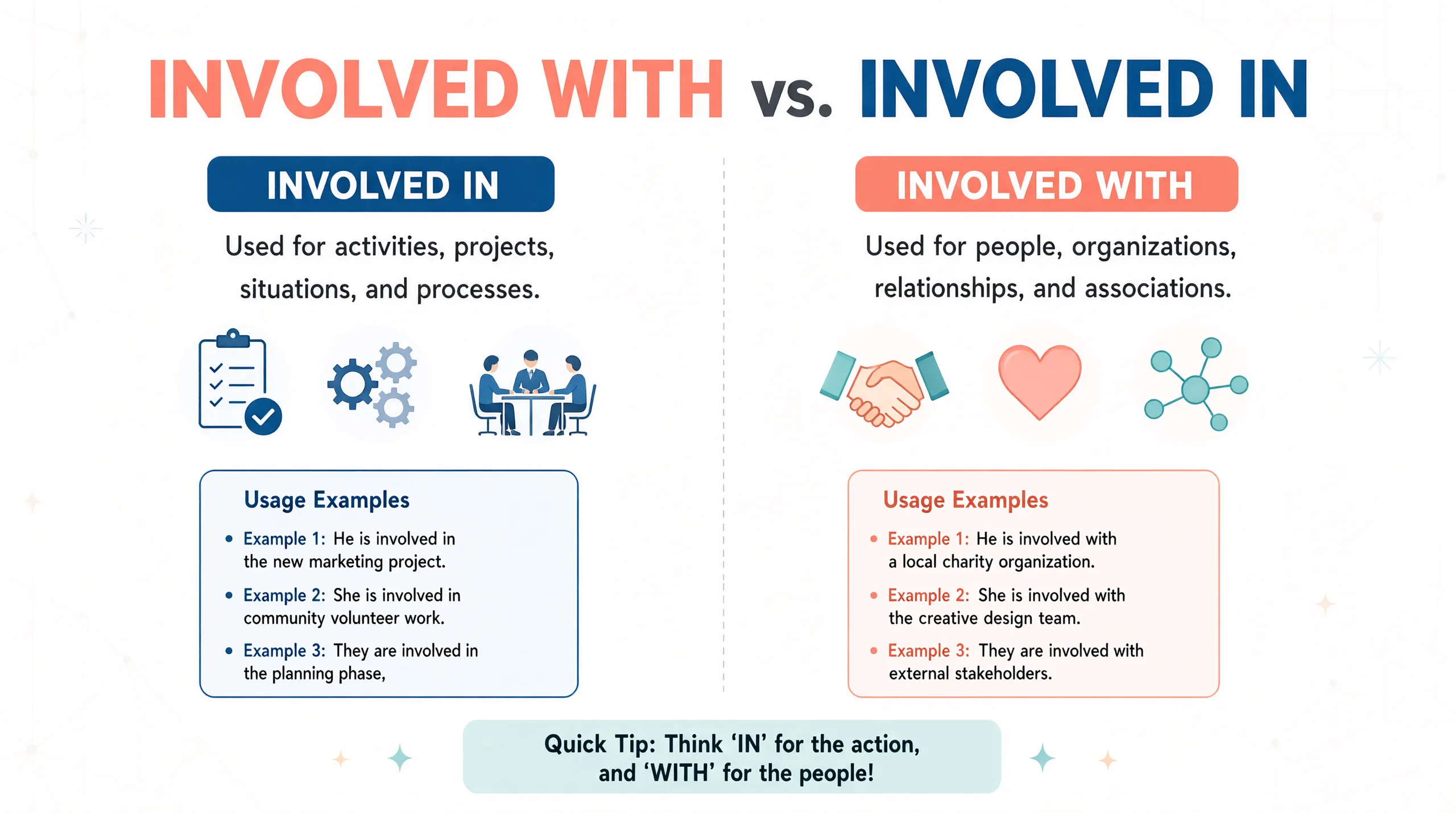
In everyday English, “involved in” usually refers to participating in an activity, event, process, situation, or organization. For example, you might be involved in a project or involved in a discussion. On the other hand, “involved with” often describes a relationship, association, connection, or ongoing interaction with a person, group, organization, or activity.
For example, you might be involved with a charity or involved with a business partner. Understanding this small difference can help you communicate more naturally, avoid common grammar mistakes, and choose the right preposition in both speaking and writing.
Quick Answer
Involved in generally means participating in an activity, event, situation, or process. Involved with usually means having a connection, relationship, or association with someone or something. For example, you are involved in a project but may be involved with a company or person.
Why Do People Confuse Involved With and Involved In?
People often confuse these expressions because both use the adjective involved followed by a preposition. They also describe participation or connection, which makes their meanings overlap in certain situations.
For example:
- She is involved in community development.
- She is involved with a community organization.
Both sentences are grammatically correct, but they communicate slightly different ideas.
The first sentence emphasizes her participation in community development. The second highlights her association with a particular organization.
The key is to understand whether you are talking about participation in an activity or a connection with someone or something.
First Word: What Does Involved In Mean?
Involved in means actively participating in, taking part in, or being connected to a particular activity, event, process, situation, or organization.
It emphasizes someone’s participation or engagement in something.
Common Uses of Involved In
You can use “involved in” in several situations:
1. Activities and Projects
Use it when someone participates in a task, project, or activity.
- She is involved in a research project.
- They are involved in organizing the event.
2. Events and Situations
Use it when someone takes part in an incident or situation.
- He was involved in an accident.
- Several people were involved in the argument.
3. Work and Professional Responsibilities
Use it to describe participation in professional activities.
- I am involved in business development.
- She is involved in managing the department.
4. Organizations and Groups
Use it when someone actively participates in an organization’s work or activities.
- He is involved in a local charity.
- My sister is involved in student activities.
Examples of Involved In
- I am involved in several community projects.
- She was involved in planning the conference.
- They are involved in an important investigation.
- My brother is involved in sports activities.
- He became involved in a difficult situation.
Second Word: What Does Involved With Mean?
Involved with means having a relationship, association, connection, or ongoing interaction with someone or something.
It often emphasizes the nature of the connection rather than participation in a specific activity.
Common Uses of Involved With
1. Relationships With People
Use it to describe a personal or romantic relationship.
- She is involved with someone from her university.
- He is romantically involved with his colleague.
2. Connections With Organizations
Use it when someone has an association with a company, charity, or institution.
- I am involved with a nonprofit organization.
- She has been involved with the university for years.
3. Professional Associations
Use it to describe working relationships or professional connections.
- He is involved with several international companies.
- Our team is involved with a local business.
4. Activities and Causes
Use it when someone has an ongoing connection or association with an activity or cause.
- She is involved with environmental protection.
- They are involved with community support programs.
Examples of Involved With
- I am involved with a local charity.
- She is involved with a talented group of artists.
- He became involved with the wrong people.
- My father is involved with several business organizations.
- They are involved with a community development program.
Involved With vs Involved In: Comparison Table
| Point | Involved In | Involved With |
| Main meaning | Participation or engagement | Connection or association |
| Common focus | Activities and situations | People and organizations |
| Emphasis | Taking part in something | Having a relationship with something |
| Example | Involved in a project | Involved with a company |
| Relationships | Less common for romantic relationships | Common for personal relationships |
| Events | Involved in an accident | Less common in this context |
| Work | Involved in management | Involved with a business partner |
Important: These are general usage patterns, not strict rules. Both expressions can sometimes be used with the same noun, but the intended meaning may change.
When to Use Involved In or Involved With?
Choosing the correct expression becomes easier when you consider the situation.
Use Involved In When Talking About Participation
Choose “involved in” when you want to explain that someone takes part in an activity, event, project, or process.
Examples:
- She is involved in teaching children.
- He is involved in a research program.
- We are involved in developing new products.
Use Involved With When Talking About Connections
Choose “involved with” when you want to describe a relationship, association, or connection with a person, company, or organization.
Examples:
- She is involved with a charitable organization.
- He is involved with a successful entrepreneur.
- I am involved with a local business.
When Both Expressions Are Possible
Sometimes, both prepositions work, but they emphasize different aspects of a situation.
Consider these sentences:
- She is involved in a nonprofit organization.
- She is involved with a nonprofit organization.
The first emphasizes her participation in the organization’s activities. The second emphasizes her association or relationship with the organization.
15 Examples of Involved With and Involved In in Sentences
Here are practical examples to help you understand how both expressions work in everyday English.
| Sentence | Correct Expression | Meaning |
| She is involved ___ a research project. | In | Participating in research |
| He is involved ___ a local charity. | With | Associated with a charity |
| I was involved ___ an accident. | In | Connected to an incident |
| She is involved ___ someone from work. | With | Has a personal relationship |
| They are involved ___ organizing the event. | In | Participating in planning |
| My father is involved ___ several businesses. | With | Has business connections |
| He became involved ___ illegal activities. | In | Participated in activities |
| We are involved ___ a community group. | With | Associated with a group |
| She is involved ___ managing the team. | In | Participates in management |
| He is involved ___ the wrong people. | With | Has an association with them |
| I am involved ___ an important investigation. | In | Connected to an investigation |
| They are involved ___ environmental causes. | With | Associated with those causes |
| My brother is involved ___ a school project. | In | Participating in a project |
| She has been involved ___ the organization for years. | With | Has a long-term association |
| Several employees were involved ___ the decision-making process. | In | Participated in the process |
Common Mistakes to Avoid
Even fluent English speakers sometimes choose the wrong preposition because the two expressions have overlapping meanings.
Here are some mistakes worth avoiding.
1. Using Involved With for Every Situation
Incorrect: He was involved with an accident.
Correct: He was involved in an accident.
Use “involved in” when referring to participation or connection to an incident.
2. Using Involved In for Every Relationship
Incorrect: She is romantically involved in him.
Correct: She is romantically involved with him.
Use “involved with” when describing a romantic relationship.
3. Forgetting the Preposition
Incorrect: I am involved the project.
Correct: I am involved in the project.
The adjective “involved” generally needs an appropriate preposition before its object.
4. Assuming Both Expressions Always Mean the Same Thing
Incorrect understanding: “Involved in a company” and “involved with a company” always communicate exactly the same meaning.
Better understanding: “Involved in” emphasizes participation, while “involved with” often emphasizes association or connection.
5. Using the Wrong Expression in Professional Writing
Incorrect: Our department is involved with preparing the annual report.
More natural: Our department is involved in preparing the annual report.
When describing participation in a specific task, “involved in” is generally the better choice.
Easy Memory Trick: How to Remember the Difference
You can remember the difference between these expressions with two simple ideas:
- IN = Inside an activity: Think of participating in a project, event, process, or situation.
- WITH = Connection: Think of having a relationship or association with a person, company, or organization.
For example:
- I am involved in a project. (I participate in it.)
- I am involved with a company. (I have a connection with it.)
This simple trick will help you choose the correct expression in most everyday situations.
American vs British English: Is There Any Difference?
There is no major difference between American and British English when using “involved in” and “involved with.”
Both varieties follow the same general grammatical patterns and meanings.
| Expression | American English | British English |
| Involved in a project | Correct | Correct |
| Involved with a company | Correct | Correct |
| Involved in an accident | Correct | Correct |
| Involved with someone | Correct | Correct |
| Involved in research | Correct | Correct |
The choice depends on meaning and context rather than regional spelling or grammar differences.
Similar Words and Expressions
Several expressions have meanings related to “involved in” and “involved with.” However, their usage can differ depending on the context.
| Expression | Simple Meaning | Example |
| Participating in | Taking part in something | She is participating in the competition. |
| Engaged in | Actively doing something | He is engaged in research. |
| Taking part in | Joining an activity | They are taking part in the event. |
| Associated with | Connected to someone or something | She is associated with the organization. |
| Connected with | Having a relationship or link | He is connected with the company. |
| Affiliated with | Officially connected to an organization | The college is affiliated with a university. |
| Working with | Cooperating with someone | I am working with a professional team. |
| Linked to | Having a connection | The incident is linked to the investigation. |
Final Verdict: Involved With or Involved In?
Both expressions are grammatically correct, but they serve slightly different purposes.
Choose “involved in” when discussing participation in activities, events, projects, processes, or situations.
Choose “involved with” when describing relationships, personal connections, professional associations, or ongoing involvement with people and organizations.
Remember that context matters. Sometimes both expressions are correct, but they communicate different shades of meaning. Understanding what you want to emphasize will help you select the more natural preposition.
FAQs:
1. Is it involved with or involved in a project?
“Involved in a project” is generally the more natural expression because it emphasizes participation in the project’s activities or work.
Example: She is involved in a new research project.
2. Is involved with a person correct?
Yes. “Involved with a person” is grammatically correct and often describes a personal, romantic, or professional relationship.
Example: He is involved with someone from his office.
3. Is involved in grammatically correct?
Yes. Involved in” is a correct English expression used to describe participation in an activity, event, situation, or process.
Example: They are involved in community development.
4. Can I use involved with for a company?
Yes. “Involved with a company” is correct when describing a professional relationship, association, or connection with that company.
Example: She is involved with an international company.
5. What is the difference between involved in and involved with someone?
“Involved with someone” usually describes a personal, romantic, or professional relationship. “Involved in someone” is generally incorrect when you mean having a relationship with a person.
Example: She is romantically involved with him.
6. Is involved in an accident correct?
Yes. “Involved in an accident” is the standard expression when someone participates in or is affected by an accident.
Example: Three vehicles were involved in the accident.
7. Can involved in and involved with be used interchangeably?
Not always. Both expressions sometimes work with the same noun, but their emphasis can differ. “Involved in” focuses on participation, while “involved with” generally focuses on association or connection.
Remember This
- Involved in = Participation in an activity, event, project, or situation.
- Involved with = A relationship, connection, or association with someone or something.
- Involved in a project = Taking part in the project.
- Involved with a company = Having a connection or association with the company.
- Involved with someone = Having a personal or professional relationship.
Conclusion
Understanding the difference between “involved with” and “involved in” can make your English more accurate and natural. Although both expressions describe connections or participation, they emphasize different aspects of a situation. Use “involved in” when talking about activities, projects, events, and processes, and choose “involved with” when describing relationships or associations.
The easiest way to remember the difference is to think of participation when you see “in” and connection when you see “with.” Pay attention to the context, practice the examples, and you will become more confident using both expressions in everyday conversations, academic writing, and professional communication.

I’m Jaxon James, an author at SaysReply, where I share simple, clear, and natural alternative ways to say things and help readers express their thoughts better.