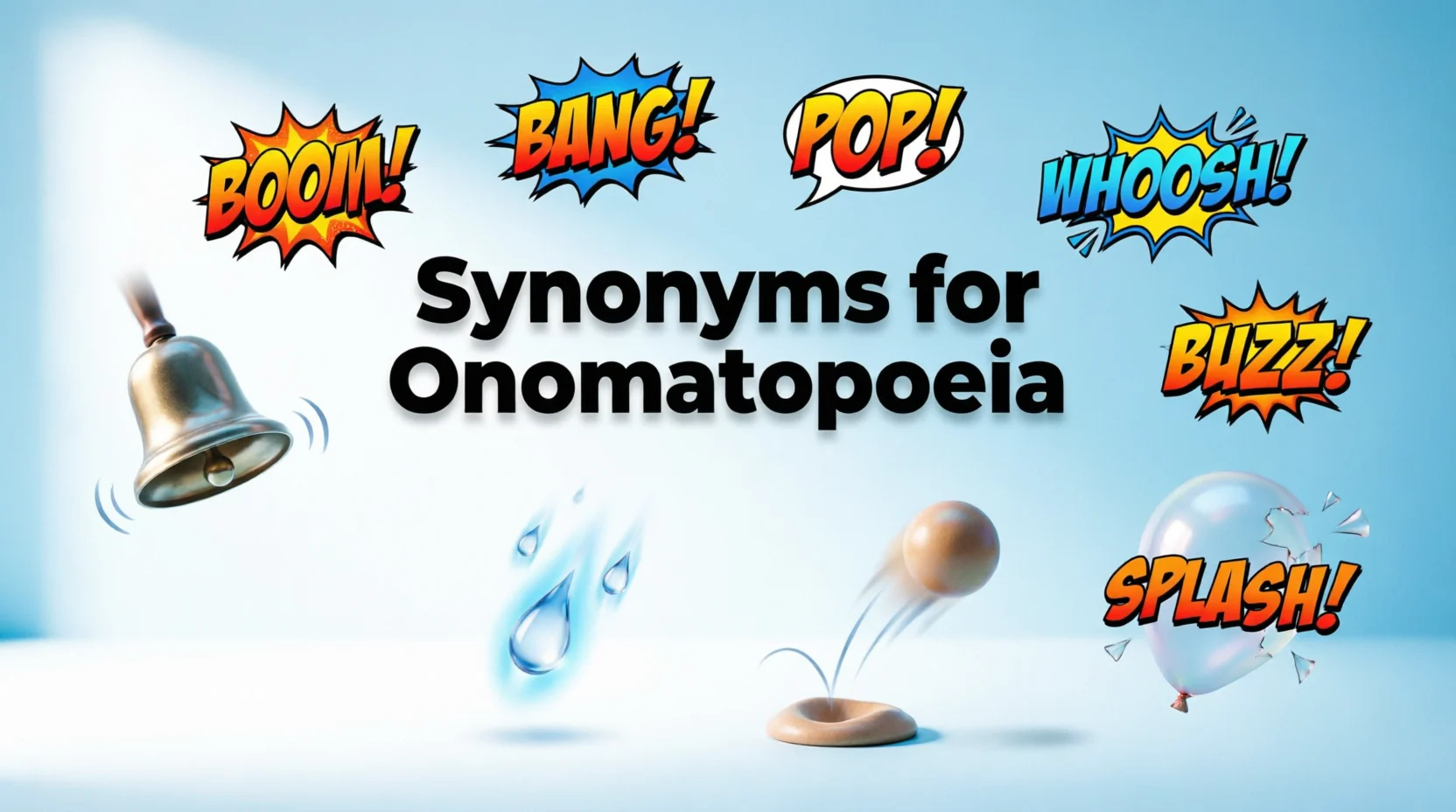
The best synonyms for onomatopoeia are words and expressions such as sound imitation, sound symbolism, echoic words, imitative words, and sound words. These terms describe language that imitates, suggests, or represents sounds. However, not every term has exactly the same meaning, so choosing the right one depends on your writing purpose.
Onomatopoeia is an important part of English vocabulary. Writers use it to make stories more vivid, help readers imagine sounds, and create a stronger connection between words and real-life experiences. Words such as buzz, bang, splash, whisper, and hiss help readers hear a scene in their minds.
In this guide, you will discover 30 synonyms and related expressions for onomatopoeia, with simple definitions, example sentences, and usage tips. If you are a student, an English learner, a blogger, or a creative writer, this list will help you choose accurate words for different contexts.
What Does Onomatopoeia Mean?
Onomatopoeia is the use of a word that imitates or resembles the sound it describes.
For example:
- Buzz: The sound a bee makes.
- Bang: A sudden, loud noise.
- Splash: The sound of something hitting water.
- Meow: The sound a cat makes.
- Tick-tock: The repeated sound of a clock.
Onomatopoeic words make writing more expressive because they help readers imagine sounds instead of simply reading about them.
For example, compare these two sentences:
- The bee flew past the flower.
- The bee buzzed past the flower.
The second sentence gives the reader a clearer sense of the sound.
30 Synonyms for Onomatopoeia and Related Terms
Onomatopoeia is a specific linguistic concept, so many words in the following list are closely related terms rather than exact synonyms. This distinction is useful when choosing vocabulary for academic writing, creative work, or language learning.
1. Sound Imitation
Meaning: The act of copying or representing a sound with words.
Example: The word bang is an example of sound imitation because it resembles a sudden impact.
Best usage: General explanations of onomatopoeia and beginner-friendly writing.
2. Sound Symbolism
Meaning: The connection between speech sounds and the ideas, qualities, or sensations they suggest.
Example: Some words contain sounds that seem to suggest softness, sharpness, or smallness.
Best usage: Linguistics, phonetics, and discussions of how sounds influence meaning.
Note: Sound symbolism is broader than onomatopoeia because a word can suggest a quality without copying an actual sound.
3. Echoic Words
Meaning: Words that imitate or resemble sounds.
Example: The echoic word clang describes the sharp sound of metal striking metal.
Best usage: Linguistic explanations and discussions of sound-based vocabulary.
4. Imitative Words
Meaning: Words that copy or imitate sounds, actions, or other features of something.
Example: The child said vroom while pretending to drive a toy car.
Best usage: General writing, language education, and descriptions of children’s speech.
5. Sound Words
Meaning: Words that represent particular sounds.
Example: The comic book used sound words such as pow, boom, and crash during the fight scene.
Best usage: Simple explanations, classroom activities, and informal writing.
6. Phonetic Imitation
Meaning: The representation of a sound through speech sounds or written language.
Example: Writing whoosh helps represent the sound of something moving quickly through the air.
Best usage: Phonetics, language learning, and discussions of written sound effects.
7. Auditory Imagery
Meaning: Language that helps readers imagine what something sounds like.
Example: The author described the wind as a low howl across the empty fields.
Best usage: Literary analysis, poetry, storytelling, and descriptive writing.
Note: Auditory imagery can use ordinary descriptive words as well as onomatopoeia.
8. Sound Effect
Meaning: A sound used to represent an action, event, or atmosphere.
Example: The writer added a loud crash to emphasize the moment the window broke.
Best usage: Comics, screenwriting, video production, and storytelling.
9. Verbal Sound Effect
Meaning: A written or spoken expression that represents a sound.
Example: The comic displayed zap! when the superhero fired a beam of energy.
Best usage: Comics, cartoons, children’s books, and creative writing.
10. Acoustic Representation
Meaning: A description or representation of sound through language or another medium.
Example: The poem’s acoustic representation of the storm included words such as rumble and roar.
Best usage: Academic writing, literary criticism, and sound studies.
11. Phonaesthetics
Meaning: The study or appreciation of the aesthetic qualities of speech sounds.
Example: The writer considered how the sounds in a character’s name influenced its overall impression.
Best usage: Linguistics, creative writing, and discussions of how words sound.
Note: Phonaesthetics concerns the pleasing or expressive qualities of sounds, not simply the imitation of noises.
12. Expressive Language
Meaning: Language that communicates feelings, impressions, or ideas vividly.
Example: The author used expressive language to bring the noisy marketplace to life.
Best usage: Essays, storytelling, speeches, and descriptive passages.
13. Mimetic Language
Meaning: Language that imitates or represents an action, experience, or feature of reality.
Example: The repeated thud-thud mimicked the sound of heavy footsteps.
Best usage: Literary analysis, linguistics, and creative writing.
14. Imitative Expression
Meaning: A word or phrase that copies or represents a sound or action.
Example: The expression ha-ha represents laughter in written dialogue.
Best usage: Informal writing, dialogue, and language-learning materials.
15. Sound Representation
Meaning: The use of words, symbols, or other forms to communicate a sound.
Example: The sound representation ding-dong suggested the ringing of a doorbell.
Best usage: Educational explanations, writing instruction, and discussions of sound notation.
16. Vocal Imitation
Meaning: The use of the voice to copy a sound.
Example: The performer used vocal imitation to reproduce the sound of a barking dog.
Best usage: Acting, voice performance, entertainment, and language practice.
17. Naturalistic Sound
Meaning: A sound that resembles something heard in the natural world.
Example: The bird’s sharp call created a naturalistic sound in the audio recording.
Best usage: Nature writing, film, audio production, and descriptive discussions.
18. Phonological Imitation
Meaning: The representation of a sound through the sound patterns of a language.
Example: The word hiss uses speech sounds that suggest the noise of escaping air.
Best usage: Linguistics, phonology, and advanced language study.
19. Sonic Imagery
Meaning: Descriptive language that creates a strong impression of sound.
Example: The poem’s sonic imagery made the reader imagine waves crashing against the shore.
Best usage: Poetry, literary criticism, and creative writing.
20. Sound Mimicry
Meaning: The act of copying or reproducing a sound.
Example: The comedian’s sound mimicry made the audience laugh as he imitated a squeaky door.
Best usage: Performance, comedy, acting, and informal descriptions.
21. Imitative Sound
Meaning: A sound that resembles or copies another sound.
Example: The repeated pop was an imitative sound representing bubbles bursting.
Best usage: Children’s literature, sound studies, and basic explanations.
22. Descriptive Sound Language
Meaning: Words and phrases used to describe sounds clearly or vividly.
Example: The writer used descriptive sound language to portray the steady patter of rain.
Best usage: Essays, reports, stories, and descriptive writing.
23. Acoustic Imagery
Meaning: Language that appeals to the reader’s sense of hearing.
Example: The acoustic imagery of bells ringing across the valley established a peaceful mood.
Best usage: Poetry, fiction, literary analysis, and descriptive essays.
24. Sound-Oriented Language
Meaning: Language that focuses on the qualities, patterns, or effects of sounds.
Example: The children’s poem used sound-oriented language to make its rhythm more engaging.
Best usage: Poetry, songwriting, phonetics, and language education.
25. Phonetic Representation
Meaning: A way of showing how a sound is spoken or heard through symbols or written forms.
Example: The author wrote brrr to represent the sound someone makes when feeling cold.
Best usage: Pronunciation guides, phonetics, and discussions of written sound expressions.
26. Comic-Book Sound Words
Meaning: Written expressions that represent sounds in comics and illustrated stories.
Example: The panel displayed wham! when the character struck the door.
Best usage: Comics, graphic novels, cartoons, and visual storytelling.
27. Interjection
Meaning: A word or expression that communicates a sudden reaction, emotion, or call.
Example: The character shouted, “Wow!” when the fireworks began.
Best usage: Dialogue, informal communication, and expressive writing.
Note: Interjections and onomatopoeia sometimes overlap, but they are not the same. Wow! expresses a reaction, while boom! can imitate a sound.
28. Ideophone
Meaning: A vivid word that evokes a sensory experience, such as a sound, movement, texture, or visual impression.
Example: In some languages, ideophones vividly describe the way something moves, sounds, or appears.
Best usage: Linguistics, cross-language studies, and discussions of expressive vocabulary.
Note: Ideophones can be broader than onomatopoeia and do not always imitate sounds.
29. Sound-Imitative Expression
Meaning: A word or phrase designed to reproduce or suggest a particular sound.
Example: The phrase drip-drop created a sound-impressive description of water falling from the roof.
Best usage: Creative writing, poetry, children’s stories, and explanatory articles.
30. Acoustic Symbolism
Meaning: The use of sound to suggest or communicate meaning.
Example: The writer explored how the sharp sounds in a word could create an impression of tension.
Best usage: Linguistics, language analysis, and discussions of the relationship between sound and meaning.
Note: Acoustic symbolism is related to sound symbolism, but the exact terminology can vary by field.
Comparison Table: Which Synonym for Onomatopoeia Should You Use?
The best alternative depends on whether you are explaining a linguistic concept, describing a sound, or discussing a literary technique.
| Term | Main meaning | Best context |
| Sound imitation | Copying a sound with words | General explanations |
| Echoic words | Words that resemble sounds | Linguistics |
| Imitative words | Words that copy sounds or features | Vocabulary lessons |
| Sound words | Words representing sounds | Beginner-friendly writing |
| Sound symbolism | Sounds suggesting meaning or qualities | Language research |
| Auditory imagery | Language that evokes hearing | Literary analysis |
| Sonic imagery | Vivid impressions of sound | Poetry and fiction |
| Sound effect | A sound representing an event | Comics and media |
| Ideophone | A vivid sensory expression | Linguistics |
| Phonetic imitation | Representing sound through speech or writing | Phonetics |
Quick Examples of Onomatopoeia
These examples show how different sound words work in everyday English.
| Word | Sound represented | Example sentence |
| Buzz | A continuous humming sound | The bee began to buzz near the window. |
| Bang | A sudden, loud impact | A loud bang came from the garage. |
| Splash | Something hitting water | The child made a splash in the pool. |
| Hiss | A sharp, continuous breath-like sound | The snake began to hiss. |
| Clang | A loud metallic sound | The gate closed with a clang. |
| Thud | A dull, heavy impact | The box landed with a thud. |
| Whoosh | Something moving quickly through air | The ball flew past with a whoosh. |
| Pop | A short, sudden sound | The balloon burst with a pop. |
| Meow | A cat’s call | The kitten gave a quiet meow. |
| Tick-tock | A repeated clock sound | The clock’s tick-tock filled the room. |
How to Choose the Right Synonym for Onomatopoeia
Not all related terms work equally well in every situation. Use the following groups to select a suitable expression.
1. For Simple English and Vocabulary Learning
Choose sound words, imitative words, or sound imitation.
These terms are easy to understand and work well in school assignments, English lessons, and introductory explanations.
Example: “Words such as buzz and bang are examples of sound imitation.”
2. For Academic and Linguistic Writing
Choose echoic words, sound symbolism, phonetic imitation, or phonological imitation.
These terms are more suitable for discussing how language represents sounds and how speech sounds communicate meaning.
Example: “The study examines echoic words in children’s language.”
Remember that these terms describe related but distinct concepts.
3. For Poetry and Creative Writing
Choose auditory imagery, sonic imagery, expressive language, or mimetic language.
These expressions are helpful when explaining how an author makes a scene feel vivid, emotional, or realistic.
Example: “The poet uses auditory imagery to recreate the sound of a storm.”
4. For Comics, Cartoons, and Children’s Books
Choose sound effects, verbal sound effects, or comic-book sound words.
These terms fit writing that uses visible sound expressions to make actions easier to imagine.
Example: “The comic uses pow! and crash! as verbal sound effects.”
5. For Sound Performance and Acting
Choose sound mimicry or vocal imitation.
These expressions describe a person copying sounds with their voice.
Example: “The actor used vocal imitation to reproduce the sound of a barking dog.”
6. For Advanced Discussion of Language and Meaning
Choose ideophone, phonaesthetics, or sound symbolism, depending on the point you want to make.
Use ideophone for vivid sensory words, phonaesthetics for the aesthetic qualities of speech sounds, and sound symbolism for relationships between sounds and meanings.
Example: “The researcher studied sound symbolism in words associated with size.”
Onomatopoeia vs. Similar Terms: What Is the Difference?
Although many expressions are related to onomatopoeia, their meanings are not interchangeable.
- Onomatopoeia vs. sound symbolism: Onomatopoeia imitates a sound, while sound symbolism includes broader associations between sounds and meaning.
- Onomatopoeia vs. auditory imagery: Onomatopoeia uses sound-imitating words, while auditory imagery includes any language that helps readers imagine hearing something.
- Onomatopoeia vs. interjection: Onomatopoeia represents a sound, while an interjection expresses a reaction or emotion. Some words can perform both functions.
- Onomatopoeia vs. sound effect: Onomatopoeia is a linguistic feature; a sound effect is a broader term that can refer to recorded, performed, or written sounds.
- Onomatopoeia vs. ideophone: Onomatopoeia imitates sounds, while ideophones can evoke a wider range of sensory experiences.
Understanding these differences helps you write more accurately and avoid using related terms as if they meant exactly the same thing.
FAQs:
1. What are the best synonyms for onomatopoeia?
The closest alternatives include sound imitation, echoic words, imitative words, and sound words. These expressions describe words that imitate or represent sounds, although they differ slightly in meaning and usage.
2. What is another word for onomatopoeia in simple English?
Sound imitation is one of the simplest ways to explain onomatopoeia. It describes words that sound like the noises they represent, such as buzz, pop, and crash.
3. Is sound symbolism the same as onomatopoeia?
No. Onomatopoeia imitates actual or perceived sounds. Sound symbolism is broader and includes cases in which speech sounds suggest qualities or meanings without directly copying a noise.
4. What are five examples of onomatopoeia?
Five common examples are buzz, bang, splash, hiss, and tick-tock. Each word imitates or represents a recognizable sound.
5. Why do writers use onomatopoeia?
Writers use onomatopoeia to make descriptions vivid, create atmosphere, emphasize action, and help readers imagine the sounds in a scene. It is especially useful in poetry, comics, children’s books, and fiction.
6. What is the difference between onomatopoeia and auditory imagery?
Onomatopoeia uses words that imitate sounds, such as clang or whoosh. Auditory imagery is a broader literary technique that helps readers imagine sounds, including through descriptions such as “the distant bells rang across the valley.”
7. Can onomatopoeia be used in academic writing?
Yes. Onomatopoeia is appropriate in academic writing about linguistics, phonetics, literature, and language development. In formal work, define the term clearly and distinguish it from broader concepts such as sound symbolism and ideophones.
Conclusion
Learning synonyms for onomatopoeia helps you explain sound-based language more clearly and choose better vocabulary for different writing situations. Terms such as sound imitation, echoic words, imitative words, and sound words are useful for simple explanations, while auditory imagery, sonic imagery, and sound symbolism are better suited to specific literary or linguistic discussions.
The most important point is that these terms are related, but they are not all exact synonyms. Choose the one that matches your intended meaning, audience, and writing style.
If you are writing a school essay, analyzing a poem, creating a comic, or improving your English vocabulary, understanding these distinctions will help you communicate with greater precision and confidence.

I am Camden Thomas, an Administrator at SaysReply. I help maintain our platform and ensure readers find clear, natural, and useful alternative ways to express their thoughts every day.