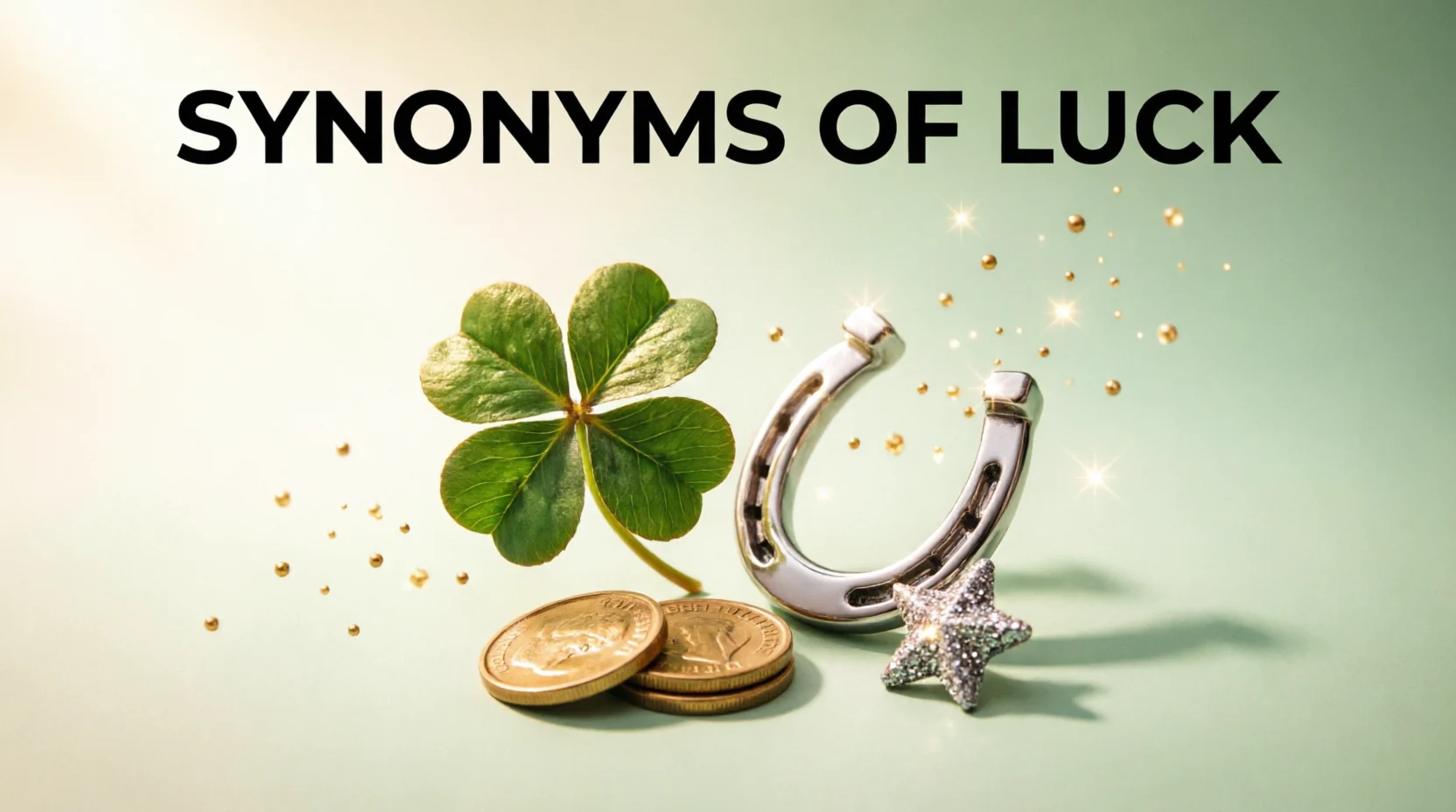
Luck is a word we use when something good or bad happens by chance. Understanding the synonyms of luck helps you express good fortune, unexpected success, favorable opportunities, and even unfortunate events more clearly. If you are a student, an ESL learner, a writer, or a content creator, learning these related words can make your vocabulary richer and your writing more natural.
Different words for luck carry different meanings. For example, fortune sounds more formal, chance emphasizes uncertainty, and serendipity describes finding something wonderful without expecting it. Choosing the right word depends on the situation, tone, and message you want to communicate.
In this guide, you will discover 30 synonyms of luck, with simple definitions, example sentences, and practical usage notes. You will also learn how to choose the best synonym for everyday conversations, academic writing, storytelling, and professional communication.
What Does Luck Mean?
Luck is the way events happen by chance rather than through a person’s direct control. It often describes unexpected success, a favorable outcome, or an unfortunate experience.
For example, if you find money on the street, you might call it good luck. If you miss a bus and arrive late for an important meeting, you might describe it as bad luck.
Luck can be positive, negative, or neutral. Its meaning depends on the outcome of an event.
- Good luck: Something favorable happens unexpectedly.
- Bad luck: Something unfortunate happens by chance.
- Mixed luck: Some events turn out well while others do not.
- A lucky break: An unexpected opportunity brings success.
30 Synonyms of Luck With Meanings and Examples
The following words are related to luck, but they are not all exact replacements. Some describe favorable circumstances, while others emphasize chance, destiny, or unexpected discoveries.
1. Fortune
Meaning: The events or circumstances that affect someone’s life, especially their success or happiness.
Example: Through good fortune, she found a job just when she needed one.
Best usage: Use fortune in formal writing, storytelling, and discussions about success or life circumstances.
2. Chance
Meaning: The possibility that something may happen without being planned or certain.
Example: By chance, I met my childhood friend at the airport.
Best usage: Use chance when emphasizing uncertainty or an unplanned event.
3. Serendipity
Meaning: The experience of discovering something valuable or pleasant unexpectedly.
Example: Finding that little bookstore while exploring the city was pure serendipity.
Best usage: Ideal for creative writing, personal stories, and unexpected discoveries.
4. Providence
Meaning: The belief that events are guided by a divine power or a higher plan.
Example: She believed that providence had brought the two families together.
Best usage: Use it in religious, spiritual, philosophical, or literary contexts.
5. Destiny
Meaning: The idea that certain events are meant to happen in a person’s life.
Example: He felt that becoming a teacher was his destiny.
Best usage: Best for stories about life paths, relationships, and significant events. Unlike luck, destiny suggests a predetermined outcome.
6. Fate
Meaning: The force or idea believed to determine what happens in someone’s life.
Example: By a strange twist of fate, they met again after twenty years.
Best usage: Useful in dramatic stories, reflective writing, and discussions about events beyond personal control.
7. Good fortune
Meaning: A favorable event or circumstance that brings happiness or success.
Example: Good fortune helped them find shelter before the storm began.
Best usage: Use this phrase when describing a positive and fortunate outcome.
8. Prosperity
Meaning: A state of success, wealth, or well-being.
Example: The business enjoyed years of prosperity after launching its new product.
Best usage: Best for financial success, economic growth, and general well-being. It describes a positive condition rather than luck itself.
9. Blessing
Meaning: Something good that brings happiness, help, or comfort.
Example: Having supportive friends has been a blessing in her life.
Best usage: Appropriate for personal, emotional, spiritual, and appreciative expressions.
10. Break
Meaning: An unexpected opportunity or advantage that helps someone succeed.
Example: Getting an interview with her dream company was the break she needed.
Best usage: Use break in informal conversations, especially when someone receives an opportunity unexpectedly.
11. Lucky break
Meaning: A sudden, favorable opportunity that improves a situation.
Example: The young musician got a lucky break when a famous producer heard her song.
Best usage: Ideal for career stories, entertainment, sports, and personal success.
12. Fluke
Meaning: An unexpected result that happens by accident rather than through a predictable pattern.
Example: Winning the competition on his first attempt seemed like a fluke.
Best usage: Use it informally when an unusual success or result may have happened by chance. It can suggest that the outcome was not repeatable.
13. Stroke of luck
Meaning: A sudden and helpful event that happens unexpectedly.
Example: A stroke of luck helped us find an available hotel room during the festival.
Best usage: Great for everyday storytelling and describing fortunate surprises.
14. Coincidence
Meaning: Two or more events happening together unexpectedly, without an obvious connection.
Example: It was an amazing coincidence that we wore the same color to the party.
Best usage: Use it when events happen together unexpectedly. A coincidence is not necessarily fortunate.
15. Opportunity
Meaning: A favorable situation that gives someone a chance to do something.
Example: The scholarship provided an opportunity to study abroad.
Best usage: Best for education, career development, and situations where someone can take action. An opportunity is not always caused by luck.
16. Windfall
Meaning: An unexpected gain, especially money or valuable resources.
Example: The unexpected inheritance was a financial windfall for the family.
Best usage: Use it in financial discussions, business writing, and situations involving unexpected gains.
17. Boon
Meaning: Something that is very helpful or beneficial.
Example: Reliable internet access has been a boon for remote workers.
Best usage: Appropriate for formal writing when describing a major benefit or advantage.
18. Favor
Meaning: An advantage or favorable circumstance that helps someone.
Example: The weather was in our favor during the outdoor event.
Best usage: Often used in expressions such as fortune favors the brave or the odds are in your favor.
19. Advantage
Meaning: A condition that puts someone in a better position than others.
Example: Her early preparation gave her an advantage in the competition.
Best usage: Best for academic, professional, sporting, and competitive contexts. An advantage may come from preparation rather than luck.
20. Breakthrough
Meaning: An important discovery or achievement that helps overcome a problem.
Example: The researchers made a breakthrough after months of experiments.
Best usage: Use it for major progress in science, business, technology, or personal development. It is related to success, not simply chance.
21. Randomness
Meaning: The quality of happening without a predictable order or pattern.
Example: The randomness of the draw meant that every participant had an equal chance.
Best usage: Best for scientific, mathematical, technical, and analytical writing.
22. Uncertainty
Meaning: A situation in which the outcome is not known or predictable.
Example: Despite the uncertainty, she remained hopeful about the results.
Best usage: Use it when discussing unpredictable outcomes. It describes the lack of certainty rather than good luck.
23. Fortune’s favor
Meaning: A phrase describing circumstances that appear to support someone’s success.
Example: With fortune’s favor, the team reached the final round.
Best usage: Suitable for literary writing, speeches, and expressive storytelling.
24. Happy accident
Meaning: An unplanned event that leads to a pleasant or useful result.
Example: The unusual color combination was a happy accident.
Best usage: Great for creative work, cooking, design, art, and casual conversations.
25. Serendipitous discovery
Meaning: A valuable or interesting finding made unexpectedly.
Example: Their serendipitous discovery changed the direction of the research.
Best usage: Best for academic stories, scientific discoveries, travel experiences, and creative projects.
26. Favorable circumstances
Meaning: Conditions that make success or a positive outcome more likely.
Example: Favorable circumstances allowed the small business to grow quickly.
Best usage: Use this phrase in formal, academic, and professional writing.
27. Windfall gain
Meaning: An unexpected financial or material benefit.
Example: The company received a windfall gain when it sold an unused property.
Best usage: Best for financial reports, business discussions, and economic explanations.
28. Good break
Meaning: An unexpected event that gives someone an advantage.
Example: Getting extra time to finish the project was a good break for the students.
Best usage: Informal and conversational, especially when discussing a helpful change in circumstances.
29. Fortuity
Meaning: The quality of happening by chance, often with a favorable result.
Example: Through sheer fortuity, the two artists met at the same exhibition.
Best usage: Best for formal writing, literary expression, and sophisticated vocabulary.
30. Happy chance
Meaning: An unexpected occurrence that leads to a pleasant result.
Example: By a happy chance, we found the exact book we had been searching for.
Best usage: Suitable for storytelling and descriptive writing when emphasizing a fortunate coincidence.
Comparison Table: Which Synonym of Luck Should You Use?
Choosing the right synonym depends on what you want to emphasize. Some words focus on unexpected events, while others describe opportunity, long-term success, or a belief about life’s direction.
| Synonym | Main emphasis | Best context |
| Fortune | Life circumstances or success | Formal writing |
| Chance | Possibility or uncertainty | Everyday English |
| Serendipity | Pleasant unexpected discovery | Creative writing |
| Fate | Events beyond personal control | Dramatic stories |
| Destiny | A predetermined life path | Inspirational writing |
| Providence | Divine guidance | Religious contexts |
| Fluke | An unusual accidental result | Casual conversation |
| Windfall | Unexpected financial gain | Finance and business |
| Blessing | Something valuable or welcome | Personal reflection |
| Lucky break | Unexpected opportunity | Careers and success |
| Coincidence | Unexpectedly connected events | Everyday storytelling |
| Boon | A helpful benefit | Formal writing |
| Advantage | A better position | Work and competition |
| Fortuity | An event caused by chance | Literary writing |
| Happy accident | An unplanned positive result | Art and creativity |
Types of Luck and Related Vocabulary
Luck can be described in several ways. Understanding these categories will help you select more precise words.
Good luck
Good luck refers to favorable events that happen unexpectedly.
Related words and phrases include:
- Fortune
- Good fortune
- Blessing
- Stroke of luck
- Lucky break
- Serendipity
Example: A stroke of luck helped him find his lost wallet.
Bad luck
Bad luck describes unfortunate events that happen unexpectedly or outside someone’s control.
Related expressions include:
- Misfortune
- Bad fortune
- Ill luck
- Hard luck
- A run of bad luck
Example: It was bad luck that the train was canceled just before her journey.
Misfortune is especially useful when describing an unfortunate event or difficult experience.
Neutral or unpredictable luck
Sometimes an event is neither good nor bad until its result becomes clear.
Related words include:
- Chance
- Coincidence
- Randomness
- Uncertainty
- Fortuity
Example: By chance, the two teams selected the same training location.
These words are helpful when you want to describe unpredictability without suggesting that an outcome is positive or negative.
How to Choose the Right Synonym of Luck
Use the following guide to select a synonym based on your meaning, tone, and writing purpose.
1. For everyday conversations
Choose simple and familiar expressions such as chance, good fortune, lucky break, and stroke of luck.
Example: “I had a lucky break when someone returned my missing phone.”
These expressions sound natural and are easy for English learners to understand.
2. For formal and academic writing
Choose fortune, fortuity, favorable circumstances, or randomness, depending on the context.
Example: “The research team benefited from favorable circumstances during the initial experiment.”
Avoid using a word such as fluke in formal writing when you want a neutral, professional tone, because it may suggest that the result was accidental or unreliable.
3. For creative and literary writing
Choose serendipity, fate, destiny, or providence.
Example: “A moment of serendipity brought the old friends together.”
These words can add emotional depth and help communicate different ideas about chance and life’s direction.
4. For financial success
Choose windfall, prosperity, or windfall gain.
Example: “The unexpected sale gave the family a financial windfall.”
Remember that prosperity usually describes sustained success, while windfall describes an unexpected gain.
5. For unexpected discoveries
Choose serendipity, happy accident, happy chance, or serendipitous discovery.
Example: “The new recipe was a happy accident that became the restaurant’s most popular dish.”
These expressions work well when an unplanned event leads to something useful or enjoyable.
6. For unfortunate situations
Choose misfortune, bad fortune, or hard luck.
Example: “It was a case of misfortune when the storm damaged their home.”
These words help you discuss negative outcomes without confusing them with neutral chance or positive fortune.
Luck vs. Fortune vs. Chance vs. Fate
Although these words are closely related, they are not interchangeable in every sentence.
| Word | Key difference | Example |
| Luck | An unexpected favorable or unfavorable outcome | She had good luck during the game. |
| Fortune | Circumstances or events affecting someone’s life | Fortune smiled on the young entrepreneur. |
| Chance | Possibility or an unplanned occurrence | We met by chance. |
| Fate | Events viewed as determined or unavoidable | He believed fate brought them together. |
| Destiny | A life path believed to be predetermined | She felt teaching was her destiny. |
| Serendipity | An unexpected discovery with a positive result | Their meeting was pure serendipity. |
The simplest way to remember the differences is that luck emphasizes outcomes, chance emphasizes possibility, fortune often emphasizes circumstances, and fate emphasizes what seems destined to happen.
Common Expressions and Idioms About Luck
Learning idioms is another way to improve your English vocabulary.
– Good luck! — A friendly wish for success. Example: Good luck with your final exams!
– Out of luck — Unable to get what you want. Example: We were out of luck because all the tickets had sold out.
– As luck would have it — As events happened, often unexpectedly. Example: As luck would have it, the shop was still open.
– Beginner’s luck — Unexpected early success by someone inexperienced. Example: His first chess victory was probably beginner’s luck.
– The luck of the draw — An outcome determined by chance. Example: Getting the best seat was simply the luck of the draw.
– Push your luck — Take too many risks after already having some success. Example: You should stop asking for favors before you push your luck.
– A stroke of good luck — A sudden fortunate event. Example: Finding a cheaper flight was a stroke of good luck.
These expressions are common in everyday English and can make conversations sound more natural.
FAQs:
1. What is the most common synonym of luck?
Fortune is one of the most common synonyms of luck. Depending on the sentence, chance, good fortune, and fate may also work.
2. What is another word for good luck?
Words and phrases for good luck include fortune, good fortune, blessing, serendipity, lucky break, and stroke of luck. Each has a slightly different meaning.
3. What is a synonym for bad luck?
Misfortune, bad fortune, ill luck, and hard luck are useful alternatives. Misfortune is particularly suitable for describing an unfortunate event.
4. Is fortune the same as luck?
Not exactly. Both can describe unexpected outcomes, but fortune can also refer to a person’s general circumstances, success, or wealth. Luck more directly describes how events turn out by chance.
5. What is a sophisticated word for luck?
Serendipity and fortuity are sophisticated alternatives. Serendipity usually refers to a pleasant unexpected discovery, while fortuity emphasizes the role of chance.
6. What is the difference between luck and serendipity?
Luck can be good or bad and applies to many kinds of outcomes. Serendipity usually describes finding something valuable or pleasant without planning to do so.
7. What is a synonym for luck in academic writing?
Depending on the meaning, academic writers can use chance, randomness, fortuity, or favorable circumstances. The most accurate choice depends on whether the sentence concerns probability, unpredictability, or a positive outcome.
8. How can I improve my vocabulary using synonyms of luck?
Learn each word with an example sentence, note its tone, and practice using it in different contexts. For instance, use chance for an unplanned event, serendipity for a fortunate discovery, and windfall for an unexpected financial gain.
Conclusion
Learning the synonyms of luck helps you communicate more precisely and express different kinds of unexpected outcomes. Words such as fortune, chance, serendipity, fate, and misfortune are related, but each carries its own meaning and tone.
For everyday conversations, try chance, lucky break, or stroke of luck. For creative writing, consider serendipity, destiny, or fate. For financial situations, windfall may be the most accurate choice.
The key is to understand the context before choosing a replacement. With practice, you can use these 30 synonyms naturally in conversations, essays, professional writing, and creative work, making your English vocabulary clearer, richer, and more expressive.

I’m Amelia Rose, an enthusiastic writer who enjoys exploring better, clearer, and more natural ways to express ideas. I create helpful content that makes finding alternative phrases simple, useful, and enjoyable for everyone.