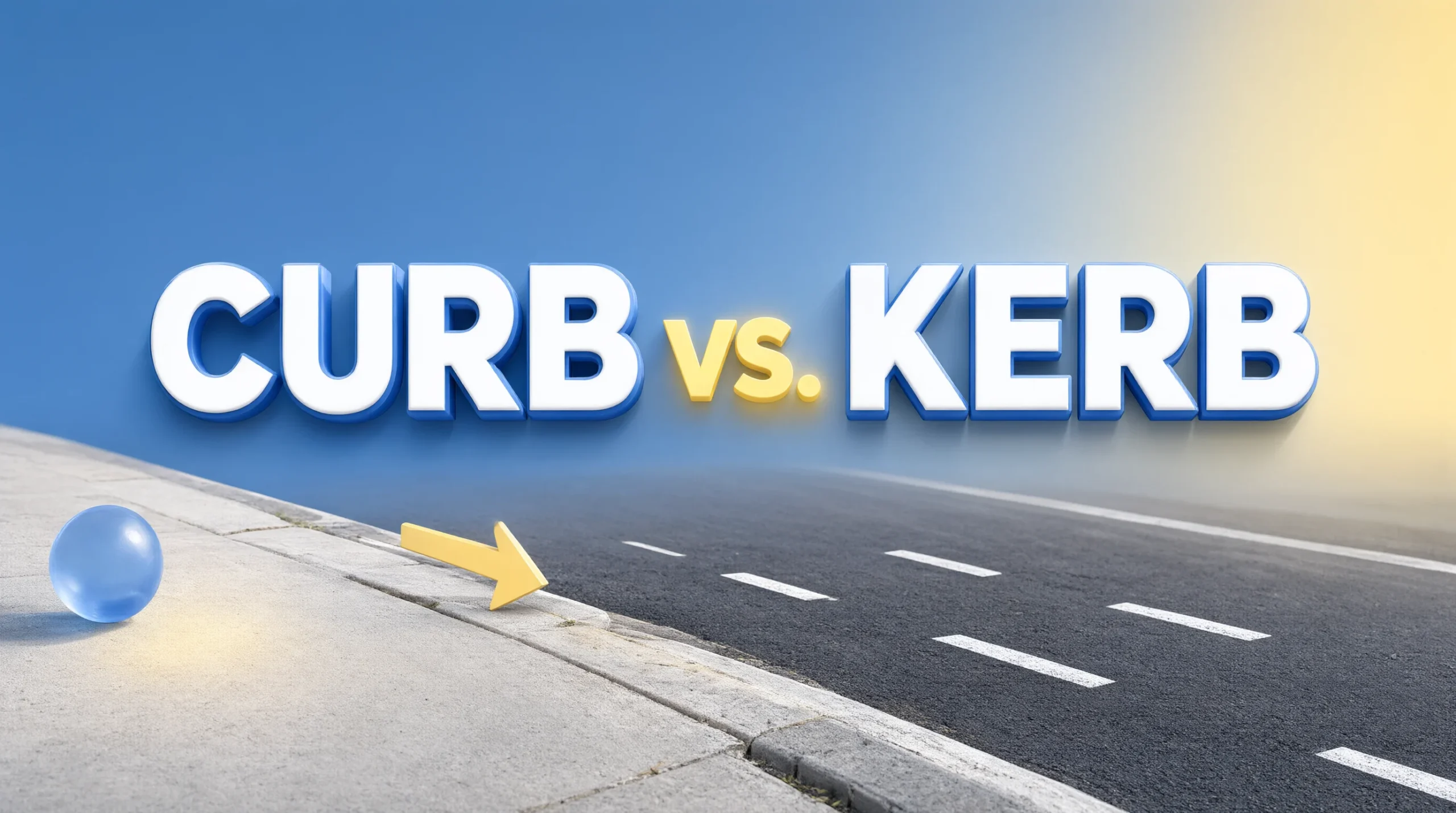
The difference between curb vs kerb is mainly a matter of regional spelling and usage. Both words refer to the raised edge between a road and a sidewalk, but curb is the standard spelling in American English, while kerb is the standard spelling in British English. However, curb also has a common verb meaning: to control, limit, or restrain something.
Understanding curb and kerb helps you choose the correct word when writing essays, emails, articles, or everyday messages. Although the two spellings usually refer to the same physical structure, their regional preferences differ.
If you are writing for an American audience, curb is generally the right choice. If you are writing for a British audience, kerb is preferred when referring to the edge of a pavement. The verb curb, meaning to control or restrict, is spelled the same way in both American and British English. Learning this simple distinction can make your writing clearer and help you avoid common spelling mistakes.
Quick Answer: Curb vs Kerb
Curb is the American English spelling for the raised edge of a road or sidewalk, while kerb is the British English spelling of the same feature. The word curb also means to control or limit something, as in “curb spending.” In this figurative sense, curb is used in both American and British English.
Why Do People Confuse Curb and Kerb?
People confuse these words because they sound exactly alike and have almost the same spelling. The only difference is the letter u in curb and the letter e in kerb.
Both spellings describe the raised border that separates a road from a pavement or sidewalk. The main difference is the variety of English being used.
Another reason for confusion is that curb has more than one meaning. It can describe a physical road feature or the act of controlling something. In contrast, kerb is primarily used for the physical edge of a road.
1. What Does Curb Mean?
Curb is a noun or verb with different meanings depending on the context.
Curb as a Noun
In American English, a curb is the raised stone or concrete edge separating a road from a sidewalk.
Examples:
- She sat on the curb while waiting for her friend.
- The driver parked beside the curb.
- Water flowed along the curb after the rain.
Curb as a Verb
As a verb, curb means to control, limit, or restrain something.
Examples:
- The government introduced measures to curb inflation.
- He tried to curb his anger during the argument.
- We need to curb unnecessary spending.
Simple definition: Curb can mean a raised road edge or the act of limiting or controlling something.
2. What Does Kerb Mean?
Kerb is the British English spelling of the noun referring to the raised edge between a road and a pavement.
It is commonly used in the United Kingdom and in writing that follows British spelling conventions.
Examples:
- The car stopped beside the kerb.
- She stepped down from the kerb to cross the road.
- The council repaired the damaged kerb outside the school.
Unlike curb, the spelling kerb is not normally used as a verb meaning to control or restrict something.
Simple definition: A kerb is the raised edge along the side of a road, usually separating the road from the pavement.
Curb vs Kerb: Comparison Table
| Feature | Curb | Kerb |
| Main meaning | Raised road edge | Raised road edge |
| Standard regional spelling | American English | British English |
| Part of speech | Noun and verb | Primarily a noun |
| Means to control or limit | Yes | No |
| Example | Park near the curb. | Park near the kerb. |
| Common phrase | Curb spending | Kerb stones |
| Pronunciation | Same | Same |
When Should You Use Curb or Kerb?
The correct choice depends on your audience and the meaning you want to express.
Use Curb When Writing in American English
Choose curb when referring to the edge of a road in American English.
Examples:
- The delivery truck stopped at the curb.
- Please do not park too close to the curb.
- The city installed a new curb near the intersection.
Use curb in both American and British English when you mean to control or limit something.
Examples:
- The company hopes to curb costs.
- She struggled to curb her excitement.
- New rules may help curb pollution.
Use Kerb When Writing in British English
Choose kerb when referring to the edge of a road in British English.
Examples:
- The bus stopped beside the kerb.
- He carefully stepped onto the pavement from the kerb.
- Workers replaced the broken kerb outside the building.
If you are writing for a British audience, using kerb for the physical road edge keeps your spelling consistent with British conventions.
12 Examples of Curb vs Kerb in Sentences
These examples show how both spellings work in everyday English.
- American English: The driver pulled over and parked beside the curb.
- British English: The driver pulled over and parked beside the kerb.
- American English: She sat on the curb and watched the parade.
- British English: He waited on the kerb for his friend.
- American English: The city repaired the damaged curb after the storm.
- British English: The council replaced the old kerb near the school.
- Both varieties: The government wants to curb rising prices.
- Both varieties: He tried to curb his anger during the meeting.
- Both varieties: The new policy could help curb unnecessary spending.
- Both varieties: Parents should help children curb excessive screen time.
- American English: The bicycle was leaning against the curb.
- British English: The pedestrian stepped carefully down from the kerb.
Notice that the spelling changes when describing the physical road edge, but the verb curb remains unchanged in both varieties.
Common Mistakes When Using Curb and Kerb
Even confident English speakers sometimes mix up these words. Here are the most common mistakes to avoid.
1. Using Kerb as a Verb
Incorrect: The company wants to kerb unnecessary spending.
Correct: The company wants to curb unnecessary spending.
Kerb is not the standard spelling of the verb meaning to limit or control.
2. Mixing American and British Spellings
If you are writing in American English, use curb for the road edge. If you are following British English, use kerb.
Both spellings are valid in their respective regional conventions.
3. Assuming Curb and Kerb Have Completely Different Meanings
They do not have completely different meanings. When referring to a road edge, they describe the same thing. The difference is primarily regional spelling.
4. Using Curb Only as a Noun
Remember that curb can also be a verb.
For example, “The company must curb expenses” uses curb to mean reduce or control.
5. Thinking the Pronunciation Changes
Both words are pronounced the same way. The spelling difference does not create a pronunciation difference.
Memory Trick: How to Remember Curb vs Kerb
Use this easy trick to remember which spelling to choose:
- Curb = USA: Both begin with a hard “C” sound, and curb is the American spelling.
- Kerb = UK: Remember kerb as the British spelling for the road edge.
- Curb control: The word curb contains the same spelling whether you are talking about a road edge or controlling behavior.
A simple sentence to remember is: “Use the curb in America, the kerb in Britain, and curb your habits everywhere.”
American vs British English: Curb and Kerb
American and British English often use different spellings for the same words. Curb and kerb are a clear example.
| Context | American English | British English |
| Road edge | Curb | Kerb |
| Limiting expenses | Curb expenses | Curb expenses |
| Controlling behavior | Curb behavior | Curb behaviour |
| Roadside parking | Park by the curb | Park by the kerb |
| Raised roadside structure | Concrete curb | Concrete kerb |
Notice that behavior is commonly spelled behaviour in British English, but the verb curb retains its American-style spelling in both varieties when used to mean control or limit.
The key is to maintain consistent regional spelling throughout your writing.
Similar Words to Curb and Kerb
Several related words can help you describe road edges or the act of limiting something. However, they are not always interchangeable.
| Word | Simple meaning | Example |
| Edge | The outer boundary of something | She stood at the edge of the pavement. |
| Border | A line separating two areas | A stone border ran along the road. |
| Boundary | A line marking a limit | The fence marks the property boundary. |
| Restrain | To hold back or control | He tried to restrain his anger. |
| Control | To manage or direct something | The rules control traffic flow. |
| Restrict | To limit what is allowed | The policy restricts vehicle access. |
| Limit | To keep something within a range | We need to limit our spending. |
| Constrain | To restrict movement or action | Budget problems constrained the project. |
The most suitable alternative depends on the context. For a physical roadside structure, edge or border may sometimes work. For the verb curb, words such as limit, restrain, control, and restrict are often appropriate.
Final Verdict: Curb vs Kerb
The difference between curb and kerb is easy to understand once you remember the regional spelling rule.
- Curb: The standard American English spelling for a road edge; also a verb meaning to control or limit something.
- Kerb: The standard British English spelling for a road edge.
- Curb as a verb: Used in both American and British English when referring to controlling or restricting something.
If you are unsure which spelling to use, consider your audience first. Use curb for American readers and kerb for British readers when describing the roadside structure. When talking about controlling spending, anger, pollution, or other things, use curb.
FAQs:
1. Is it curb or kerb in American English?
Curb is the standard American English spelling. For example, “The car stopped beside the curb.”
2. Is kerb British or American?
Kerb is the standard British English spelling for the raised edge between a road and a pavement. American English generally uses curb.
3. Do curb and kerb mean the same thing?
Yes. When referring to the raised edge along a road, both words mean the same thing. The difference is regional spelling rather than meaning.
4. Can curb be used as a verb?
Yes. Curb means to control, limit, or restrain something. For example, “The company introduced new rules to curb spending.”
5. Is kerb spending correct?
No. In standard modern English, the correct phrase is curb spending. The verb curb is used in both American and British English.
6. How do you pronounce curb and kerb?
Both words are pronounced the same way: /kɜːrb/ in many British and American pronunciation descriptions, with some differences in accent. The spelling does not change the basic pronunciation.
7. Should I use curb or kerb in an international article?
Choose the spelling that best matches your intended audience and keep it consistent. Use curb for American English and kerb for British English when referring to a road edge. Use curb for the verb meaning to control or limit.
Remember This
- Curb = American English road edge.
- Kerb = British English road edge.
- Curb = control or limit, in both varieties of English.
- Both spellings sound the same.
When in doubt, remember that curb spending is correct regardless of whether you are writing for American or British readers.
Conclusion
The difference between curb and kerb comes down to regional spelling and how the word is used. Both refer to the raised edge of a road, but American English prefers curb, while British English prefers kerb. Knowing this distinction helps you write clearly and choose the right spelling for your audience.
Remember that curb also functions as a verb meaning to control, limit, or restrain something. This meaning is used in both American and British English. Once you learn these simple rules, choosing between curb and kerb becomes much easier in everyday conversations, academic writing, and professional communication.

I’m Jaxon James, an author at SaysReply, where I share simple, clear, and natural alternative ways to say things and help readers express their thoughts better.








3 thoughts on “Curb vs Kerb: What’s the Difference? Meaning, Spelling, and”