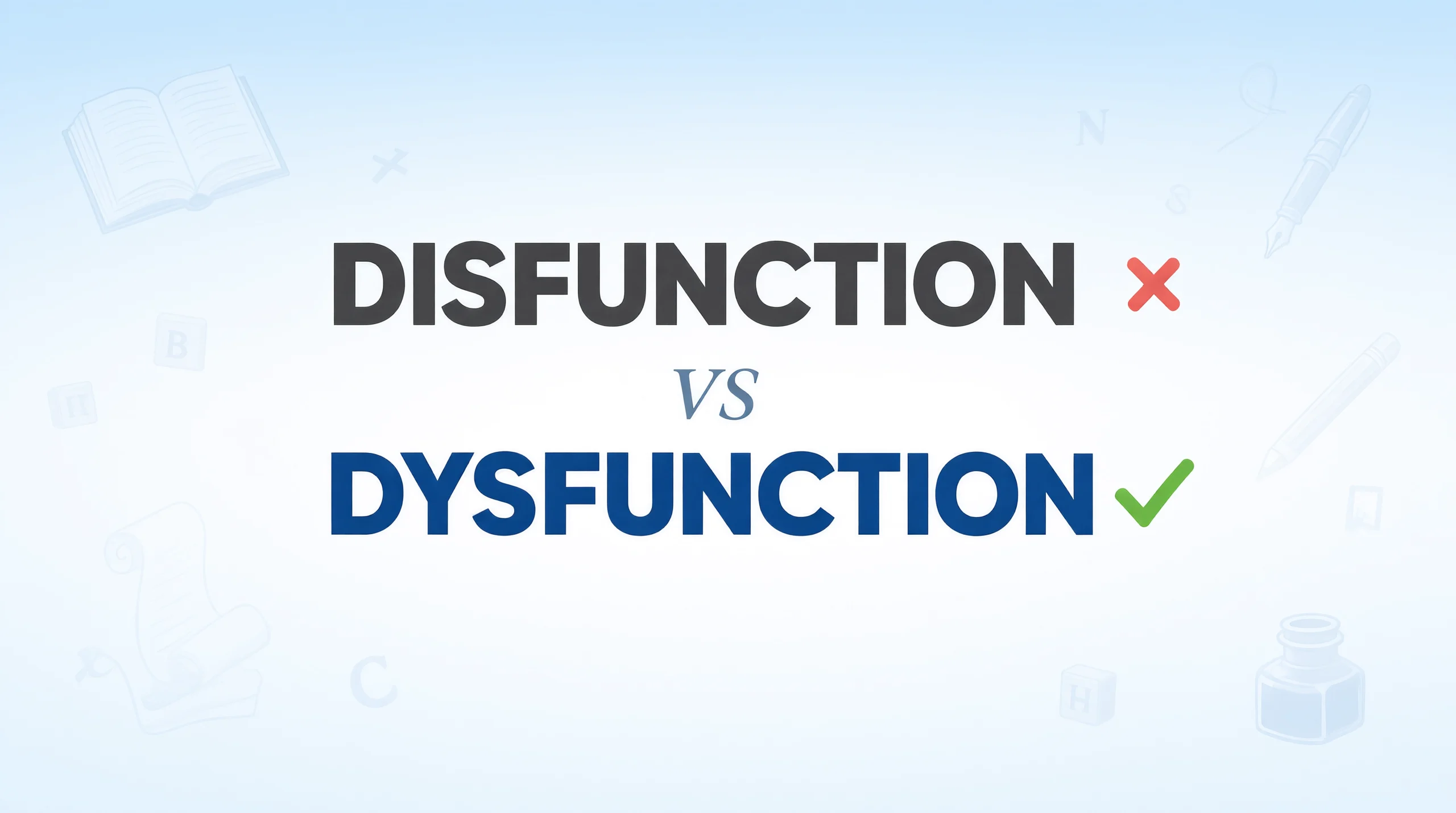
Have you ever wondered if to write disfunction or dysfunction? These words look similar, so it is easy to become confused when writing an email, completing a school assignment, or creating professional content. However, there is an important difference between the two spellings.
Dysfunction is the correct and standard English spelling. It describes a problem with how something works, such as a body organ, a family relationship, a computer system, or an organization. Disfunction is generally considered a misspelling of dysfunction in modern standard English. If you want to communicate clearly and use correct English, choose dysfunction.
Understanding this spelling difference can help you improve your vocabulary, avoid common writing mistakes, and express your ideas more accurately. In this guide, you will learn the meanings of both spellings, discover when to use dysfunction, explore practical examples, and understand how related words such as dysfunctional and malfunction differ. By the end, you will know which spelling to choose in everyday, academic, and professional writing.
Quick Answer
Dysfunction is the correct spelling in standard modern English. It refers to a failure or problem in the normal functioning of a person, relationship, system, or organization. Disfunction is generally an incorrect spelling. For example, write “family dysfunction” or “a dysfunctional system,” not “family disfunction.”
Why Do People Confuse Disfunction and Dysfunction?
People confuse these spellings because both begin with similar sounds and contain the word function. The prefix dis- is also common in English, as seen in words such as disagree, disconnect, and dislike.
However, the standard word for impaired or abnormal functioning is dysfunction.
The confusion often happens for three reasons:
- Similar spelling patterns: Both forms look plausible to someone unfamiliar with the word.
- The meaning of prefixes: English speakers may assume that adding dis- to function creates the correct word.
- Pronunciation: In ordinary speech, the difference between the two spellings may not be obvious.
Remember that spelling is not always predictable from word parts alone. Learning the established spelling is the easiest way to avoid this mistake.
First Word: Disfunction
Disfunction is generally regarded as a misspelling of dysfunction in contemporary standard English.
You may occasionally encounter it in informal writing, online discussions, or text containing spelling errors. However, it is not the recommended spelling when you mean an impairment in normal functioning.
Meaning of Disfunction
When writers use disfunction to describe a problem with how something operates, they usually intend to express the meaning of dysfunction.
For example:
- Incorrect: The report identified family disfunction.
- Correct: The report identified family dysfunction.
In formal writing, educational assignments, reports, and professional communication, use dysfunction instead.
Second Word: Dysfunction
Dysfunction is the correct standard English word for impaired, abnormal, or ineffective functioning.
It can describe difficulties in different areas of life, including health, relationships, technology, and organizations.
Meaning of Dysfunction
Dysfunction is a noun that refers to a condition in which a person, relationship, organ, or system does not function normally or effectively.
Examples include:
- Medical dysfunction: A problem affecting the normal operation of a body part or biological process.
- Family dysfunction: Unhealthy patterns of communication or behavior within a family.
- Organizational dysfunction: Problems that prevent a workplace or organization from operating effectively.
- System dysfunction: A failure or weakness that interferes with a system’s intended purpose.
Example Sentences
- The doctor evaluated the patient’s thyroid dysfunction.
- Family dysfunction can create challenges in communication.
- The company introduced new policies to address organizational dysfunction.
- The software update revealed a problem in the system’s functioning.
- The counselor helped the family recognize unhealthy patterns.
These examples show that dysfunction applies to many situations, not just medical conditions.
Disfunction vs. Dysfunction: Comparison Table
| Feature | Disfunction | Dysfunction |
| Standard spelling | Generally incorrect | Correct |
| Meaning | Usually intended to mean dysfunction | Impaired or abnormal functioning |
| Formal writing | Avoid | Recommended |
| Academic writing | Avoid | Correct choice |
| Medical contexts | Not recommended | Commonly used |
| Related adjective | Avoid disfunctional | Dysfunctional |
| Example | Disfunction in the system | Dysfunction in the system |
The key distinction is simple: use dysfunction whenever you mean a problem with normal functioning.
When Should You Use Each Word?
When to Use Dysfunction
Use dysfunction in writing whenever you are describing a problem that interferes with normal or effective functioning.
Common expressions include:
- Family dysfunction: Unhealthy family interactions or relationships.
- Sexual dysfunction: Difficulties involving sexual functioning.
- Erectile dysfunction: A persistent difficulty achieving or maintaining an erection.
- Organ dysfunction: An organ that does not work normally.
- Cognitive dysfunction: Problems with mental processes such as memory or attention.
- Organizational dysfunction: Ineffective workplace structures or practices.
- Dysfunctional behavior: Behavior that negatively affects a person’s life or relationships.
Choose the term that best describes the specific situation. For example, family dysfunction concerns relationship patterns, while organ dysfunction concerns the functioning of a body organ.
When to Use Disfunction
In ordinary modern English, you should generally avoid using disfunction when you intend to describe impaired functioning.
If you encounter this spelling in a document, check the context. The writer may have intended to use dysfunction.
If you are quoting an original text, preserve the spelling as it appears in the source when accuracy requires it. Otherwise, use the standard spelling.
12 Examples of Dysfunction in Sentences
Here are practical examples to help you understand how to use dysfunction correctly.
- Medical: The test results suggested a possible thyroid dysfunction.
- Family: Family dysfunction can make honest communication difficult.
- Workplace: The manager worked to resolve dysfunction within the team.
- Technology: Engineers investigated the dysfunction affecting the payment system.
- Relationships: They sought counseling to address patterns of relationship dysfunction.
- Education: The study examined how family dysfunction may affect students’ well-being.
- Healthcare: Early assessment can help identify certain types of organ dysfunction.
- Organization: Poor communication contributed to organizational dysfunction.
- Psychology: The therapist explored the family dynamics associated with dysfunction.
- Everyday life: The group struggled with dysfunction because its members could not agree on their responsibilities.
- Research: Researchers examined the relationship between sleep disturbances and cognitive dysfunction.
- Sentence correction: The original report mentioned disfunction, but the editor corrected it to dysfunction.
Notice that dysfunction can refer to a medical problem, a relationship difficulty, or an ineffective system. Its precise meaning depends on the context.
Common Mistakes to Avoid
Even when you know the correct spelling, you may confuse dysfunction with other related words.
Mistake 1: Writing Disfunction Instead of Dysfunction
Incorrect: The organization suffered from serious disfunction.
Correct: The organization suffered from serious dysfunction.
Mistake 2: Using Disfunctional Instead of Dysfunctional
Incorrect: The family had a disfunctional relationship.
Correct: The family had a dysfunctional relationship.
Dysfunctional is the standard adjective used to describe something that does not function normally or effectively.
Mistake 3: Confusing Dysfunction With Malfunction
These words are related, but they are not always interchangeable.
- Dysfunction often describes impaired functioning or an ongoing problem with a person, relationship, or system.
- Malfunction usually describes a failure or fault in the operation of equipment, machinery, or a system.
For example, a dysfunctional team may communicate poorly, while a malfunctioning printer may fail to print.
Mistake 4: Assuming Every Prefix Works the Same Way
English prefixes do not always combine with words in the way learners expect. Although dis- appears in many familiar words, that does not make disfunction the standard spelling.
Mistake 5: Using the Word Without Considering Context
Dysfunction can describe a medical condition or a social problem, but it should not automatically be used to label every disagreement or difficulty. Choose a more precise term when appropriate.
Memory Trick: How to Remember Dysfunction
Use this simple memory trick:
DYSFUNCTION = DYS + FUNCTION
The prefix dys- is used in English words associated with something being difficult, abnormal, or impaired. For example:
- Dyslexia: A learning difference that can affect reading and spelling.
- Dysplasia: Abnormal development of cells or tissues.
- Dysfunction: Impaired or abnormal functioning.
When you mean that something is not functioning properly, remember the spelling with DYS at the beginning.
A second trick is to memorize the phrase “family dysfunction.” Because this is a common expression, remembering it can help you recall the correct spelling in other contexts.
American vs. British English: Is There a Spelling Difference?
There is no meaningful American-versus-British spelling distinction between these two forms in standard contemporary English.
| English variety | Recommended spelling |
| American English | Dysfunction |
| British English | Dysfunction |
| Canadian English | Dysfunction |
| Australian English | Dysfunction |
Unlike words such as color and colour or organize and organise, dysfunction does not have a commonly accepted regional spelling alternative of disfunction.
Whether you are writing for an American, British, Canadian, or Australian audience, dysfunction is the appropriate standard spelling.
Similar Words You Should Know
Learning related vocabulary can help you describe problems more accurately.
| Word | Simple meaning | Example |
| Dysfunction | Impaired or abnormal functioning | The team experienced organizational dysfunction. |
| Dysfunctional | Not functioning normally or effectively | They worked in a dysfunctional environment. |
| Malfunction | A failure in operation | The machine had a malfunction. |
| Impairment | A reduction in ability or function | The assessment identified a hearing impairment. |
| Disorder | A condition involving disrupted or abnormal functioning | The patient was evaluated for a sleep disorder. |
| Inefficiency | Failure to work effectively or with minimal waste | Inefficiency delayed the project. |
| Breakdown | A failure or collapse of functioning | The negotiations ended in a breakdown. |
| Dysfunctionality | The state or quality of being dysfunctional | The report discussed dysfunctionality in the system. |
These terms have overlapping meanings, but they are not exact synonyms in every situation. For instance, impairment often emphasizes a reduced ability, whereas malfunction commonly describes an operational fault.
Final Verdict: Disfunction or Dysfunction?
The correct choice is dysfunction.
Use this spelling in essays, articles, emails, workplace documents, medical discussions, and everyday communication. Disfunction is generally a misspelling when used to describe impaired functioning.
Remember these three forms:
- Dysfunction: Noun — The system has a dysfunction.
- Dysfunctional: Adjective — The system is dysfunctional.
- Dysfunctionality: Noun describing the state or quality of being dysfunctional.
Choosing the correct form will make your writing clearer and help you communicate more confidently.
FAQs:
1. Is disfunction a real word?
Disfunction occasionally appears in written English, but it is generally treated as a misspelling of dysfunction in contemporary standard usage. For formal, academic, and professional writing, use dysfunction.
2. Is dysfunction one word or two?
Dysfunction is one word. It is not written as two separate words or with a hyphen.
Correct: Dysfunction
Incorrect: Dys function or dys-function
3. What does dysfunction mean in simple English?
Dysfunction means that something is not working normally or effectively. It can refer to a body organ, a relationship, a family, a workplace, or a technical system.
4. What is the adjective form of dysfunction?
The standard adjective is dysfunctional. For example, “The team developed dysfunctional communication habits.”
5. Is dysfunctional the same as disfunctional?
No. Dysfunctional is the standard spelling. Disfunctional is generally considered a misspelling when used with the intended meaning of not functioning properly.
6. What is the difference between dysfunction and malfunction?
Dysfunction often refers to impaired functioning in a broader sense, including biological, social, and organizational problems. Malfunction usually refers to a fault that prevents a machine, device, or system from operating correctly.
7. Does American English use disfunction?
No. American English uses dysfunction as the standard spelling. The same spelling is recommended in British, Canadian, and Australian English.
8. What is an example of dysfunction in a sentence?
“Poor communication created dysfunction within the department.” In this sentence, dysfunction means that the department was not working together effectively.
Remember This
- Correct spelling: Dysfunction
- Generally incorrect spelling: Disfunction
- Correct adjective: Dysfunctional
- Simple meaning: A problem with normal or effective functioning
- American and British English: Both use dysfunction
Whenever you are unsure, choose dysfunction.
Conclusion
The difference between disfunction and dysfunction is mainly a matter of standard spelling. Although both forms may look reasonable, dysfunction is the accepted choice when describing impaired or abnormal functioning. Understanding this distinction helps you avoid spelling mistakes and communicate more clearly in everyday, academic, and professional writing.
Remember that dysfunction can describe many situations, from medical conditions to family relationships and workplace problems. Its related adjective, dysfunctional, is equally useful when explaining how something operates poorly. By learning these forms and practicing them in sentences, you can strengthen your English vocabulary and choose the right word with confidence.

I’m Sawyer Michael, a writer passionate about language and communication. I enjoy helping readers discover clearer, more natural, and creative ways to express their thoughts through words.









1 thought on “Disfunction or Dysfunction: Which Spelling Is Correct?”