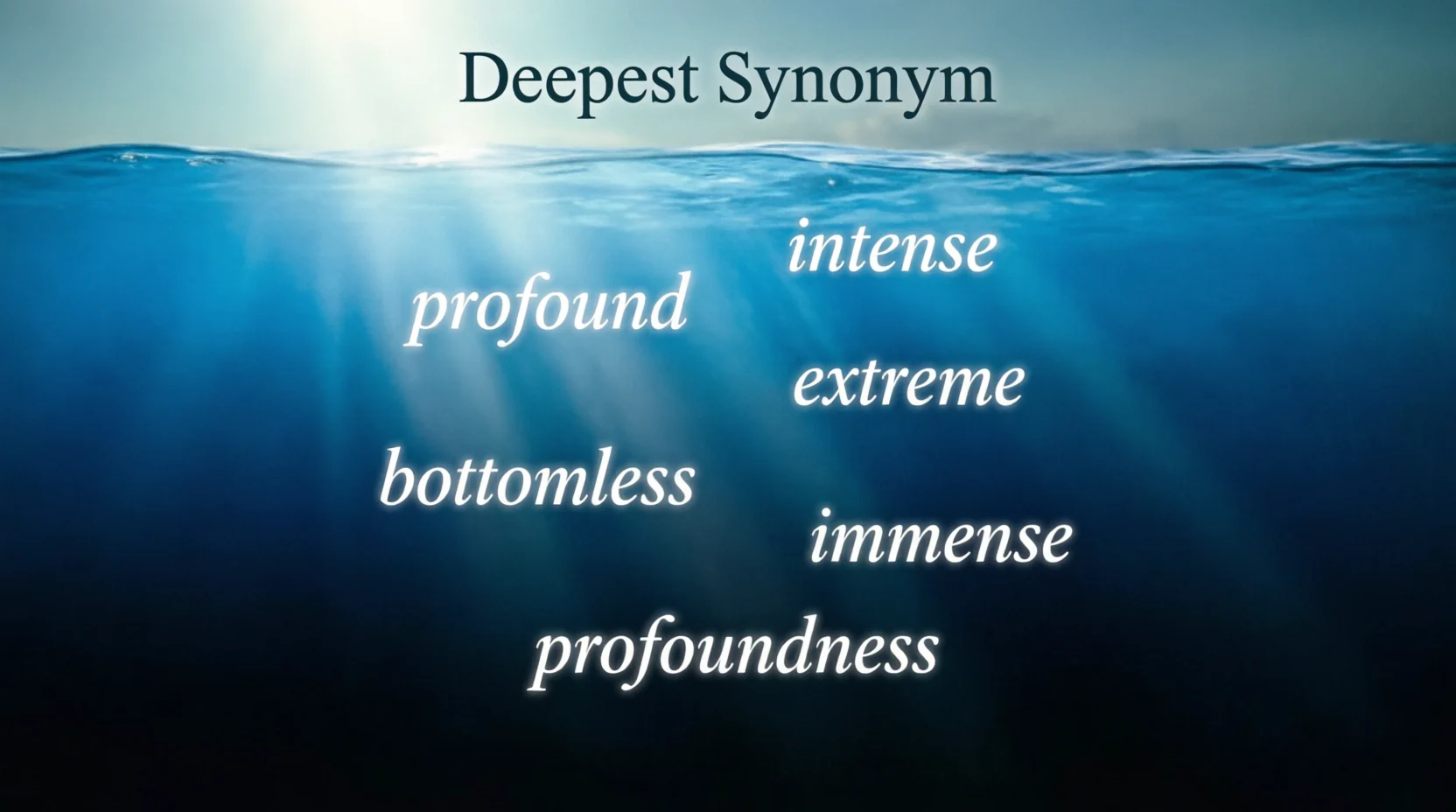
Finding the right deepest synonym depends on what you mean by “deepest.” You may be describing great physical depth, intense feelings, profound ideas, strong concentration, or the most extreme level of something. Words such as profound, profoundest, lowest, innermost, most intense, bottomless, and extreme can work in different contexts. The best choice depends on the sentence and the exact meaning you want to express.
Quick Answer
The best synonym for deepest is often profoundest when you mean the greatest intellectual or emotional depth. However, lowest works for physical position, innermost for location or feelings, most intense for emotions or experiences, and most profound for ideas or meaning.
Examples
- Deepest thought → most profound thought
- Deepest part of the ocean → lowest part of the ocean
- Deepest feelings → most intense feelings
- Deepest secret → innermost secret
- Deepest respect → profoundest respect
What Does “Deepest” Mean?
Deepest is the superlative form of deep, meaning “having the greatest depth, intensity, seriousness, or extent.”
The word can describe both literal and figurative ideas.
Physical Meaning
When talking about physical distance from the surface, deepest means being at the greatest depth.
Example:
“The submarine reached the deepest part of the ocean.”
Emotional Meaning
When describing feelings, deepest can mean the strongest or most powerful.
Example:
“She expressed her deepest gratitude.”
Intellectual Meaning
When describing ideas, thoughts, or understanding, deepest can mean the most profound or thoughtful.
Example:
“He asked one of the deepest questions of the discussion.”
Personal or Hidden Meaning
Deepest can also describe something far inside a person’s mind or feelings.
Example:
“Her deepest fears remained private.”
30 Synonyms for Deepest
The following alternatives are useful, but they are not interchangeable in every sentence. Each carries a slightly different meaning or tone.
1. Profoundest
Simple meaning: Having the greatest depth of thought, meaning, or feeling.
Example: “That was his profoundest observation about human nature.”
Best usage/context: Serious ideas, wisdom, emotions, philosophy, and intellectual discussions.
2. Most profound
Simple meaning: The deepest in meaning, thought, or significance.
Example: “Her most profound insight changed the way I viewed the problem.”
Best usage/context: Formal writing, academic discussions, reflections, and important ideas.
3. Lowest
Simple meaning: At the greatest distance below a particular level.
Example: “The divers reached the lowest point of the cave.”
Best usage/context: Physical depth, positions, levels, and measurements.
4. Innermost
Simple meaning: Furthest inside.
Example: “He finally revealed his innermost feelings.”
Best usage/context: Emotions, thoughts, secrets, places, and private experiences.
5. Most intense
Simple meaning: Having the strongest force or feeling.
Example: “She experienced the most intense sadness of her life.”
Best usage/context: Emotions, experiences, sensations, conflicts, and reactions.
6. Most meaningful
Simple meaning: Having the greatest importance or significance.
Example: “That was the most meaningful conversation we had.”
Best usage/context: Relationships, experiences, conversations, memories, and personal reflections.
7. Most serious
Simple meaning: Having the greatest importance or gravity.
Example: “They discussed the most serious problems facing the community.”
Best usage/context: Problems, situations, consequences, responsibilities, and concerns.
8. Most significant
Simple meaning: Having the greatest importance or effect.
Example: “This was the most significant discovery of the decade.”
Best usage/context: Academic, professional, historical, and analytical writing.
9. Most extreme
Simple meaning: Reaching the greatest degree or limit.
Example: “The experiment tested the material under the most extreme conditions.”
Best usage/context: Conditions, situations, behaviors, measurements, and limits.
10. Farthest
Simple meaning: At the greatest distance.
Example: “The hikers traveled to the farthest point of the trail.”
Best usage/context: Physical distance, locations, journeys, and spatial relationships.
11. Furthest
Simple meaning: At or to the greatest extent or distance.
Example: “This argument takes the discussion furthest.”
Best usage/context: Distance, progress, development, and abstract extent.
12. Most penetrating
Simple meaning: Showing unusually deep understanding or insight.
Example: “She offered the most penetrating analysis of the issue.”
Best usage/context: Analysis, criticism, observations, questions, and intellectual writing.
13. Most insightful
Simple meaning: Showing the greatest ability to understand something clearly.
Example: “His most insightful comments came at the end of the discussion.”
Best usage/context: Opinions, observations, analysis, discussions, and essays.
14. Most thoughtful
Simple meaning: Showing the greatest amount of careful thought.
Example: “Her most thoughtful response addressed everyone’s concerns.”
Best usage/context: Comments, responses, decisions, writing, and personal communication.
15. Most serious-minded
Simple meaning: Showing the strongest focus on important matters.
Example: “His most serious-minded work explored questions of morality.”
Best usage/context: People, writing, discussions, and intellectual subjects.
16. Bottommost
Simple meaning: Located at the very bottom.
Example: “The bottommost layer contained the oldest material.”
Best usage/context: Physical positions, layers, structures, and technical descriptions.
17. Deep-seated
Simple meaning: Existing strongly and for a long time.
Example: “The disagreement came from deep-seated fears.”
Best usage/context: Beliefs, fears, attitudes, conflicts, habits, and emotions.
18. Rooted
Simple meaning: Firmly established at a deep level.
Example: “The tradition is deeply rooted in local history.”
Best usage/context: Beliefs, traditions, customs, problems, and cultural ideas.
19. Fundamental
Simple meaning: Basic and extremely important.
Example: “The discussion raised the most fundamental questions about justice.”
Best usage/context: Principles, questions, concepts, systems, and beliefs.
20. Ultimate
Simple meaning: Existing at the greatest or final level.
Example: “The ultimate goal was to create a lasting solution.”
Best usage/context: Goals, purposes, results, limits, and abstract concepts.
21. Absolute
Simple meaning: Complete and unrestricted.
Example: “She had absolute confidence in her decision.”
Best usage/context: Certainty, freedom, authority, confidence, and extreme degrees.
22. Complete
Simple meaning: Whole or lacking nothing.
Example: “He experienced complete silence in the remote valley.”
Best usage/context: States, conditions, silence, understanding, and completion.
23. Thorough
Simple meaning: Covering something carefully and completely.
Example: “The researcher conducted the most thorough investigation possible.”
Best usage/context: Research, investigations, explanations, reviews, and examinations.
24. Extensive
Simple meaning: Covering a large amount or area.
Example: “The report provides the most extensive analysis of the subject.”
Best usage/context: Research, studies, knowledge, reports, areas, and collections.
25. Far-reaching
Simple meaning: Having effects that extend widely.
Example: “The decision had far-reaching consequences.”
Best usage/context: Decisions, policies, changes, effects, and consequences.
26. All-encompassing
Simple meaning: Including almost everything within its scope.
Example: “The book offers an all-encompassing examination of the subject.”
Best usage/context: Ideas, explanations, studies, systems, and broad discussions.
27. Inmost
Simple meaning: Furthest inside or most private.
Example: “She shared her inmost thoughts with her closest friend.”
Best usage/context: Thoughts, feelings, secrets, and personal experiences.
28. Abysmal
Simple meaning: Extremely low or extremely bad.
Example: “The team’s performance reached an abysmal level.”
Best usage/context: Very low quality, conditions, performance, or states. It is usually negative.
29. Bottomless
Simple meaning: Seemingly without an end or bottom.
Example: “He seemed to possess a bottomless supply of patience.”
Best usage/context: Figurative descriptions of resources, emotions, patience, knowledge, or physical depth.
30. Boundless
Simple meaning: Without limits or boundaries.
Example: “She showed boundless enthusiasm for the project.”
Best usage/context: Love, enthusiasm, energy, imagination, possibility, and other limitless qualities.
Deepest Synonyms Comparison Table
| Synonym | Main Meaning | Common Context | Tone |
|---|---|---|---|
| Profoundest | Greatest intellectual or emotional depth | Ideas, feelings | Formal |
| Most profound | Greatest depth of meaning | Ideas, reflections | Formal |
| Lowest | Greatest physical depth | Places, levels | Neutral |
| Innermost | Furthest inside | Feelings, thoughts | Neutral |
| Most intense | Greatest strength | Emotions, experiences | Neutral |
| Most meaningful | Greatest significance | Experiences, relationships | Neutral |
| Most serious | Greatest importance | Problems, situations | Neutral |
| Most significant | Greatest importance or effect | Research, history | Formal |
| Most extreme | Greatest degree | Conditions, behavior | Neutral |
| Farthest | Greatest physical distance | Places, journeys | Neutral |
| Furthest | Greatest distance or extent | Distance, progress | Neutral |
| Most penetrating | Greatest analytical depth | Analysis, questions | Formal |
| Most insightful | Greatest understanding | Ideas, comments | Neutral |
| Most thoughtful | Greatest care in thinking | Responses, decisions | Neutral |
| Deep-seated | Firmly established | Beliefs, fears | Neutral |
| Rooted | Firmly established | Traditions, beliefs | Neutral |
| Fundamental | Basic and essential | Principles, concepts | Formal |
| Ultimate | Final or greatest | Goals, purposes | Formal |
| Thorough | Complete and detailed | Research, investigation | Neutral |
| Extensive | Large in scope | Research, reports | Formal |
| Far-reaching | Having broad effects | Decisions, changes | Formal |
| All-encompassing | Including nearly everything | Studies, explanations | Formal |
| Inmost | Most private or internal | Feelings, thoughts | Literary |
| Bottomless | Without apparent limit | Resources, emotions | Figurative |
| Boundless | Without limits | Love, enthusiasm | Positive |
| Abysmal | Extremely low or bad | Quality, performance | Negative |
How to Choose the Right Synonym for “Deepest”
The best alternative depends on what kind of depth you are describing.
For Physical Depth
Use lowest, bottommost, or sometimes deepest itself.
- deepest part of the lake
- lowest point of the valley
- bottommost layer of the structure
Example:
“The researchers reached the lowest section of the underground chamber.”
For Emotional Depth
Use most intense, innermost, inmost, or deep-seated.
- deepest feelings → innermost feelings
- deepest fear → deep-seated fear
- deepest sadness → most intense sadness
These alternatives make the specific emotional meaning clearer.
For Intellectual Depth
Use most profound, profoundest, most insightful, or most penetrating.
Example:
“Her most profound observation concerned the nature of human identity.”
For Importance
Use most significant, most meaningful, most serious, or fundamental.
Example:
“This was the most significant discovery in the study.”
For Great Extent
Use most extensive, far-reaching, or all-encompassing.
Example:
“The new evidence led to far-reaching changes.”
For Limitless Qualities
Use boundless or bottomless.
Example:
“His boundless curiosity encouraged him to keep learning.”
Deepest vs. Profoundest
Deepest is broader and can describe physical depth, feelings, thoughts, or intensity.
Profoundest is mainly figurative. It usually refers to thoughts, ideas, emotions, wisdom, or meaning.
Compare:
- “The deepest part of the ocean.” ✓
- “The profoundest part of the ocean.” ✗
But:
- “Her deepest thoughts.” ✓
- “Her profoundest thoughts.” ✓
The second sentence sounds more formal and literary.
Deepest vs. Most Intense
These words overlap when describing emotions, but they emphasize different qualities.
Deepest often suggests emotional depth, significance, or something deeply personal.
Most intense emphasizes strength.
- “He expressed his deepest gratitude.”
- “She experienced the most intense pain.”
The first focuses on profound personal feeling, while the second focuses on emotional or physical strength.
Deepest vs. Innermost
Innermost specifically means “furthest inside.”
It works particularly well with private thoughts, feelings, beliefs, and secrets.
- deepest feelings → innermost feelings
- deepest thoughts → innermost thoughts
- deepest secret → innermost secret
However, innermost does not normally replace deepest when discussing physical depth.
Deepest vs. Lowest
These words can overlap when discussing physical depth, but they are not always interchangeable.
Deepest describes the greatest distance downward from a surface or starting point.
Lowest describes the smallest vertical position or level.
For example:
- “the deepest part of the ocean”
- “the lowest point in the valley”
In many contexts, deepest sounds more natural when discussing water, holes, or underground spaces.
Common Mistakes When Using Synonyms for Deepest
1. Using “profound” for physical depth
Incorrect:
“The profoundest part of the swimming pool.”
Better:
“The deepest part of the swimming pool.”
Profound generally refers to figurative depth rather than physical measurement.
2. Using “lowest” for emotional depth
You would not normally say:
“She expressed her lowest gratitude.”
Instead, say:
“She expressed her deepest gratitude.”
3. Treating every synonym as interchangeable
Synonyms often share a basic idea but differ in context, tone, and grammatical usage.
For example, boundless means “without limits,” while innermost means “furthest inside.” Neither is a universal replacement for deepest.
4. Using “abysmal” as a positive synonym
Abysmal can suggest an extreme degree, but it is generally negative.
For example:
“The service was abysmal.”
It does not normally mean that something has profound emotional or intellectual depth.
5. Confusing “farthest” and “furthest”
Both can express great distance or extent. Farthest is especially common for physical distance, while furthest is also frequently used for abstract progress or extent.
FAQs:
What is the best synonym for deepest?
There is no single synonym that works in every situation. Most profound is useful for ideas and feelings, lowest for physical position, and innermost for private thoughts or emotions.
What is a synonym for deepest feelings?
Good alternatives include innermost feelings, inmost feelings, and most intense feelings. The best choice depends on whether you want to emphasize privacy, emotional depth, or intensity.
What is another word for deepest thought?
Most profound thought, most insightful thought, and most penetrating thought are useful alternatives.
What is a synonym for deepest meaning?
Most profound meaning, greatest significance, or ultimate meaning can work depending on the sentence.
What is the opposite of deepest?
The opposite depends on context. For physical depth, shallowest is usually the clearest opposite. For figurative depth, words such as superficial or surface-level may work.
Is “profoundest” a correct word?
Yes. Profoundest is the superlative form of profound. However, most profound is often more natural in modern English, especially in everyday and formal prose.
What is a synonym for deepest secret?
Innermost secret is a close alternative. Most private secret can also work when the emphasis is on privacy rather than emotional depth.
Can “deepest” mean “most important”?
Sometimes. Expressions such as deepest concern, deepest respect, and deepest significance can communicate strong importance or feeling. However, most significant or most important may be clearer when importance is the main idea.
Conclusion
The word deepest has several meanings, so the best synonym depends on the context. For physical depth, choose lowest or bottommost. For emotions, consider most intense, innermost, or inmost. For ideas and intellectual meaning, most profound, profoundest, most insightful, and most penetrating are strong choices.
Understanding these differences helps you make your writing more precise. Instead of replacing deepest automatically, identify the kind of depth you mean first—physical, emotional, intellectual, personal, or figurative—and then select the word that communicates that meaning most naturally.

I am Camden Thomas, an Administrator at SaysReply. I help maintain our platform and ensure readers find clear, natural, and useful alternative ways to express their thoughts every day.