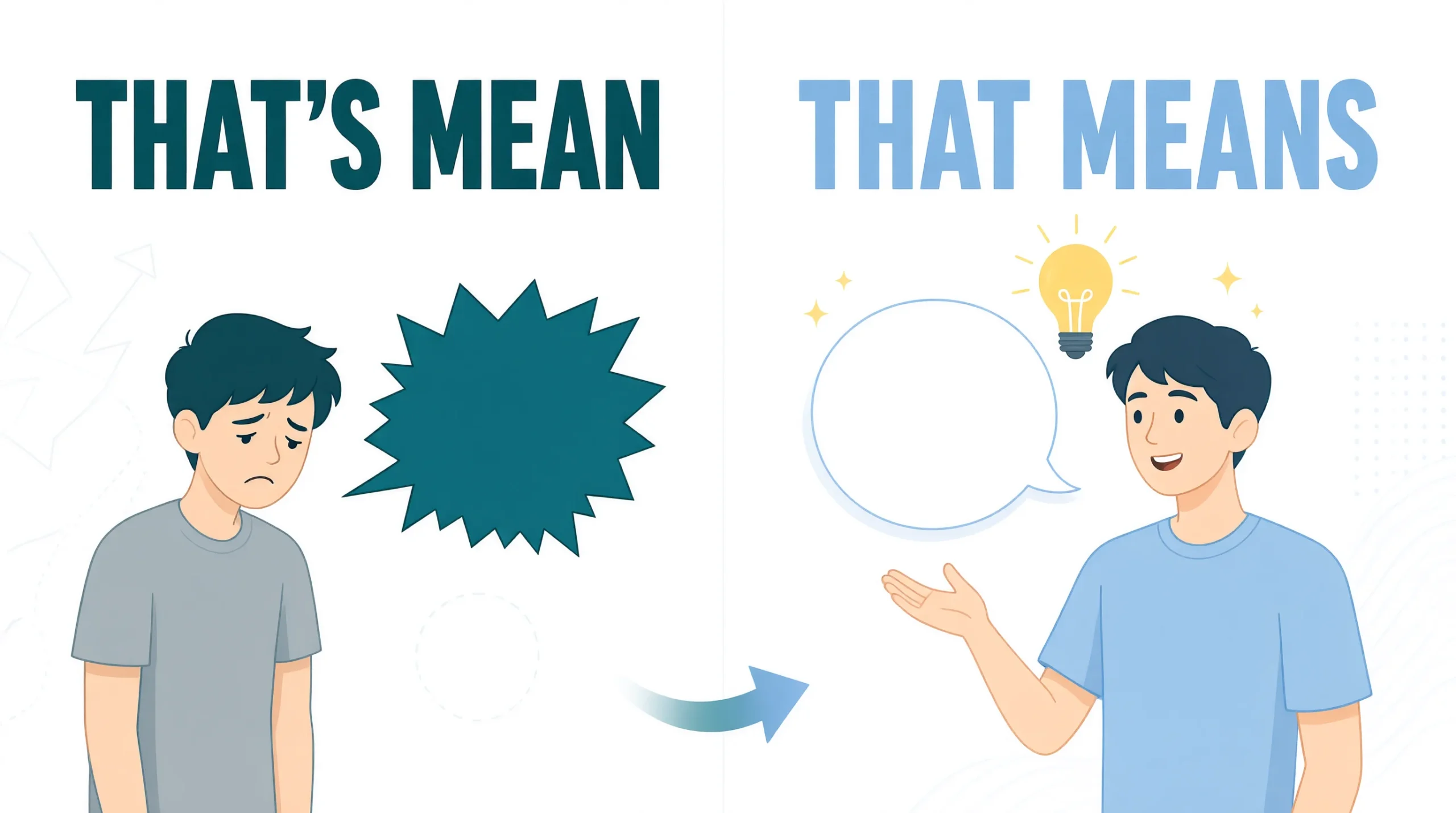
Have you ever wondered if to write “that’s mean” or “that means”? Although these phrases look and sound similar, they have different meanings and uses. Choosing the correct expression depends on what you want to say. “That’s mean” usually describes someone’s unkind behavior, while “that means” explains the meaning, result, or consequence of something.
For example, you might say, “That’s mean!” when someone makes a hurtful comment. However, you would say, “That means we need to leave early” when explaining the result of a situation. Understanding this small grammatical difference can help you write clearer sentences, speak more naturally, and avoid common English mistakes. Both expressions are correct, but they are not interchangeable. In this guide, you will learn their meanings, grammatical structures, differences, and everyday uses through simple explanations and practical examples.
Quick Answer
“That’s mean” means that something is unkind, cruel, or hurtful. “That means” explains what something signifies or what result follows from it. Use “that’s mean” to describe unkind behavior and “that means” to explain an idea, fact, or consequence. The correct choice depends on your intended meaning.
Why Do People Confuse “That’s Mean” and “That Means”?
People often confuse these expressions because they sound almost identical in everyday speech. The word “that’s” is a contraction of “that is,” while “means” is the third-person singular form of the verb “mean.”
The confusion becomes easier to understand when you look at their grammatical structures:
- That’s mean = That is mean. Here, “mean” is an adjective describing something unkind.
- That means = That signifies or results in. Here, “means” is a verb explaining the significance or consequence of something.
Compare these sentences:
- “That’s mean of you.” This describes someone’s unkind behavior.
- “That means you were right.” This explains the conclusion drawn from a situation.
Remember that the words may sound similar, but their meanings and grammatical functions are different.
What Does “That’s Mean” Mean?
“That’s mean” is a shortened form of “that is mean.” It describes an action, comment, or behavior that is unkind, insensitive, or hurtful.
In this expression, “that’s” means “that is,” and “mean” is an adjective.
Examples of “That’s Mean”
- “That’s mean of him to laugh at her mistake.”
- “You took her book without asking? That’s mean!”
- “That’s mean to say about someone who is trying their best.”
- “Making fun of his appearance is mean.”
- “That’s mean of you to exclude your friend from the group.”
The phrase is commonly used in casual conversations, especially when reacting to someone’s behavior.
Is “That’s Mean” Grammatically Correct?
Yes, “that’s mean” is grammatically correct when you use “mean” to describe unkind behavior.
For example:
“That’s mean of you to ignore her.”
The sentence uses “that’s” as a contraction of “that is.” The adjective “mean” describes the behavior being discussed.
However, do not confuse this meaning of “mean” with its other uses, such as “to signify” or “to intend.”
What Does “That Means” Mean?
“That means” is used to explain the significance, interpretation, or result of something. It often introduces a conclusion based on information, an event, or a situation.
In this expression, “means” is a verb. It can be replaced by phrases such as “signifies,” “indicates,” or “results in,” depending on the context.
Examples of “That Means”
- “The store is closed. That means we must come back tomorrow.”
- “You passed the test. That means you can move to the next level.”
- “She has not replied. That means she might be busy.”
- “The road is wet. That means it probably rained.”
- “You finished all your work. That means you can relax.”
“That means” is useful in conversations, academic writing, explanations, instructions, and everyday problem-solving.
Is “That Means” Grammatically Correct?
Yes. “That means” is grammatically correct when you explain what a situation, statement, or fact signifies.
For example:
“If the train is delayed, that means we will arrive late.”
Here, “means” connects the condition with its likely consequence.
“That’s Mean” vs. “That Means”: Comparison Table
| Feature | That’s Mean | That Means |
| Full form | That is mean | That means |
| Main function | Describes unkindness | Explains meaning or consequence |
| Part of speech | “Mean” is an adjective | “Means” is a verb |
| Typical context | Hurtful actions or comments | Explanations and conclusions |
| Example | “That’s mean of you.” | “That means we are late.” |
| Similar expression | “That is unkind.” | “That signifies…” |
The simplest distinction is that “that’s mean” describes unkindness, while “that means” explains something.
When Should You Use Each Expression?
Choose the expression that matches the purpose of your sentence.
Use “That’s Mean” When Describing Unkindness
Use “that’s mean” when you want to criticize or comment on something hurtful, unfair, or insensitive.
Examples:
- “That’s mean of you to spread rumors.”
- “Laughing at someone who is struggling is mean.”
- “That’s mean! He worked hard on that project.”
You can also use “that is unkind” as a more formal alternative.
Use “That Means” When Explaining Something
Use “that means” when interpreting information, clarifying a statement, or describing a result.
Examples:
- “The deadline is today. That means we must finish now.”
- “He has a fever. That means he may be sick.”
- “Your answer is correct. That means you understood the lesson.”
You can often replace “that means” with “that indicates” or “that implies,” depending on the sentence.
12 Examples of “That’s Mean” vs. “That Means”
These examples show how changing one expression can change the meaning of a sentence.
| That’s Mean | That Means |
| “That’s mean of you to laugh at her.” | “That means she is upset.” |
| “That’s mean to say to a child.” | “That means the child needs help.” |
| “Ignoring your friend is mean.” | “That means your friend may feel ignored.” |
| “That’s mean of him to spread rumors.” | “That means the rumors could cause problems.” |
| “That’s mean! She did nothing wrong.” | “That means she deserves an apology.” |
| “Making fun of others is mean.” | “That means you should be more considerate.” |
| “That’s mean of them to exclude you.” | “That means you may need new friends.” |
| “That’s mean to criticize her appearance.” | “That means appearance should not define someone’s worth.” |
| “That’s mean of you to break your promise.” | “That means I cannot rely on your promise.” |
| “That’s mean to mock someone’s mistake.” | “That means everyone should be allowed to learn.” |
| “That’s mean of him to take credit for your work.” | “That means he may not be giving you proper recognition.” |
| “That’s mean! You hurt her feelings.” | “That means you should apologize.” |
Notice that “that’s mean” expresses a judgment about behavior, whereas “that means” draws an explanation or conclusion.
Common Mistakes to Avoid
Even fluent English speakers sometimes confuse these expressions when speaking quickly or writing informal messages.
Mistake 1: Using “That’s Mean” to Explain a Result
Incorrect: “The bus is late. That’s mean we will arrive late.”
Correct: “The bus is late. That means we will arrive late.”
Use “that means” when you are explaining a consequence.
Mistake 2: Using “That Means” to Describe Unkind Behavior
Incorrect: “You laughed at her mistake. That means!”
Correct: “You laughed at her mistake. That’s mean!”
The second sentence expresses disapproval of the behavior.
Mistake 3: Forgetting the Full Form of “That’s”
Remember that “that’s” can mean “that is” or “that has,” depending on the context. In “that’s mean,” it means “that is.”
You cannot expand “that means” into “that is means.” The word “means” is already the main verb.
Mistake 4: Assuming “Mean” Always Describes Unkindness
The word “mean” has several meanings. It can describe unkind behavior, refer to the mathematical average, or express what a word or statement signifies.
For example:
- “That’s mean.” = That is unkind.
- “What does this word mean?” = What does this word signify?
- “The mean of 4 and 8 is 6.” = The mathematical average is 6.
Always consider the surrounding sentence.
Memory Trick: How to Remember the Difference
Use this simple memory trick:
Mean = unkind. Means = explains.
- If you are talking about rude or hurtful behavior, choose “that’s mean.”
- If you are explaining information or a result, choose “that means.”
Think of these examples:
“That’s mean!” — Someone said something hurtful.
“That means we should leave.” — You are explaining what a situation requires.
You can also check the sentence by replacing the expression:
- If “that is unkind” makes sense, use “that’s mean.”
- If “that signifies” or “that results in” makes sense, use “that means.”
This quick substitution test will help you choose the correct phrase in most everyday situations.
American vs. British English
There is no meaningful difference between American and British English in the standard use of “that’s mean” and “that means.” Both expressions are grammatically correct in both varieties.
| Expression | American English | British English |
| That’s mean | Correct | Correct |
| That means | Correct | Correct |
| That is unkind | Correct | Correct |
| That signifies | Correct | Correct |
The choice depends on meaning rather than regional spelling or grammar.
In both varieties, “that’s mean” commonly describes unkind behavior, while “that means” introduces an explanation or conclusion.
Similar Words and Expressions
Several expressions can replace “that’s mean” or “that means,” but the best alternative depends on the context.
Alternatives to “That’s Mean”
- That’s unkind: A clear, slightly more formal way to criticize behavior.
- That’s cruel: Stronger language for behavior that causes significant hurt.
- That’s rude: Appropriate for impolite or disrespectful behavior.
- That’s insensitive: Useful when someone ignores another person’s feelings.
- That’s hurtful: Emphasizes the emotional impact of an action or comment.
Example: “That’s insensitive to say when she is having a difficult day.”
Alternatives to “That Means”
- That signifies: Emphasizes the meaning or importance of something.
- That indicates: Suggests that evidence points toward a conclusion.
- That implies: Expresses an indirect meaning or suggestion.
- That suggests: Introduces a possible interpretation.
- That results in: Emphasizes a consequence or outcome.
Example: “The dark clouds indicate that rain may be coming.”
These alternatives are not always interchangeable. Choose the one that best matches the intended meaning and level of certainty.
Final Verdict: Which One Is Correct?
Both “that’s mean” and “that means” are correct English expressions, but they serve different purposes.
Use “that’s mean” when describing something unkind, hurtful, or cruel. Use “that means” when explaining the meaning of information or the result of a situation.
For example:
- “That’s mean of you to laugh at him.” — Describes unkind behavior.
- “He is crying. That means he may be upset.” — Explains a possible reason or interpretation.
The best way to avoid confusion is to identify whether you are describing behavior or explaining information before choosing your words.
FAQs:
1. Is it “that’s mean” or “that means”?
Both are correct. “That’s mean” means that something is unkind, while “that means” explains what something signifies or what result follows.
2. What does “that’s mean” mean in a conversation?
“That’s mean” is a way to express disapproval of an unkind or hurtful action. For example, “That’s mean of you to make fun of him” criticizes the behavior.
3. What does “that means” mean in simple English?
“That means” explains what something tells you or what happens as a result. For example, “The shop is closed. That means we cannot buy anything there right now.”
4. Is “that’s mean” grammatically correct?
Yes. “That’s mean” is a contraction of “that is mean.” The adjective “mean” describes behavior that is unkind or hurtful.
5. Can I use “that means” to explain a consequence?
Yes. “That means” frequently introduces a consequence or conclusion. For example, “You missed the bus. That means you will need another way to get to school.”
6. Is “that’s mean” the same as “that means”?
No. “That’s mean” describes unkindness, whereas “that means” explains significance or consequence. They have different grammatical structures and cannot usually replace each other.
7. What is another way to say “that’s mean”?
Depending on the context, you can say “that’s unkind,” “that’s cruel,” “that’s rude,” or “that’s hurtful.” Each expression communicates disapproval, but some are stronger than others.
Remember This
- That’s mean = That is unkind.
- That means = That signifies or explains something.
- Use “that’s mean” to describe hurtful behavior.
- Use “that means” to explain information, a conclusion, or a consequence.
- Both expressions are correct in American and British English.
Conclusion
Understanding the difference between “that’s mean” and “that means” is simple once you recognize their grammatical roles. Although the expressions sound similar, one describes unkind behavior and the other explains the meaning or result of something. Learning this distinction will help you avoid common writing mistakes and communicate more clearly.
Whenever you are unsure, check what you want to express. If you are criticizing an unkind action, use “that’s mean.” If you are explaining what a fact or situation signifies, use “that means.” With a little practice, you will be able to choose the correct expression naturally in everyday conversations, schoolwork, and professional writing.

I’m Amelia Rose, an enthusiastic writer who enjoys exploring better, clearer, and more natural ways to express ideas. I create helpful content that makes finding alternative phrases simple, useful, and enjoyable for everyone.