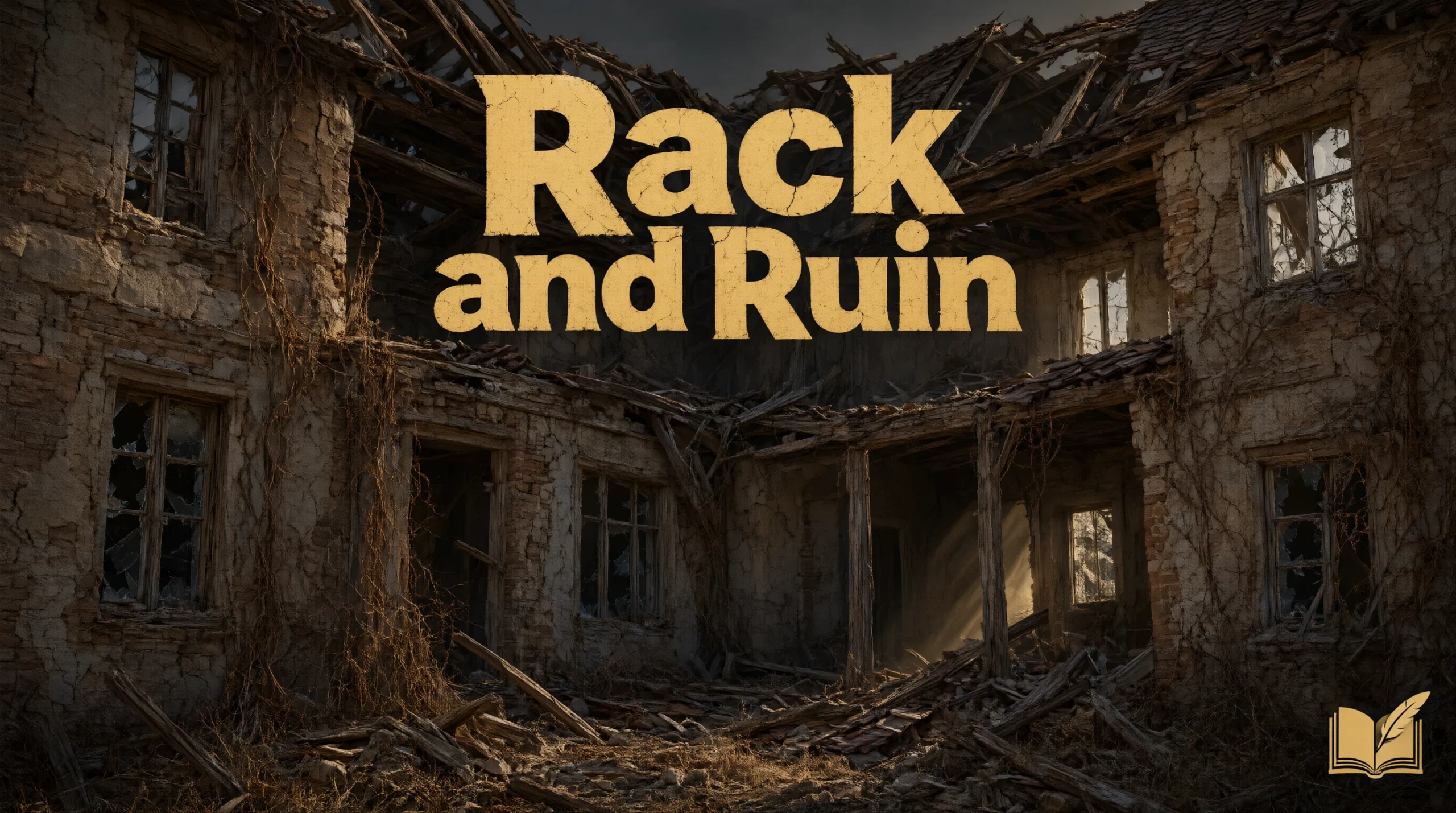
The phrase “rack and ruin” describes a state of serious damage, decline, or destruction. It is commonly used when a building, business, relationship, or situation becomes badly damaged or falls into a state of neglect. For example, you might say, “The old farmhouse fell into rack and ruin after years without repairs.” The expression paints a picture of something that was once in good condition but has gradually deteriorated.
Understanding the meaning of rack and ruin helps you use this traditional English expression naturally in writing and conversation. It often appears in books, news stories, historical descriptions, and everyday discussions about things that have been neglected or allowed to deteriorate.
Although the phrase contains two words, it functions as a single idiomatic expression. Its meaning is not simply the combined dictionary meaning of “rack” and “ruin.” Instead, the complete phrase communicates severe deterioration, disorder, or destruction. Learning its meaning, correct usage, and example sentences will help you recognize it and understand when it is appropriate to use.
Quick Answer
Rack and ruin means a condition of severe damage, decay, or deterioration. The expression is often used to describe buildings, businesses, relationships, or other things that have been neglected or destroyed over time. For example, “Without maintenance, the property fell into rack and ruin.”
Why Do People Confuse “Rack and Ruin”?
People sometimes find this expression confusing because the word “rack” has several meanings in English. It can refer to a frame used for holding objects, a device for stretching something, or a verb meaning to cause strain or distress.
The word “ruin,” meanwhile, refers to destruction, serious damage, or the remains of something that has been destroyed.
When these words appear together in “rack and ruin,” they form an established idiom. The phrase describes a state of serious deterioration rather than two separate actions.
Another source of confusion is the similar expression “wreak havoc.” Although both expressions can describe destructive situations, they are not interchangeable in every sentence.
First Word: What Does “Rack” Mean?
The word rack has several meanings depending on the context.
As a noun, it can refer to a structure used to hold or store items, such as a coat rack or a luggage rack. As a verb, it can mean to strain, torment, or cause distress.
In the expression “rack and ruin,” the word has a historical and idiomatic role. Its meaning should not be interpreted simply as a storage frame or any other modern standalone definition.
Examples of “Rack”
- She placed her coat on the rack.
- The detective tried to rack his brain for answers.
- The old shelves were damaged beyond repair.
These examples demonstrate ordinary uses of “rack.” In the idiom “rack and ruin,” however, the complete expression carries a different, established meaning.
Second Word: What Does “Ruin” Mean?
The word ruin means severe damage, destruction, or the loss of something’s original condition or value.
It can be used as a noun or a verb. As a noun, it describes destruction or the remains of something damaged. As a verb, it means to destroy, spoil, or seriously damage something.
Examples of “Ruin”
- The storm left the garden in ruins.
- Poor planning could ruin the entire project.
- The ancient ruins attract visitors every year.
In “rack and ruin,” the word “ruin” reinforces the idea of serious deterioration or destruction. Together, the two words form an idiom that describes a badly damaged or neglected condition.
Rack and Ruin vs. Related Expressions: Comparison Table
| Expression | Meaning | Example |
| Rack and ruin | Severe deterioration or destruction | The empty house fell into rack and ruin. |
| Ruin | Destruction or serious damage | The fire caused the ruin of the building. |
| Wreak havoc | Cause widespread damage or disruption | The storm wreaked havoc across the town. |
| Fall apart | Break down or lose its structure | The old chair began to fall apart. |
| Go to waste | Be unused or wasted | The fresh food went to waste. |
| In disrepair | In poor condition because of damage or neglect | The bridge is in disrepair. |
| Run-down | In poor condition, often because of age or neglect | They bought a run-down cottage. |
When Should You Use “Rack and Ruin”?
Use “rack and ruin” when you want to describe something that has deteriorated badly or fallen into a state of neglect.
It is especially suitable for descriptive writing, storytelling, and discussions about long-term decline.
1. Describing an Old Building
Use the phrase when a building has become damaged or neglected.
Example: “The abandoned mansion fell into rack and ruin after its owners moved away.”
2. Describing a Business
The expression can describe a business that has declined because of poor management, neglect, or financial difficulties.
Example: “Years of mismanagement brought the family business to rack and ruin.”
3. Describing a Garden or Property
It can refer to land or outdoor spaces that have become overgrown or poorly maintained.
Example: “Without regular care, the beautiful garden was left in rack and ruin.”
4. Describing a Relationship or Situation
The phrase can be used figuratively to describe the serious deterioration of a relationship, organization, or plan.
Example: “Constant arguments brought their once-strong partnership to rack and ruin.”
12 Examples of “Rack and Ruin” in Sentences
Here are twelve examples showing how the expression works in different contexts.
- Building: The abandoned factory fell into rack and ruin after production stopped.
- House: The old family home was left to rack and ruin for decades.
- Business: Poor decisions brought the once-successful company to rack and ruin.
- Garden: The neglected garden had gone to rack and ruin by the end of summer.
- Farm: Without anyone to manage it, the farm fell into rack and ruin.
- Relationship: Years of mistrust brought their relationship to rack and ruin.
- Organization: A lack of leadership allowed the organization to fall into rack and ruin.
- Historic property: The castle stood in rack and ruin until restoration work began.
- Project: Poor planning threatened to bring the entire project to rack and ruin.
- Community: The closure of major employers contributed to the town’s decline and eventual rack and ruin.
- Equipment: The unused machinery was left to fall into rack and ruin in the old workshop.
- Figurative use: Neglect and careless management brought the once-thriving estate to rack and ruin.
These examples show that the expression can describe both physical deterioration and figurative decline. In many cases, it suggests that damage developed over time because something was neglected or poorly managed.
Common Mistakes When Using “Rack and Ruin”
Although the expression is straightforward once understood, several mistakes are worth avoiding.
Mistake 1: Interpreting the Words Separately
The phrase does not usually refer to a rack followed by a separate act of destruction.
Incorrect interpretation: A rack and some ruined objects.
Correct interpretation: A state of severe deterioration or destruction.
Mistake 2: Using It for Minor Damage
The expression generally suggests substantial deterioration, not a small scratch or a minor repair.
Instead of saying, “My new pen is in rack and ruin,” say, “My pen is damaged.”
Mistake 3: Confusing It With “Wreak Havoc”
“Rack and ruin” describes a condition of deterioration or destruction. “Wreak havoc” describes causing serious damage, disruption, or confusion.
Example: “The storm wreaked havoc on the town, leaving several buildings in rack and ruin.”
Both expressions can appear in the same sentence, but they perform different functions.
Mistake 4: Using It in Every Casual Conversation
The expression is correct in modern English, but it can sound literary or traditional. In casual conversation, phrases such as “fall apart,” “be badly damaged,” or “be in terrible condition” may sound more natural.
Memory Trick: How to Remember “Rack and Ruin”
A simple way to remember “rack and ruin” is to picture an old house with a damaged roof, broken windows, crumbling walls, and an overgrown garden.
The entire property has deteriorated because nobody has looked after it.
Remember this association:
Rack and ruin = severe deterioration + neglect or destruction.
You can also connect “ruin” with something destroyed or badly damaged. When you see “rack and ruin,” think of the overall condition of something that has fallen into serious disrepair.
Is “Rack and Ruin” American or British English?
“Rack and ruin” is understood in both British and American English. It is not exclusive to either variety, although its traditional, somewhat literary tone may make it more noticeable in formal writing, historical accounts, and descriptive prose.
| Feature | British English | American English |
| Meaning | Severe deterioration or destruction | Severe deterioration or destruction |
| Correctness | Correct | Correct |
| Typical tone | Traditional or literary | Traditional or literary |
| Common alternative | Fall into disrepair | Fall apart or fall into disrepair |
The expression does not have a different fundamental meaning in British and American English. The main difference is often stylistic preference: speakers may choose simpler alternatives in everyday conversation.
Similar Words and Expressions
Several English expressions convey meanings similar to “rack and ruin,” but each has a slightly different emphasis.
- Disrepair: A poor condition caused by damage or lack of maintenance.
- Decay: The gradual deterioration of something over time.
- Deterioration: A decline in quality, condition, or effectiveness.
- Destruction: The act or result of damaging something severely.
- Ruination: The process or result of bringing something to ruin.
- Neglect: Failure to provide necessary care or attention.
- Fall apart: To break into pieces or stop functioning properly.
- Go to seed: To become neglected or lose a former standard of quality.
- Wreak havoc: To cause widespread damage or disruption.
- Go downhill: To become worse in quality, condition, or performance.
For example, “The building is in disrepair” is a relatively neutral description. “The building has fallen into rack and ruin” is more vivid and emphasizes the extent of its deterioration.
Final Verdict: What Does “Rack and Ruin” Mean?
“Rack and ruin” is an established English idiom meaning severe deterioration, damage, or destruction. It is often used for buildings, businesses, gardens, relationships, and other things that have declined because of neglect, poor management, or damaging circumstances.
The expression is correct in both British and American English. Although it may sound traditional or literary, it remains useful when you want to describe a serious decline in a vivid way.
For everyday communication, “fall into disrepair” or “fall apart” may be simpler alternatives. For descriptive writing, “rack and ruin” adds emphasis and a sense of long-term deterioration.
FAQs:
1. What does “rack and ruin” mean in simple English?
“Rack and ruin” means being badly damaged, destroyed, or allowed to deteriorate. It often describes something that has become neglected over time, such as an abandoned house or a failing business.
2. Is “rack and ruin” an idiom?
Yes. “Rack and ruin” is an idiomatic expression. Its complete meaning is severe deterioration or destruction, rather than the literal meanings of the individual words.
3. What does “fall into rack and ruin” mean?
“Fall into rack and ruin” means to deteriorate badly over time. For example, “The old school fell into rack and ruin after it closed” means the school became severely neglected and damaged.
4. Is “rack and ruin” the same as “wreak havoc”?
No. “Rack and ruin” describes a state of severe deterioration or destruction, while “wreak havoc” means to cause serious damage or disruption.
Example: “The flood wreaked havoc, leaving several homes in rack and ruin.”
5. What is a synonym for “rack and ruin”?
Depending on the context, similar expressions include “severe disrepair,” “decay,” “destruction,” “deterioration,” and “fall apart.” The best alternative depends on whether you want to emphasize neglect, damage, or decline.
6. Is “rack and ruin” still used today?
Yes. It is still understood and used in modern English, especially in descriptive writing, literature, and discussions of neglected properties or declining organizations. It may sound more traditional than everyday alternatives such as “fall apart.”
7. Can “rack and ruin” describe a relationship?
Yes. It can be used figuratively to describe a relationship that has deteriorated severely. For example, “Years of dishonesty brought their relationship to rack and ruin.”
Remember This
- Meaning: Severe deterioration, damage, or destruction.
- Common use: Neglected buildings, declining businesses, damaged property, and deteriorating relationships.
- Similar expressions: Fall into disrepair, fall apart, decay, and deteriorate.
- English variety: Understood in both British and American English.
- Example: “The once-beautiful estate fell into rack and ruin after years of neglect.”
The key is to remember that “rack and ruin” describes a serious condition of decline, not a minor problem.
Conclusion
“Rack and ruin” is a useful traditional English expression for describing something that has become severely damaged, neglected, or deteriorated. If you are writing about an abandoned building, a struggling business, or a relationship that has broken down, the phrase communicates a strong sense of decline.
To use it correctly, treat it as one complete idiom and consider the context. Although simpler phrases may be more natural in casual conversation, “rack and ruin” remains an expressive choice for descriptive writing and situations where you want to emphasize the extent of the damage.

I am Camden Thomas, an Administrator at SaysReply. I help maintain our platform and ensure readers find clear, natural, and useful alternative ways to express their thoughts every day.










3 thoughts on “Rack and Ruin: Meaning, Examples, Common Mistakes, and”