Run-on sentences are one of the most common grammar mistakes in English. They happen when two or more complete thoughts are joined incorrectly without proper punctuation or a suitable connecting word. Understanding run-on sentences helps students, ESL learners, and writers create clear, natural, and grammatically correct sentences.
Many people confuse run-on sentences with long sentences. However, a sentence is not necessarily incorrect because it contains many words. The real problem occurs when independent clauses are connected without the correct punctuation or conjunction. Learning to recognize this mistake makes writing easier to read and understand. In this guide, you will learn what run-on sentences mean, why they happen, how to identify them, and how to correct them with simple examples.
Quick Answer: What Are Run-On Sentences?
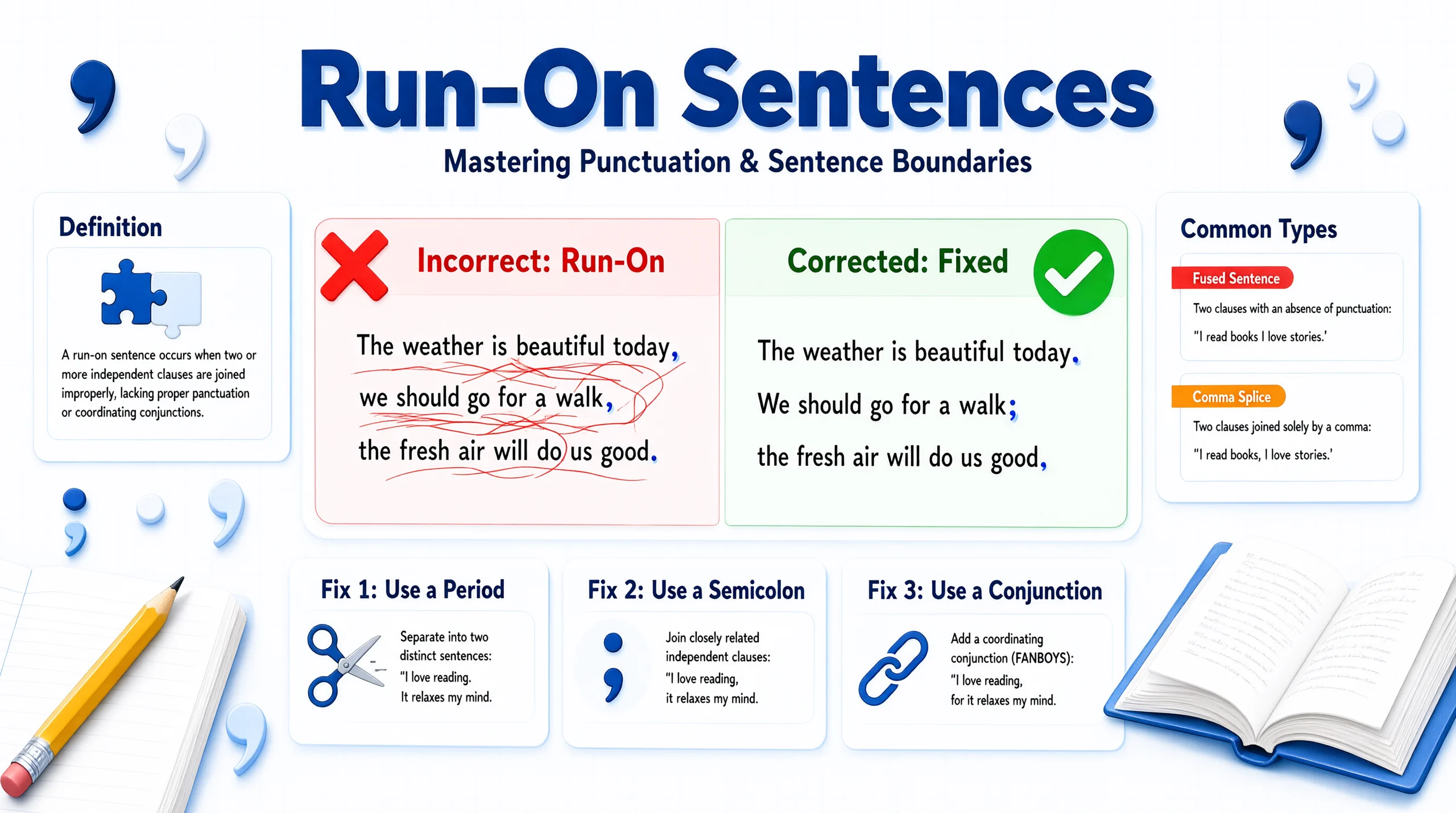
A run-on sentence occurs when two or more independent clauses are joined incorrectly without appropriate punctuation or a coordinating conjunction. For example, “I was tired I went to bed” is a run-on sentence. A correct version is “I was tired, so I went to bed.” Run-on sentences can be fixed using periods, semicolons, or conjunctions.
Why Do People Confuse Run-On Sentences?
People often confuse run-on sentences with long or complicated sentences because both may contain several ideas. However, they are not the same.
A long sentence can be grammatically correct if its clauses are connected properly. A run-on sentence is grammatically incorrect because its independent clauses lack the necessary punctuation or connection.
For example:
- Long but correct: Although I was tired after working all day, I finished my homework before going to bed.
- Run-on: I was tired after working all day I finished my homework before going to bed.
The first sentence uses a dependent clause and an independent clause correctly. The second joins two independent clauses without proper punctuation.
First Word: Run-On
The term run-on describes something that continues without an appropriate stopping point.
In grammar, a run-on sentence occurs when one complete thought runs directly into another without the correct punctuation or connecting structure.
A run-on sentence can contain two or more independent clauses. Each independent clause has its own subject and verb and can express a complete idea.
Examples:
- She loves reading she visits the library every week.
- The weather was cold we stayed inside.
- He missed the bus he arrived late.
All three examples contain separate complete thoughts that have been joined incorrectly.
What Is an Independent Clause?
An independent clause is a group of words that contains a subject and a verb and expresses a complete thought.
Examples:
- She likes music.
- They play football.
- I finished my assignment.
Each example can stand alone as a complete sentence.
Second Word: Sentences
A sentence is a group of words that expresses a complete thought. It usually contains a subject and a predicate and ends with appropriate punctuation.
In English, sentences can contain one or several clauses.
For example:
- Simple sentence: My brother plays cricket.
- Compound sentence: My brother plays cricket, and I enjoy football.
- Complex sentence: My brother plays cricket because he enjoys sports.
A grammatically correct sentence connects its ideas using appropriate punctuation and grammatical structures.
When two complete sentences are joined incorrectly, the result may be a run-on sentence.
Run-On Sentences vs Correct Sentences: Comparison Table
| Feature | Run-On Sentence | Correct Sentence |
| Meaning | Two or more complete thoughts joined incorrectly | Ideas connected using correct grammar |
| Punctuation | Missing or incorrect | Appropriate punctuation |
| Readability | Often confusing | Clear and understandable |
| Grammar | Contains a joining error | Follows sentence rules |
| Example | I like tea I drink it daily. | I like tea, and I drink it daily. |
When Should You Use Run-On Sentences and Correct Sentences?
You should avoid run-on sentences in formal, academic, and professional writing. Instead, use correct sentence structures to communicate your ideas clearly.
The term run-on sentence is used when identifying a grammar mistake, not as a recommended writing style.
Here are three common ways to correct run-on sentences.
1. Use a Period
Separate two independent clauses into two sentences.
Incorrect: I enjoy reading I visit the library often.
Correct: I enjoy reading. I visit the library often.
Use a period when both ideas can stand independently.
2. Use a Comma and Coordinating Conjunction
Connect two independent clauses using a comma and a coordinating conjunction.
Common coordinating conjunctions include:
- For
- And
- Nor
- But
- Or
- Yet
- So
Incorrect: She was hungry she prepared dinner.
Correct: She was hungry, so she prepared dinner.
3. Use a Semicolon
A semicolon can connect two closely related independent clauses.
Incorrect: The road was crowded we arrived late.
Correct: The road was crowded; we arrived late.
A semicolon is useful when two ideas are closely connected and you want to keep them in one sentence.
15 Examples of Run-On Sentences and Their Corrections
The easiest way to understand run-on sentences is to study incorrect examples and their corrected versions.
| Incorrect Run-On Sentence | Correct Sentence |
| I love coffee I drink it every morning. | I love coffee, and I drink it every morning. |
| She was tired she went to sleep. | She was tired, so she went to sleep. |
| He likes football he watches every match. | He likes football. He watches every match. |
| The sun was shining we went outside. | The sun was shining, so we went outside. |
| I forgot my keys I could not enter. | I forgot my keys, so I could not enter. |
| They studied hard they passed the exam. | They studied hard; they passed the exam. |
| My mother was cooking I helped her. | My mother was cooking, and I helped her. |
| The movie was interesting we watched it twice. | The movie was interesting, so we watched it twice. |
| He missed breakfast he was hungry. | He missed breakfast, so he was hungry. |
| I called my friend she did not answer. | I called my friend, but she did not answer. |
| It started raining we went indoors. | It started raining, so we went indoors. |
| She speaks English she also speaks French. | She speaks English, and she also speaks French. |
| The shop was closed we returned home. | The shop was closed, so we returned home. |
| I enjoy writing I practice every day. | I enjoy writing, and I practice every day. |
| He worked late he missed the train. | He worked late, so he missed the train. |
These examples show that a small punctuation change or connecting word can make a sentence much easier to understand.
Common Mistakes When Writing Run-On Sentences
Many writers make similar mistakes when connecting independent clauses. Understanding these errors can help you avoid them.
1. Joining Two Sentences Without Punctuation
Incorrect: I went to school I met my friend.
Correct: I went to school, and I met my friend.
Two independent clauses cannot simply be placed together without an appropriate connection.
2. Using Only a Comma
This mistake is called a comma splice.
Incorrect: She loves music, she listens to it every day.
Correct: She loves music, and she listens to it every day.
A comma alone cannot normally join two independent clauses.
3. Using a Conjunction Without a Comma
When a coordinating conjunction connects two independent clauses, a comma is generally required before it.
Incorrect: I wanted to go outside but it was raining.
Correct: I wanted to go outside, but it was raining.
4. Making Sentences Too Long
Long sentences are not automatically run-on sentences, but unnecessary clauses can make writing difficult to understand.
Better approach: Divide complicated ideas into shorter, meaningful sentences when doing so improves clarity.
Memory Trick: How to Remember Run-On Sentences
Use this simple trick:
Two complete thoughts + no proper connection = Run-on sentence.
Remember these three correction methods:
- Period: Separate the ideas.
- Comma + conjunction: Connect the ideas.
- Semicolon: Join closely related independent clauses.
For example:
Run-on: I was hungry I made a sandwich.
Correct options:
- I was hungry. I made a sandwich.
- I was hungry, so I made a sandwich.
- I was hungry; I made a sandwich.
If you remember these three methods, identifying and correcting run-on sentences becomes much easier.
American vs British English: Are Run-On Sentences Different?
There is no significant difference between American and British English when it comes to the basic definition of run-on sentences.
Both varieties follow the same fundamental grammar principle: independent clauses must be connected correctly.
However, punctuation preferences can sometimes differ between American and British writing styles, particularly regarding quotation marks and certain punctuation conventions.
The rules for avoiding run-on sentences remain the same in both varieties.
Examples:
- American English: I wanted to travel, but I had no money.
- British English: I wanted to travel, but I had no money.
Both sentences are grammatically correct.
Similar Words and Related Grammar Terms
Several grammar terms are closely related to run-on sentences. Understanding their meanings can help you recognize different sentence errors.
| Term | Simple Meaning |
| Comma splice | Two independent clauses joined using only a comma |
| Sentence fragment | An incomplete sentence that does not express a complete thought |
| Independent clause | A group of words expressing a complete thought |
| Dependent clause | A clause that cannot stand alone as a complete sentence |
| Compound sentence | A sentence containing two or more independent clauses |
| Complex sentence | A sentence containing an independent clause and at least one dependent clause |
| Conjunction | A word that connects words, phrases, or clauses |
| Semicolon | A punctuation mark used to connect closely related independent clauses |
These terms are useful when studying English grammar because they explain how sentences are formed and connected.
Final Verdict: What Should You Remember About Run-On Sentences?
A run-on sentence is a grammatical error that happens when two or more independent clauses are connected incorrectly.
It is not defined by the number of words in a sentence. Instead, the problem is the missing or incorrect punctuation or connection between complete thoughts.
You can correct run-on sentences by using a period, a semicolon, or a comma with a suitable coordinating conjunction. Learning these methods will help you write more clearly and confidently.
FAQs:
1. What is a run-on sentence in simple words?
A run-on sentence happens when two or more complete sentences are joined incorrectly without proper punctuation or a suitable connecting word.
Example: I like apples I eat them daily.
Correct: I like apples, and I eat them daily.
2. What are the three types of run-on sentences?
Run-on sentences are commonly discussed in two main forms:
- Fused sentences: Two independent clauses joined without punctuation.
- Comma splices: Two independent clauses joined using only a comma.
Some educational materials also discuss faulty conjunctions and other incorrect clause connections as related errors.
3. How do you fix a run-on sentence?
You can fix a run-on sentence in three common ways:
- Use a period to separate the clauses.
- Use a comma and a coordinating conjunction.
- Use a semicolon between closely related independent clauses.
Choose the method that makes your meaning clearest.
4. Is a long sentence always a run-on sentence?
No. A long sentence is not necessarily a run-on sentence. It can be grammatically correct if all its clauses are connected using proper punctuation and conjunctions.
A run-on sentence is identified by an incorrect connection between independent clauses, not by its length.
5. What is the difference between a run-on sentence and a comma splice?
A run-on sentence is a broad term for incorrectly joining independent clauses. A comma splice is a specific type of run-on sentence in which two independent clauses are joined using only a comma.
Example of a comma splice: I was hungry, I made dinner.
6. Can a semicolon fix a run-on sentence?
Yes. A semicolon can correct a run-on sentence when it separates two closely related independent clauses.
Example:
Incorrect: It was getting dark we returned home.
Correct: It was getting dark; we returned home.
7. Why should students avoid run-on sentences?
Students should avoid run-on sentences because they can make writing confusing and difficult to follow. Correct sentence structure improves readability, grammar, communication, and academic writing.
Remember This
- A run-on sentence joins independent clauses incorrectly.
- Long sentences are not always run-on sentences.
- A fused sentence has no punctuation between independent clauses.
- A comma splice uses only a comma to join independent clauses.
- Periods, semicolons, and coordinating conjunctions can fix run-on sentences.
- Clear sentence structure makes writing easier to understand.
Conclusion
Run-on sentences are common grammar mistakes, but they are easy to understand once you learn how independent clauses work. Whenever you write two complete thoughts, make sure they are connected using appropriate punctuation or a suitable conjunction. This simple habit can improve your writing and help you avoid confusing sentences.
If you are a student, an ESL learner, or someone who wants to improve everyday English, practicing with incorrect and corrected examples will strengthen your grammar skills. Remember that good writing is not about using long or complicated sentences. It is about expressing your thoughts clearly, naturally, and correctly.

I’m Sawyer Michael, a writer passionate about language and communication. I enjoy helping readers discover clearer, more natural, and creative ways to express their thoughts through words.