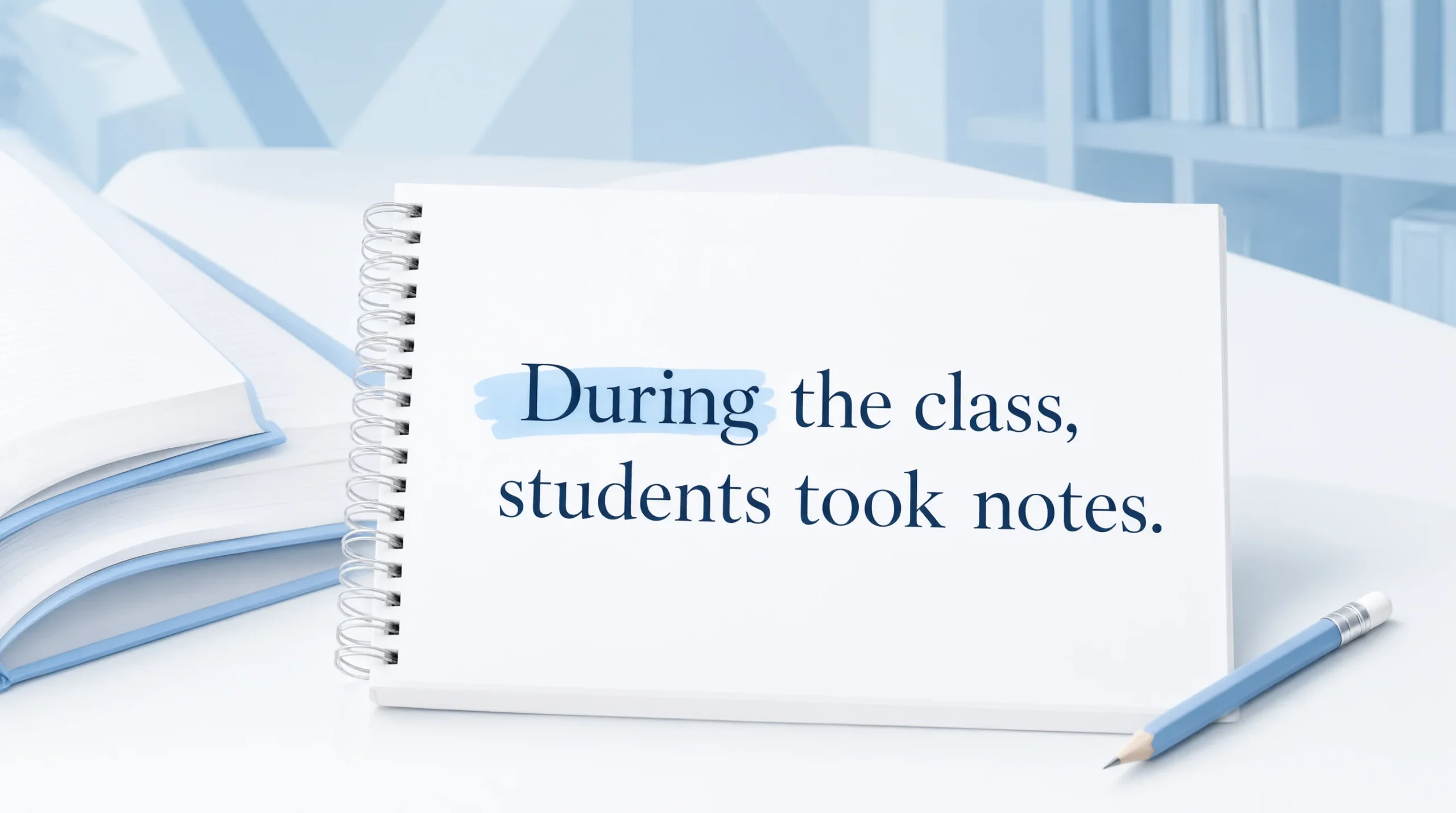
Starting a sentence with during is grammatically correct when you want to explain when an event happens or describe something that takes place within a particular period. For example, “During the meeting, everyone shared their ideas.” In this sentence, during the meeting tells readers when everyone shared their ideas.
Many students and English learners wonder if they can begin a sentence with during or if it sounds awkward or incorrect. The good news is that there is no grammar rule against starting a sentence with this word. The important thing is to use it with the correct type of word or phrase.
During is a preposition, so it normally comes before a noun or noun phrase, such as the summer, class, or the journey. It does not usually introduce a complete clause with its own subject and verb. Understanding this difference will help you write clearer sentences in school assignments, emails, essays, stories, and everyday conversations.
Quick Answer
Yes, you can start a sentence with during. Use it before a noun or noun phrase to show when something happens. For example, “During the lesson, the teacher explained the topic.” Do not use during directly before a complete clause, such as “During I was studying.” Use while instead.
Why Do People Confuse It?
People often confuse during with words such as while, when, and throughout because all of them can relate to time. However, they follow different grammatical patterns.
The main difference is that during is a preposition, while while is a conjunction when it introduces a clause.
Compare these examples:
- Correct: During the exam, the room remained quiet.
- Correct: While the students were taking the exam, the room remained quiet.
- Incorrect: During the students were taking the exam, the room remained quiet.
The first sentence uses a noun phrase, the exam. The second uses a complete clause, the students were taking the exam. The third incorrectly places during before that clause.
First Word: During
During is a preposition that means at some point within a period or throughout a particular event or time frame, depending on the context.
You can place it at the beginning of a sentence to establish the time before explaining what happened.
How to Use During at the Beginning of a Sentence
A common structure is:
During + noun or noun phrase, + main clause.
Examples:
- During the night, the temperature dropped.
- During my vacation, I visited several historical places.
- During the presentation, the audience asked thoughtful questions.
- During the winter holidays, many families travel together.
In each example, the opening phrase provides time-related information. The main clause explains the action or situation.
Does During Need a Comma?
When a sentence begins with a short introductory phrase using during, a comma is often used to separate that phrase from the main clause for clarity.
For example:
“During the break, we went outside.”
A comma is especially helpful when the introductory phrase is longer or when it makes the sentence easier to read. With very short introductory phrases, comma use can sometimes depend on style and clarity.
Second Word: While
While is commonly used as a conjunction to introduce a clause containing a subject and a verb. It can describe two actions happening at the same time or contrast two situations.
Examples:
- While I was cooking, my brother set the table.
- While the children played, their parents prepared dinner.
- While she enjoys reading, her sister prefers painting.
- While we were waiting for the bus, it started raining.
Notice that while can be followed by a complete clause, such as I was cooking or the children played.
Can You Start a Sentence With While?
Yes. Starting a sentence with while is also grammatically correct.
For example:
“While I was studying, my phone rang.”
The introductory clause is followed by a comma and the main clause. This construction is useful when you want to connect two actions or express a contrast.
During vs. While: Comparison Table
| Feature | During | While |
| Part of speech | Preposition | Conjunction when introducing a clause |
| Followed by | A noun or noun phrase | A subject and verb |
| Shows time | Yes | Yes |
| Shows contrast | Not normally | Yes |
| Sentence-starting example | During the class, I took notes. | While the class was in progress, I took notes. |
| Common mistake | During I was sleeping | While I was sleeping |
Both words can express events occurring within the same time period, but their grammatical structures are different.
When Should You Use Each?
Choose during when you want to name an event, activity, or period of time. Choose while when you want to describe an action using a subject and verb or show a contrast.
Use During With Nouns
Use during when the time expression is a noun or noun phrase.
Examples:
- During the interview, I answered every question.
- During the festival, the streets were crowded.
- During the afternoon, we worked on our project.
Use While With Clauses
Use while when the following words form a clause.
Examples:
- While I was attending the interview, my phone vibrated.
- While the festival was taking place, the streets were crowded.
- While we were working on our project, the electricity went out.
Use While to Show Contrast
While can also mean although or whereas.
For example:
“While the first plan is affordable, the second plan offers more features.”
Here, while compares two ideas rather than describing two simultaneous actions.
15 Examples of Starting a Sentence With During
Here are practical examples for schoolwork, professional writing, everyday communication, and storytelling.
- During the meeting, the manager explained the new policy.
- During the summer, many children attend sports camps.
- During my childhood, I spent hours reading adventure stories.
- During the examination, all students must remain silent.
- During the storm, several trees fell across the road.
- During the trip, we stopped at a small village.
- During the interview, she spoke confidently about her experience.
- During the night, the security guard checked every entrance.
- During the lesson, the teacher answered questions from the class.
- During the celebration, everyone enjoyed music and dancing.
- During the conversation, I learned something surprising.
- During the holidays, our family visits relatives.
- During the first week, employees receive basic training.
- During the experiment, researchers recorded their observations.
- During the final chapter, the mystery behind the character’s disappearance becomes clear.
Each example starts with during followed by a noun phrase. The main clause then communicates the central idea.
Common Mistakes When Starting a Sentence With During
Although starting with during is correct, some sentence patterns are grammatically incorrect.
Mistake 1: Using During Before a Complete Clause
Incorrect: During I was sleeping, someone knocked on the door.
Correct: While I was sleeping, someone knocked on the door.
Why? I was sleeping is a complete clause, so while is the appropriate choice.
Mistake 2: Forgetting the Noun After During
Incorrect: During I went to school, I met my friend.
Correct: During my journey to school, I met my friend.
Another correct option is: “While I was going to school, I met my friend.”
Why? In this use, during needs a noun or noun phrase rather than a complete clause.
Mistake 3: Using During When You Mean While
Incorrect: During she was reading, the baby woke up.
Correct: While she was reading, the baby woke up.
Why? The phrase she was reading contains a subject and a verb. Use while to introduce it.
Mistake 4: Creating an Incomplete Sentence
Incomplete: During the conference.
Complete: During the conference, the speakers discussed new research.
Why? The first example is a phrase, not a complete sentence. It can work as a fragment in informal notes or creative writing, but it does not express a complete thought on its own.
Mistake 5: Using an Unclear Time Expression
Unclear: During the time, we completed the work.
Clearer: During the afternoon, we completed the work.
Or: During the meeting, we completed the work.
Why? A more specific noun phrase helps readers understand which period or event you mean.
Memory Trick: During + Noun, While + Clause
Remember this simple rule:
- During + noun: During the movie, I fell asleep.
- While + subject + verb: While I was watching the movie, I fell asleep.
Ask yourself one question: What comes immediately after the word?
If it is a noun phrase, during may be correct. If it is a complete clause, while is usually the better choice.
American vs. British English
There is no major difference between American and British English in the basic grammar of during. In both varieties, you can begin a sentence with during when it is followed by a suitable noun phrase.
Examples accepted in both varieties:
- During the weekend, we visited our grandparents.
- During the school holidays, children often travel with their families.
- During the meeting, the team discussed its next steps.
The main differences you may notice involve vocabulary and spelling elsewhere in the sentence, not this grammatical rule. Both American and British writers use while to introduce clauses as well.
Similar Words to During
Several words and expressions can replace during, but the best choice depends on your meaning.
| Word or phrase | Meaning | Example |
| While | At the same time as; also used for contrast | While I was studying, my friend called. |
| Throughout | From the beginning to the end of a period | Throughout the meeting, she took notes. |
| Within | Inside a specified period or limit | We completed the task within an hour. |
| In | During a particular period, season, or year | In the summer, we visit the coast. |
| Throughout the course of | Over the duration of an event or process | Throughout the course of the project, we reviewed our progress. |
| When | At the time that something happens | When the class ended, we went home. |
These expressions are related, but they are not always interchangeable. For example, throughout often emphasizes the whole duration, whereas during can refer to an event or to a point within a period.
Final Verdict: Is Starting a Sentence With During Correct?
Yes, starting a sentence with during is completely acceptable in standard English. It is a useful way to establish the time or context before describing an action.
The key is to follow it with a noun or noun phrase, as in “During the lesson, I took notes.” If you want to follow the introductory word with a subject and verb, use while instead: “While the teacher was explaining, I took notes.”
FAQs:
1. Is it grammatically correct to start a sentence with during?
Yes. You can start a sentence with during when it introduces a noun or noun phrase that identifies a time period or event.
Example: “During the ceremony, everyone stood quietly.”
2. Should I put a comma after during at the beginning of a sentence?
Usually, place a comma after the complete introductory phrase, not immediately after the word during.
Correct: “During the class, I asked a question.”
Incorrect punctuation: “During, the class I asked a question.”
3. Can I start a sentence with during in an essay?
Yes. Starting a sentence with during is appropriate in academic essays, reports, and other formal writing when the sentence is grammatically complete and relevant to your argument.
Example: “During the study, researchers collected data from several groups.”
4. Can I say “during I was working”?
No. In standard English, during does not normally introduce a complete clause such as I was working.
Correct: “While I was working, my colleague called.”
You can also write: “During my work, my colleague called,” although the meaning and naturalness depend on the context.
5. What is the difference between during and while?
During is normally followed by a noun phrase, while while can introduce a clause containing a subject and verb.
- During the movie, I ate popcorn.
- While I was watching the movie, I ate popcorn.
Both sentences are correct.
6. Can I start a paragraph with during?
Yes. You can start a paragraph with a sentence beginning with during if the time expression connects naturally to the paragraph’s topic.
Example: “During the nineteenth century, major changes transformed transportation and communication.”
7. Is “during the day” correct at the beginning of a sentence?
Yes. During the day is a correct introductory time phrase.
Example: “During the day, the streets are busy with shoppers and commuters.”
Remember This
- Starting a sentence with during is grammatically correct.
- Use during + noun or noun phrase.
- Use while + subject and verb when introducing a clause.
- A comma after the introductory phrase often improves readability.
- The same basic rules apply in American and British English.
Conclusion
Starting a sentence with during is a simple and effective way to tell readers when something happens. It works well in essays, stories, reports, emails, and everyday writing. As long as you follow during with a suitable noun or noun phrase, your sentence can be clear, natural, and grammatically correct.
The most important distinction to remember is the difference between during and while. Use during the meeting when naming an event, and while we were meeting when introducing a clause. Learning this small grammatical difference will help you avoid common mistakes and express your ideas with greater confidence.

I am Camden Thomas, an Administrator at SaysReply. I help maintain our platform and ensure readers find clear, natural, and useful alternative ways to express their thoughts every day.