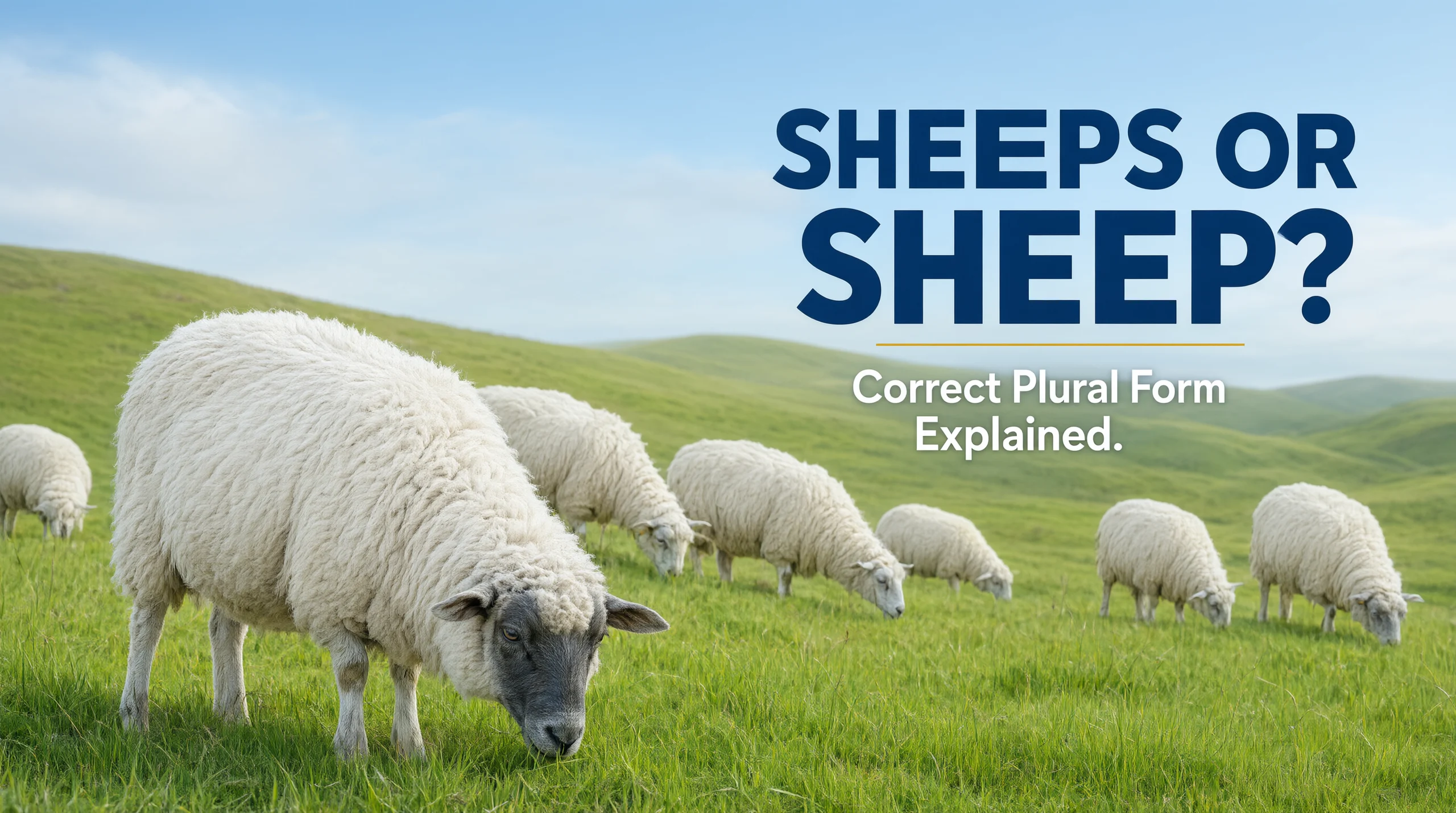
The correct plural of sheep is sheep, not sheeps. Many English learners use “sheeps” because most English nouns form their plurals by adding -s or -es. However, sheep is an irregular noun that keeps the same form in both singular and plural. You can say “one sheep,” “two sheep,” or “a hundred sheep.”
Understanding the difference between sheep and sheeps helps you speak and write English more naturally. This rule is especially useful for students, ESL learners, writers, and anyone who wants to improve their grammar.
If you are describing farm animals, discussing wool production, or writing a school assignment, choosing the correct word makes your sentences clearer. In this guide, you will learn why people confuse these words, how to use sheep correctly, and how it differs from similar animal words such as lamb, ewe, and ram. You will also find practical examples, common mistakes, and easy memory tricks to help you remember the correct plural form.
Quick Answer: Is It Sheeps or Sheep?
Sheep is both the singular and plural form of the noun. Use “sheep” for one animal and for two or more animals. “Sheeps” is generally incorrect in standard English when referring to multiple animals. For example, say “one sheep” and “five sheep,” not “five sheeps.”
Why Do People Confuse Sheep and Sheeps?
People often confuse these words because most English countable nouns take -s or -es in the plural.
For example:
- One cat → two cats
- One dog → two dogs
- One box → two boxes
- One sheep → two sheep
The last example follows a different plural pattern. Some English nouns have identical singular and plural forms. Sheep is one of the most common examples.
Learners may also encounter “sheeps” in informal writing, mistakes, or nonstandard English. However, it is not the normal plural form used in standard English.
First Word: Sheep
Sheep is a noun referring to a woolly farm animal commonly raised for wool, meat, milk, and other agricultural purposes.
The word can refer to one animal or several animals. The surrounding sentence tells you whether it is singular or plural.
Meaning of Sheep
- Singular: One sheep.
- Plural: Two or more sheep.
- Pronunciation: /ʃiːp/
- Part of speech: Noun.
- Plural rule: The word stays unchanged.
Examples of Sheep
- One sheep is standing near the fence.
- Three sheep are eating grass.
- The sheep needs water.
- The sheep need water.
Notice that the verb changes according to the meaning. Use is or needs for one sheep and are or need for multiple sheep.
Second Word: Sheeps
Sheeps is generally considered an incorrect plural of sheep in standard English.
Although adding -s is a common plural rule, it does not apply to every noun. Sheep belongs to a group of nouns whose singular and plural forms are identical.
Is Sheeps Ever Correct?
In ordinary writing and conversation, use sheep, not “sheeps,” when talking about multiple animals.
The word “sheeps” may occasionally appear in nonstandard writing or specialized contexts, such as discussions involving different types or varieties of wool in technical terminology. Such usage is context-dependent and uncommon. For everyday English, “sheep” is the correct choice.
Examples:
- Incorrect: There are ten sheeps on the farm.
- Correct: There are ten sheep on the farm.
- Incorrect: The farmer owns many sheeps.
- Correct: The farmer owns many sheep.
Sheep vs. Sheeps: Comparison Table
| Feature | Sheep | Sheeps |
| Standard English | Correct | Generally incorrect |
| Singular form | One sheep | Not standard |
| Plural form | Two sheep | Not standard |
| Grammar | Noun | Usually a mistaken plural |
| Example | Five sheep are grazing. | Five sheeps are grazing. |
| Best use | Everyday speaking and writing | Avoid in ordinary English |
When Should You Use Each Word?
Use Sheep for One Animal
Use “sheep” when referring to a single animal.
Examples:
- A sheep is sleeping in the field.
- The sheep has thick wool.
- I saw a sheep near the road.
Use Sheep for Multiple Animals
Use the same word when referring to two or more animals.
Examples:
- Two sheep are drinking water.
- The farmer bought six sheep.
- Many sheep live on this farm.
Avoid Sheeps in Standard English
When counting animals or describing a group, use “sheep” with numbers and plural expressions.
Examples:
- Correct: a flock of sheep
- Correct: several sheep
- Correct: many sheep
- Incorrect: a flock of sheeps
- Incorrect: several sheeps
12 Examples of Sheep in Sentences
These examples show how to use sheep correctly in everyday English.
- One sheep is eating grass.
The noun refers to a single animal. - Five sheep are standing near the barn.
The noun refers to multiple animals. - The farmer feeds his sheep every morning.
Sheep can refer to a group. - I saw a sheep beside the road.
The sentence describes one animal. - The sheep are resting under a tree.
The plural meaning is clear from the verb “are.” - There are twenty sheep on the farm.
The noun stays unchanged after a number. - She bought a soft wool blanket made from sheep’s wool.
Sheep’s is the singular possessive form used here to describe wool from a sheep. - The farmer moved the sheep into a larger field.
Sheep can refer to several animals without changing its spelling. - A little sheep followed its mother.
The sentence refers to one young animal. - Hundreds of sheep graze on the hillside.
The word remains sheep even with a large number. - The sheep needs medical attention.
The singular verb “needs” indicates one animal. - The sheep need more food.
The plural verb “need” indicates multiple animals.
Common Mistakes with Sheep and Sheeps
Here are frequent errors and their corrections.
| Incorrect Sentence | Correct Sentence |
| I saw three sheeps. | I saw three sheep. |
| There are many sheeps here. | There are many sheep here. |
| The sheeps are hungry. | The sheep are hungry. |
| Two sheeps escaped. | Two sheep escaped. |
| A flock of sheeps is nearby. | A flock of sheep is nearby. |
Another Common Mistake: Using the Wrong Verb
Because sheep has the same form in both numbers, learners sometimes forget to change the verb.
- One sheep is eating.
- Two sheep are eating.
- The sheep has a thick coat.
- The sheep have thick coats.
The noun stays the same, but the verb must agree with the intended meaning.
Memory Trick: How to Remember Sheep
Use this simple rule:
One sheep, two sheep, ten sheep—never add an extra “s.”
You can also remember the phrase:
“Sheep stays the same.”
Think of sheep as a word that does not change when you count more animals. Repeating a few examples aloud can make the pattern easier to remember.
Practice:
- One sheep
- Two sheep
- Five sheep
- Twenty sheep
After a little practice, using “sheep” correctly will become natural.
American vs. British English: Is the Rule Different?
No. The plural rule for sheep is the same in standard American and British English.
| English Variety | Singular | Plural |
| American English | One sheep | Two sheep |
| British English | One sheep | Two sheep |
Both varieties use “sheep” for one animal and for multiple animals. “Sheeps” is not the standard plural in either variety.
Although pronunciation and vocabulary may differ between American and British English, this grammar rule does not change.
Similar Words: Sheep, Lamb, Ewe, and Ram
Several words are associated with sheep, but they do not all mean the same thing.
| Word | Meaning | Example |
| Sheep | The animal in general | The sheep are grazing. |
| Lamb | A young sheep | The lamb is following its mother. |
| Ewe | An adult female sheep | The ewe is caring for her lamb. |
| Ram | An adult male sheep | The ram is standing near the gate. |
| Flock | A group of sheep or birds | A flock of sheep crossed the field. |
What Is the Difference Between Sheep and Lamb?
A sheep is the general name for the animal, while a lamb is a young sheep. Lamb is also commonly used to refer to the meat of a young sheep.
What Is the Difference Between Sheep and Ewe?
A ewe is an adult female sheep. The word “sheep” can refer to an animal of either sex.
What Is the Difference Between Sheep and Ram?
A ram is an adult male sheep. The general word “sheep” does not specify whether the animal is male or female.
Final Verdict: Sheep or Sheeps?
Sheep is the correct word for both singular and plural use in standard English. Use “one sheep” when referring to a single animal and “many sheep” when referring to a group. Avoid “sheeps” in ordinary writing and conversation.
Remember that English has exceptions to its usual plural rules. Just as we say “one deer” and “two deer,” we say “one sheep” and “two sheep.” Learning these patterns will help you avoid common grammar mistakes and communicate more confidently.
FAQs:
1. Is “sheeps” a real word?
“Sheeps” may appear in nonstandard writing or specialized contexts, but it is not the standard plural of sheep. In everyday English, use “sheep” for both singular and plural meanings.
2. What is the plural of sheep?
The plural of sheep is sheep. The spelling stays the same whether you are talking about one animal or many animals.
3. Can I say “two sheeps”?
No. In standard English, say “two sheep.” The word does not take an additional -s when it becomes plural.
4. Why is the plural of sheep not sheeps?
Sheep is an irregular noun with an unchanged plural form. Unlike regular nouns such as cats and dogs, it does not add -s to indicate more than one.
5. Is it “a sheep” or “an sheep”?
The correct phrase is “a sheep” because sheep begins with a consonant sound, /ʃ/. For example, “I saw a sheep in the field.”
6. Do American and British English use sheeps differently?
No. Both standard American and British English use “sheep” as the singular and plural form. The usual plural “sheeps” is incorrect in both varieties.
7. What do you call a group of sheep?
A group of sheep is commonly called a flock. For example, “A flock of sheep was grazing in the field.”
8. Is it “the sheep is” or “the sheep are”?
Both can be correct, depending on the meaning. Use “the sheep is” when referring to one animal and “the sheep are” when referring to multiple animals.
Remember This
- One sheep is correct.
- Two sheep is correct.
- Many sheep is correct.
- Many sheeps is generally incorrect in standard English.
- Sheep has the same singular and plural form in American and British English.
The easiest rule to remember is that sheep stays sheep, no matter how many animals you count.
Conclusion
The difference between sheep and sheeps is simple once you learn the plural rule. Sheep is the correct form for both one animal and multiple animals, while sheeps is generally incorrect in everyday standard English. Remembering this exception will help you write accurate sentences and avoid a common mistake.
Practice using phrases such as “one sheep,” “three sheep,” and “a flock of sheep” in your daily English. With regular use, you will remember the correct form easily and become more confident in your grammar.

I am Camden Thomas, an Administrator at SaysReply. I help maintain our platform and ensure readers find clear, natural, and useful alternative ways to express their thoughts every day.










6 thoughts on “Sheeps or Sheep: Which Word Is Correct? Meaning, Rules, and”