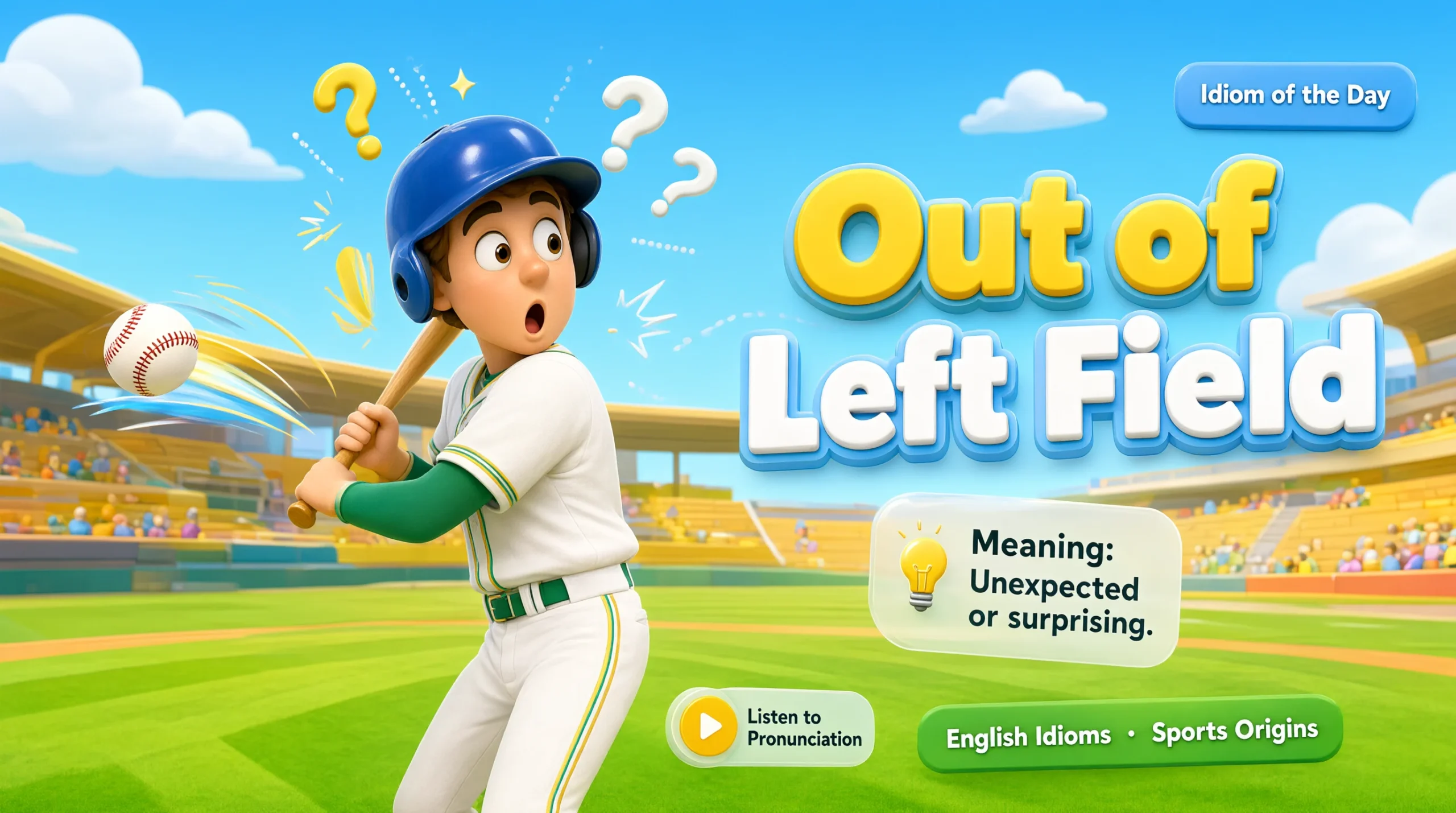
The phrase “out of left field” is an informal English idiom used to describe something unexpected, surprising, or completely unrelated to what people were discussing or expecting. When someone says that an idea, question, comment, or event came out of left field, they mean it appeared suddenly and caught everyone off guard. For example, if a student suddenly asks about vacation plans during a serious mathematics lesson, the question might seem out of left field.
This expression is common in everyday American English, conversations, workplace discussions, and informal writing. It can describe an unusual suggestion, an unexpected decision, a surprising question, or an event that seems to come from nowhere. Understanding the phrase helps English learners recognize figurative language and communicate more naturally. Although it contains the words “left” and “field,” it usually has nothing to do with directions or an actual sports field. Its meaning depends on the situation in which it is used.
Quick Answer: What Does Out of Left Field Mean?
Out of left field means unexpected, surprising, unusual, or completely unrelated to the current situation. People use this informal idiom when something happens or someone says something that nobody anticipated. For example: “His question came completely out of left field.”
Why Do People Confuse It?
People sometimes confuse “out of left field” because its literal meaning sounds different from its figurative meaning.
The expression contains three familiar words:
- Out: Away from or outside something.
- Of: A word showing a relationship or connection.
- Left field: An area of a baseball field.
However, when these words appear together in this idiom, they describe something unexpected rather than a physical location.
Another reason for confusion is that the phrase can describe different situations. Sometimes it refers to a surprising comment, while other times it describes an unusual idea, unexpected news, or an unrelated question.
For example:
- “Her suggestion came out of left field.” (An unexpected suggestion.)
- “That question was out of left field.” (A surprising or unrelated question.)
- “The announcement came out of left field.” (Unexpected news.)
The meaning becomes clearer when you consider the context.
First Word: Out
The word “out” is commonly used as an adverb, preposition, or part of a phrasal expression. Its basic meaning relates to movement away from the inside of something or a position outside a particular place.
Meaning of Out
Out can describe:
- Movement from inside to outside.
- Something that is no longer available or present.
- A person or thing that is excluded.
- Something becoming publicly known.
Examples of Out
- She walked out of the room.
- The children went out to play.
- His name was left out of the list.
- The secret finally came out.
In the expression “out of left field,” the word “out” contributes to the idea of something appearing from an unexpected direction.
Second Word: Left Field
Left field is a term originally associated with baseball. It refers to the part of the baseball playing area located to the left of the batter’s perspective when facing the pitcher.
Over time, the expression developed a figurative meaning. Something coming from left field became associated with an unexpected or surprising development.
Meaning of Left Field
In everyday English, “left field” can suggest:
- An unusual direction.
- An unexpected source.
- An unfamiliar idea.
- Something surprising or unrelated.
Examples of Left Field
- His idea came from left field.
- That suggestion seems completely out of left field.
- The question was a little out of left field.
- Her response came from an unexpected direction.
When combined with “out of,” the phrase creates the familiar idiom meaning something unexpected or surprising.
Out of Left Field vs. Similar Expressions: Comparison Table
| Expression | Meaning | Example |
| Out of left field | Unexpected or surprising | His question came out of left field. |
| Out of nowhere | Appearing suddenly | She called me out of nowhere. |
| Caught off guard | Surprised unexpectedly | The announcement caught us off guard. |
| Unexpected | Not anticipated | We received unexpected news. |
| Random | Without an obvious connection | That was a random question. |
| Curveball | An unexpected challenge or surprise | The manager threw us a curveball. |
| Unpredictable | Difficult to anticipate | His behavior is unpredictable. |
These expressions are related, but they are not always interchangeable. For example, “random” can describe something without an obvious connection, while “out of left field” often emphasizes how surprising something is.
When Should You Use Out of Left Field?
Use “out of left field” when you want to describe something that is unexpected, unusual, or unrelated to what people were discussing.
It works particularly well in informal conversations, storytelling, casual workplace discussions, and friendly communication.
1. When Someone Asks an Unexpected Question
Use it when a person suddenly asks something unrelated to the conversation.
Example: “Your question about my childhood was completely out of left field.”
2. When Someone Makes a Surprising Suggestion
Use it when an idea appears unexpectedly.
Example: “His suggestion to move abroad came out of left field.”
3. When Unexpected News Arrives
Use it when people receive surprising information.
Example: “The announcement about the company closing came out of left field.”
4. When Someone Changes the Subject Suddenly
Use it when a person introduces a completely different topic.
Example: “We were discussing dinner when she brought up marriage. That came out of left field.”
5. When Something Unusual Happens
Use it when an event does not match what people expected.
Example: “The team’s decision to cancel the event was out of left field.”
15 Examples of Out of Left Field in Sentences
Here are 15 practical examples that show how to use this idiom naturally in everyday English.
- Her question came completely out of left field during the meeting.
- His decision to quit his job was totally out of left field.
- That comment was so out of left field that nobody knew how to respond.
- We were talking about school when he suddenly mentioned his wedding plans.
- The manager’s suggestion came out of left field.
- I never expected such an unusual answer from her.
- His request to change the entire project was out of left field.
- The news about their sudden move came out of left field.
- She asked me a question that seemed completely unrelated to our discussion.
- The teacher’s unexpected announcement caught everyone by surprise.
- His idea about starting a business came out of left field.
- That was an out-of-left-field comment, but it made everyone laugh.
- Nobody expected the company to make such an unusual decision.
- Her sudden offer to help was completely out of left field.
- The conversation took an unexpected turn when he mentioned his childhood.
These examples demonstrate that the idiom can describe comments, questions, decisions, suggestions, announcements, and surprising events.
Common Mistakes When Using Out of Left Field
Although this expression is easy to understand, English learners sometimes use it incorrectly.
1. Taking the Phrase Literally
Incorrect: “He walked out of left field and entered the building.”
Correct: “His question came out of left field.”
The idiom usually describes an unexpected situation rather than someone physically leaving a baseball field.
2. Using It for Every Surprise
Not every surprising event is necessarily out of left field.
For example, if you expect a birthday party but do not know the exact time, the party itself is not necessarily out of left field.
The expression works best when something is genuinely unexpected or unusual.
3. Confusing It With Out of Nowhere
These phrases are related, but their emphasis is slightly different.
- Out of left field: Something surprising, unexpected, or unrelated.
- Out of nowhere: Something that appears or happens suddenly, seemingly without warning.
4. Forgetting the Hyphen in Adjective Form
When the phrase comes before a noun as a compound adjective, hyphens are commonly used.
Example:
- Correct: That was an out-of-left-field suggestion.
- Also correct: Her suggestion came out of left field.
The hyphenated version helps readers recognize the expression as one descriptive unit.
Memory Trick: How to Remember Out of Left Field
A simple way to remember this idiom is to connect it with the idea of an unexpected direction.
Imagine watching a baseball game. You are looking toward the pitcher, but something surprising happens from the left side of the field.
You did not expect it, so it catches your attention.
Remember this simple connection:
Left field = An unexpected direction
Out of left field = Something surprising or unusual
Whenever someone says something completely unexpected, you can use this expression to describe the situation.
American vs. British English: Is Out of Left Field Common in Both?
“Out of left field” is strongly associated with American English because its origin comes from baseball, a sport with a major cultural presence in the United States.
However, English speakers in other countries, including the United Kingdom, may also understand and use it.
| Feature | American English | British English |
| Expression | Out of left field | Out of left field |
| Meaning | Unexpected or surprising | Unexpected or surprising |
| Usage | Common in informal conversation | Understood, but less traditionally associated with British English |
| Alternative | Out of nowhere | Out of the blue |
| Example | His idea came out of left field. | His idea came completely out of the blue. |
British English speakers often use “out of the blue” to communicate a similar idea.
Both expressions are correct, but “out of left field” has a particularly American flavor.
Similar Words and Expressions to Out of Left Field
Several English expressions communicate a similar meaning. Learning them can help you choose the right phrase for different situations.
1. Out of the Blue
Something that happens unexpectedly, without warning.
Example: “She called me out of the blue.”
2. Unexpected
Something that was not anticipated.
Example: “We received unexpected news.”
3. Surprising
Something that causes surprise.
Example: “His decision was surprising.”
4. Random
Something that seems unrelated or without a clear reason.
Example: “That was a random question.”
5. Unusual
Something that is different from what normally happens.
Example: “She made an unusual suggestion.”
6. Unforeseen
Something that was not predicted or expected.
Example: “We experienced unforeseen problems.”
7. Abrupt
Something that happens suddenly or without preparation.
Example: “The meeting came to an abrupt end.”
8. Curveball
An unexpected situation or challenge.
Example: “The sudden change in plans threw us a curveball.”
9. Unpredictable
Something that is difficult to anticipate.
Example: “His unpredictable behavior surprised everyone.”
10. Caught Off Guard
Surprised by something you were not prepared for.
Example: “Her unexpected question caught me off guard.”
Final Verdict: What Does Out of Left Field Really Mean?
“Out of left field” is an informal English idiom that means unexpected, surprising, unusual, or unrelated to what someone anticipated. It is commonly used to describe surprising questions, unusual comments, unexpected decisions, and sudden developments.
The expression comes from baseball terminology but is now widely understood as a figurative phrase. It is particularly useful in casual conversations when you want to explain that something happened or was said without warning.
FAQs:
1. What does out of left field mean in simple words?
Out of left field means something unexpected, surprising, or unusual. People use it when someone says or does something that nobody anticipated. For example, an unrelated question during an important meeting might come out of left field.
2. Is out of left field a positive or negative expression?
It can be either positive or negative, depending on the situation. A surprising business idea might be positive, while an unexpected criticism might be negative. The expression itself does not automatically communicate good or bad feelings.
3. Is out of left field an idiom?
Yes, “out of left field” is an English idiom. Its figurative meaning is different from the literal meaning of its individual words. It describes something unexpected, surprising, or unrelated rather than an actual location on a baseball field.
4. What is another way to say out of left field?
Common alternatives include “out of the blue,” “unexpected,” “surprising,” “random,” “unusual,” and “unforeseen.” The best alternative depends on the context and the type of surprise you want to describe.
5. Is out of left field informal?
Yes, it is generally an informal expression. It is suitable for everyday conversations, friendly discussions, and casual workplace communication. In formal writing, words such as “unexpected,” “unanticipated,” or “unforeseen” may be more appropriate.
6. What is an example of out of left field?
An example is: “His suggestion to move to another country came completely out of left field.” This means nobody expected him to suggest moving abroad, so his idea surprised everyone.
7. Where did the expression out of left field come from?
The expression is associated with American baseball terminology. It developed from the idea of something coming from an unexpected direction on the baseball field. Its figurative use describes surprising or unpredictable ideas and events.
Remember This
- Out of left field means unexpected or surprising.
- It is an informal English idiom.
- It can describe questions, comments, ideas, decisions, and events.
- It is strongly associated with American English.
- “Out of the blue” is a useful alternative.
- Use it when something happens or is said unexpectedly.
Conclusion
Understanding the phrase “out of left field” can make your everyday English more natural and expressive. It is a useful idiom for describing unexpected questions, unusual suggestions, surprising news, and situations that nobody anticipated. Although it comes from baseball terminology, its modern meaning is connected to surprises rather than sports.
The next time someone makes an unexpected comment or introduces a completely unrelated idea, you can confidently say, “That came out of left field!” Learning expressions like this will help you understand everyday conversations, improve your vocabulary, and communicate more confidently in English.

I am Camden Thomas, an Administrator at SaysReply. I help maintain our platform and ensure readers find clear, natural, and useful alternative ways to express their thoughts every day.