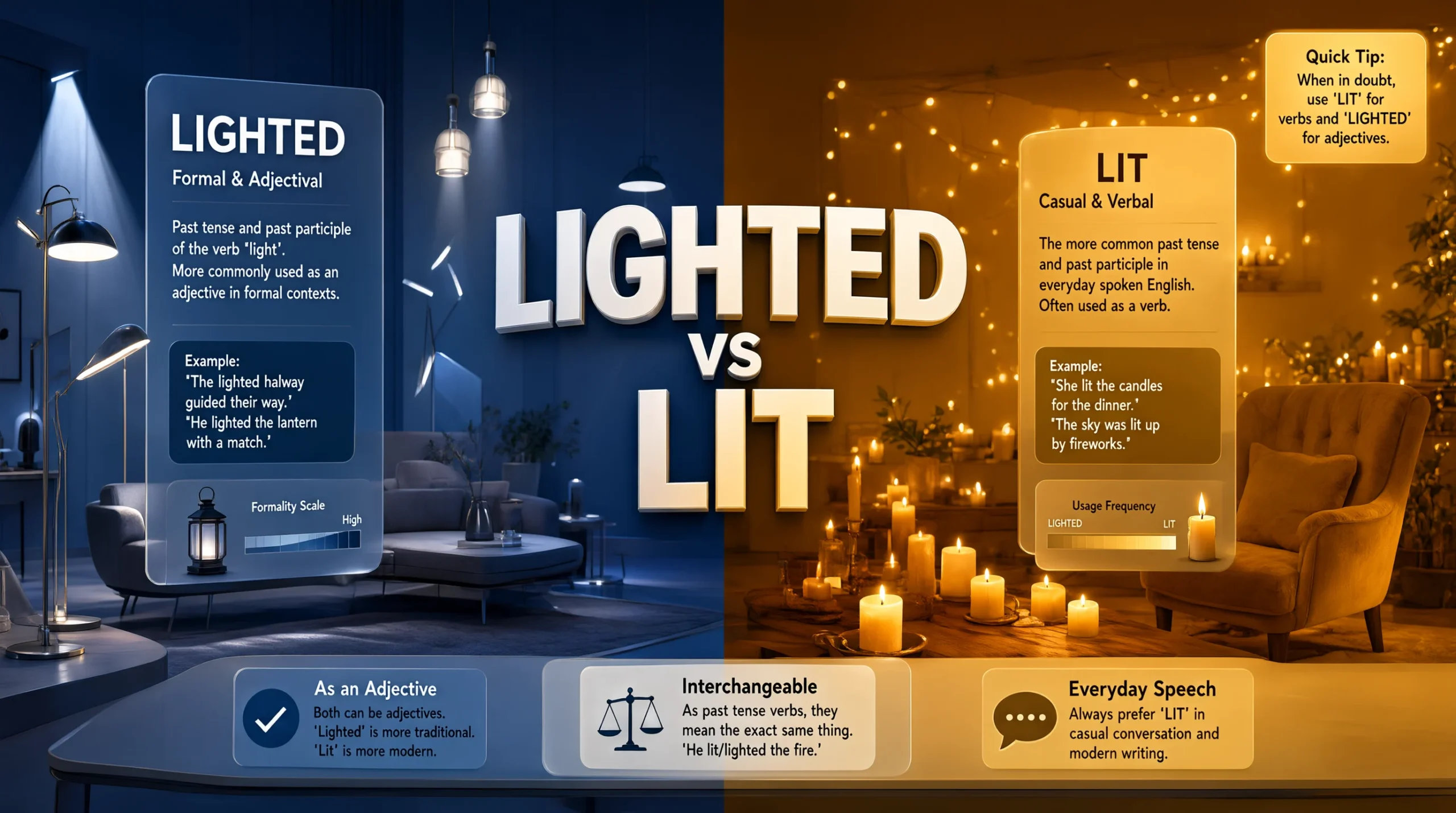
Choosing between lighted vs lit can be confusing because both words are correct forms of the verb light. They describe something that has been made bright, set on fire, or illuminated. However, they can differ slightly in usage, style, and context.
The main difference is that lit is the more common past tense and past participle of light, while lighted is also grammatically correct and is often used when describing something that has been illuminated or provided with light. For example, you can say, “She lit a candle” or “She lighted a candle.” Both sentences are correct. Similarly, “a lit candle” and “a lighted candle” are acceptable. Understanding these forms will help you choose the right word in everyday conversations, academic writing, and formal English.
Quick Answer
Lit and lighted are both correct past tense and past participle forms of the verb light. Lit is more common in modern English, especially in everyday speech. Lighted is also correct and frequently appears in descriptive expressions such as “a lighted room” or “a lighted candle.”
Why Do People Confuse Lighted and Lit?
People confuse these words because they share the same basic meaning and grammatical function. Both can describe an action that happened in the past or a condition resulting from that action.
The confusion also comes from irregular and regular verb forms.
- Lit: An irregular verb form.
- Lighted: A regular-style verb form.
English speakers commonly use both forms, but their preferences may change depending on the sentence and writing style.
For example:
- He lit the fireplace.
- He lighted the fireplace.
Both sentences are grammatically correct and communicate the same basic action.
First Word: Lighted
Lighted is the past tense and past participle form of the verb light. It means to make something bright, illuminate an area, or set something on fire.
It is a regular-style form that adds “-ed” to the base verb.
Meaning of Lighted
Lighted means illuminated, brightened, or caused to burn.
It can describe candles, rooms, streets, buildings, fireplaces, and other objects that produce or receive light.
Examples of Lighted
- The lighted candles decorated the dining table.
- We walked along a lighted street at night.
- She lighted the fireplace before dinner.
- The building was beautifully lighted for the celebration.
- He entered the lighted room quietly.
When Is Lighted Used?
Lighted is often used in descriptive writing, particularly when emphasizing the condition of something being illuminated.
Common expressions include:
- Lighted candle
- Lighted room
- Lighted street
- Lighted fireplace
- Lighted sign
- Lighted pathway
Second Word: Lit
Lit is the irregular past tense and past participle form of the verb light. It means to make something bright, illuminate it, or cause it to burn.
It is widely used in everyday English and is generally the more natural choice in conversational writing.
Meaning of Lit
Lit means illuminated, set on fire, or made bright.
It can describe an action or the resulting condition of an object.
Examples of Lit
- She lit a candle during the power outage.
- He lit the fire to keep everyone warm.
- The room was lit by a small lamp.
- They lit the lantern before leaving.
- The candles were lit before the guests arrived.
When Is Lit Used?
Lit is commonly used in everyday conversations, informal writing, and many formal contexts.
Common expressions include:
- Lit candle
- Lit fire
- Lit cigarette
- Lit match
- Lit lantern
- Well-lit room
It is also used in modern slang. For example, “The party was lit” means the party was exciting or enjoyable. This informal meaning is different from its traditional meaning of illuminated or set on fire.
Lighted vs Lit: Comparison Table
| Feature | Lighted | Lit |
| Base verb | Light | Light |
| Grammatical form | Past tense and past participle | Past tense and past participle |
| Meaning | Illuminated or set on fire | Illuminated or set on fire |
| Usage | Correct, sometimes more descriptive | More common in everyday English |
| Style | Often descriptive | Natural and widely used |
| Example | A lighted candle | A lit candle |
| Informal slang | Less common | Can mean exciting or excellent |
When Should You Use Lighted or Lit?
Both forms are correct, but choosing the right one depends on your sentence and preferred writing style.
Use Lighted When:
- You want to describe an illuminated object.
- You are writing descriptive prose.
- You prefer the regular-style form.
- You want to emphasize an object’s illuminated condition.
Examples:
- The lighted windows looked beautiful.
- A lighted candle stood beside the book.
- We followed the lighted pathway.
Use Lit When:
- You are speaking in everyday conversations.
- You are describing an action in the past.
- You want a natural and concise expression.
- You are using common expressions such as “well-lit room.”
Examples:
- She lit the candle.
- He lit the match.
- The room was lit with soft lamps.
Helpful tip: When you are unsure, choose lit. It is widely accepted and sounds natural in most modern English contexts.
12 Examples of Lighted vs Lit in Sentences
Here are practical examples showing how both words work in similar sentences.
| Lighted | Lit |
| She lighted a candle. | She lit a candle. |
| He lighted the fireplace. | He lit the fireplace. |
| They lighted the lantern. | They lit the lantern. |
| The lighted room looked welcoming. | The lit room looked welcoming. |
| We walked along a lighted street. | We walked along a lit street. |
| She lighted the match. | She lit the match. |
| The lighted candles smelled wonderful. | The lit candles smelled wonderful. |
| He lighted a cigarette. | He lit a cigarette. |
| The building was lighted at night. | The building was lit at night. |
| They lighted the campfire. | They lit the campfire. |
| The lighted sign attracted attention. | The lit sign attracted attention. |
| The hallway was lighted by lamps. | The hallway was lit by lamps. |
These examples demonstrate that both words can work in similar contexts without changing the basic meaning.
Common Mistakes When Using Lighted and Lit
Although both words are correct, some learners make mistakes when using them.
1. Thinking Lighted Is Incorrect
Incorrect assumption: “Lighted” is not a real English word.
Correction: Lighted is a grammatically correct form of the verb light.
2. Thinking Lit Is Only Slang
Some people associate lit with modern slang, but it also has a traditional grammatical meaning.
For example:
- She lit the candle.
- The fireplace was lit.
Both sentences use lit in its standard English sense.
3. Using Both Forms Together Unnecessarily
Avoid combining both forms in the same verb construction.
Incorrect: She has lit the candle lighted.
Correct: She has lit the candle.
Correct: She has lighted the candle.
4. Confusing Lit With Light
Remember that light is the base form, while lit and lighted are past forms.
- Present: I light a candle.
- Past: I lit a candle.
- Past participle: I have lit a candle.
Memory Trick: How to Remember Lighted vs Lit
A simple memory trick can help you remember the difference.
Think of “lit” as the short and common form. It is usually the easiest choice for everyday English.
Think of “lighted” as the longer descriptive form. It is useful when describing illuminated objects and places.
Remember these examples:
- I lit the candle.
- The lighted candle looked beautiful.
Both are correct, so you do not need to worry about choosing one as the only acceptable form.
Lighted vs Lit in American and British English
Both American and British English accept lighted and lit. Neither form belongs exclusively to one variety of English.
However, lit is widely used in both varieties, particularly in everyday conversation.
| English Variety | Lit | Lighted |
| American English | Common | Correct |
| British English | Common | Correct |
| Formal writing | Accepted | Accepted |
| Everyday speech | Very common | Less common in many contexts |
For example:
- American English: She lit the fireplace.
- British English: She lit the fireplace.
Both sentences are natural and grammatically correct.
The choice is mainly about style and context rather than a strict difference between American and British spelling.
Similar Words Related to Lighted and Lit
Understanding related words can help you expand your vocabulary and describe light more accurately.
| Word | Simple Meaning | Example |
| Illuminated | Made bright with light | The building was illuminated. |
| Brightened | Made lighter or brighter | The lamp brightened the room. |
| Glowing | Giving off a soft light | The glowing candle looked beautiful. |
| Shining | Producing or reflecting light | The shining lamp caught my attention. |
| Lighted | Made bright or set on fire | The lighted candle was on the table. |
| Lit | Made bright or set on fire | He lit the match. |
| Ablaze | Burning strongly or brightly | The fireplace was ablaze. |
| Radiant | Giving off or reflecting light | The radiant room looked cheerful. |
These words are related but are not always interchangeable. Choose the one that best communicates your intended meaning.
Final Verdict: Lighted or Lit?
The correct choice is that both lighted and lit are grammatically correct. They are two accepted past tense and past participle forms of the verb light.
However, lit is generally more common and natural in modern everyday English. Lighted is also useful, especially in descriptive writing and expressions such as “lighted candle” or “lighted pathway.”
If you are writing a sentence and cannot decide which form to use, choose lit. It is a reliable option in most situations.
FAQs:
1. Is It Lit or Lighted?
Both are correct. Lit is the more common form in modern English, while lighted is also grammatically acceptable.
For example:
- She lit a candle.
- She lighted a candle.
Both sentences are correct.
2. Is Lighted a Real Word?
Yes, lighted is a real and grammatically correct English word. It is the past tense and past participle form of the verb light.
Example: The lighted room looked warm and inviting.
3. Is Lit More Correct Than Lighted?
No. Neither form is more grammatically correct than the other. However, lit is more commonly used in everyday modern English.
4. Should I Write Well-Lit or Well-Lighted?
Both expressions are correct, but well-lit is generally the more common and natural choice.
Example: The students studied in a well-lit classroom.
5. What Is the Past Tense of Light?
The past tense of light can be either lit or lighted.
Examples:
- He lit the candle.
- He lighted the candle.
Both are correct.
6. Is Lit Slang or Proper English?
Lit is both proper English and modern slang.
Its traditional meaning is illuminated or set on fire. In informal slang, it can describe something exciting, entertaining, or excellent.
Example: The party was lit!
7. Is It Lighted a Candle or Lit a Candle?
Both expressions are grammatically correct. However, “lit a candle” is more common and natural in everyday English.
Example: She lit a candle before going to bed.
Remember This
- Lit: The more common past tense and past participle of light.
- Lighted: Another correct past tense and past participle form.
- Both: Can mean illuminated, brightened, or set on fire.
- Everyday English: Lit is generally the preferred choice.
- Descriptive writing: Lighted is also useful and correct.
Conclusion
Understanding the difference between lighted and lit is simple once you know that both words are correct forms of the verb light. They share the same basic meaning, but lit is generally more common in everyday English, while lighted can be useful in descriptive sentences.
If you write “she lit a candle” or “she lighted a candle,” your sentence is grammatically correct. Remember that lit is usually the easiest choice when you want natural, clear, and modern English.

I’m Jaxon James, an author at SaysReply, where I share simple, clear, and natural alternative ways to say things and help readers express their thoughts better.