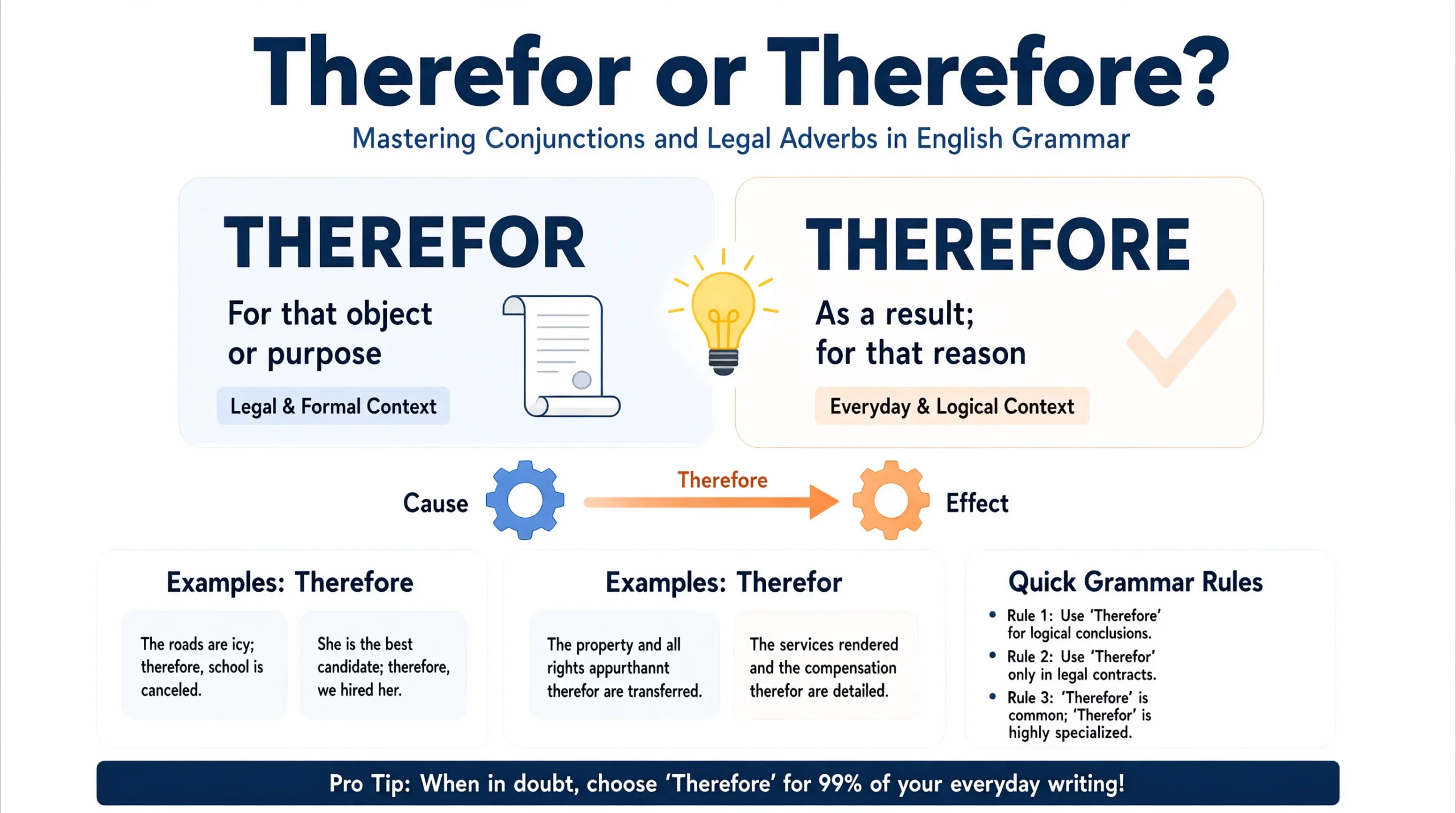
Have you ever wondered if to write therefor or therefore? These two words look almost identical, but they have different meanings and uses. If you are writing an email, completing a school assignment, preparing a report, or improving your English vocabulary, knowing the difference can help you avoid common spelling mistakes.
The correct word in most everyday situations is therefore, which means “for that reason” or “as a result.” You use it to connect an idea with its conclusion. For example, “It was raining; therefore, we stayed home.” The word therefor is also a real English word, but it is much less common. It generally means “for that” or “in exchange for that” and appears mainly in legal, financial, or formal contexts. Understanding when to use each word will make your writing clearer and more accurate.
Quick Answer: Therefor or Therefore?
Therefore is the correct choice when you mean “for that reason,” “consequently,” or “as a result.” For example, “She studied hard; therefore, she passed the exam.” Therefor is a separate, uncommon word meaning “for that” or “in exchange for that.” In everyday English, you will almost always need “therefore.”
Why Do People Confuse Therefor and Therefore?
People often confuse these words because they differ by only one letter. Both begin with “therefor,” making it easy to leave out the final e when spelling “therefore.”
Another reason is pronunciation. In ordinary speech, the final vowel in “therefore” may be weak, so the difference is not always obvious when people hear the word.
Autocorrect and fast typing can also contribute to the mistake. Writers may accidentally type “therefor” when they intend to express a conclusion.
The simplest way to avoid confusion is to focus on meaning rather than spelling alone.
First Word: Therefore
Therefore is an adverb that means “for that reason,” “as a result,” or “consequently.” It shows that one statement follows logically from another.
Meaning of Therefore
Use “therefore” when the information in one sentence explains or supports the result in another.
Examples:
- The road was blocked; therefore, we took another route.
- He forgot his password; therefore, he could not log in.
- The evidence was incomplete; therefore, the investigation continued.
In each example, “therefore” introduces a result or conclusion based on the preceding information.
How to Use Therefore in a Sentence
“Therefore” can appear at the beginning, middle, or end of a sentence, depending on the intended structure.
At the beginning:
- Therefore, we decided to postpone the meeting.
- Therefore, the answer must be incorrect.
In the middle:
- The shop was closed and therefore unavailable to customers.
- The figures were inaccurate and therefore needed revision.
Between two independent clauses:
- The weather was dangerous; therefore, the flight was canceled.
When “therefore” connects two independent clauses, a semicolon before it and a comma after it is a common, clear punctuation choice.
Second Word: Therefor
Therefor is a real English word, but it is rarely used in everyday conversation or general writing. It generally means “for that” or “in exchange for that.”
It often appears in legal documents, contracts, and financial language, where a specific exchange, payment, or consideration is being described.
Meaning of Therefor
The word “therefor” refers to something given, paid, or provided in exchange for something else.
Examples:
- The agreement specified the amount payable therefor.
- The company received payment therefor under the contract.
- The document described the services provided and the compensation therefor.
These examples use “therefor” in a formal sense, referring to payment or compensation for something previously mentioned.
Is Therefor a Common English Word?
No. Although “therefor” is grammatically valid, it is uncommon in modern everyday English. Most readers are more familiar with “therefore.”
If you are writing a school essay, a casual message, a blog post, or a standard business email, you will usually want “therefore” when expressing a result.
Therefor vs. Therefore: Comparison Table
| Feature | Therefore | Therefor |
| Meaning | For that reason; as a result | For that; in exchange for that |
| Part of speech | Adverb | Adverb |
| Common usage | Everyday and formal writing | Mainly legal or formal writing |
| Purpose | Shows a result or conclusion | Refers to an exchange or something provided for something else |
| Example | It was late; therefore, we left. | The amount payable therefor was agreed upon. |
| Frequency | Very common | Rare |
| Best choice for general writing | Yes | Only when its specific meaning is intended |
The key difference is meaning: therefore expresses a conclusion, while therefor refers to something given or paid in exchange.
When to Use Each Word
When Should You Use Therefore?
Use “therefore” when you want to explain the result of an action, situation, fact, or decision.
Choose “therefore” when:
- You are explaining a consequence.
- You are presenting a logical conclusion.
- You are writing an essay or report.
- You are connecting evidence to a conclusion.
- You are explaining why something happened.
Examples:
- The team practiced regularly; therefore, its performance improved.
- The information was incorrect; therefore, we corrected the report.
- She missed the bus and therefore arrived late.
When Should You Use Therefor?
Use “therefor” only when you specifically mean “for that” or “in exchange for that,” especially in formal or legal writing.
Choose “therefor” when:
- You are interpreting a legal agreement.
- You are describing compensation for a service.
- You are referring to payment for something previously mentioned.
- The context requires the traditional formal meaning.
Example:
“The contractor completed the work and received the agreed payment therefor.”
In ordinary writing, you could make the sentence clearer by saying, “The contractor completed the work and received the agreed payment for it.”
12 Examples of Therefor and Therefore in Sentences
These examples show how the two words work in different contexts.
Examples Using Therefore
- The store was closed; therefore, we returned home.
“Therefore” introduces the result of the store being closed. - She practiced every day; therefore, her skills improved.
It connects regular practice with improvement. - The train was delayed; therefore, we arrived late.
The delay explains the late arrival. - He did not submit the application; therefore, he was not considered.
It introduces the consequence of not applying. - The evidence supported the claim; therefore, the judge accepted it.
It presents a conclusion based on evidence. - It was getting dark, and therefore we decided to leave.
“Therefore” connects the situation with the decision. - The instructions were unclear; therefore, the team requested clarification.
It shows the reason for asking questions. - Water is essential for life; therefore, conserving it matters.
It introduces a conclusion based on the importance of water.
Examples Using Therefor
- The contract stated the amount payable therefor.
The word refers to payment for something previously mentioned. - The supplier received the agreed compensation therefor.
It refers to compensation in exchange for goods or services. - The document specified the fee and the conditions applicable therefor.
The word refers to the fee or its associated conditions, although a clearer modern rewrite may be preferable. - The parties agreed on the price and the consideration payable therefor.
It refers to the payment or consideration exchanged under the agreement.
Remember that “therefor” is unusual in ordinary English. In most of these formal examples, phrases such as “for it,” “for those services,” or “in exchange for that” may sound more natural to modern readers.
Common Mistakes With Therefor and Therefore
1. Using Therefor to Show a Result
Incorrect: It was raining; therefor, we stayed inside.
Correct: It was raining; therefore, we stayed inside.
Why? The sentence explains a result, so “therefore” is needed.
2. Adding an Extra E to Therefor in a Legal Phrase
If a legal or financial sentence specifically means “in exchange for that,” changing “therefor” to “therefore” may change the intended meaning.
For example:
“The amount payable therefor was specified in the agreement.”
Here, “therefor” refers to payment for something previously mentioned.
3. Assuming Therefor Is Always a Spelling Error
Incorrect assumption: “Therefor” is never a real word.
Correct understanding: “Therefor” is valid but uncommon. Whether it is correct depends on the sentence’s meaning.
4. Using Therefore Without a Logical Connection
Weak: “I bought a notebook; therefore, the sky is blue.”
Better: “I needed to take notes; therefore, I bought a notebook.”
“Therefore” should introduce a conclusion or result that logically follows from the preceding information.
5. Forgetting Punctuation
Incorrect: The meeting ended therefore we went home.
Clearer: The meeting ended; therefore, we went home.
You can also write: “The meeting ended, so we went home.”
Correct punctuation helps readers understand the relationship between the two ideas.
Easy Memory Trick: Therefor or Therefore
Use this simple memory trick to remember the difference.
Therefore = the reason or result.
Think of “therefore” as a word that answers the question, “What happened as a result?”
Example: “I was tired; therefore, I went to bed.”
Therefor = for that.
Think of “therefor” as referring to something provided or paid in exchange for something else.
Example: “The contract stated the payment therefor.”
Another useful trick is to remember that therefore has an extra E, just like the extra step of explaining an effect or conclusion.
If you are unsure, replace the word with “as a result.” If the sentence still makes sense, “therefore” is probably the right choice.
American vs. British English: Is There a Difference?
There is no meaningful American-versus-British spelling difference between “therefor” and “therefore.” Both forms exist in both varieties of English, and their meanings remain essentially the same.
| Point | American English | British English |
| Correct spelling for a result | Therefore | Therefore |
| Meaning of therefore | As a result | As a result |
| Use of therefor | Rare, mainly formal or legal | Rare, mainly formal or legal |
| Spelling variation | No difference | No difference |
For example, an American writer might say, “The roads were icy; therefore, school was canceled.” A British writer can use exactly the same sentence.
The choice depends on meaning, not nationality.
Similar Words and Alternatives
Several words can replace “therefore” when you want to express a result or conclusion.
| Word or phrase | Meaning | Example |
| Consequently | As a result | The roads flooded; consequently, traffic slowed. |
| Thus | As a result or in this way | The evidence was incomplete; thus, no decision was made. |
| Hence | For this reason | The deadline passed; hence, the delay. |
| Accordingly | In a way that follows from the circumstances | The rules changed; accordingly, we revised the plan. |
| As a result | Because of what happened before | It snowed heavily; as a result, flights were canceled. |
| So | For that reason | I was tired, so I went home. |
| For that reason | Because of the stated situation | The figures were wrong; for that reason, we checked them again. |
For “therefor,” possible alternatives depend on the context. Phrases such as “for it,” “for that,” “in exchange for that,” and “in return for it” may work when they preserve the intended meaning.
However, these alternatives are not interchangeable in every sentence. Always consider what the original sentence is trying to communicate.
Final Verdict: Therefor or Therefore?
For almost all everyday writing, therefore is the word you want when expressing a result, reasoned conclusion, or consequence.
Use “therefore” in school assignments, essays, emails, reports, and general communication. For example, “The instructions were incomplete; therefore, we asked for clarification.”
Use “therefor” only when you specifically mean “for that” or “in exchange for that,” particularly in formal or legal contexts.
The easiest rule is this: if you can replace the word with “as a result,” write therefore. If the sentence refers to something provided or paid in exchange for something else, therefor may be appropriate.
FAQs:
1. Is therefor or therefore correct?
Both words are correct, but they have different meanings. “Therefore” means “for that reason” or “as a result.” “Therefor” means “for that” or “in exchange for that” and is mainly used in formal contexts.
2. Is therefor a real word?
Yes. “Therefor” is a legitimate English word, not simply a misspelling of “therefore.” It is uncommon in everyday writing but may appear in legal and financial documents.
3. What does therefore mean in simple English?
“Therefore” means “because of that” or “as a result.” For example, “I forgot my umbrella; therefore, I got wet.”
4. How do you spell therefore correctly?
The correct spelling is t-h-e-r-e-f-o-r-e. It ends with an additional “e” compared with “therefor.”
5. Can I use therefor in an essay?
Usually, no. If you are explaining a result or conclusion, use “therefore.” Use “therefor” only if your sentence specifically requires its less common meaning, such as referring to payment under a contract.
6. What is the difference between therefor and therefore in legal writing?
In legal writing, “therefor” can mean “for that” or “in exchange for that,” often referring to payment or consideration. “Therefore” still means “for that reason” or “consequently.” The surrounding sentence determines which word is appropriate.
7. Is there a difference between therefore and therefor in American and British English?
No significant regional spelling difference exists. Both forms are recognized in American and British English, and the distinction is based on meaning rather than regional preference.
8. What word can I use instead of therefore?
You can use “consequently,” “thus,” “hence,” “accordingly,” “so,” or “as a result.” Choose the alternative that fits your sentence and writing style.
Remember This
- Therefore = for that reason, consequently, or as a result.
- Therefor = for that or in exchange for that.
- Therefore is the standard choice for everyday writing.
- Therefor is rare and mainly appears in formal, legal, or financial contexts.
- Both words are valid, but they are not interchangeable.
When in doubt, ask yourself whether you are explaining a result. If you are, use “therefore.”
Conclusion
Understanding the difference between “therefor” and “therefore” is a simple way to improve your spelling and make your writing clearer. Although the words look almost identical, their meanings are different. “Therefore” expresses a result or conclusion, while “therefor” refers to something given or paid in exchange for something else.
For students, English learners, and everyday writers, the most useful rule is to choose “therefore” whenever you mean “as a result.” Save “therefor” for the rare situations in which its specific meaning is necessary. With this distinction in mind, you can write more confidently and avoid one of English’s easily overlooked word-choice mistakes.

I’m Sawyer Michael, a writer passionate about language and communication. I enjoy helping readers discover clearer, more natural, and creative ways to express their thoughts through words.










1 thought on “Therefor or Therefore: Which Spelling Is Correct?”