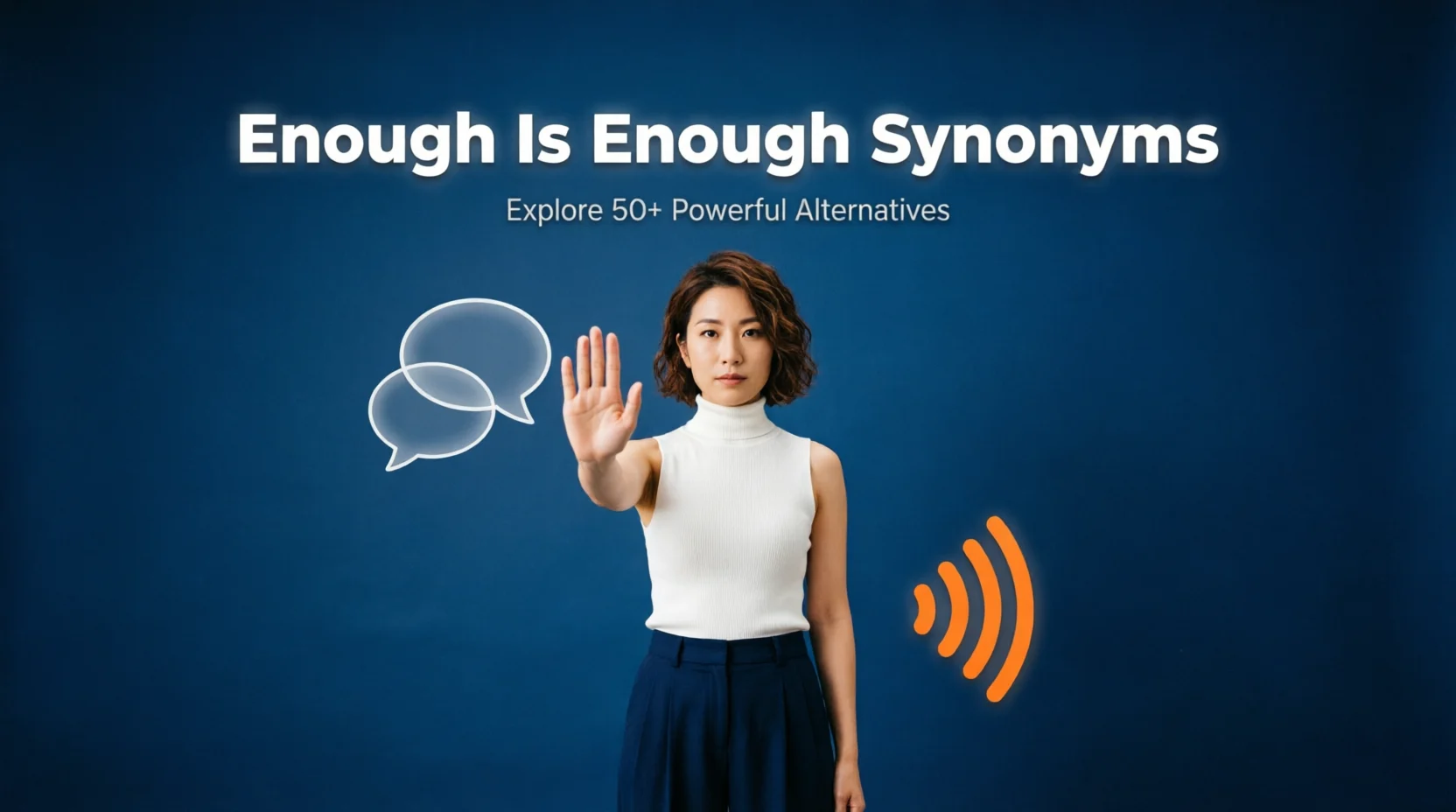
Looking for the best enough is enough synonyms to express frustration, set boundaries, or show that you will no longer tolerate something? Common alternatives include I’ve had it, that’s the last straw, no more, this has to stop, I’ve reached my limit, and I’ve had enough. Each phrase communicates that a situation has become unacceptable, but some sound calm and firm while others express anger or strong frustration.
If you are writing a message, improving your English vocabulary, or looking for a powerful phrase to use in conversation, choosing the right alternative helps you express your feelings clearly and naturally.
Quick Answer: What Are the Best Synonyms for “Enough Is Enough”?
“Enough is enough” means that you will not accept or tolerate a situation any longer. It often expresses frustration, disappointment, anger, or a firm decision to stop allowing something to continue.
Here are some of the best alternatives:
- I’ve had enough: I cannot tolerate this situation any longer.
- I’ve had it: I am extremely frustrated.
- That’s the last straw: One final event has pushed me beyond my limit.
- No more: I refuse to accept any further instances of something.
- This has to stop: The situation must end.
- I’ve reached my limit: I cannot handle any more.
- I’m done with this: I no longer want to deal with the situation.
- Not anymore: I will no longer allow or accept this.
- Enough already: Stop doing or saying something that has gone on too long.
- I’ve drawn the line: I have established a firm boundary.
For example, instead of saying, “Enough is enough with these constant excuses,” you could say, “I’ve had enough of these constant excuses.” Both sentences communicate frustration and a refusal to tolerate the behavior any longer.
What Does “Enough Is Enough” Mean?
The expression “enough is enough” is an idiom used when someone decides that a situation has gone too far and must stop.
It often follows repeated problems, broken promises, unfair treatment, unnecessary arguments, or behavior that someone no longer wishes to tolerate.
1. Expressing Frustration
The phrase can show that someone has become tired or angry because a problem keeps happening.
Example: Enough is enough! I’m tired of hearing the same excuses every day.
Similar expressions: I’ve had it, I’ve had enough, that’s enough already.
2. Setting Personal Boundaries
It can communicate that someone will no longer accept certain behavior.
Example: Enough is enough. I will not tolerate being spoken to disrespectfully.
Similar expressions: I’ve drawn the line, no more, this has to stop.
3. Ending an Argument or Repeated Problem
The phrase can signal a decision to stop an argument, activity, or pattern of behavior.
Example: Enough is enough. Let’s stop arguing and find a solution.
Similar expressions: Let’s put an end to this, this ends now, no more arguments.
4. Showing That a Final Event Has Gone Too Far
Sometimes one additional incident becomes the reason someone finally decides to act.
Example: When he broke another promise, that was the last straw.
Similar expressions: That’s the final straw, I’ve reached my limit, I’ve had it.
30 Synonyms for “Enough Is Enough” With Meanings and Examples
The following expressions vary in tone. Some are polite and controlled, while others sound emotional, forceful, or confrontational. Choose the phrase that matches your situation.
1. I’ve Had Enough
Simple meaning: I will not tolerate any more of this situation.
Example sentence: I’ve had enough of the constant delays and excuses.
Best usage/context: A natural, versatile alternative for everyday conversations, personal relationships, workplace frustrations, and repeated problems.
2. I’ve Had It
Simple meaning: I am extremely frustrated and cannot tolerate the situation any longer.
Example sentence: I’ve had it with his broken promises.
Best usage/context: Informal conversations when you want to express strong irritation or emotional exhaustion.
3. That’s the Last Straw
Simple meaning: One final problem has made an already difficult situation unbearable.
Example sentence: She missed another important meeting, and that was the last straw.
Best usage/context: Use it when a final incident pushes someone beyond their limit after several earlier problems.
4. No More
Simple meaning: Nothing further will be accepted or allowed.
Example sentence: No more excuses; we need to finish the work today.
Best usage/context: Short, direct statements that establish a firm boundary or demand an immediate change.
5. This Has to Stop
Simple meaning: The current behavior or situation must end.
Example sentence: This constant blaming has to stop.
Best usage/context: Suitable for serious conversations, repeated misconduct, arguments, and situations that require change.
6. I’ve Reached My Limit
Simple meaning: I cannot handle any more stress, frustration, or difficulty.
Example sentence: I’ve reached my limit with these endless last-minute changes.
Best usage/context: Use it to communicate emotional exhaustion or a personal boundary without necessarily sounding aggressive.
7. I’m Done With This
Simple meaning: I no longer want to continue dealing with the situation.
Example sentence: I’m done with this endless argument.
Best usage/context: Informal conversations when you want to end an interaction or withdraw from a frustrating situation.
8. Enough Already
Simple meaning: Stop because something has gone on for too long.
Example sentence: Enough already! We’ve discussed this issue all afternoon.
Best usage/context: Useful when someone repeats the same complaint, excuse, question, or behavior too often.
9. Not Anymore
Simple meaning: Something that was once accepted or continued will no longer be allowed.
Example sentence: I used to accept these unfair conditions, but not anymore.
Best usage/context: Best for expressing a change in attitude, expectations, or personal boundaries.
10. I’ve Drawn the Line
Simple meaning: I have established a firm limit that must not be crossed.
Example sentence: I’ve drawn the line at disrespectful behavior.
Best usage/context: Appropriate when communicating clear personal, professional, or relationship boundaries.
11. That’s Enough
Simple meaning: Stop because the current amount or behavior is sufficient or excessive.
Example sentence: That’s enough arguing for one day.
Best usage/context: Suitable for everyday situations, parenting, disagreements, and requests to stop an activity.
12. I’ve Had My Fill
Simple meaning: I have experienced or tolerated as much as I can stand.
Example sentence: I’ve had my fill of workplace gossip.
Best usage/context: A natural expression for situations, habits, or experiences that have become tiresome.
13. I’ve Reached the Breaking Point
Simple meaning: I have reached the stage where I can no longer cope with the pressure.
Example sentence: After months of working without support, she reached the breaking point.
Best usage/context: Use it for intense stress, prolonged pressure, emotional exhaustion, or a serious personal limit.
14. This Is the Final Straw
Simple meaning: This is the last problem I am willing to tolerate.
Example sentence: The unexpected cancellation was the final straw.
Best usage/context: Similar to “that’s the last straw,” especially when explaining why you have decided to take action.
15. I’m Fed Up
Simple meaning: I am tired, annoyed, or frustrated with something.
Example sentence: I’m fed up with people ignoring the rules.
Best usage/context: Informal conversations about repeated annoyances, unfair treatment, or persistent problems.
16. I’ve Lost My Patience
Simple meaning: I can no longer remain patient with the situation.
Example sentence: I’ve lost my patience with the repeated delays.
Best usage/context: Suitable for expressing frustration when someone’s behavior or a problem has continued for too long.
17. I Won’t Put Up With This
Simple meaning: I refuse to tolerate the current behavior or situation.
Example sentence: I won’t put up with being blamed for someone else’s mistakes.
Best usage/context: Use it when you want to make a strong statement about unacceptable behavior.
18. This Ends Now
Simple meaning: The situation must stop immediately.
Example sentence: The bullying has continued for too long. This ends now.
Best usage/context: A forceful expression for serious situations in which an immediate end is necessary.
19. I’m Sick and Tired of This
Simple meaning: I am extremely annoyed or exhausted by something repeated.
Example sentence: I’m sick and tired of hearing the same complaints without any solutions.
Best usage/context: Informal and emphatic conversations where you want to express strong frustration.
20. I’ve Had All I Can Take
Simple meaning: I cannot tolerate or manage any more of the situation.
Example sentence: I’ve had all I can take from these constant arguments.
Best usage/context: Use it when frustration has built up over time and you feel unable to continue tolerating the problem.
21. Cut It Out
Simple meaning: Stop doing something annoying or inappropriate.
Example sentence: Cut it out! Your jokes are making everyone uncomfortable.
Best usage/context: Informal requests to stop irritating, disruptive, or inappropriate behavior. It can sound sharp or impatient.
22. Put an End to This
Simple meaning: Take action to make the situation stop.
Example sentence: We need to put an end to this cycle of blame.
Best usage/context: Suitable for formal discussions, workplace situations, repeated conflicts, and problem-solving conversations.
23. I’m Not Taking This Anymore
Simple meaning: I refuse to continue accepting the current treatment or situation.
Example sentence: I’m not taking this unfair treatment anymore.
Best usage/context: Informal, assertive communication when someone wants to reject continued mistreatment or unreasonable demands.
24. I’ve Had Enough of This Nonsense
Simple meaning: I refuse to tolerate behavior or explanations that I consider unreasonable.
Example sentence: I’ve had enough of this nonsense; let’s focus on the actual problem.
Best usage/context: Informal situations involving excuses, pointless arguments, unreasonable demands, or disruptive behavior. It may sound dismissive.
25. No Longer Acceptable
Simple meaning: Something cannot reasonably be allowed or approved anymore.
Example sentence: These repeated safety violations are no longer acceptable.
Best usage/context: Professional, academic, and formal communication when stating that behavior or conditions must change.
26. This Cannot Continue
Simple meaning: The current situation must change because continuing it is not reasonable.
Example sentence: This pattern of missed deadlines cannot continue.
Best usage/context: Workplace discussions, serious conversations, formal warnings, and situations requiring improvement.
27. I’ve Come to the End of My Rope
Simple meaning: I have run out of patience, energy, or ability to cope.
Example sentence: I’ve come to the end of my rope trying to resolve the same issue.
Best usage/context: Informal English, especially when describing prolonged stress or frustration.
28. I’ve Reached the End of My Tether
Simple meaning: I have reached the point where I can no longer tolerate a difficult situation.
Example sentence: I’m at the end of my tether after dealing with these constant complaints.
Best usage/context: Common in British English, particularly when expressing extreme frustration or emotional exhaustion.
29. I Won’t Tolerate This Any Longer
Simple meaning: I refuse to continue accepting the situation.
Example sentence: I won’t tolerate this disrespectful behavior any longer.
Best usage/context: Strong, clear language for setting boundaries in professional, personal, or formal situations.
30. I’ve Reached My Breaking Point
Simple meaning: I can no longer cope with the pressure or frustration.
Example sentence: I’ve reached my breaking point with the constant demands.
Best usage/context: Suitable for expressing intense pressure or emotional exhaustion after a prolonged difficult experience.
Comparison Table: Which “Enough Is Enough” Synonym Should You Use?
| Expression | Main meaning | Tone | Best context |
|---|---|---|---|
| I’ve had enough | Cannot tolerate more | Firm | Everyday conversations |
| I’ve had it | Extremely frustrated | Informal, strong | Personal frustrations |
| That’s the last straw | Final problem crosses the limit | Emotional | Repeated disappointments |
| No more | Refuses further acceptance | Direct | Boundaries and demands |
| This has to stop | Behavior must end | Serious | Repeated problems |
| I’ve reached my limit | Cannot handle more | Firm, personal | Stress and pressure |
| I’m done with this | Will not continue | Informal | Ending an argument |
| Enough already | Stop the repetition | Impatient | Repeated complaints |
| I’ve drawn the line | Established a boundary | Assertive | Rules and expectations |
| I’m fed up | Tired and annoyed | Informal | Everyday frustrations |
| Cut it out | Stop doing that | Sharp, casual | Annoying behavior |
| This ends now | Immediate stop required | Forceful | Serious situations |
| No longer acceptable | Cannot be approved | Formal | Workplace communication |
| This cannot continue | Change is necessary | Professional | Performance and conduct |
| I won’t tolerate this any longer | Refuses further mistreatment | Strong, formal | Boundary-setting |
How to Choose the Right Synonym for “Enough Is Enough”
The best expression depends on your tone, intended meaning, and the person you are speaking to.
1. Choose by Tone
Polite and calm
- This has gone far enough.
- I think we need to stop here.
- This is no longer acceptable.
Example: I think these repeated delays have gone far enough, and we need a better plan.
Firm and assertive
- I’ve drawn the line.
- I won’t tolerate this any longer.
- This has to stop.
Example: I’ve drawn the line at disrespectful comments.
Angry or frustrated
- I’ve had it.
- I’m fed up.
- I’ve had enough of this nonsense.
Example: I’m fed up with the constant excuses.
Strong and dramatic
- That’s the last straw.
- I’ve reached my breaking point.
- This ends now.
Example: Canceling the meeting again was the last straw.
2. Choose by Meaning
To express frustration: Use I’ve had enough, I’m fed up, or I’ve lost my patience.
To establish boundaries: Use I’ve drawn the line, no more, or I won’t put up with this.
To stop an argument: Use That’s enough, cut it out, or let’s put an end to this.
To respond to repeated disappointment: Use that’s the last straw or this is the final straw.
To describe emotional exhaustion: Use I’ve reached my limit, I’ve had all I can take, or I’ve reached my breaking point.
To sound professional: Use this cannot continue, no longer acceptable, or this needs to stop.
3. Choose by Intent
- To ask someone to stop immediately: Say, “That’s enough” or “This has to stop.”
- To express personal frustration: Say, “I’ve had enough” or “I’m fed up.”
- To communicate a boundary: Say, “I won’t tolerate this any longer.”
- To explain a final decision: Say, “That’s the last straw.”
- To end an unproductive discussion: Say, “Let’s put an end to this.”
- To address a recurring workplace problem: Say, “This cannot continue.”
- To show that your attitude has changed: Say, “Not anymore.”
Common Mistakes When Using “Enough Is Enough” Synonyms
1. Using “That’s the Last Straw” for a Minor Problem
The phrase usually suggests that several problems have accumulated and one final event has pushed someone beyond their limit.
Less suitable: I spilled a little water, and that’s the last straw!
More natural: That’s frustrating.
Use “that’s the last straw” when the event has greater significance in the wider situation.
2. Confusing “I’ve Had Enough” With “That’s Enough”
“I’ve had enough” expresses your own frustration or limit. “That’s enough” usually tells someone that something should stop or that the current amount is sufficient.
Examples:
- I’ve had enough of these delays.
- That’s enough arguing for today.
The first describes your feelings; the second can be a direct instruction.
3. Using Informal Expressions in Formal Situations
Phrases such as “I’ve had it,” “cut it out,” and “I’m sick and tired of this” may sound too emotional or casual in professional communication.
Instead, consider:
- This situation is no longer acceptable.
- These delays cannot continue.
- We need to address this issue immediately.
4. Sounding More Aggressive Than Intended
Expressions such as “This ends now” and “I won’t put up with this” can sound confrontational.
If you want to remain calm, try saying:
“I’d like us to resolve this issue and make sure it doesn’t happen again.”
This communicates a clear expectation without unnecessarily escalating the conversation.
5. Confusing “Enough Is Enough” With “I’ve Had My Fill”
Both expressions communicate that you have reached a limit, but their emphasis differs.
- Enough is enough: The situation must stop or change.
- I’ve had my fill: You have experienced as much of something as you want.
Example: “Enough is enough. We need to stop arguing” focuses on ending the behavior, while “I’ve had my fill of office gossip” emphasizes being tired of an experience.
FAQs:
1. What is another way to say “enough is enough”?
You can say “I’ve had enough,” “that’s the last straw,” “this has to stop,” “no more,” or “I’ve reached my limit.” The best choice depends on whether you want to express frustration, establish a boundary, or demand a change.
2. What is a polite synonym for “enough is enough”?
Polite alternatives include “I think we’ve gone far enough,” “this needs to change,” and “I’d like this situation to stop.” These expressions communicate dissatisfaction without sounding unnecessarily aggressive.
3. What is a strong synonym for “enough is enough”?
Strong alternatives include “I won’t tolerate this any longer,” “this ends now,” and “I’ve had all I can take.” They communicate a firm refusal to continue accepting a situation.
4. What does “that’s the last straw” mean?
“That’s the last straw” means that one final problem has made an already difficult situation unbearable. It often follows several earlier disappointments or frustrations.
5. What is a synonym for “enough is enough” in a relationship?
Depending on the situation, you could say “I’ve reached my limit,” “I won’t tolerate this behavior anymore,” or “this has to stop.” These expressions can communicate personal boundaries without necessarily ending the relationship.
6. How do you say “enough is enough” professionally?
In professional communication, use phrases such as “this cannot continue,” “this is no longer acceptable,” or “we need to address this issue immediately.” These alternatives sound direct and constructive.
7. Is “I’ve had enough” rude?
Not necessarily. It is a common expression, but it can sound frustrated or confrontational depending on your tone and context. In a formal conversation, “I believe this situation needs to change” may be more appropriate.
8. What is the difference between “enough is enough” and “I’ve had enough”?
“Enough is enough” often emphasizes that a situation or behavior must stop. “I’ve had enough” focuses more directly on the speaker’s frustration and personal limit. Both can be used to express a refusal to tolerate more.
Conclusion
Choosing the right enough is enough synonym helps you communicate frustration, establish boundaries, and express your limits with confidence. Use “I’ve had enough” for everyday frustration, “that’s the last straw” when a final incident changes everything, and “this has to stop” when you want a behavior to end. For professional situations, “this cannot continue” and “this is no longer acceptable” are often more effective.
The key is to match your words to your intention. A calm expression can set a firm boundary just as clearly as an angry one, helping you communicate your message naturally and confidently.

I’m Sawyer Michael, a writer passionate about language and communication. I enjoy helping readers discover clearer, more natural, and creative ways to express their thoughts through words.