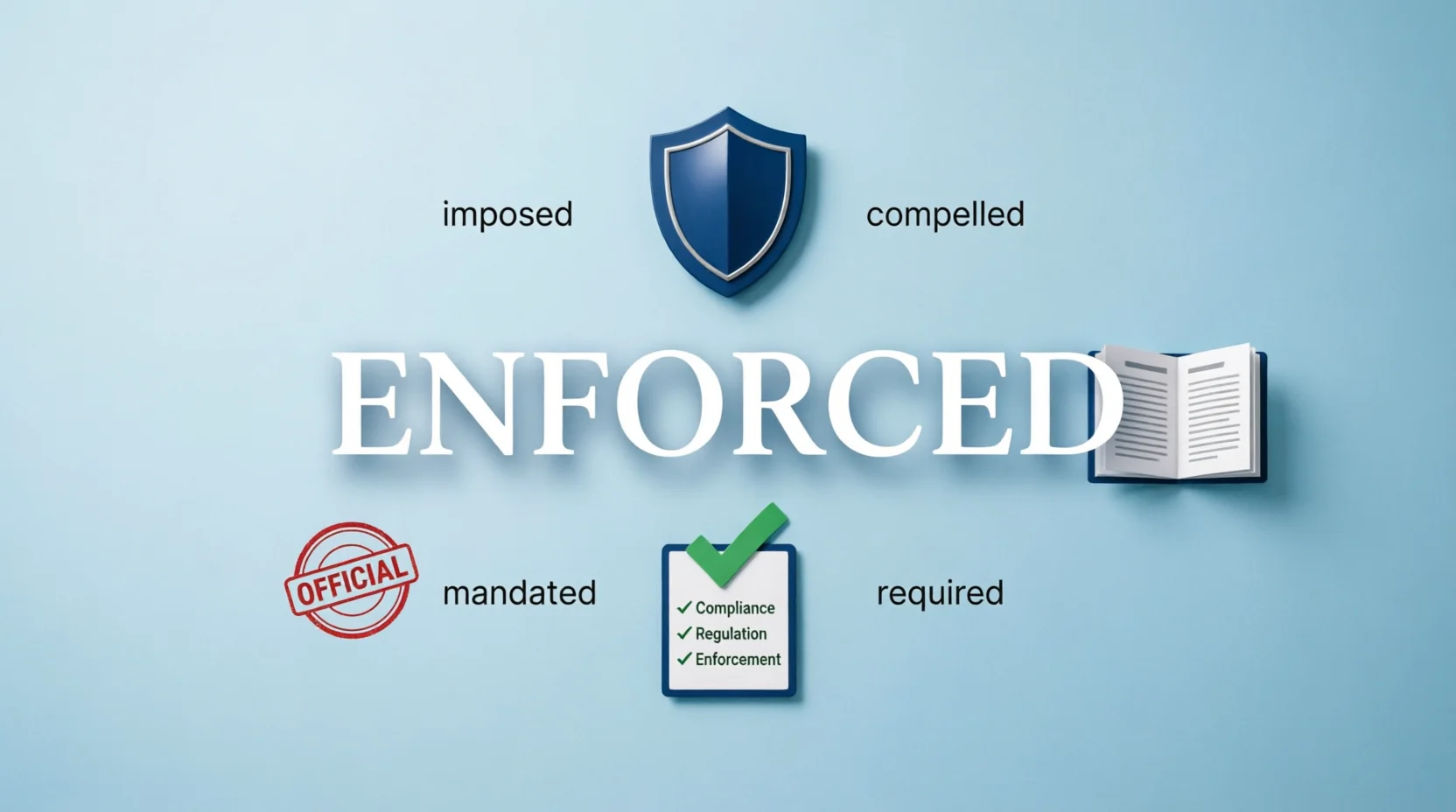
Choosing the right enforced synonym can make your writing clearer, more precise, and more natural. Common synonyms for enforced include imposed, implemented, compelled, mandated, required, applied, and upheld. However, the best alternative depends on if you are describing a rule, a law, a policy, or an action that someone must follow.
For students, ESL learners, writers, and content creators, understanding these differences makes it easier to express authority, obligation, compliance, and control accurately.
Quick Answer: What Is a Synonym for Enforced?
A synonym for enforced is a word that describes making people obey a rule, ensuring a requirement is followed, or compelling someone to do something.
The most useful alternatives include:
- Imposed: Put a rule, restriction, or penalty into effect.
- Implemented: Put a plan, policy, or system into action.
- Mandated: Officially required by an authority.
- Compelled: Forced someone to act or respond.
- Required: Made necessary or obligatory.
- Applied: Put a rule or principle into practice.
- Upheld: Maintained or supported a law, decision, or principle.
- Enacted: Made a law or formal measure legally effective.
For example, “The school enforced its attendance policy” could become “The school implemented its attendance policy.” However, implemented emphasizes putting the policy into practice, while enforced emphasizes ensuring that people follow it.
What Does Enforced Mean?
Enforced is the past tense and past participle of the verb enforce. It means making sure that a law, rule, agreement, or requirement is obeyed. It can also describe a situation in which someone is forced to do something.
The word often appears in legal, professional, educational, and everyday contexts involving authority or responsibility.
1. Enforced as Making People Obey Rules
When an authority enforces a rule, it takes action to ensure that people follow it.
Example: The teacher enforced the classroom rules fairly.
Related words: applied, upheld, implemented, maintained.
2. Enforced as Making Something Compulsory
Enforced can describe a requirement that people must follow, even if they would prefer not to.
Example: The company enforced a strict safety policy.
Related words: mandated, required, imposed, compulsory.
3. Enforced as Compelling Someone to Act
The word can also describe an action or situation that leaves someone with little or no choice.
Example: Financial difficulties enforced a change in their plans.
Related words: compelled, forced, obliged, constrained.
In this example, forced or compelled would generally sound more natural than enforced.
4. Enforced in Legal and Government Settings
Governments and legal authorities enforce laws, regulations, court orders, and legal obligations.
Example: The authorities enforced the new traffic regulations.
Related words: upheld, implemented, administered, applied.
5. Enforced in Workplaces and Institutions
Organizations enforce policies and procedures to maintain standards, safety, and accountability.
Example: The manager enforced the company’s code of conduct.
Related words: applied, required, maintained, mandated.
30 Synonyms for Enforced With Meanings and Examples
The following 30 alternatives cover different meanings of enforced. Some are close synonyms, while others fit specific contexts such as law, workplace policies, personal obligations, or official requirements.
1. Imposed
Simple meaning: Put a rule, restriction, or burden into effect.
Example sentence: The government imposed new restrictions on vehicle emissions.
Best usage/context: Use it for rules, penalties, taxes, limits, and obligations introduced by an authority, especially when people have little choice.
2. Implemented
Simple meaning: Put a plan, policy, or decision into action.
Example sentence: The school implemented stricter safety procedures.
Best usage/context: Best for policies, strategies, programs, and procedures that are introduced and put into practice.
3. Mandated
Simple meaning: Officially required by a law, rule, or authority.
Example sentence: The organization mandated annual safety training.
Best usage/context: Suitable for government regulations, workplace requirements, official policies, and formal obligations.
4. Compelled
Simple meaning: Forced or strongly persuaded someone to act.
Example sentence: The court compelled the company to release the records.
Best usage/context: Use it when an authority, circumstance, or pressure makes an action necessary.
5. Forced
Simple meaning: Made someone do something against their wishes or without a real choice.
Example sentence: The circumstances forced the family to relocate.
Best usage/context: Best for situations involving pressure, necessity, coercion, or a lack of choice.
6. Required
Simple meaning: Made necessary or obligatory.
Example sentence: Employees were required to complete the training.
Best usage/context: A clear, neutral alternative for rules, instructions, qualifications, and mandatory tasks.
7. Applied
Simple meaning: Put a rule, principle, or standard into practice.
Example sentence: The judge applied the law consistently.
Best usage/context: Use it when a rule or standard is used in a particular case or situation.
8. Upheld
Simple meaning: Maintained or supported a law, decision, or principle.
Example sentence: The court upheld the original ruling.
Best usage/context: Best for legal decisions, established rules, rights, and principles that are maintained rather than overturned.
9. Enacted
Simple meaning: Made a law or formal measure official.
Example sentence: The legislature enacted a new environmental law.
Best usage/context: Use it for laws and formal legislation. It does not mean the same thing as enforcing a law after it has been enacted.
10. Administered
Simple meaning: Managed or carried out a system, policy, or procedure.
Example sentence: The agency administered the program according to federal guidelines.
Best usage/context: Appropriate for government programs, regulations, tests, policies, and formal procedures.
11. Executed
Simple meaning: Carried out a plan, order, or decision.
Example sentence: The team executed the approved safety plan.
Best usage/context: Suitable for plans, instructions, agreements, and formal decisions. In legal contexts, its meaning depends on the specific action being described.
12. Applied rigorously
Simple meaning: Used a rule or standard strictly and consistently.
Example sentence: The school applied its attendance requirements rigorously.
Best usage/context: Use it when emphasizing strict compliance and consistent application.
13. Maintained
Simple meaning: Kept something in place or continued to uphold it.
Example sentence: The supervisor maintained strict standards for workplace safety.
Best usage/context: Appropriate for standards, discipline, rules, and established procedures that remain in effect.
14. Regulated
Simple meaning: Controlled an activity through rules or standards.
Example sentence: The agency regulated the industry’s safety practices.
Best usage/context: Best for industries, business activities, public services, and conduct governed by formal standards.
15. Compulsory
Simple meaning: Required by a rule, law, or authority.
Example sentence: Attendance at the safety session was compulsory.
Best usage/context: Use it to describe requirements, activities, education, or participation that is not optional. It is an adjective rather than a direct verb replacement.
16. Obligated
Simple meaning: Bound by a duty, responsibility, or requirement.
Example sentence: The contract obligated the supplier to deliver the materials on time.
Best usage/context: Suitable for contracts, duties, responsibilities, and legal or moral commitments.
17. Coerced
Simple meaning: Forced someone to act through threats, pressure, or intimidation.
Example sentence: The witness claimed that he was coerced into signing the statement.
Best usage/context: Use it when the method of forcing someone involves improper pressure, threats, or intimidation.
18. Constrained
Simple meaning: Limited someone’s freedom, choices, or actions.
Example sentence: Strict regulations constrained the company’s available options.
Best usage/context: Best for restrictions, limited choices, boundaries, and circumstances that prevent free action.
19. Pressured
Simple meaning: Pushed someone to do something through persuasion, expectations, or stress.
Example sentence: Employees felt pressured to accept the new schedule.
Best usage/context: Use it for social, workplace, or personal situations involving strong expectations rather than formal legal authority.
20. Dictated
Simple meaning: Ordered something or determined what must happen.
Example sentence: The agreement dictated the conditions for payment.
Best usage/context: Suitable for strict instructions, binding terms, and circumstances that determine an outcome.
21. Ordered
Simple meaning: Officially directed someone to do something.
Example sentence: The court ordered the company to correct the violation.
Best usage/context: Best for commands issued by courts, managers, officials, or other authorities.
22. Decreed
Simple meaning: Officially declared or ordered something.
Example sentence: The ruler decreed that the new regulations would take effect immediately.
Best usage/context: Use it for formal declarations or commands, especially in historical, governmental, or legal writing.
23. Stipulated
Simple meaning: Specifically stated as a condition or requirement.
Example sentence: The contract stipulated that payment must be made within thirty days.
Best usage/context: Appropriate for contracts, agreements, formal conditions, and clearly defined requirements.
24. Enjoined
Simple meaning: Officially ordered or prohibited through a legal directive.
Example sentence: The court enjoined the company from continuing the disputed practice.
Best usage/context: Best for formal legal writing, especially when a court orders someone to do or stop doing something.
25. Penalized
Simple meaning: Punished for breaking a rule or failing to meet a requirement.
Example sentence: Players were penalized for violating the competition rules.
Best usage/context: Use it when enforcement involves a penalty for noncompliance. It describes a consequence rather than enforcement in general.
26. Sanctioned
Simple meaning: Officially approved or penalized, depending on the context.
Example sentence: The governing body sanctioned the club for repeated violations.
Best usage/context: Use it carefully. Sanctioned can mean authorized or officially penalized, so the surrounding sentence must make the intended meaning clear.
27. Policed
Simple meaning: Monitored and controlled to ensure rules are followed.
Example sentence: The organization policed its online discussion rules.
Best usage/context: Suitable for monitoring behavior, enforcing standards, and supervising compliance. It may sound informal when used outside policing or regulatory contexts.
28. Reinforced
Simple meaning: Strengthened a rule, expectation, or message.
Example sentence: The manager reinforced the importance of following safety procedures.
Best usage/context: Use it when reminding people of an existing requirement or making it stronger. Reinforcement does not always mean that a rule is strictly enforced.
29. Asserted
Simple meaning: Stated or exercised authority, a right, or a position firmly.
Example sentence: The regulator asserted its authority to investigate the complaint.
Best usage/context: Suitable when emphasizing the exercise of authority or a firm claim. It is not a direct synonym for making everyone comply.
30. Enforced strictly
Simple meaning: Made sure a rule was followed without allowing exceptions easily.
Example sentence: The facility enforced its access policy strictly.
Best usage/context: Use this phrase when you want to emphasize close monitoring, consistent compliance, and limited tolerance for violations.
Comparison Table: Which Enforced Synonym Should You Use?
| Synonym | Main emphasis | Best context |
| Imposed | Introducing a rule or restriction | Taxes, limits, penalties |
| Implemented | Putting a policy into practice | Plans and procedures |
| Mandated | Making something officially required | Laws and policies |
| Compelled | Making someone act | Legal duties or strong necessity |
| Forced | Removing someone’s choice | Personal or difficult circumstances |
| Required | Making something necessary | Instructions and obligations |
| Applied | Using a rule in a situation | Laws and standards |
| Upheld | Maintaining a decision or principle | Courts and legal rulings |
| Enacted | Making legislation official | Government and lawmaking |
| Administered | Managing a formal process | Programs and procedures |
| Regulated | Controlling through standards | Industries and public activities |
| Coerced | Forcing through improper pressure | Threats and intimidation |
| Constrained | Limiting freedom or options | Rules and restrictions |
| Ordered | Giving an authoritative command | Courts and official directives |
| Penalized | Punishing a violation | Discipline and compliance |
How to Choose the Right Synonym for Enforced
The best alternative depends on what happened, who exercised authority, and whether the sentence focuses on a rule, an action, or a consequence.
1. Choose by Meaning
For rules and policies: Use imposed, implemented, mandated, or applied.
Example: The company implemented a new attendance policy.
For laws and court decisions: Use upheld, enacted, ordered, or enjoined.
Example: The court upheld the decision.
For actions taken under pressure: Use compelled, forced, coerced, or pressured.
Example: The circumstances compelled him to reconsider.
For duties and requirements: Use required, obligated, or stipulated.
Example: The contract required the supplier to meet the deadline.
For penalties and violations: Use penalized or sanctioned when the sentence focuses on punishment.
Example: The league penalized the team for breaking the rules.
2. Choose by Tone
| Tone | Recommended words | Example |
| Simple and everyday | Required, ordered, forced | The manager required everyone to attend. |
| Formal and professional | Implemented, administered, stipulated | The agency implemented the new procedure. |
| Legal | Enjoined, upheld, enacted | The court upheld the ruling. |
| Strict and authoritative | Mandated, imposed, decreed | The government imposed new restrictions. |
| Negative or critical | Coerced, pressured, compelled | The employee felt coerced into agreeing. |
3. Choose by Intent
- To explain that a policy was put into practice: Use implemented.
- To show that a rule became compulsory: Use mandated or required.
- To describe a restriction introduced by an authority: Use imposed.
- To explain that someone had no real choice: Use forced or compelled.
- To describe pressure involving threats or intimidation: Use coerced.
- To explain that a court maintained a decision: Use upheld.
- To describe the creation of a law: Use enacted.
- To focus on punishment for breaking a rule: Use penalized.
Common Mistakes When Using Enforced Synonyms
1. Confusing Enacted With Enforced
Enacted means a law was formally made or passed. Enforced means action is taken to ensure that people obey it.
Incorrect: The government enforced the law when lawmakers approved it.
Better: The government enacted the law, and the relevant authorities later enforced it.
2. Using Implemented and Enforced as Exact Matches
Implemented focuses on putting a plan or policy into action. Enforced focuses on ensuring compliance.
Example: The company implemented a new policy in January.
Example: The company enforced the policy by addressing repeated violations.
Both words can appear in the same situation, but they emphasize different actions.
3. Confusing Required With Compelled
Required generally describes an obligation, while compelled often emphasizes pressure, necessity, or a lack of choice.
Example: Employees were required to complete training.
Example: The evidence compelled the committee to reconsider its decision.
Use the word that reflects the degree and type of obligation.
4. Using Coerced for Every Mandatory Rule
A rule can be mandatory without being coercive. Coerced usually suggests threats, intimidation, or improper pressure.
Less accurate: The school coerced students to wear uniforms.
More neutral: The school required students to wear uniforms.
Use coerced when the method of pressure is central to the meaning.
5. Confusing Sanctioned With Penalized
Sanctioned can mean officially approved or punished. Because it has two contrasting meanings, it can create confusion.
Clearer examples:
- Approval: The committee sanctioned the proposed activity.
- Punishment: The committee sanctioned the club for breaking the rules.
When clarity matters, use approved or penalized instead.
6. Using Upheld When You Mean Introduced
Upheld means maintained or confirmed something that already exists, often a legal decision or principle. It does not normally mean creating a new rule.
Better: The court upheld the existing regulation.
For a newly introduced rule, use enacted, imposed, or implemented, depending on the situation.
FAQs:
1. What is the closest synonym for enforced?
Applied, imposed, and implemented are useful alternatives when discussing rules and policies. Compelled or forced may fit better when describing a person made to act against their wishes.
2. What is a formal synonym for enforced?
Formal alternatives include mandated, imposed, administered, stipulated, and upheld. The best choice depends on whether the sentence concerns a requirement, an official process, or a legal decision.
3. What is another word for strictly enforced?
You can use rigorously applied, strictly implemented, or firmly upheld. For example, “The rules were strictly enforced” could become “The rules were rigorously applied.”
4. What is the difference between enforced and imposed?
Enforced means ensuring that a rule or requirement is obeyed. Imposed means introducing or placing a rule, restriction, or obligation on someone.
For example, an authority may impose a fine and then enforce the payment requirement.
5. What is a synonym for enforced by law?
Depending on the sentence, use mandated, required, legally compelled, or ordered. If describing an authority’s actions to ensure compliance, enforced may actually be the most precise word.
6. What is the opposite of enforced?
Possible opposites include ignored, waived, relaxed, repealed, and unenforced. The correct antonym depends on the context: a rule can be ignored, an obligation waived, or a law repealed.
7. Is enforced a positive or negative word?
Enforced is generally neutral. It can describe the fair application of safety rules or the strict use of an unjust restriction. Its tone depends on the rule, the authority, and the way enforcement occurs.
8. Can enforced mean forced?
Sometimes, but the words are not always interchangeable. Enforced usually refers to making a rule or requirement effective, while forced commonly refers to making a person do something against their wishes.
Conclusion
Choosing the right enforced synonym helps you communicate rules, obligations, authority, and pressure with greater accuracy. Use imposed for restrictions, implemented for policies put into practice, mandated for official requirements, and compelled when someone is made to act. In legal writing, enacted, upheld, and enjoined have specific meanings that should not be confused.
Always consider the context and the action you want to emphasize. A precise word will make your writing clearer, more professional, and easier to understand.

I’m Jaxon James, an author at SaysReply, where I share simple, clear, and natural alternative ways to say things and help readers express their thoughts better.