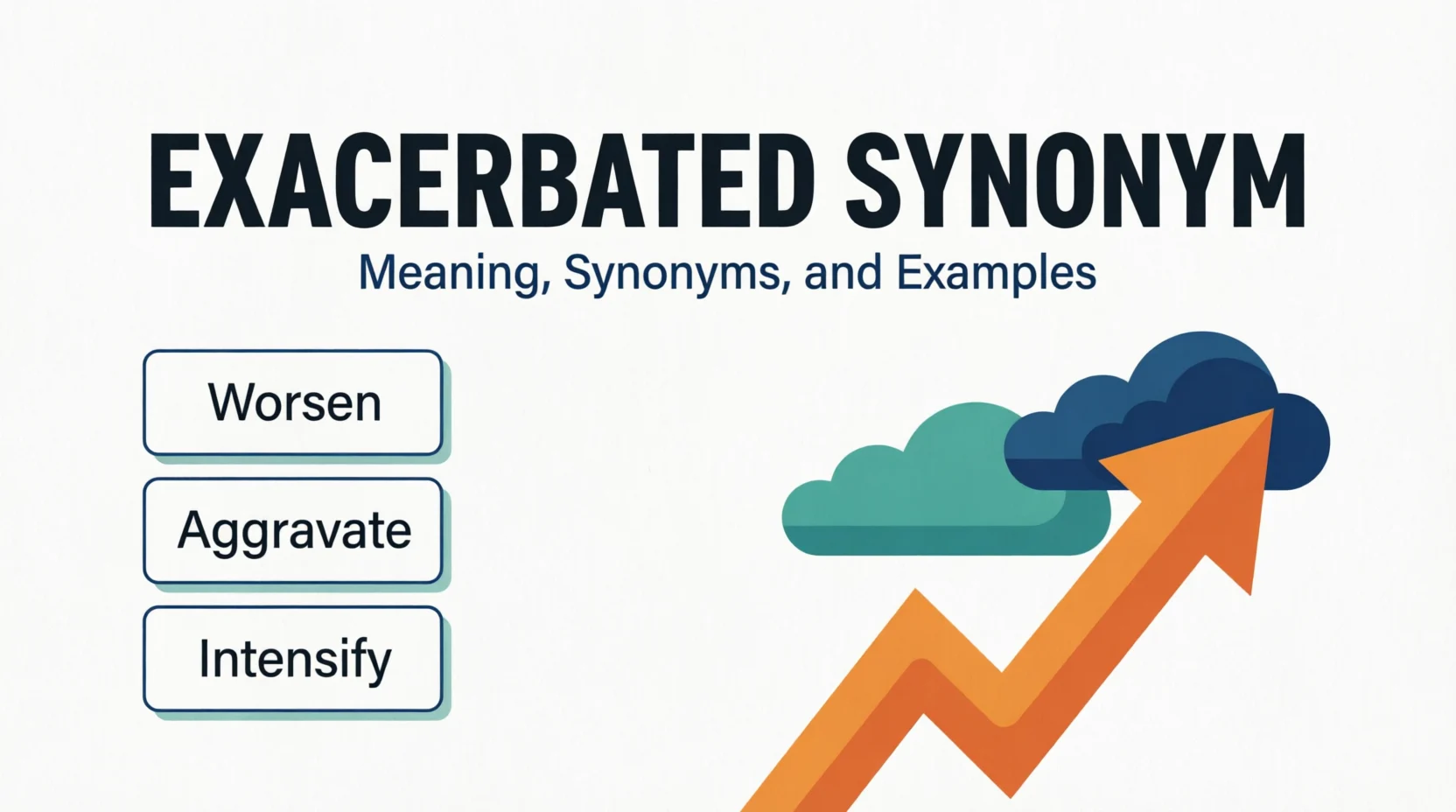
Looking for the best exacerbated synonym? Common alternatives include worsened, aggravated, intensified, heightened, increased, amplified, and compounded. The right word depends on whether you are describing a worsening problem, stronger pain, growing tension, or a situation made more difficult by additional factors.
Understanding these alternatives helps students, ESL learners, writers, and content creators express changes more precisely. If you are writing an academic essay, a professional report, or an everyday message, choosing the correct synonym makes your meaning clearer.
Quick Answer: What Is a Synonym for Exacerbated?
A synonym for exacerbated is a word that means made something worse, more severe, or more difficult.
The most useful alternatives include:
- Worsened: Became or made something worse.
- Aggravated: Made a problem, condition, or situation more severe.
- Intensified: Made something stronger or more powerful.
- Heightened: Increased the level of something, such as fear or awareness.
- Amplified: Made something stronger or more noticeable.
- Compounded: Made a problem worse by adding another difficulty.
- Escalated: Increased in seriousness, intensity, or scale.
- Deepened: Made a feeling, problem, or division more profound.
Example: “The heavy rain exacerbated the flooding” can be rewritten as “The heavy rain worsened the flooding.”
Although these words share similar meanings, they are not interchangeable in every sentence.
What Does Exacerbated Mean?
Exacerbated is the past tense and past participle of exacerbate. It means made an existing problem, illness, conflict, or difficult situation worse or more severe.
The word is commonly used in formal writing, medicine, academic discussions, news reports, and professional communication.
1. Exacerbated Meaning in Everyday English
In everyday language, exacerbated describes an action that makes an already difficult situation worse.
Example: His careless comments exacerbated the argument.
Similar words: worsened, aggravated, intensified.
2. Exacerbated Meaning in Medical Contexts
In healthcare, the word often describes something that makes symptoms or an existing medical condition more severe.
Example: Cold weather exacerbated her joint pain.
Similar words: aggravated, worsened, intensified.
The word does not necessarily mean that a condition caused a new illness. It may simply mean that existing symptoms became more severe.
3. Exacerbated Meaning in Social and Emotional Contexts
The word can describe stronger emotions, increased tension, or worsening relationships.
Example: The misunderstanding exacerbated the tension between the friends.
Similar words: heightened, intensified, deepened.
4. Exacerbated Meaning in Business and Academic Writing
In formal writing, exacerbated often describes circumstances that increase the seriousness of an existing challenge.
Example: Rising costs exacerbated the company’s financial difficulties.
Similar words: compounded, worsened, aggravated.
30 Synonyms for Exacerbated With Meanings and Examples
The following alternatives cover different shades of meaning, from making a problem worse to increasing intensity or adding new difficulties.
1. Worsened
Simple meaning: Made something worse or became less favorable.
Example sentence: The delay worsened the situation for everyone involved.
Best usage/context: The closest everyday alternative for problems, conditions, relationships, and circumstances that become more difficult.
2. Aggravated
Simple meaning: Made a problem, pain, or difficult situation more severe.
Example sentence: Running aggravated his existing knee pain.
Best usage/context: Particularly useful for medical symptoms, conflicts, frustrations, and existing problems.
3. Intensified
Simple meaning: Made something stronger or more powerful.
Example sentence: The criticism intensified the pressure on the team.
Best usage/context: Use it for emotions, pressure, conflict, competition, pain, and other experiences that grow stronger.
4. Heightened
Simple meaning: Increased the level or degree of something.
Example sentence: The unexpected announcement heightened public concern.
Best usage/context: Suitable for fear, awareness, anxiety, tension, concern, and sensitivity.
5. Amplified
Simple meaning: Made something stronger, louder, or more noticeable.
Example sentence: Social media amplified the controversy.
Best usage/context: Best for publicity, criticism, messages, concerns, and effects that become more noticeable or influential.
6. Compounded
Simple meaning: Made a problem worse by adding another difficulty.
Example sentence: Staff shortages compounded the company’s financial problems.
Best usage/context: Use it when multiple problems combine and increase the overall difficulty.
7. Escalated
Simple meaning: Increased in seriousness, intensity, or scale.
Example sentence: The disagreement escalated into a heated argument.
Best usage/context: Appropriate for conflicts, crises, costs, violence, and situations that grow more serious.
8. Deepened
Simple meaning: Made something more serious, intense, or profound.
Example sentence: The broken promise deepened the distrust between them.
Best usage/context: Suitable for mistrust, sadness, divisions, disagreements, and long-term problems.
9. Increased
Simple meaning: Made something greater in amount, number, or degree.
Example sentence: The shortage increased the pressure on local hospitals.
Best usage/context: A simple, neutral choice when describing a measurable rise in pressure, costs, risks, or difficulties.
10. Exacerbated Further: Aggravated More
Simple meaning: Made an already serious problem even worse.
Example sentence: The lack of communication aggravated the existing conflict even more.
Best usage/context: The phrase aggravated further may work when emphasizing an additional worsening, although further aggravated is often smoother. Avoid unnecessary repetition when aggravated alone is sufficient.
11. Inflamed
Simple meaning: Made emotions, conflict, or irritation more intense.
Example sentence: The insulting remark inflamed public anger.
Best usage/context: Use it for anger, hostility, controversy, conflict, and physical inflammation when medically appropriate.
12. Aggravated Further: Exacerbated More
Simple meaning: Increased the severity of an existing problem even more.
Example sentence: The new restrictions aggravated the economic difficulties further.
Best usage/context: This phrase is grammatically possible but often repetitive. Prefer further aggravated the economic difficulties or simply worsened the economic difficulties.
13. Magnified
Simple meaning: Made something seem larger or more important.
Example sentence: The lack of information magnified public fears.
Best usage/context: Suitable for fears, risks, weaknesses, differences, and problems that appear greater or attract more attention.
14. Intensified Further: Strengthened
Simple meaning: Made something stronger or more forceful.
Example sentence: The new evidence strengthened the pressure on the organization.
Best usage/context: Strengthened works when an effect becomes more powerful, but it does not always mean a problem became worse. Use intensified when the negative meaning must remain clear.
15. Exacerbated by Additional Factors: Compounded
Simple meaning: Made worse through the addition of other problems.
Example sentence: Inflation compounded the challenges faced by small businesses.
Best usage/context: Particularly effective in academic writing, financial reports, and explanations involving several connected causes.
16. Deteriorated
Simple meaning: Became worse in quality, condition, or health.
Example sentence: Relations between the two departments deteriorated after the dispute.
Best usage/context: Use it when the condition itself becomes worse over time. Unlike exacerbated, it does not necessarily describe something actively making another problem worse.
17. Aggravated the Severity: Worsened
Simple meaning: Increased the seriousness of an existing difficulty.
Example sentence: Poor planning worsened the consequences of the emergency.
Best usage/context: Use worsened when you want a straightforward alternative without the formality of exacerbated.
18. Intensified the Impact: Magnified
Simple meaning: Made the effect of something more significant.
Example sentence: The power outage magnified the disruption caused by the storm.
Best usage/context: Suitable when the consequences or impact of an event become more noticeable or severe.
19. Exaggerated
Simple meaning: Made something seem greater, worse, or more important than it really was.
Example sentence: The headline exaggerated the seriousness of the disagreement.
Best usage/context: Use it when a description overstates a problem. Unlike exacerbated, it does not necessarily mean the actual situation became worse.
20. Inflated
Simple meaning: Increased something beyond its normal or reasonable level.
Example sentence: Incorrect estimates inflated the projected costs.
Best usage/context: Best for costs, prices, figures, claims, expectations, and estimates that have been increased excessively.
21. Heightened Further: Intensified
Simple meaning: Increased the intensity of an existing feeling or situation.
Example sentence: The unexpected delay intensified the passengers’ frustration.
Best usage/context: Intensified is usually the more natural single-word choice when an emotion or experience becomes stronger.
22. Agitated
Simple meaning: Made someone feel nervous, upset, or disturbed.
Example sentence: The repeated interruptions agitated the already frustrated audience.
Best usage/context: Use it for emotional disturbance or restlessness. It is not a general substitute for every instance of exacerbated.
23. Provoked
Simple meaning: Caused a reaction, often anger or hostility.
Example sentence: The provocative statement worsened the disagreement and provoked further anger.
Best usage/context: Appropriate when an action triggers an emotional response or reaction that contributes to a worsening situation.
24. Worsened Considerably: Deteriorated
Simple meaning: Became noticeably worse.
Example sentence: The patient’s condition deteriorated overnight.
Best usage/context: Use deteriorated to describe a worsening condition or situation. It is especially common in medical, environmental, and organizational contexts.
25. Intensified the Conflict: Escalated
Simple meaning: Increased the seriousness of a disagreement or confrontation.
Example sentence: The exchange of accusations escalated the conflict.
Best usage/context: Suitable for arguments, disputes, political tensions, and other conflicts that become more serious.
26. Perpetuated
Simple meaning: Caused a problem or situation to continue.
Example sentence: The outdated policy perpetuated inequality within the organization.
Best usage/context: Use it when an action keeps a harmful situation going. It is not an exact synonym because it emphasizes continuation rather than increased severity.
27. Reinforced
Simple meaning: Made something stronger or more firmly established.
Example sentence: The repeated rumors reinforced public suspicion.
Best usage/context: Suitable for beliefs, fears, attitudes, and patterns that become stronger. It implies worsening only when the reinforced thing is harmful.
28. Exacerbated the Divide: Widened
Simple meaning: Made a gap or difference greater.
Example sentence: The controversial decision widened the divide between the two groups.
Best usage/context: Best for divisions, inequalities, disagreements, and gaps between people or positions.
29. Triggered
Simple meaning: Caused something to begin or happen.
Example sentence: The sudden price increase triggered further financial difficulties.
Best usage/context: Use it when an event starts a reaction or problem. It does not always mean the problem itself became more severe.
30. Aggravated the Situation: Made Worse
Simple meaning: Caused an existing situation to become more difficult or serious.
Example sentence: His refusal to cooperate made the situation worse.
Best usage/context: Ideal for simple English, everyday conversations, and writing where clarity matters more than formality.
Comparison Table: Which Exacerbated Synonym Should You Use?
| Synonym | Main meaning | Best context |
| Worsened | Made less favorable | General problems |
| Aggravated | Increased severity | Pain, symptoms, conflicts |
| Intensified | Made stronger | Emotions, pressure, conflict |
| Heightened | Increased a level | Fear, concern, awareness |
| Compounded | Added to existing difficulties | Financial or complex problems |
| Escalated | Increased in seriousness | Disputes and crises |
| Deepened | Made more profound | Distrust, sadness, divisions |
| Amplified | Made more noticeable | Publicity, concerns, criticism |
| Inflamed | Increased anger or hostility | Conflict and public reaction |
| Magnified | Made seem greater | Fears, risks, weaknesses |
| Deteriorated | Became worse | Health, conditions, relationships |
| Exaggerated | Overstated the seriousness | Claims and descriptions |
| Inflated | Increased excessively | Prices, costs, figures |
| Perpetuated | Kept a problem going | Inequality and harmful patterns |
| Widened | Increased a gap | Social divisions and differences |
How to Choose the Right Synonym for Exacerbated
The best synonym depends on what became worse, how the change happened, and the tone you want to use.
1. Choose by Meaning
For general problems: Use worsened, aggravated, or compounded.
Example: The unexpected expense worsened the family’s financial situation.
For stronger emotions: Use intensified, heightened, or inflamed.
Example: The harsh criticism intensified her frustration.
For growing conflict: Use escalated, deepened, or widened.
Example: The dispute escalated after both sides rejected the proposal.
For health and physical conditions: Use aggravated, worsened, or deteriorated, depending on the sentence.
Example: The exercise aggravated his existing injury.
For increased costs or figures: Use increased, inflated, or compounded.
Example: Unexpected fees increased the total cost of the project.
2. Choose by Tone
| Tone | Recommended words | Example |
| Simple and conversational | Worsened, made worse | The delay worsened the problem. |
| Formal and academic | Aggravated, compounded | The shortage compounded existing challenges. |
| Professional and analytical | Intensified, increased | The policy intensified financial pressure. |
| Strong and dramatic | Escalated, inflamed | The comments inflamed public anger. |
| Descriptive and reflective | Deepened, heightened | The experience deepened her concerns. |
3. Choose by Intent
- To show that a problem became more serious: Use worsened or aggravated.
- To describe stronger emotions: Use intensified or heightened.
- To explain how several problems combine: Use compounded.
- To describe a growing dispute: Use escalated.
- To describe worsening health or quality: Use deteriorated or worsened.
- To describe a growing social divide: Use widened.
- To describe a harmful situation that continues: Use perpetuated.
- To describe an overstated claim: Use exaggerated, not exacerbated.
Common Mistakes When Using Exacerbated Synonyms
1. Confusing Exacerbated With Exaggerated
These words have different meanings.
- Exacerbated: Made an actual problem worse.
- Exaggerated: Made something seem greater or more serious than it really was.
Example: The storm exacerbated the flooding.
Example: The report exaggerated the amount of damage.
2. Confusing Exacerbated With Deteriorated
Exacerbated usually describes something making an existing problem worse. Deteriorated describes a condition or situation becoming worse.
Correct: The cold weather exacerbated her symptoms.
Correct: Her symptoms deteriorated over the following days.
In the second sentence, symptoms worsened would often be more natural.
3. Using Intensified for Every Situation
Intensified emphasizes greater strength or intensity, not necessarily a negative outcome.
Example: The discussion intensified as more people joined.
This sentence does not automatically mean the discussion became harmful. If you want to emphasize a worsening situation, explain the negative effect.
4. Using Compounded Without Additional Problems
Compounded is most appropriate when one difficulty adds to another.
Correct: Rising prices compounded the family’s financial difficulties.
Less precise: The loud noise compounded the room’s volume.
For a straightforward increase in volume, increased or amplified is more natural.
5. Confusing Provoked With Exacerbated
Provoked means caused a reaction, while exacerbated means made an existing problem worse.
Example: His remark provoked an argument.
Example: His continued insults exacerbated the argument.
The first action starts the conflict; the second makes it worse.
6. Repeating Similar Words Unnecessarily
Phrases such as “worsened and aggravated the problem” or “further exacerbated and intensified the issue” may be repetitive.
Choose one accurate word unless you need to distinguish between separate effects.
FAQs:
1. What is the closest synonym for exacerbated?
Worsened is usually the closest and simplest synonym. Aggravated is another strong alternative, especially when describing pain, symptoms, conflicts, or existing difficulties.
2. What is a formal synonym for exacerbated?
Formal alternatives include aggravated, compounded, intensified, and heightened. For example, “The shortage exacerbated the crisis” could become “The shortage compounded the crisis.”
3. What is a simple word for exacerbated?
The simplest alternative is worsened. You can also say made worse, which is especially useful for beginner-friendly writing and everyday conversation.
4. What is the difference between aggravated and exacerbated?
Both mean making an existing problem worse and are often interchangeable. Aggravated is common in discussions of pain, symptoms, and conflict, while exacerbated often appears in formal or academic writing.
5. What is a synonym for exacerbated in medical writing?
Common choices include aggravated, worsened, and intensified. For example, “The medication exacerbated the symptoms” means the symptoms became more severe after the medication was used. Medical wording should accurately reflect the circumstances and should not imply a cause unless it is supported.
6. What is a synonym for exacerbated in academic writing?
Useful academic alternatives include compounded, intensified, aggravated, and heightened. Choose compounded when multiple difficulties combine and heightened when a level of concern, awareness, or tension increases.
7. Can exacerbated be used for positive situations?
Usually, exacerbated has a negative meaning because it describes making a problem or undesirable condition worse. For positive changes, words such as enhanced, improved, or strengthened are generally more appropriate.
8. What is the opposite of exacerbated?
Possible antonyms include alleviated, eased, relieved, improved, mitigated, and lessened. For example, “The treatment alleviated the symptoms” means the symptoms became less severe rather than worse.
Conclusion
Choosing the right exacerbated synonym helps you communicate changes accurately and naturally. Use worsened for general problems, aggravated for pain or existing difficulties, intensified for stronger emotions, and compounded when several challenges combine. For growing conflicts, escalated is often the best choice, while deteriorated describes a condition that becomes worse over time.
Always consider the context, tone, and exact meaning before replacing a word. A precise synonym makes your writing easier to understand and helps you express complex ideas in simple, effective English.

I’m Jaxon James, an author at SaysReply, where I share simple, clear, and natural alternative ways to say things and help readers express their thoughts better.