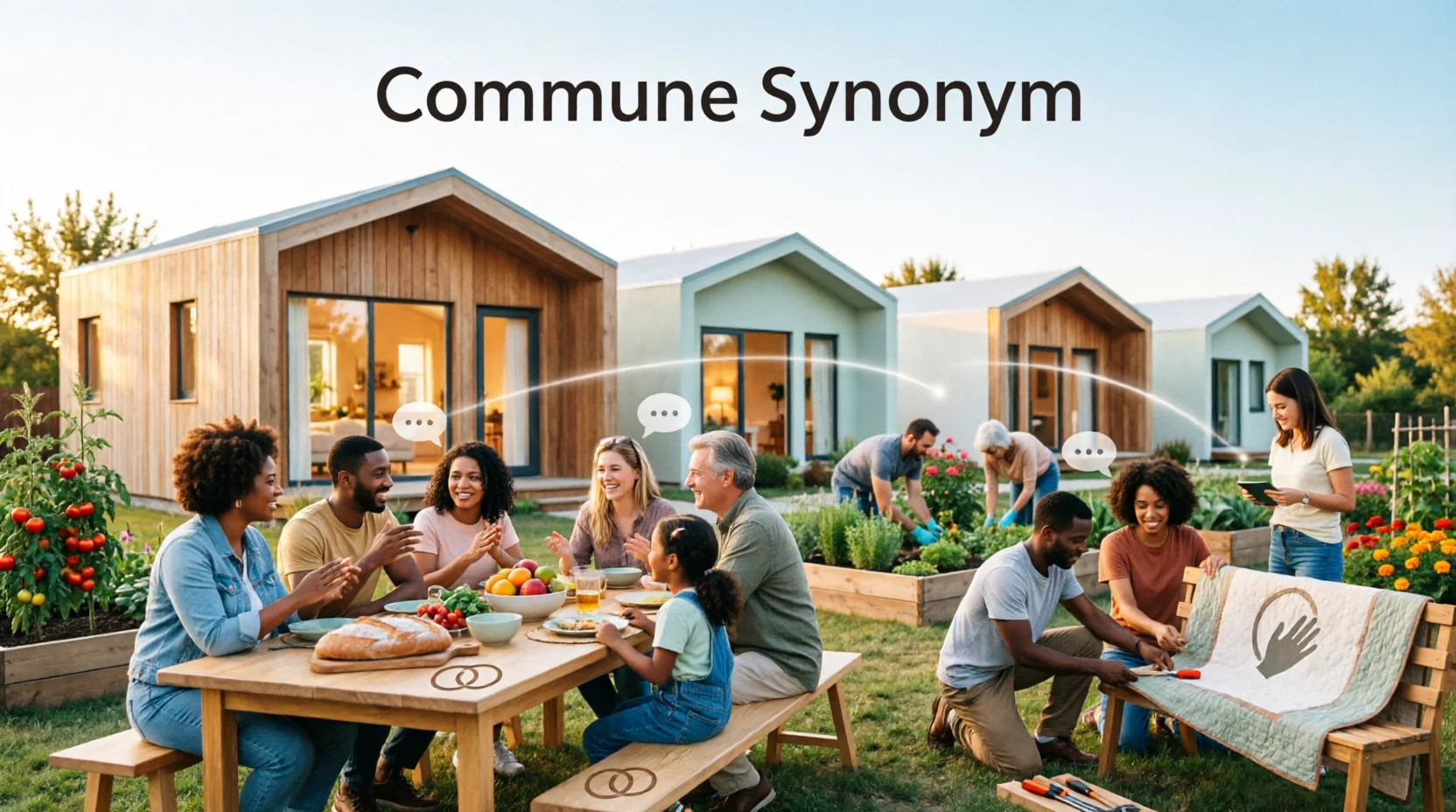
If you are looking for a commune synonym, the right alternative depends on what commune means in your sentence. As a verb, commune can mean to communicate deeply or spiritually. As a noun, it can refer to a small community or a group of people living together and sharing responsibilities. Common alternatives include communicate, connect, interact, community, settlement, collective, and colony.
Quick Answer: What Is a Synonym for Commune?
The best synonym for commune depends on its meaning:
- Commune = communicate deeply: connect, communicate, interact, relate, converse
- Commune = share thoughts or feelings: confide, converse, engage, bond
- Commune = community: community, collective, settlement, group
- Commune = shared-living community: colony, cooperative, community, fellowship
Because commune has several meanings, there is no single synonym that works perfectly in every situation.
What Does Commune Mean?
The word commune has both verb and noun uses.
As a verb, commune means to communicate or connect deeply with someone, something, nature, or a spiritual presence.
Example:
She went into the forest to commune with nature.
Here, commune with nature suggests a quiet, meaningful connection rather than ordinary conversation.
As a noun, a commune can mean a community in which people live together and often share property, work, responsibilities, or beliefs.
Example:
The artists lived together in a small rural commune.
The meaning becomes clear from the surrounding context.
30 Synonyms for Commune
Below are 30 useful alternatives, organized around the different meanings of commune.
1. Communicate
Simple meaning: To share information, thoughts, or feelings with someone.
Example:
Good friends communicate openly with each other.
Best usage/context: Everyday communication, relationships, workplaces, and formal writing.
2. Connect
Simple meaning: To form a meaningful relationship or bond.
Example:
She connected with nature during her long walk.
Best usage/context: Emotional, social, spiritual, and personal connections.
3. Converse
Simple meaning: To talk with someone.
Example:
The two writers conversed about literature for hours.
Best usage/context: Polite or somewhat formal discussions.
4. Interact
Simple meaning: To communicate or spend time with another person or group.
Example:
Students interact with one another during group activities.
Best usage/context: Social, educational, professional, and academic contexts.
5. Relate
Simple meaning: To understand or form a connection with someone or something.
Example:
He could easily relate to the character’s struggles.
Best usage/context: Emotional understanding and personal connections.
6. Engage
Simple meaning: To become involved with someone, something, or an activity.
Example:
The speaker encouraged everyone to engage with the discussion.
Best usage/context: Formal, professional, academic, and social situations.
7. Confide
Simple meaning: To share private thoughts or feelings with someone you trust.
Example:
She confided in her closest friend.
Best usage/context: Personal conversations involving trust or secrets.
8. Talk
Simple meaning: To speak with someone.
Example:
They talked about their plans for the future.
Best usage/context: Casual, everyday English.
9. Discuss
Simple meaning: To talk about a particular subject.
Example:
The team discussed the problem carefully.
Best usage/context: Meetings, education, work, and formal communication.
10. Converse With
Simple meaning: To have a conversation with someone.
Example:
He enjoyed conversing with local residents.
Best usage/context: Formal or literary writing.
11. Bond
Simple meaning: To develop a close emotional connection.
Example:
The travelers bonded over their shared experiences.
Best usage/context: Friendships, families, relationships, and communities.
12. Associate
Simple meaning: To spend time with or have a connection with others.
Example:
She regularly associates with people who share her interests.
Best usage/context: Social or professional relationships.
13. Relate To
Simple meaning: To understand someone’s experience or feelings.
Example:
Many readers can relate to the character’s loneliness.
Best usage/context: Emotional and personal contexts.
14. Commune With Nature
Simple meaning: To experience a deep connection with the natural world.
Example:
He enjoys hiking because it allows him to commune with nature.
Best usage/context: Nature writing, spirituality, reflection, and literature.
15. Connect Spiritually
Simple meaning: To experience a deep spiritual relationship or awareness.
Example:
Meditation helped her connect spiritually with her surroundings.
Best usage/context: Religious, spiritual, and reflective writing.
16. Fellowship
Simple meaning: Friendly companionship within a group that shares interests or beliefs.
Example:
The retreat provided fellowship among members of the community.
Best usage/context: Religious, social, community, and formal contexts.
17. Community
Simple meaning: A group of people who live together or share something in common.
Example:
The community worked together to support local families.
Best usage/context: The noun sense of commune.
18. Collective
Simple meaning: A group of people acting or living together.
Example:
The artists formed a creative collective.
Best usage/context: Art, politics, social organizations, and shared projects.
19. Settlement
Simple meaning: A place where people establish a community and live.
Example:
The settlement grew around the river.
Best usage/context: Historical, geographical, and community-related writing.
20. Colony
Simple meaning: A group of people living together in an established community.
Example:
The religious group established a small colony in the countryside.
Best usage/context: Historical and community contexts; use carefully because colony has additional political meanings.
21. Cooperative
Simple meaning: An organization or community in which people work together and share responsibilities.
Example:
The residents created a cooperative to manage their shared resources.
Best usage/context: Housing, business, agriculture, and community organization.
22. Group
Simple meaning: A number of people considered together.
Example:
A small group lived together and shared their daily responsibilities.
Best usage/context: General situations where a simple word is preferred.
23. Society
Simple meaning: An organized community of people with shared relationships, customs, or institutions.
Example:
Every society develops its own traditions and values.
Best usage/context: Social studies, history, sociology, and formal writing.
24. Fellowship Community
Simple meaning: A community based on companionship, shared beliefs, or common interests.
Example:
The fellowship community gathered every weekend.
Best usage/context: Religious, spiritual, and community-oriented contexts.
25. Circle
Simple meaning: A group of people connected by friendship, interests, or shared experiences.
Example:
She found a supportive circle of creative people.
Best usage/context: Informal social and personal writing.
26. Network
Simple meaning: A connected group of people or organizations.
Example:
The writers created a network to exchange ideas.
Best usage/context: Professional, social, academic, and organizational contexts.
27. Association
Simple meaning: A group of people organized around a shared purpose or interest.
Example:
The association supports independent artists.
Best usage/context: Organizations, clubs, professional groups, and formal writing.
28. Partnership
Simple meaning: A relationship in which people work together toward a shared goal.
Example:
Their partnership helped establish a sustainable community.
Best usage/context: Business, projects, cooperation, and relationships.
29. Kinship
Simple meaning: A close connection based on family, similarity, or shared qualities.
Example:
She felt a strong kinship with the people she met.
Best usage/context: Emotional, literary, cultural, and family-related contexts.
30. Unity
Simple meaning: A state in which people are joined together by common goals or beliefs.
Example:
The community demonstrated remarkable unity during the crisis.
Best usage/context: Social, political, community, and inspirational writing.
Commune Synonyms Comparison Table
| Synonym | Main Meaning | Tone | Best Context |
|---|---|---|---|
| Communicate | Share thoughts or information | Neutral | Everyday communication |
| Connect | Form a meaningful bond | Neutral | Personal or spiritual |
| Converse | Talk with someone | Formal | Discussions |
| Interact | Communicate or participate | Neutral | Social or professional |
| Relate | Understand or connect | Neutral | Emotional situations |
| Engage | Become involved | Formal | Work or education |
| Confide | Share private feelings | Personal | Trusted relationships |
| Bond | Form a close connection | Warm | Friendship and relationships |
| Fellowship | Shared companionship | Formal | Religious/community |
| Community | Group of people | Neutral | Social groups |
| Collective | Organized group | Formal | Creative/social groups |
| Settlement | Established community | Formal | History/geography |
| Colony | Established group/community | Historical | Historical contexts |
| Cooperative | Shared organization | Formal | Housing/business |
| Association | Organized group | Formal | Clubs and organizations |
| Kinship | Deep connection | Literary | Emotional/cultural writing |
| Unity | Being joined together | Formal | Community and social contexts |
Commune vs. Communicate
Commune and communicate are related, but they are not interchangeable in every situation.
Communicate usually means exchanging information, ideas, or feelings.
We communicate through words and gestures.
Commune suggests a deeper or more reflective connection.
She went to the mountains to commune with nature.
Therefore, communicate is the broader everyday term, while commune often has a more intimate, spiritual, or literary feeling.
Commune vs. Connect
These words can overlap when commune is used as a verb.
Connect is more common in modern everyday English:
I connected with the other students.
Commune sounds more reflective:
He communed with nature.
Use connect when you want natural conversational English. Use commune when emphasizing a deep, contemplative, spiritual, or poetic relationship.
Commune vs. Community
These words are connected but have different grammatical roles.
- Commune can be a noun describing a particular type of shared-living community.
- Community is the much broader word for a group of people connected by location, interests, identity, or relationships.
Example:
They lived in a rural commune.
They belonged to a close rural community.
The first sentence suggests a particular communal living arrangement, while the second simply describes a social group.
How to Choose the Right Commune Synonym
The best synonym depends on meaning, tone, and intention.
For Everyday Communication
Choose:
- communicate
- talk
- converse
- discuss
- interact
These are useful when commune simply refers to talking or exchanging ideas.
For Emotional Connection
Choose:
- connect
- bond
- relate
- kinship
- fellowship
These words work when the focus is a meaningful relationship.
For Spiritual or Reflective Writing
Choose:
- connect spiritually
- commune with nature
- fellowship
- connect
- engage
These alternatives preserve the deeper feeling associated with commune.
For a Shared-Living Community
Choose:
- community
- collective
- cooperative
- settlement
- colony
The exact choice depends on how the group is organized and what the sentence describes.
For Formal Writing
Choose:
- communicate
- interact
- engage
- association
- collective
- cooperative
These generally sound clearer in academic, professional, and informational writing.
For Literary Writing
Choose:
- commune
- converse
- bond
- kinship
- fellowship
- connect
These can create a more emotional, reflective, or expressive tone.
Common Usage Mistakes
1. Treating Every Synonym as Identical
Not every synonym can replace commune without changing the meaning.
For example:
She communed with nature.
Replacing commune with talk would sound unnatural because the sentence describes a deep connection rather than literal conversation.
2. Confusing Commune With Community
A commune can describe a specific type of community, but community has a much broader meaning.
Do not automatically substitute one for the other.
3. Using “Confide” for General Conversation
Confide implies sharing something personal or private.
She confided in her sister.
It would not normally replace commune when simply describing ordinary conversation.
4. Using “Colony” Without Considering Context
Colony has several meanings, including historical and biological ones. When discussing people living together, make sure the surrounding sentence clearly establishes the intended meaning.
5. Choosing a Formal Word for Casual Writing
Words such as converse, association, and fellowship can sound more formal than talk, group, or connect.
Choose the word that matches the style of your sentence.
FAQs:
What is the closest synonym for commune?
There is no single closest synonym because commune has multiple meanings. For the verb, connect, communicate, or converse may work depending on context. For the noun, community or collective may be suitable.
What is a simple synonym for commune?
Connect is a simple and useful synonym when commune means forming a deep connection. Community can work when commune is being used as a noun.
What is a synonym for “commune with nature”?
Possible alternatives include connect with nature, experience a connection with nature, and engage deeply with nature. Among these, connect with nature sounds the most natural in everyday English.
Is “communicate” a synonym for commune?
Sometimes. Both can describe communication, but commune usually suggests a deeper, more intimate, spiritual, or reflective connection. Communicate is broader and more common.
Is “community” a synonym for commune?
It can be a close alternative when commune is being used as a noun for a group of people living together. However, community has a much wider meaning.
What is the opposite of commune?
The appropriate opposite depends on the meaning. For emotional connection, words such as disconnect, isolate, or withdraw may provide a contrast. For a community, separation or division may be appropriate.
Is commune a formal word?
Commune is not necessarily formal, but its verb form can sound literary, spiritual, or reflective. In everyday conversation, people are more likely to say connect, talk, or communicate.
Which synonym for commune is best for academic writing?
For academic writing, communicate, interact, engage, community, collective, or association may be appropriate depending on the intended meaning. The most precise choice should match the specific context.
Conclusion
The best commune synonym depends on what you want to express. When commune means deep communication, connect, communicate, converse, and interact are useful choices. When it refers to a shared community, community, collective, cooperative, and settlement can be appropriate.
The key is to consider the exact meaning and tone of your sentence. A precise synonym does more than replace a word—it preserves the idea, feeling, and context behind the original expression.

I’m Amelia Rose, an enthusiastic writer who enjoys exploring better, clearer, and more natural ways to express ideas. I create helpful content that makes finding alternative phrases simple, useful, and enjoyable for everyone.










2 thoughts on “Commune Synonym: 30 Clear Alternatives With Meanings”