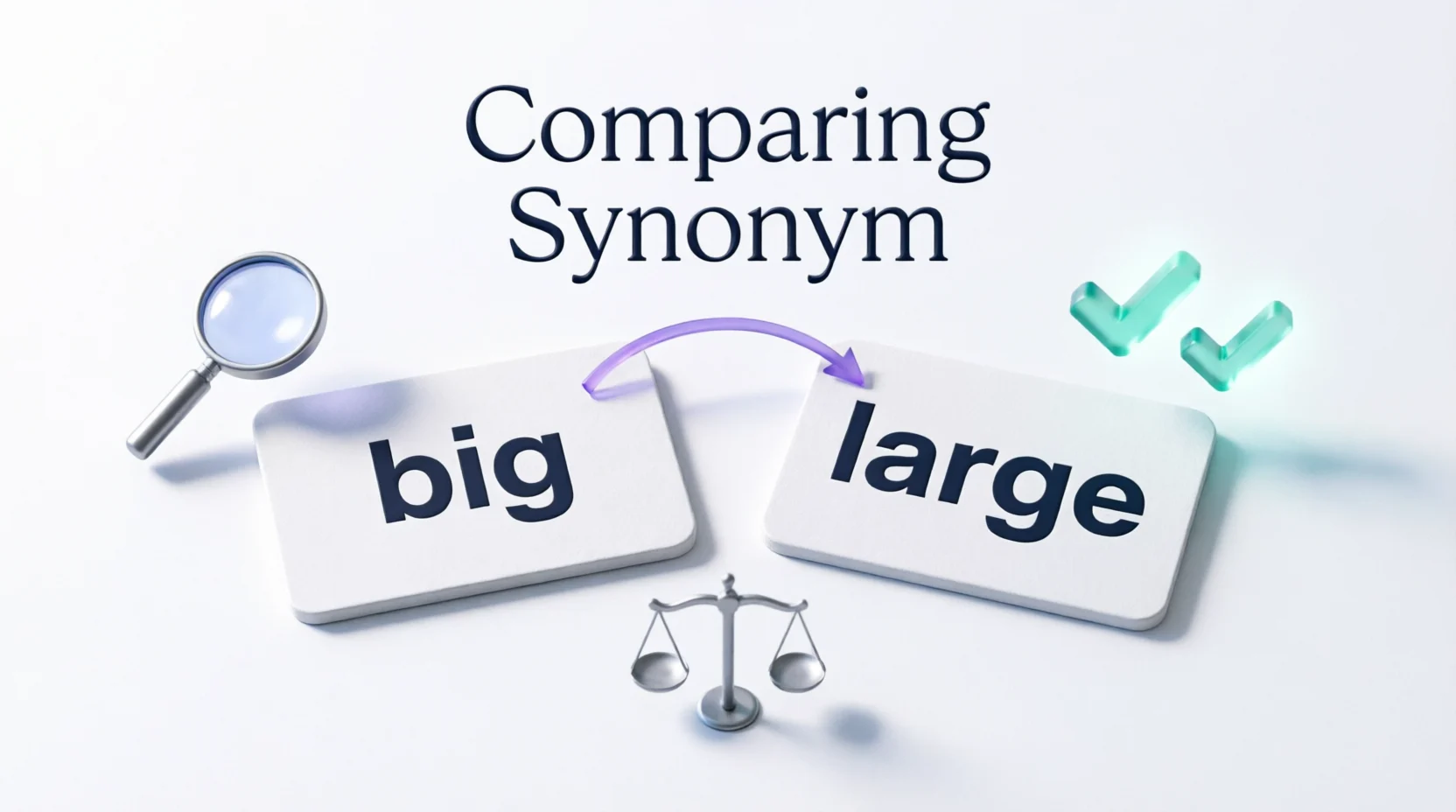
If you need a comparing synonym, the best choice depends on what you mean by comparing. Common alternatives include contrasting, evaluating, examining, matching, assessing, weighing, measuring, and analyzing. Some words focus on finding similarities, while others emphasize differences, quality, value, or careful judgment.
Choosing the right synonym can make your writing more precise. If you are writing an essay, report, review, email, or creative piece, understanding the small differences between these words helps you communicate your exact meaning.
Quick Answer: What Is a Synonym for Comparing?
Some of the most useful synonyms for comparing are:
- Contrasting — focusing mainly on differences
- Evaluating — judging quality, value, or effectiveness
- Assessing — carefully judging something
- Examining — looking at something closely
- Analyzing — studying parts and relationships in detail
- Matching — checking whether things are similar or suitable
- Measuring — comparing something against a standard
- Weighing — considering different advantages and disadvantages
- Juxtaposing — placing things side by side for comparison
- Relating — showing a connection between things
The right word depends on whether you want to emphasize similarities, differences, quality, suitability, or detailed examination.
Comparing: Meaning and Usage
Comparing means looking at two or more people, objects, ideas, situations, or choices to identify their similarities and differences.
For example:
We are comparing two smartphones before buying one.
Here, the speaker is examining the phones to understand how they are alike and different.
The word comparing is often neutral. It does not necessarily mean that one option is better than another. The purpose may simply be to understand the relationship between things.
Comparing in Different Contexts
You might compare:
- Two products
- Two books
- Different opinions
- Prices
- Academic results
- Job offers
- Personal experiences
- Features and benefits
- Historical events
- Different methods or approaches
For example:
The report compares the costs of public and private transportation.
In academic writing, comparing often means identifying both similarities and differences. In everyday speech, it can simply mean looking at two or more things side by side.
30 Synonyms for Comparing
1. Contrasting
Simple meaning: Looking at differences between things.
Example: The essay is contrasting traditional and modern teaching methods.
Best usage/context: Use contrasting when differences are more important than similarities.
2. Evaluating
Simple meaning: Judging the quality, value, or effectiveness of something.
Example: We are evaluating three proposals before making a decision.
Best usage/context: Best for decisions, research, performance reviews, and formal writing.
3. Assessing
Simple meaning: Carefully judging or estimating something.
Example: The teacher is assessing the students’ writing skills.
Best usage/context: Useful for education, professional situations, performance, ability, and risk.
4. Examining
Simple meaning: Looking at something carefully.
Example: Researchers are examining the results of both experiments.
Best usage/context: Good when you want to emphasize careful observation rather than judgment.
5. Analyzing
Simple meaning: Studying something in detail to understand it.
Example: The students are analyzing two poems for their themes.
Best usage/context: Particularly useful for academic, scientific, literary, and technical writing.
6. Matching
Simple meaning: Checking whether things are similar, equal, or suitable together.
Example: The manager is matching candidates with available positions.
Best usage/context: Use it for compatibility, similarities, pairing, or suitability.
7. Measuring
Simple meaning: Comparing something with a standard, scale, or measurement.
Example: The study is measuring the effectiveness of two teaching methods.
Best usage/context: Best for performance, size, quantity, progress, or results.
8. Weighing
Simple meaning: Considering different factors before making a decision.
Example: She is weighing the advantages and disadvantages of both offers.
Best usage/context: Ideal when comparing choices, benefits, risks, or disadvantages.
9. Juxtaposing
Simple meaning: Placing two things close together to highlight similarities or differences.
Example: The artist is juxtaposing bright and dark colors.
Best usage/context: Common in literary, artistic, cultural, and analytical writing.
10. Relating
Simple meaning: Showing how two things are connected.
Example: The article relates climate change to changes in agriculture.
Best usage/context: Use when the main purpose is showing a relationship rather than ranking options.
11. Correlating
Simple meaning: Examining whether two things are connected or change together.
Example: Researchers are correlating exercise levels with sleep quality.
Best usage/context: Mainly useful in scientific, statistical, and research contexts.
12. Ranking
Simple meaning: Putting things in an order based on quality, importance, or performance.
Example: The website is ranking the five most popular laptops.
Best usage/context: Use when comparison results in an ordered list.
13. Differentiating
Simple meaning: Identifying what makes things different.
Example: The guide explains how to differentiate between the two products.
Best usage/context: Useful when the goal is to distinguish similar things.
14. Distinguishing
Simple meaning: Recognizing the differences between things.
Example: Students must learn to distinguish between fact and opinion.
Best usage/context: Best when two or more things may be confused with each other.
15. Considering
Simple meaning: Thinking carefully about different possibilities or factors.
Example: We are considering several options before choosing a supplier.
Best usage/context: Good for decisions and situations involving multiple possibilities.
16. Reviewing
Simple meaning: Looking at something carefully, often to judge or summarize it.
Example: The committee is reviewing the two proposed plans.
Best usage/context: Common in professional, academic, editorial, and business contexts.
17. Investigating
Simple meaning: Studying something carefully to discover facts or understand it.
Example: Scientists are investigating the effects of the new treatment.
Best usage/context: Appropriate when comparison involves research or finding information.
18. Scrutinizing
Simple meaning: Examining something extremely carefully.
Example: The editor is scrutinizing both versions of the article.
Best usage/context: Use when the examination is especially detailed or critical.
19. Surveying
Simple meaning: Looking broadly at several things to understand their features or condition.
Example: The report surveys different approaches to language teaching.
Best usage/context: Useful for broad reviews, research, and overviews.
20. Checking
Simple meaning: Looking at things to see whether they are correct, similar, or suitable.
Example: I am checking the two documents for differences.
Best usage/context: Best for everyday and informal situations.
21. Weighing Up
Simple meaning: Carefully considering different choices.
Example: He is weighing up the benefits of both career options.
Best usage/context: Common in conversational English, especially British English.
22. Setting Against
Simple meaning: Considering one thing in relation to another.
Example: The article sets the modern approach against the traditional method.
Best usage/context: Useful in formal, analytical, and literary writing.
23. Benchmarking
Simple meaning: Comparing performance with a recognized standard or competitor.
Example: The company is benchmarking its customer service against industry leaders.
Best usage/context: Common in business, management, technology, and performance analysis.
24. Testing Against
Simple meaning: Comparing something with a standard or expected result.
Example: The researchers are testing the new model against existing methods.
Best usage/context: Useful in science, technology, research, and performance testing.
25. Balancing
Simple meaning: Considering different factors so that none is ignored.
Example: The manager is balancing the costs and benefits of both plans.
Best usage/context: Best when comparison involves competing advantages, disadvantages, needs, or priorities.
26. Matching Up
Simple meaning: Comparing things to see how well they correspond.
Example: We are matching up the two lists to find missing names.
Best usage/context: Informal conversations and practical comparisons.
27. Lining Up
Simple meaning: Putting choices or items together for easy comparison.
Example: The website lines up several plans so customers can compare their features.
Best usage/context: Informal writing and conversational contexts.
28. Cross-Checking
Simple meaning: Comparing information with another source to confirm accuracy.
Example: The researcher is cross-checking the figures with the original records.
Best usage/context: Best for facts, data, documents, records, and verification.
29. Differencing
Simple meaning: Identifying or calculating the difference between values or items.
Example: The analyst used differencing to examine changes between the two data sets.
Best usage/context: Mainly appropriate in technical, mathematical, statistical, and specialized contexts.
30. Appraising
Simple meaning: Judging the value, quality, or condition of something.
Example: The expert is appraising the value of the antique furniture.
Best usage/context: Useful for formal evaluations, property, art, performance, and professional judgment.
Comparing Synonyms: Quick Comparison Table
| Synonym | Main Focus | Formality | Best Context |
|---|---|---|---|
| Comparing | Similarities and differences | Neutral | General use |
| Contrasting | Differences | Formal | Essays, analysis |
| Evaluating | Quality or effectiveness | Formal | Decisions, reports |
| Assessing | Judgment or estimation | Formal | Education, work |
| Examining | Careful observation | Neutral/Formal | Research |
| Analyzing | Detailed study | Formal | Academic writing |
| Matching | Similarity or suitability | Neutral | Everyday use |
| Measuring | Performance against a standard | Neutral/Formal | Data, results |
| Weighing | Pros and cons | Neutral | Decisions |
| Juxtaposing | Side-by-side comparison | Formal | Art, literature |
| Ranking | Order or position | Neutral | Lists, performance |
| Differentiating | Differences | Formal | Explanations |
| Distinguishing | Important differences | Neutral/Formal | Education |
| Considering | Options or factors | Neutral | Decision-making |
| Reviewing | Examination or summary | Neutral/Formal | Work, documents |
| Scrutinizing | Very close examination | Formal | Critical analysis |
| Benchmarking | Standard-based comparison | Formal | Business |
| Cross-checking | Accuracy and confirmation | Neutral | Data and records |
| Appraising | Value or quality | Formal | Property, art, evaluation |
Comparing vs. Contrasting
These words are related, but they are not always interchangeable.
Comparing can include both similarities and differences.
The essay compares city life with rural life.
Contrasting focuses more strongly on differences.
The essay contrasts the noise of city life with the quietness of rural life.
A simple rule is:
Compare = similarities and/or differences
Contrast = mainly differences
Comparing vs. Evaluating
Comparing does not necessarily involve deciding which option is better.
We compared the two phones.
This sentence simply tells us that the phones were examined together.
Evaluating suggests judgment.
We evaluated the two phones before buying one.
Here, the purpose is likely to judge their quality, usefulness, or value.
Comparing vs. Analyzing
Comparing focuses on relationships between two or more things.
Analyzing goes deeper by breaking something into parts and examining how those parts work or relate.
For example:
The students compared two novels.
This means they looked at the novels together.
The students analyzed the themes, characters, and symbols in both novels.
This suggests a more detailed examination.
How to Choose the Right Synonym for Comparing
For Neutral, Everyday Writing
Choose:
- Comparing
- Checking
- Matching
- Considering
- Reviewing
These words sound natural and are easy to understand.
For Academic Writing
Choose:
- Analyzing
- Examining
- Assessing
- Evaluating
- Contrasting
- Distinguishing
- Juxtaposing
These words can make academic explanations more precise when they accurately describe the intended action.
For Formal Professional Writing
Choose:
- Evaluating
- Assessing
- Reviewing
- Appraising
- Benchmarking
- Measuring
These work well in reports, business documents, research, and professional discussions.
When You Mean Differences
Choose:
- Contrasting
- Differentiating
- Distinguishing
- Juxtaposing
These words are more specific than the general word comparing.
When You Mean Similarity or Compatibility
Choose:
- Matching
- Matching up
- Correlating
- Relating
These emphasize connections or correspondence.
When You Mean Careful Judgment
Choose:
- Evaluating
- Assessing
- Appraising
- Weighing
- Scrutinizing
These suggest that the comparison involves thoughtful judgment.
When You Mean Data or Standards
Choose:
- Measuring
- Benchmarking
- Correlating
- Testing against
- Cross-checking
These are particularly useful for research, statistics, business, and technical writing.
Common Mistakes When Using Comparing Synonyms
1. Using “Contrasting” When You Mean Similarities Too
Contrasting usually emphasizes differences. If your discussion gives equal attention to similarities and differences, comparing may be more accurate.
2. Using “Evaluating” for a Neutral Comparison
If you are only describing how two things are alike and different, evaluating may suggest that you are judging their quality.
3. Using “Analyzing” as a General Replacement
Analyzing is more specific than comparing. It normally suggests detailed examination rather than simply placing two things side by side.
4. Using “Matching” for Every Comparison
Matching often implies similarity, compatibility, or correspondence. It does not always work when discussing broad differences.
5. Choosing a Formal Word When a Simple Word Is Better
Words such as juxtaposing, scrutinizing, and appraising can sound too formal in casual conversation.
Instead of:
We are juxtaposing two restaurant menus.
You might simply say:
We are comparing two restaurant menus.
The simpler version is often more natural.
6. Assuming All Synonyms Have Exactly the Same Meaning
Synonyms usually share a general meaning but can differ in emphasis, tone, and context. The best synonym is the one that communicates your intended idea most precisely.
Examples of Comparing Synonyms in Sentences
Here are several examples showing how the meaning changes:
- Comparing: We are comparing the two plans.
- Contrasting: The article is contrasting their major differences.
- Evaluating: The committee is evaluating both proposals.
- Assessing: The manager is assessing their potential risks.
- Analyzing: Researchers are analyzing the available data.
- Matching: The system is matching applicants with suitable positions.
- Measuring: The study is measuring their performance.
- Weighing: She is weighing the benefits and drawbacks.
- Juxtaposing: The author is juxtaposing two opposing viewpoints.
- Ranking: The website is ranking the products by customer ratings.
These examples show why replacing comparing with any random synonym can change the intended meaning.
FAQs:
What is the best synonym for comparing?
There is no single best synonym in every situation. Contrasting works for differences, evaluating for judgment, analyzing for detailed study, and matching for similarity or suitability.
What is a formal synonym for comparing?
Common formal alternatives include evaluating, assessing, examining, analyzing, contrasting, appraising, and benchmarking. The appropriate choice depends on the context.
What is another word for comparing two things?
You can use contrasting, examining, matching, assessing, evaluating, analyzing, or weighing, depending on what you are trying to communicate.
What is the difference between comparing and contrasting?
Comparing can discuss similarities and differences, while contrasting primarily emphasizes differences.
What is a synonym for comparing in academic writing?
Useful academic alternatives include analyzing, examining, assessing, evaluating, contrasting, and distinguishing.
What is a synonym for comparing prices?
Depending on your meaning, you can use checking, evaluating, measuring, assessing, or comparing. For example, “checking prices” sounds natural in everyday English.
What is a synonym for comparing performance?
Good choices include assessing, evaluating, measuring, benchmarking, and ranking. Each emphasizes a slightly different aspect of performance comparison.
Can “evaluating” replace “comparing”?
Sometimes. Evaluating means judging quality, value, effectiveness, or importance, while comparing can simply identify similarities and differences. Therefore, they are related but not always interchangeable.
Conclusion
The best comparing synonym depends on the exact meaning you want to express. Comparing is the broadest choice, while words such as contrasting, evaluating, assessing, analyzing, matching, measuring, weighing, and ranking add more specific meanings.
When choosing an alternative, first ask what you are actually doing. Are you identifying differences, judging quality, checking compatibility, examining data, or considering several choices? Once you identify the purpose, the right synonym becomes much easier to select.
Using precise vocabulary makes your writing clearer and more natural. Instead of replacing comparing simply because you want a different word, choose a synonym that accurately communicates your intended meaning and fits the tone of your sentence.

I am Camden Thomas, an Administrator at SaysReply. I help maintain our platform and ensure readers find clear, natural, and useful alternative ways to express their thoughts every day.