When writing an email, choosing the correct words can make your message clearer and more professional. One common question is if to say “copy on email” or “copy in email.” Both expressions may appear in workplace conversations, but their meanings and natural usage depend on the sentence and the context.
If you want someone to receive a copy of an email, the most natural expression is usually “copy someone on an email” or “CC someone on an email.” If you are talking about information written inside an email, “in the email” is generally the better choice. For example, “I copied Sarah on the email” means Sarah received a copy, while “The details are in the email” means the information appears in the message.
Understanding this difference helps you write clearer emails, communicate confidently at work, and avoid common grammar mistakes. If you are a student, an English learner, or a professional, learning when to use “on” and “in” will make your everyday communication more natural.
Quick Answer: Copy On vs. Copy In Email
“Copy someone on an email” means including that person as a recipient so they receive a copy of the message. “In an email” usually refers to information contained within the message. For example, say “Please copy me on the email” when requesting a copy, but “Please include the details in the email” when referring to its contents.
Why Do People Confuse “Copy On” and “Copy In”?
People often confuse these expressions because English prepositions can have different meanings depending on the words around them.
The preposition “on” is commonly used when describing someone’s inclusion in an email conversation. The preposition “in” often refers to something contained within an email message.
For example:
- “Please copy me on the email.” This asks someone to include you as a recipient.
- “Please mention my name in the email.” This asks someone to write your name in the message.
The difference is not simply about grammar. It is also about what you want to communicate.
1. What Does “Copy On Email” Mean?
“Copy someone on an email” means including someone as a recipient of an email so that they receive the message, usually for information or awareness.
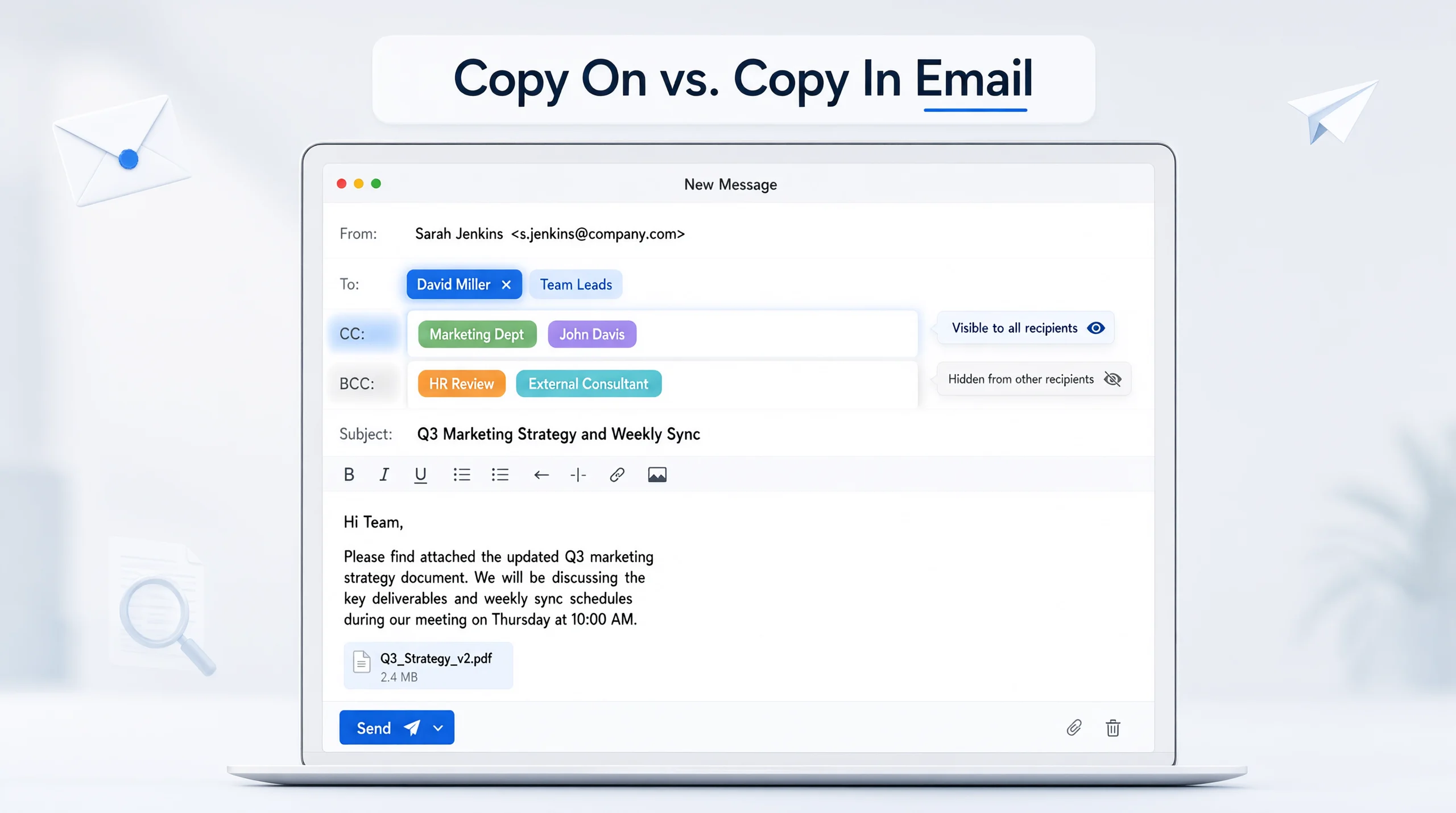
In professional communication, this often means adding someone to the CC field. CC stands for “carbon copy.”
Examples of “Copy On Email”
- Please copy me on the email to the client.
- I copied my manager on the message.
- Could you copy Sarah on your reply?
- Please keep the finance team copied on all payment-related emails.
- I will copy you on the next update.
Is “Copy On Email” Grammatically Correct?
Yes, the expression is correct when used in a complete sentence with the appropriate context. However, “copy someone on an email” is more precise and natural than simply saying “copy on email.”
For example:
- Natural: “Please copy me on the email.”
- Less clear: “Please copy on email.”
In the second example, the person and the intended action are unclear.
You can also say “CC me on the email,” which is common in professional communication.
2. What Does “Copy In Email” Mean?
The expression “copy in email” is less straightforward because it can refer to different things depending on the sentence.
When you mean information contained within a message, use “in the email.” When you mean adding a person to an email conversation, some speakers, particularly in British English, use “copy someone in” or “copy someone into the email.”
Examples of “In the Email”
- The meeting time is in the email.
- Please include the address in the email.
- I explained the problem in my email.
- The attachment is mentioned in the email.
- You can find the instructions in the email below.
Examples of “Copy Someone In”
- Please copy me in on the discussion.
- I will copy the project manager in.
- Could you copy James into the email?
- Please copy the support team in so they know what happened.
These constructions are used in some varieties of English, especially British English. In American English, “copy someone on the email” is generally more common.
Remember that “in the email” and “copy someone in” do not necessarily mean the same thing.
Copy On vs. Copy In Email: Comparison Table
| Expression | Meaning | Example |
| Copy someone on an email | Include someone as a recipient | Copy me on the email. |
| CC someone on an email | Add someone to the CC field | CC my supervisor on the reply. |
| Copy someone in | Include someone in an email exchange | Copy me in on the conversation. |
| Copy someone into an email | Add someone to an email conversation | Copy her into the email chain. |
| In the email | Information contained in the message | The deadline is in the email. |
| On the email | Included as a recipient or associated with the message | I copied him on the email. |
When Should You Use Each Expression?
Choosing the right expression becomes easier when you focus on your intended meaning.
Use “Copy Someone On an Email” When Adding a Recipient
Use this expression when you want another person to receive the email.
Examples:
- Please copy my supervisor on the email.
- I copied the HR department on my reply.
- Could you copy me on future updates?
This is a strong default choice for American English and is widely understood internationally.
Use “In the Email” When Referring to Message Content
Use “in the email” when discussing information, instructions, names, dates, or other details written in the message.
Examples:
- The deadline is in the email.
- Please include the invoice number in the email.
- I found the address in your previous email.
Use “Copy Someone In” When It Fits Your Variety of English
In British English and some other varieties, “copy someone in” is a natural way to describe including someone in an email exchange.
Examples:
- Please copy me in on the next message.
- I’ll copy the team leader in.
- Could you copy Priya into the email?
If you are unsure which expression your reader expects, “copy someone on the email” is a clear and widely understood option.
10+ Examples of “Copy On” vs. “Copy In Email”
Here are practical examples showing how each expression works in everyday communication.
| Sentence | Meaning |
| 1. Please copy me on the email to the supplier. | Include me as a recipient. |
| 2. I copied my manager on the update. | My manager received the update. |
| 3. Can you CC me on your reply? | Include me in the CC field. |
| 4. Please copy the team on all project updates. | Keep the team informed by email. |
| 5. The meeting date is in the email. | The date is written in the message. |
| 6. Please put the reference number in the email. | Include the number in the message text. |
| 7. I explained everything in my email. | The explanation is contained in the message. |
| 8. Please copy me in on the discussion. | Include me in the email conversation. |
| 9. I will copy the director into the email chain. | Add the director to the conversation. |
| 10. Her name is in the email. | Her name appears in the message. |
| 11. Please copy Alex on the final response. | Alex should receive the response. |
| 12. The instructions are included in the email below. | The instructions appear in the message. |
Examples in Professional Emails
Requesting to be included:
“Could you please copy me on future emails about this project?”
Asking someone to include information:
“Please include the revised deadline in the email.”
Keeping a manager informed:
“I have copied my manager on this message for visibility.”
Adding a colleague to a discussion:
“I’ll copy Emma into the email chain so she can follow the conversation.”
These examples show that the correct preposition depends on whether you are talking about a recipient or the contents of a message.
Common Mistakes to Avoid
Even experienced English speakers sometimes use these expressions imprecisely. Here are common mistakes and their clearer alternatives.
Mistake 1: Saying “Copy on Email” Without Enough Context
Incorrect or unclear: “Please copy on email.”
Better: “Please copy me on the email.”
The revised sentence identifies who should receive the message.
Mistake 2: Using “In” When You Mean a Recipient
Less natural in American English: “Please copy me in the email.”
Clearer: “Please copy me on the email.”
The first version may be understood in some varieties of English, but the second is a more reliable choice for an international audience.
Mistake 3: Confusing CC With the Email Body
Incorrect for the intended meaning: “Put me in the email” when you mean that you want to receive a copy.
Clearer: “CC me on the email.”
If you want your name written in the message itself, say, “Please mention me in the email.”
Mistake 4: Confusing “Copy On” With “Copy and Paste”
“Copy me on the email” means include you as a recipient. “Copy the text into the email” means duplicate text and place it in the message.
These are different actions, even though both use the word “copy.”
Mistake 5: Using “On” for Information Contained in a Message
Less natural: “The details are on the email.”
Better: “The details are in the email.”
Use “in” when referring to information contained in the message.
A Simple Memory Trick
Remember this easy rule:
- ON = recipient: Someone is included on the email.
- IN = contents: Information is written in the email.
Think of an email as a message with two parts: the people who receive it and the information it contains.
If you are talking about who receives the message, think “on.” If you are talking about what the message says, think “in.”
This is a useful guideline rather than an absolute rule, because expressions such as “copy someone in” are also natural in some varieties of English.
American English vs. British English
The difference between American and British English can explain why you may hear both expressions.
American English
American speakers commonly say:
- Copy me on the email.
- CC me on the message.
- Keep me copied on future updates.
These expressions are widely used in business communication.
British English
British speakers may use:
- Copy me in on the email.
- Copy me into the email chain.
- I’ll copy Sarah in.
These constructions are common ways to describe including someone in an email exchange.
Which Version Should You Choose?
Both varieties communicate the same general idea when used appropriately. If you are writing to an international audience or are unsure of the reader’s preference, “Please copy me on the email” is a clear and broadly understood choice.
For message content, both American and British English commonly use “in the email,” as in “The details are in the email.”
Similar Words and Expressions
Several related expressions can help you communicate more precisely.
CC
CC means “carbon copy.” It lets you send an email to additional recipients, typically so they can stay informed.
Example: “Please CC the department head on your reply.”
BCC
BCC means “blind carbon copy.” It sends a copy to a recipient without displaying that recipient’s address to the other recipients in the usual recipient fields.
Example: “Please BCC the mailing list recipients to protect their email addresses.”
Include
“Include” is a general word meaning to make someone or something part of a group or message.
Example: “Please include me in the email conversation.”
Forward
“To forward an email” means to send a message you received to another person.
Example: “I’ll forward the original email to my supervisor.”
Forwarding a message is different from copying someone on the original email.
Email Chain
An email chain is a series of related messages exchanged on the same topic.
Example: “Please add the new team member to the email chain.”
Email Thread
An email thread is a group of connected messages, often displayed together in an email application.
Example: “I’ll copy you on the email thread.”
Final Verdict: Copy On vs. Copy In Email
The best expression depends on what you want to say.
Use “copy someone on an email” when you want to include someone as a recipient. Use “in the email” when you are referring to information contained in the message. In British English and some other varieties, “copy someone in” or “copy someone into an email” is also natural.
For example:
- “Please copy me on the email” means you want to receive a copy.
- “Please include the details in the email” means you want the details written in the message.
When in doubt, these two examples provide a reliable starting point for clear, professional communication.
FAQs:
1. Is it “copy on email” or “copy in email”?
“Copy someone on an email” is a common and natural expression, especially in American English. “Copy someone in” is also used, particularly in British English. If you mean information contained in a message, use “in the email.”
2. Should I say “CC me on the email” or “CC me in the email”?
“CC me on the email” is generally the safest choice for American English and international workplace communication. “CC me in” may be heard in British English, although “copy me in” is also common.
3. What does “copy me on this email” mean?
It means that you want the sender to include you as a recipient of the email, usually in the CC field, so you can see the message and stay informed.
4. Is “copy me into the email” correct?
Yes. “Copy me into the email” is a natural expression in British English and other varieties. It means including you in the email conversation. “Copy me on the email” is another widely understood alternative.
5. What is the difference between CC and BCC?
CC allows recipients to see the addresses of other people listed in the To and CC fields. BCC hides the BCC recipients’ addresses from other recipients in the usual recipient fields. Both can be used to send copies of a message.
6. Should I use “in the email” or “on the email” for information?
Use “in the email” when referring to information contained in the message. For example, “The appointment time is in the email.” Use “on the email” when describing someone being copied on or included as a recipient of a message.
7. Is “keep me copied” correct?
Yes. “Keep me copied on future emails” is a natural way to ask someone to continue including you in relevant email communications. You can also say, “Please keep me in the loop.”
Remember This
- Copy someone on an email: Include a person as a recipient.
- Copy someone in: Include a person in an email exchange; common in British English.
- Copy someone into an email: Add a person to an email conversation.
- In the email: Refer to information written in the message.
- CC: Send a visible copy to an additional recipient.
- BCC: Send a copy without showing that recipient’s address to other recipients in the usual recipient fields.
Conclusion
Understanding the difference between “copy on” and “copy in” makes everyday email communication easier. Although both expressions can be correct in the right context, they are not always interchangeable. “Copy someone on an email” is a clear, widely understood way to ask to receive a copy, while “in the email” refers to the message’s contents.
When writing professional emails, focus on the action you want to describe. Choose “on” when referring to recipients and “in” when referring to information inside the message. If you are communicating with British English speakers, “copy someone in” may also sound natural. These simple distinctions will help you write clearer messages and communicate with greater confidence.

I am Camden Thomas, an Administrator at SaysReply. I help maintain our platform and ensure readers find clear, natural, and useful alternative ways to express their thoughts every day.