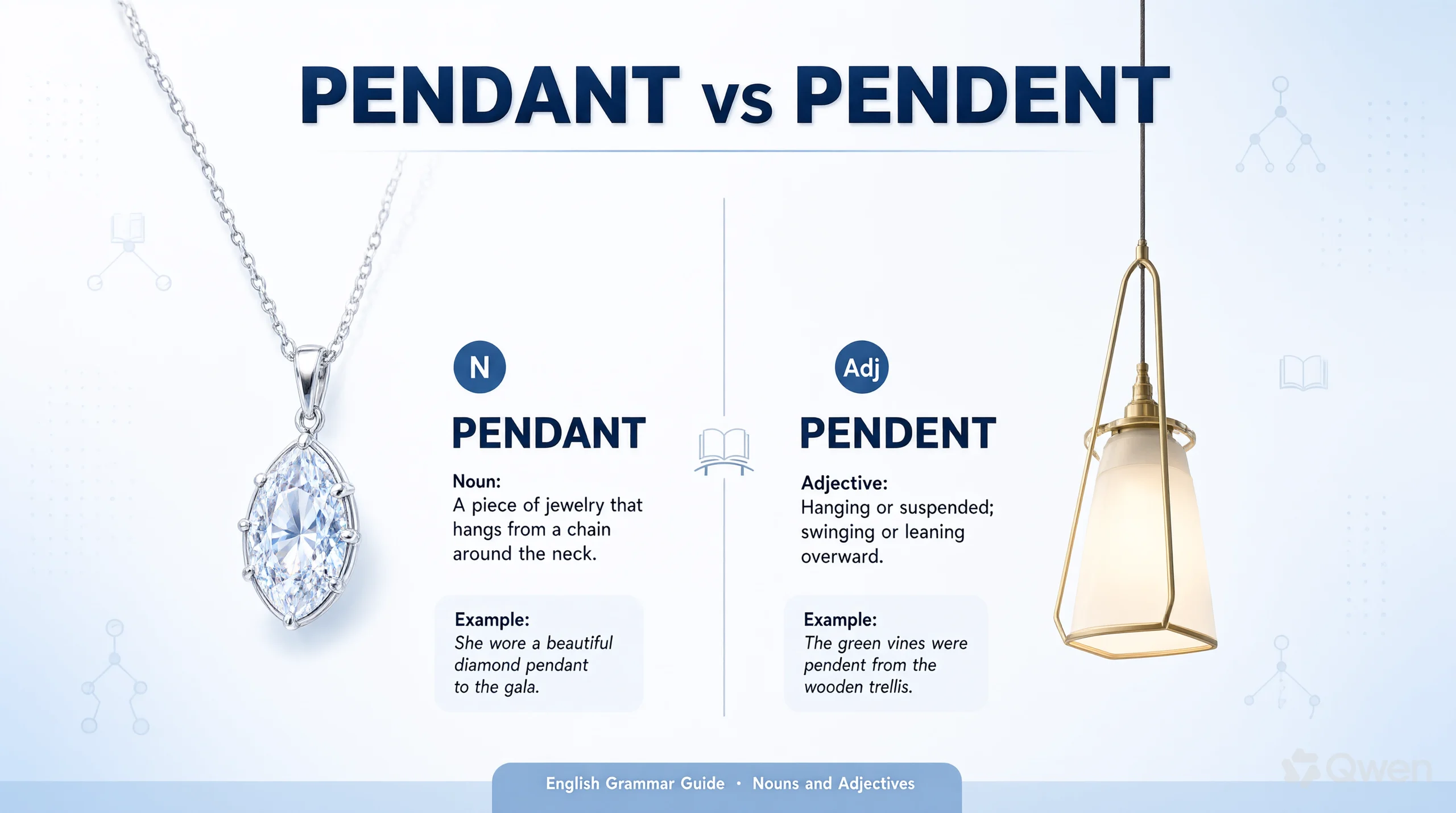
The words pendant and pendent look almost identical, sound similar, and share a connection with the idea of hanging. However, they have different meanings and uses. Knowing the difference can help you choose the correct spelling in everyday writing, academic work, and professional communication.
The main difference is that pendant is a noun that refers to a piece of jewelry or a decorative object that hangs from something, such as a necklace. Pendent is an adjective that describes something hanging, suspended, or projecting downward. Although both words are related to hanging, they are not interchangeable. In this guide, you will learn what each word means, when to use it, how to remember the difference, and how to avoid common spelling mistakes.
Quick Answer: Pendant vs Pendent
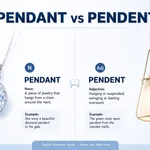
Pendant is a noun meaning a hanging ornament, usually a piece of jewelry attached to a necklace. Pendent is an adjective meaning hanging or suspended from something. For example, a gold pendant hangs from a chain, while a pendent branch hangs downward from a tree. The correct choice depends on the meaning and grammatical role.
Why Do People Confuse Pendant and Pendent?
People often confuse pendant and pendent because they:
- Have almost identical spellings.
- Share the same Latin root associated with hanging.
- Have similar pronunciations.
- Describe objects or things associated with hanging.
- Differ by only one vowel: the second letter after the initial consonant.
However, their grammatical functions make the distinction easier to understand.
- Pendant: Names an object, usually jewelry.
- Pendent: Describes the position or condition of something hanging.
Remember that pendant is generally a noun, whereas pendent is generally an adjective.
What Does Pendant Mean?
Pendant is a noun that refers to an ornament, decoration, or piece of jewelry that hangs from something. It most commonly describes a decorative piece attached to a necklace or chain and worn around the neck.
A pendant can be made from different materials, including gold, silver, platinum, glass, wood, or gemstones.
Emeralva | Certified Colombian Emerald Jewelry
Sterling Silver Heart Pendant Necklace – Philip Jones Jewellery
8
Examples of Pendant in Sentences
- She wore a beautiful diamond pendant around her neck.
- My grandmother gave me a gold pendant.
- The silver pendant was attached to a delicate chain.
- He bought a heart-shaped pendant for his wife.
- The antique pendant was decorated with colorful gemstones.
Other Uses of Pendant
Although jewelry is its most familiar meaning, pendant can also describe a hanging decorative object or fitting.
For example:
- A crystal pendant hanging from a chandelier.
- A decorative pendant hanging from a ceiling.
- A pendant light suspended above a kitchen island.
In architecture and design, the word can also describe certain hanging ornamental features.
What Does Pendent Mean?
Pendent is an adjective that describes something hanging, suspended, or extending downward from a higher point.
It is often used in descriptive, literary, botanical, architectural, and technical writing. Unlike pendant, it does not normally name a piece of jewelry.
El Sauce Llorón: Origen, Cuidados y Su Impacto Vital en…
Delicate white campanula flowers hanging in soft natural light
6
Examples of Pendent in Sentences
- The pendent branches of the willow tree moved in the wind.
- Small pendent flowers covered the garden plant.
- A pendent ornament hung from the ceiling.
- The pendent vines created a beautiful natural curtain.
- The rock formation had a long, pendent shape.
Other Uses of Pendent
Pendent can appear in several descriptive contexts:
- Botany: Describing flowers, leaves, or branches that hang downward.
- Architecture: Describing decorative features that extend downward.
- General description: Referring to anything suspended from a higher point.
It is a relatively uncommon word in everyday conversation. More familiar alternatives include hanging, dangling, suspended, and drooping.
Pendant vs Pendent: Comparison Table
| Feature | Pendant | Pendent |
| Part of speech | Noun | Adjective |
| Main meaning | A hanging ornament | Hanging or suspended |
| Common use | Jewelry and decoration | Descriptive writing |
| Example | A gold pendant | Pendent branches |
| Word function | Names an object | Describes something |
| Everyday usage | Common | Less common |
| Related idea | Ornament | Suspension |
The easiest distinction: A pendant is something that hangs, while pendent describes something that is hanging.
When Should You Use Pendant or Pendent?
Choosing between these words becomes easier when you understand what you want to communicate.
When to Use Pendant
Use pendant when you are talking about:
- A necklace ornament.
- A decorative object that hangs.
- A gemstone attached to a chain.
- A hanging decorative light or fitting.
Examples:
- I purchased a beautiful silver pendant.
- The pendant contained a small blue sapphire.
- We installed a modern pendant light above the dining table.
When to Use Pendent
Use pendent when you want to describe something that hangs downward.
Examples:
- The pendent branches reached toward the ground.
- The plant produced delicate pendent flowers.
- A pendent decoration was suspended from the ceiling.
Simple rule: If you are naming jewelry or an ornament, use pendant. If you are describing something hanging, use pendent.
12 Examples of Pendant vs Pendent in Sentences
Here are practical examples to help you understand the difference.
| Pendant (Noun) | Pendent (Adjective) |
| She wore a gold pendant. | The pendent branches looked beautiful. |
| He gifted her a diamond pendant. | The pendent flowers attracted butterflies. |
| My pendant has a heart-shaped design. | The pendent vines covered the wall. |
| The pendant was made of silver. | A pendent ornament hung above us. |
| She lost her favorite pendant. | The pendent leaves moved gently. |
| The necklace had a pearl pendant. | The pendent structure extended downward. |
More Everyday Examples
- Pendant: The jeweler designed a beautiful emerald pendant.
- Pendent: The pendent flowers grew along the garden wall.
- Pendant: My mother wears a religious pendant every day.
- Pendent: The pendent branches provided shade.
- Pendant: The crystal pendant reflected the sunlight.
- Pendent: A pendent decoration hung from the old ceiling.
These examples show how the two words work differently in sentences.
Common Mistakes When Using Pendant and Pendent
Even experienced writers sometimes confuse these spellings. Here are some mistakes to avoid.
1. Using Pendent for Jewelry
Incorrect: She bought a beautiful gold pendent.
Correct: She bought a beautiful gold pendant.
Why? Pendant is the standard spelling for a jewelry ornament.
2. Using Pendant as an Adjective
Incorrect: The pendant branches touched the ground.
Correct: The pendent branches touched the ground.
Why? Pendent describes branches that hang downward.
3. Assuming Both Words Are Interchangeable
Although both words relate to hanging, they have different grammatical functions.
Incorrect: The necklace contained a beautiful pendent.
Correct: The necklace contained a beautiful pendant.
4. Confusing Pendant with Pending
Pendant and pending are different words.
- Pendant: A hanging ornament.
- Pending: Awaiting a decision, completion, or resolution.
Example:
- She wore a gold pendant.
- The application is still pending.
Memory Trick: How to Remember Pendant vs Pendent
Use these simple tricks to remember the correct spelling.
Pendant = Accessory
Think of the letter A in the word pendant as a reminder of an accessory. A pendant is commonly a jewelry accessory.
Pendent = Hanging
Think of pendent as describing something that depends or hangs from another point.
Another useful trick is to remember their grammatical roles:
- Pendant names something.
- Pendent describes something.
If you remember these two points, you can avoid most spelling mistakes.
Pendant vs Pendent in American and British English
The distinction between pendant and pendent is generally the same in American and British English.
| Usage | American English | British English |
| Jewelry ornament | Pendant | Pendant |
| Hanging or suspended | Pendent | Pendent |
| Pendant light | Pendant light | Pendant light |
| Descriptive hanging branches | Pendent branches | Pendent branches |
There is no major American-versus-British spelling difference between these two words.
Both varieties use pendant for jewelry and pendent as an adjective meaning hanging or suspended.
Similar Words Related to Pendant and Pendent
Understanding related vocabulary can help you expand your English vocabulary and choose more precise expressions.
| Word | Meaning | Example |
| Hanging | Suspended from something | A hanging decoration |
| Dangling | Hanging loosely | A dangling rope |
| Suspended | Supported from above | A suspended light |
| Drooping | Bending downward | Drooping flowers |
| Pendant | A hanging ornament | A gold pendant |
| Pendent | Hanging downward | Pendent branches |
| Necklace | Jewelry worn around the neck | A pearl necklace |
| Ornament | A decorative object | A Christmas ornament |
| Chandelier | A decorative ceiling light | A crystal chandelier |
| Pending | Awaiting a decision | A pending application |
Important: Pending is not a synonym for pendent. Although their spellings look similar, their meanings are different.
Final Verdict: Pendant or Pendent?
Both pendant and pendent are correct English words, but they serve different purposes.
- Use pendant when referring to jewelry, such as a gold necklace ornament, or another hanging decorative object.
- Use pendent when describing something that hangs or is suspended downward, such as branches, flowers, or decorative features.
For everyday writing, pendant is much more common because it is frequently used in jewelry and interior design. Pendent is less common and is mainly found in descriptive or technical contexts.
FAQs:
1. Is it pendant or pendent?
Both spellings are correct, but their meanings are different. Pendant is a noun referring to a hanging ornament or piece of jewelry. Pendent is an adjective describing something that hangs or is suspended downward.
2. What is the difference between pendant and pendent?
The main difference is their grammatical function. Pendant names a hanging object, while pendent describes the position or condition of something hanging. For example, a diamond pendant hangs from a necklace, while pendent branches hang from a tree.
3. Is a necklace pendant or pendent?
The correct word is pendant. A pendant is a decorative object attached to a necklace or chain. For example, a gold heart-shaped ornament worn around the neck is called a pendant.
4. Is pendent a real English word?
Yes, pendent is a real English word. It is an adjective meaning hanging, suspended, or extending downward. It is commonly used in descriptive, botanical, architectural, and literary contexts.
5. Is pendant more common than pendent?
Yes, pendant is considerably more common in everyday English. It frequently appears in jewelry descriptions, shopping, fashion, and interior design. Pendent is less common and generally appears in specialized or descriptive writing.
6. Can pendant and pendent be used interchangeably?
No, they are not generally interchangeable. Pendant is a noun that names an ornament, while pendent is an adjective that describes something hanging. Using one in place of the other can change the meaning or make a sentence grammatically incorrect.
7. Is pendent the same as pending?
No, pendent and pending have different meanings. Pendent means hanging or suspended, while pending means awaiting a decision, action, or completion. For example, pendent branches hang downward, but a pending application is waiting for approval.
Remember This
- Pendant: A noun meaning a hanging ornament or piece of jewelry.
- Pendent: An adjective meaning hanging or suspended.
- Pendant necklace: Correct.
- Pendent branches: Correct.
- Pending application: Correct, but a completely different meaning.
The simplest way to remember the difference is that pendant is an object, while pendent describes how something hangs.
Conclusion
Understanding the difference between pendant and pendent is simple once you recognize their grammatical roles. Pendant refers to a hanging ornament, especially jewelry worn around the neck, whereas pendent describes something suspended or extending downward. Although their spellings and meanings are closely related, they are used in different contexts.
The next time you write about jewelry, decorations, flowers, or hanging branches, choose the word that matches your intended meaning. Remember: a pendant is something you wear or display, while pendent describes something that hangs.

I’m Sawyer Michael, a writer passionate about language and communication. I enjoy helping readers discover clearer, more natural, and creative ways to express their thoughts through words.