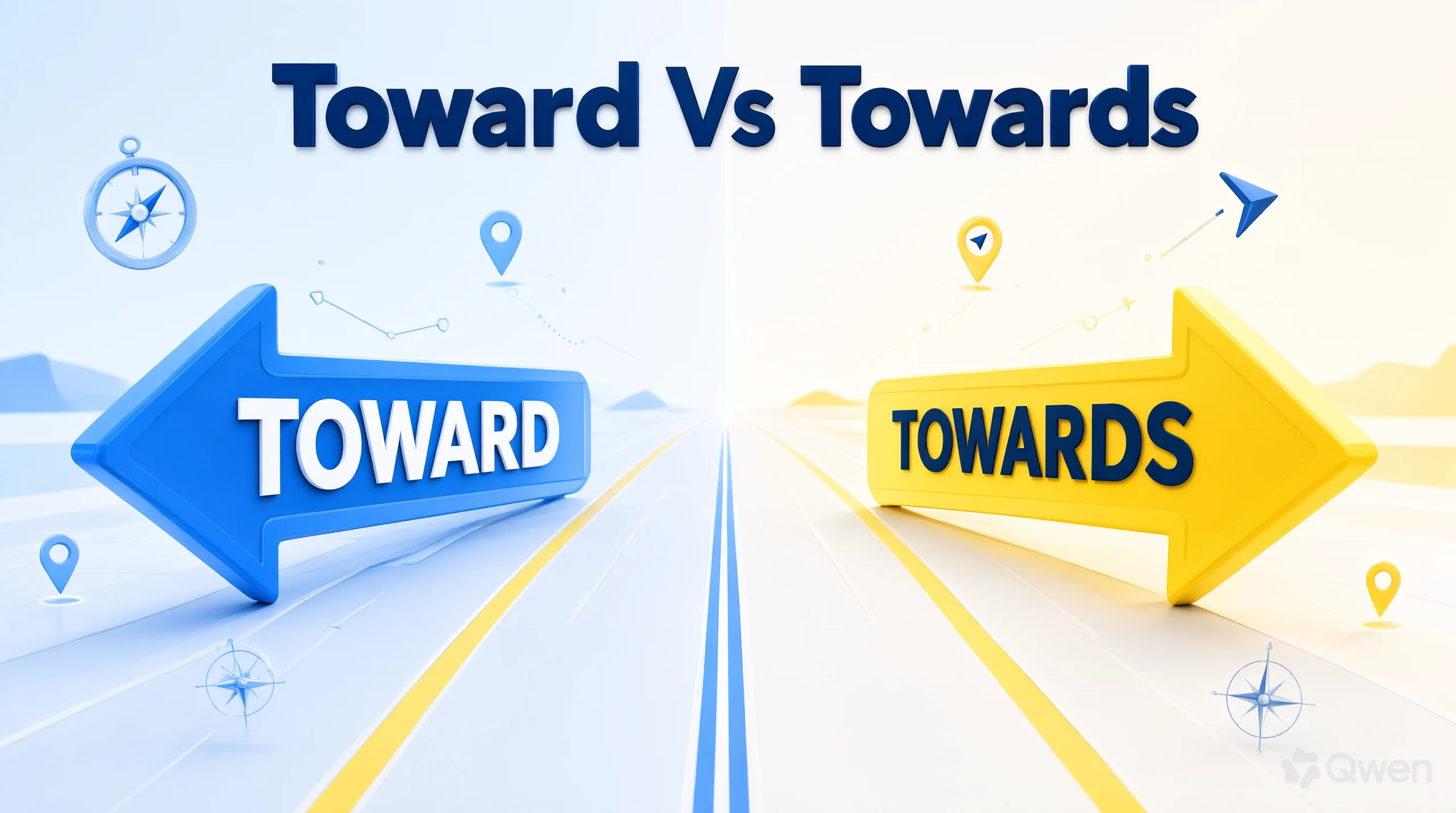
The words toward and towards have the same basic meaning. Both are prepositions used to describe movement, direction, progress, or an attitude directed at someone or something. For example, you can write “She walked toward the door” or “She walked towards the door.” Both sentences are grammatically correct and communicate the same idea.
The main difference is regional preference. Toward is more commonly used in American English, while towards is more common in British English. However, neither word is incorrect in either variety of English. Choosing the right one depends mainly on your audience, writing style, and consistency.
Understanding this small spelling difference can help you write more naturally, avoid common grammar mistakes, and feel more confident when using English in everyday conversations, academic assignments, and professional writing.
Quick Answer: Toward vs Towards
Toward and towards mean the same thing: in the direction of someone or something. The difference is regional preference, not meaning or grammar. American English generally prefers “toward,” while British English generally prefers “towards.” Both forms are correct, so choose one based on your audience and use it consistently.
Why Do People Confuse Toward and Towards?
People often confuse these words because they look almost identical and express exactly the same general meaning.
The only visible difference is the letter s at the end of “towards.” This small spelling variation makes learners wonder whether one form is grammatically incorrect or whether the two words have different meanings.
There are three main reasons for this confusion:
- Regional differences: American and British English often prefer different spellings.
- Similar usage: Both words work in the same grammatical situations.
- Different writing habits: People may encounter both forms in books, websites, newspapers, and conversations.
The important thing to remember is that adding an “s” does not change the meaning of the word.
1. Toward: Meaning, Definition, and Examples
Toward is a preposition that means in the direction of someone or something. It can describe physical movement, progress toward a goal, or feelings and attitudes directed at another person.
It is especially common in American English.
What Does Toward Mean?
The word “toward” can express several related ideas:
- Direction: Moving closer to a particular place or object.
- Progress: Making an effort to achieve something.
- Attitude: Showing a particular feeling toward someone.
- Contribution: Giving money or effort to help achieve something.
Examples of Toward in Sentences
- She walked toward the school.
- The dog ran toward its owner.
- We are working toward a better future.
- He showed kindness toward everyone.
- The car moved toward the entrance.
- They are taking steps toward success.
- She turned toward the window.
- His attitude toward learning has improved.
- The company contributed money toward the project.
- The child reached toward his mother.
In all these examples, “toward” indicates direction, movement, progress, or an intended target.
2. Towards: Meaning, Definition, and Examples
Towards is also a preposition meaning in the direction of someone or something. It has the same grammatical function and meaning as “toward.”
It is particularly common in British English, although it is also used in other varieties of English.
What Does Towards Mean?
The word “towards” can describe:
- Physical direction: Moving closer to a place or person.
- Development: Making progress toward an objective.
- Feelings: Expressing an attitude toward someone.
- Purpose: Contributing something to a particular goal.
Examples of Towards in Sentences
- She walked towards the garden.
- The children ran towards their teacher.
- We are moving towards a solution.
- He has a positive attitude towards education.
- The train travelled towards London.
- They are working towards their dreams.
- The bird flew towards the trees.
- She leaned towards her friend.
- He saved money towards buying a house.
- The country is moving towards economic growth.
These sentences have the same meanings they would have if “towards” were replaced with “toward.”
Toward vs Towards: Comparison Table
| Feature | Toward | Towards |
| Meaning | In the direction of | In the direction of |
| Word type | Preposition | Preposition |
| Grammar | Correct | Correct |
| American English | More common | Less common |
| British English | Less common | More common |
| Physical direction | Yes | Yes |
| Progress | Yes | Yes |
| Attitude | Yes | Yes |
| Formal writing | Acceptable | Acceptable |
Key difference: The two words have identical meanings, but their popularity differs across English varieties.
When Should You Use Toward or Towards?
Choosing between these words is easy when you understand your audience.
Use Toward in American English
Choose “toward” when writing for an American audience or following American English spelling conventions.
Examples:
- He walked toward the building.
- We are working toward success.
- Her feelings toward him changed.
It is a natural choice for American academic writing, business communication, and everyday conversations.
Use Towards in British English
Choose “towards” when writing for a British audience or following British English conventions.
Examples:
- She walked towards the station.
- We are moving towards a better future.
- His attitude towards work is positive.
It is widely used in British writing and everyday communication.
Can You Use Both in One Sentence?
Grammatically, both words can appear in the same sentence, but doing so is usually unnecessary.
For example:
– She walked toward the door while her brother moved towards the window.
This sentence is grammatically correct. However, using the same form throughout your writing generally creates better consistency.
12 Examples of Toward vs Towards in Everyday English
Here are practical examples showing how both words can be used in identical situations.
| Toward | Towards |
| He walked toward the park. | He walked towards the park. |
| She moved toward the door. | She moved towards the door. |
| The dog ran toward me. | The dog ran towards me. |
| We are working toward success. | We are working towards success. |
| They travelled toward the city. | They travelled towards the city. |
| She looked toward the sky. | She looked towards the sky. |
| He turned toward his friend. | He turned towards his friend. |
| We are moving toward change. | We are moving towards change. |
| She has kindness toward others. | She has kindness towards others. |
| They contributed toward the goal. | They contributed towards the goal. |
| The bird flew toward the house. | The bird flew towards the house. |
| He took a step toward recovery. | He took a step towards recovery. |
Notice that the meaning does not change when you replace one form with the other.
Common Mistakes When Using Toward and Towards
Although both forms are correct, English learners sometimes make mistakes when using them.
1. Thinking That Towards Is Grammatically Incorrect
Incorrect understanding: “Towards” is always wrong because it contains an extra letter.
Correct understanding: Both forms are standard English prepositions.
2. Thinking That They Have Different Meanings
Some learners assume that “toward” means movement and “towards” means progress.
This is incorrect. Both words can describe movement, progress, feelings, and direction.
3. Using Them Inconsistently
Switching between the two forms without a reason can make an article or document look inconsistent.
For example:
- The company is moving toward success.
- Its employees are working towards the same goal.
Both sentences are correct, but using one preferred form throughout the document is generally better.
4. Confusing Toward With To
Although they can sometimes express similar ideas, they are not always interchangeable.
- She walked to the school. (The school is her destination.)
- She walked toward the school. (She moved in its direction, but may not have reached it.)
This distinction is important because “toward” does not necessarily mean that someone reaches the destination.
Easy Memory Trick: How to Remember Toward vs Towards
You can remember the difference with one simple rule:
American English = Toward
British English = Towards
Think of the final “s” in “towards” as a spelling preference commonly associated with British English.
Remember that this is a regional preference, not a strict grammar rule. If you are unsure which form to use, choose the version that matches the English style of your writing.
Toward vs Towards in American and British English
The biggest difference between these words is their popularity in different English-speaking regions.
American English
American English generally prefers “toward” without the final “s.”
For example:
- Walk toward the exit.
- Progress toward your goals.
- His attitude toward the situation.
American newspapers, educational materials, and professional writing commonly use this form.
British English
British English generally prefers “towards” with the final “s.”
For example:
- Walk towards the exit.
- Progress towards your goals.
- His attitude towards the situation.
British publications, educational materials, and everyday writing commonly use this spelling.
Which One Is More Formal?
Neither word is inherently more formal than the other.
Both are appropriate for:
- Academic essays
- Business emails
- Professional documents
- Formal reports
- Everyday conversations
The best approach is to follow the regional English convention you have chosen.
Similar Words Related to Toward and Towards
Several English words express ideas similar to “toward” and “towards.” However, their meanings and grammatical uses can differ.
| Word | Simple Meaning | Example |
| To | In the direction of a destination | She went to school. |
| In the direction of | Moving toward something | He walked in the direction of the park. |
| Near | Close to something | The house is near the river. |
| Approaching | Moving closer | The train is approaching the station. |
| Facing | Positioned toward something | The house is facing the sea. |
| Against | In opposition to something | They protested against the decision. |
| For | Intended to benefit something | She worked for a better future. |
These words can sometimes express related ideas, but they are not direct replacements in every sentence.
Final Verdict: Toward or Towards?
Both toward and towards are correct English words. They have the same meaning, pronunciation, and grammatical function. The only significant difference is regional preference.
Use “toward” when following American English conventions and “towards” when following British English conventions.
If you are writing for an international audience, either form is acceptable. The most important thing is to remain consistent throughout your writing.
FAQs:
1. Is It Toward or Towards?
Both spellings are correct. “Toward” is more common in American English, while “towards” is more common in British English. They have exactly the same general meaning and can be used in the same grammatical situations.
2. Is Towards Grammatically Correct?
Yes, “towards” is grammatically correct. It is a standard English preposition used to describe direction, movement, progress, and attitudes. It is particularly common in British English.
3. Is Toward American or British English?
“Toward” is more commonly associated with American English. However, it is also correct in British English. It is not an exclusively American word.
4. Is Towards British or American English?
“Towards” is more commonly used in British English. However, American English speakers also use it. The difference is a matter of regional preference rather than grammatical correctness.
5. Do Toward and Towards Mean the Same Thing?
Yes, both words have the same meaning. They describe movement or direction toward someone or something. They can also express progress, feelings, and attitudes.
6. Which Is More Formal: Toward or Towards?
Neither is more formal. Both are suitable for academic, professional, and casual writing. Your choice should depend on whether you are following American or British English conventions.
7. Can I Use Toward and Towards Interchangeably?
Yes, you can generally use them interchangeably without changing the meaning of a sentence. However, it is better to choose one form and use it consistently throughout your writing.
Remember This
- Toward: More common in American English.
- Towards: More common in British English.
- Meaning: Both words mean in the direction of something.
- Grammar: Both are correct prepositions.
- Writing tip: Choose one form and use it consistently.
Conclusion
Understanding the difference between “toward” and “towards” is simple once you recognize that both words have the same meaning. They describe direction, movement, progress, and attitudes toward people or situations. The extra “s” does not change the word’s meaning or grammatical function.
The main distinction is regional usage: American English generally prefers “toward,” while British English generally prefers “towards.” Neither is wrong, so choose the form that suits your audience and maintain consistency in your writing.

I am Camden Thomas, an Administrator at SaysReply. I help maintain our platform and ensure readers find clear, natural, and useful alternative ways to express their thoughts every day.