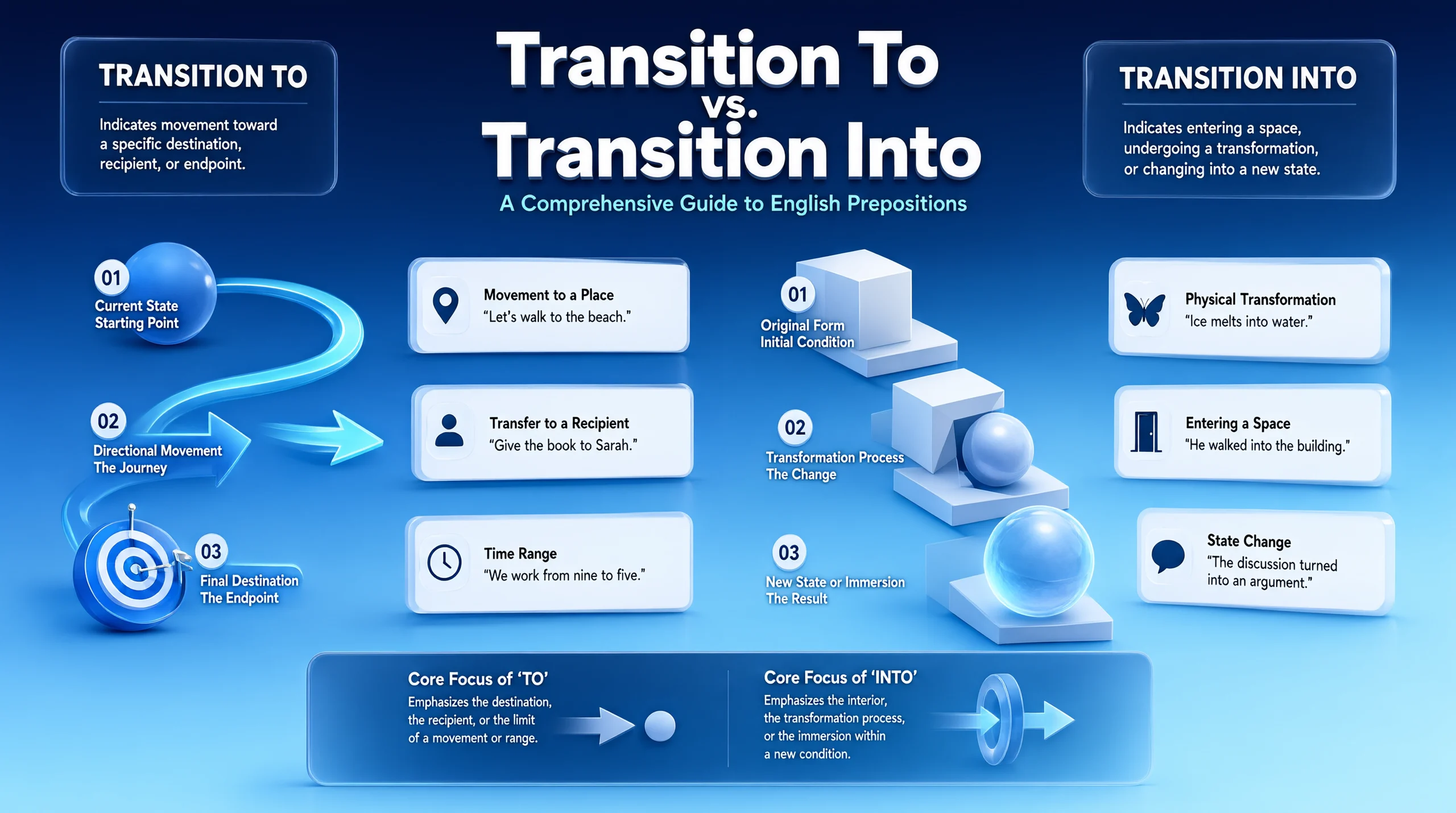
Have you ever wondered if to say “transition to” or “transition into”? Both expressions are grammatically correct, but they are used in slightly different situations. Choosing the right one depends on what you want to describe, such as moving to a new stage, changing a situation, entering a different role, or becoming something new.
The main difference is that “transition to” generally describes moving toward or changing to a new stage, condition, system, or situation. In comparison, “transition into” often emphasizes entering a new state, role, condition, or phase. For example, you can transition to a new job, but you can transition into adulthood. Although these expressions sometimes overlap, understanding their context will help you use them naturally in speaking and writing.
Quick Answer
Both “transition to” and “transition into” are correct. Use “transition to” when referring to a new stage, system, or situation. Use “transition into” when emphasizing entry into a new state, role, or condition. The best choice depends on the meaning and context of your sentence.
Why Do People Confuse “Transition To” and “Transition Into”?
People often confuse these expressions because both describe change, movement, or progress from one situation to another.
The word transition means a process of changing from one condition, stage, or situation to another. Since both to and into can introduce a destination, they sometimes appear interchangeable.
However, there is a small difference in emphasis:
- Transition to: Focuses on the destination or the next stage.
- Transition into: Focuses on entering or becoming part of a new state, role, or condition.
For example:
- The company will transition to a new management system.
- The company will transition into a more competitive market.
The first sentence emphasizes adopting a new system. The second emphasizes entering a different business environment.
First Phrase: Transition To
“Transition to” is a correct English expression used when describing a change from one stage, condition, system, or situation to another.
The preposition to identifies the destination or direction of the change. It is particularly common when discussing education, business, technology, careers, and everyday life.
When Should You Use “Transition To”?
Use “transition to” in these situations:
1. Moving to a new stage
Use this expression when someone or something moves from one stage to another.
Examples:
- Children transition to secondary school.
- The project will transition to its next phase.
- The country is transitioning to a new economic model.
2. Changing systems or processes
Use it when describing the adoption of a different system, method, or process.
Examples:
- Our company will transition to digital payments.
- The school plans to transition to online learning.
- We are transitioning to a more efficient workflow.
3. Changing jobs or responsibilities
Use it when someone moves toward a different professional position or responsibility.
Examples:
- She wants to transition to a leadership role.
- He transitioned to a new department last year.
4. Moving toward a different lifestyle
Examples:
- They are transitioning to a healthier lifestyle.
- I want to transition to a more flexible work schedule.
Second Phrase: Transition Into
“Transition into” is also grammatically correct. It describes the process of entering, becoming, or moving into a new state, role, condition, or phase.
The preposition into emphasizes the movement from one situation into another. It often highlights the result of a change or the new condition someone or something enters.
When Should You Use “Transition Into”?
Use “transition into” in these situations:
1. Entering a new stage of life
Use it when describing a change into a different period or stage of life.
Examples:
- Children transition into adolescence.
- She is transitioning into adulthood.
- Many people find it difficult to transition into retirement.
2. Becoming something different
Use it when emphasizing a change in identity, condition, or character.
Examples:
- The small business transitioned into a successful company.
- The discussion transitioned into an argument.
- The quiet afternoon transitioned into a busy evening.
3. Entering a new professional role
Use it when someone begins operating in a different professional position.
Examples:
- He transitioned into a management position.
- She successfully transitioned into the teaching profession.
4. Changing into a new condition
Examples:
- The weather transitioned into a colder period.
- The organization transitioned into a more sustainable business model.
Transition To vs. Transition Into: Comparison Table
| Feature | Transition To | Transition Into |
| Main meaning | Moving to a new destination or stage | Entering a new state or condition |
| Focus | Destination or next step | Entry or transformation |
| Common use | Systems, careers, stages, processes | Roles, conditions, identities, life stages |
| Example | Transition to a new job | Transition into management |
| Emphasis | Where the change leads | What someone or something becomes |
| Grammar | Transition + to | Transition + into |
Important: These expressions can overlap. For example, both “transition to adulthood” and “transition into adulthood” are correct. The second emphasizes entering adulthood, while the first presents it as the next stage.
When to Use Each Expression
Choosing between these phrases becomes easier when you understand the situation.
Use “Transition To” for Destinations and Next Steps
Choose this expression when discussing:
- A new stage in a project.
- A different educational system.
- A new workplace or department.
- A different technology or process.
- A change in lifestyle or routine.
Examples:
- We plan to transition to a new software platform.
- The students will transition to college next year.
- The company is transitioning to renewable energy.
Use “Transition Into” for New States and Roles
Choose this expression when discussing:
- Entering adulthood or retirement.
- Becoming a manager or professional.
- Changing into a different condition.
- Entering a new phase of development.
- Developing a different identity or role.
Examples:
- She transitioned into a leadership position.
- He is transitioning into retirement.
- The conversation transitioned into a serious discussion.
12 Examples of “Transition To” and “Transition Into” in Sentences
Here are practical examples to help you understand how both expressions work in everyday English.
| Transition To | Transition Into |
| 1. I want to transition to a new career. | 1. I want to transition into the healthcare profession. |
| 2. The school will transition to online classes. | 2. The students will transition into a new learning environment. |
| 3. Our company is transitioning to digital services. | 3. The company transitioned into a global organization. |
| 4. She plans to transition to a healthier lifestyle. | 4. She is transitioning into a healthier stage of life. |
| 5. We will transition to the next project phase. | 5. The project is transitioning into its final stage. |
| 6. He transitioned to a different department. | 6. He transitioned into a management role. |
More Everyday Examples
7. Transition to:
– The family decided to transition to a smaller home.
8. Transition into:
– The child is transitioning into adolescence.
9. Transition to:
– Our organization is transitioning to a four-day workweek.
10. Transition into:
– The conversation gradually transitioned into a debate.
11. Transition to:
– The business plans to transition to environmentally friendly packaging.
12. Transition into:
– The caterpillar transitions into a butterfly during its life cycle.
These examples show that the choice depends on whether you want to emphasize a destination or entry into a new condition.
Common Mistakes When Using “Transition To” and “Transition Into”
Even experienced English speakers sometimes use these expressions incorrectly. Understanding the following mistakes can help you write more clearly.
Mistake 1: Assuming Both Expressions Always Mean Exactly the Same Thing
Although they overlap, their emphasis can differ.
Incorrect assumption:
– Transition to and transition into are always interchangeable.
Better understanding:
- Transition to emphasizes a destination.
- Transition into emphasizes entering a new state or condition.
Mistake 2: Using the Wrong Preposition
Incorrect:
– She transitioned in a management role.
Correct:
– She transitioned into a management role.
The preposition into expresses entering the new role.
Mistake 3: Forgetting That “Transition” Can Be a Noun or Verb
Both forms are correct, but their sentence structures differ.
Verb:
– We will transition to a new system.
Noun:
– The transition to a new system will take time.
Mistake 4: Adding an Unnecessary Preposition
Incorrect:
– We are transitioning to into a new system.
Correct:
– We are transitioning to a new system.
Or:
– We are transitioning into a new working environment.
Choose the preposition that communicates your intended meaning.
Memory Trick: How to Remember the Difference
Here is a simple trick to remember which expression to use.
- TO = Target: Think of moving toward a destination, goal, or next stage.
- INTO = Entry: Think of entering a new situation, role, or condition.
Remember these examples:
- Transition to a new school.
- Transition into adulthood.
When you think about a destination, use to. When you want to emphasize entering or becoming something, into is often the better choice.
American vs. British English: Is There a Difference?
There is no significant difference between American and British English when using “transition to” and “transition into.”
Both expressions are grammatically acceptable in both varieties of English.
| Expression | American English | British English |
| Transition to a new job | Correct | Correct |
| Transition into adulthood | Correct | Correct |
| Transition to digital learning | Correct | Correct |
| Transition into retirement | Correct | Correct |
The choice depends on meaning and context rather than regional spelling or grammar rules.
Similar Words and Expressions
Several English words have meanings related to transition. However, they are not always interchangeable.
| Word or Phrase | Simple Meaning | Example |
| Shift to | Change direction or focus | We shifted to a new strategy. |
| Move to | Go to another place or situation | She moved to a new department. |
| Change into | Become something different | The discussion changed into an argument. |
| Evolve into | Develop gradually into something | The idea evolved into a business. |
| Progress to | Move forward to another stage | Students progress to advanced classes. |
| Adapt to | Become comfortable with a change | He adapted to his new workplace. |
| Transform into | Change completely into something | The village transformed into a city. |
| Convert to | Change from one form or system to another | They converted to solar energy. |
These alternatives can make your writing more precise and help you avoid repeating the word transition.
Final Verdict: Transition To or Transition Into?
Both “transition to” and “transition into” are grammatically correct. Neither expression is universally better than the other.
Use “transition to” when describing movement toward a destination, a new stage, a different system, or a situation.
Use “transition into” when emphasizing entry into a new condition, role, phase, or identity.
For example, “transition to a new career” focuses on the career change as a destination, while “transition into a teaching career” emphasizes entering that profession.
FAQs:
1. Is it correct to say “transition to”?
Yes, “transition to” is grammatically correct. It describes moving from one stage, system, condition, or situation to another.
Example: The company plans to transition to a new operating system.
2. Is it correct to say “transition into”?
Yes, “transition into” is also correct. It emphasizes entering a new state, role, condition, or stage.
Example: She transitioned into a leadership position.
3. What is the difference between transition to and transition into?
“Transition to” focuses on the destination or next stage, while “transition into” emphasizes entering or becoming part of a new condition or role.
Both can sometimes be used in the same context with slightly different emphasis.
4. Should I say “transition to adulthood” or “transition into adulthood”?
Both expressions are correct.
“Transition to adulthood” presents adulthood as the next stage of life, while “transition into adulthood” emphasizes entering that stage.
5. Is it “transition to a new role” or “transition into a new role”?
Both are grammatically acceptable.
“Transition to a new role” focuses on the new position as a destination. “Transition into a new role” emphasizes entering and adapting to that position.
6. Can I use “transition into” for a career?
Yes. “Transition into” is commonly used when someone enters a new profession or career field.
Example: After graduation, he transitioned into a career in engineering.
7. Does “transition to” mean the same as “change to”?
They have similar meanings, but they are not always identical. “Change to” can describe a simple replacement, while “transition to” often suggests a gradual or organized process of moving from one condition to another.
Example: The school will transition to a new curriculum next year.
Remember This
- Transition to = Moving toward a destination, stage, or new system.
- Transition into = Entering a new role, condition, or state.
- Both expressions are grammatically correct.
- Neither is exclusively American or British English.
- Choose the expression that best communicates your intended meaning.
Conclusion
Understanding the difference between “transition to” and “transition into” can make your English communication clearer and more natural. Both expressions describe change, but they emphasize different aspects of that change. The first generally highlights a destination, while the second focuses more on entering a new state, role, or condition.
The easiest way to remember the difference is to think of “to” as a target and “into” as an entry. With regular practice and the examples in this guide, you can confidently choose the right expression in everyday conversations, academic writing, and professional communication.

I’m Jaxon James, an author at SaysReply, where I share simple, clear, and natural alternative ways to say things and help readers express their thoughts better.










1 thought on “Transition To or Transition Into: Which Phrase Is Correct?”